 Quran
Quran

Many parents raising Muslim children outside majority-Muslim countries share the same worry: how do we give our kids a real connection to the Quran when we can’t always read it correctly ourselves? That gap between intention and ability is exactly what structured online Quranic education was built to close.
Quranic studies for children online means live, one-on-one instruction in Quran reading, memorization, Tajweed, or Arabic delivered through video sessions with a qualified teacher.
Buruj Academy structures this instruction around six dedicated children’s programs, each targeting a distinct stage of a child’s Quranic development.
Table of Contents:
What Is the Best Online Quran Course for Kids to Start Reading the Quran?
The Online Quran Classes for Kids at Buruj Academy is the starting point for children who have not yet begun reading Quranic text. It combines letter recognition, correct pronunciation, and guided recitation in one structured pathway.
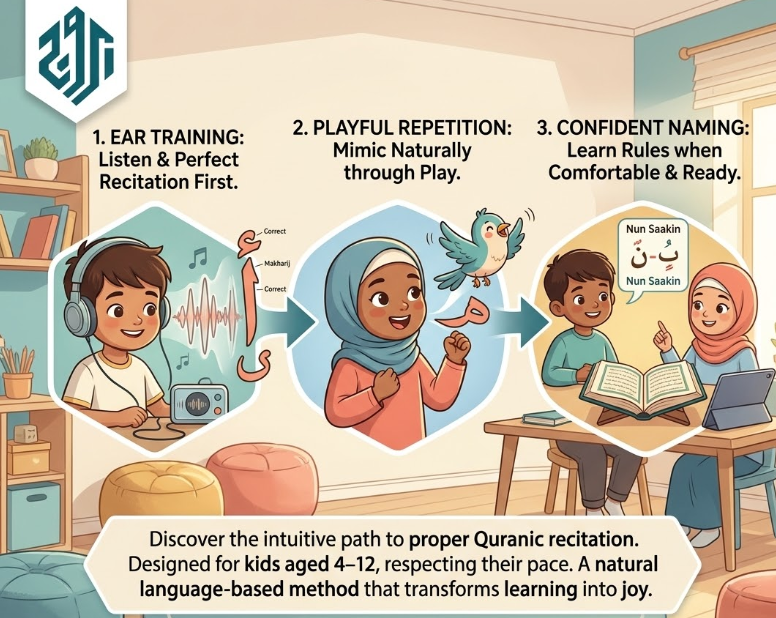
We built this course around a simple observation from our sessions: children learn Arabic sounds faster when they hear them modeled correctly and repeated immediately, not when they’re handed a chart and asked to self-correct.
A live teacher catches a mispronounced ح or ع the moment it happens, before the wrong sound becomes a habit.
This course suits children roughly ages 4 to 12, though we adjust pacing rather than content for younger beginners. Sessions run one-on-one, so a five-year-old and a ten-year-old on the same course follow entirely different rhythms.
Help your child start learning the Quran with a FREE trial
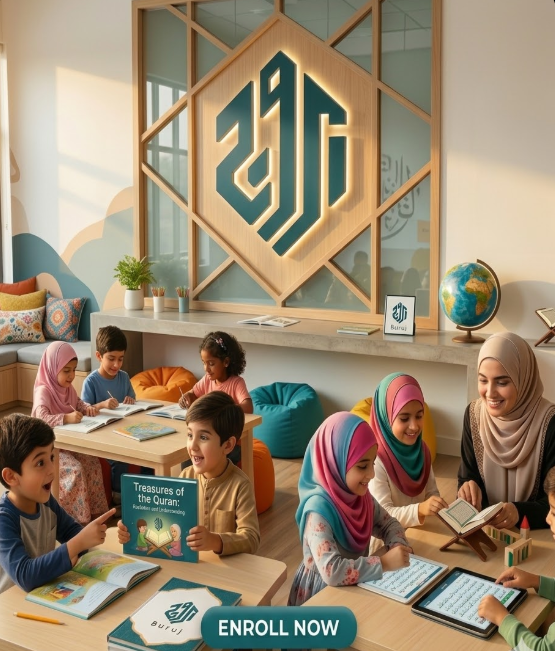
Parents often ask how this differs from teaching Quran to non-Arabic speaking kids through free apps. The distinction is live correction: an app can play a correct recitation, but it cannot hear your child’s attempt and adjust in real time.
We also draw on practical techniques from our guide on making Quran reading fun for kids, since sustained attention matters as much as method for young learners. A child who dreads the lesson will not retain the sounds, however correct the curriculum is.
How Does the Buruj Method Apply to Beginning Readers?
Sound-before-rules means we train a child’s ear to recognize correct pronunciation before we name any Tajweed rule.
This mirrors how children acquire their first language: by imitation, not grammar instruction, and it prevents the common pattern of a child memorizing a rule’s name without being able to apply it in live recitation.
Which Online Hifz Program Helps Children Memorize the Quran?
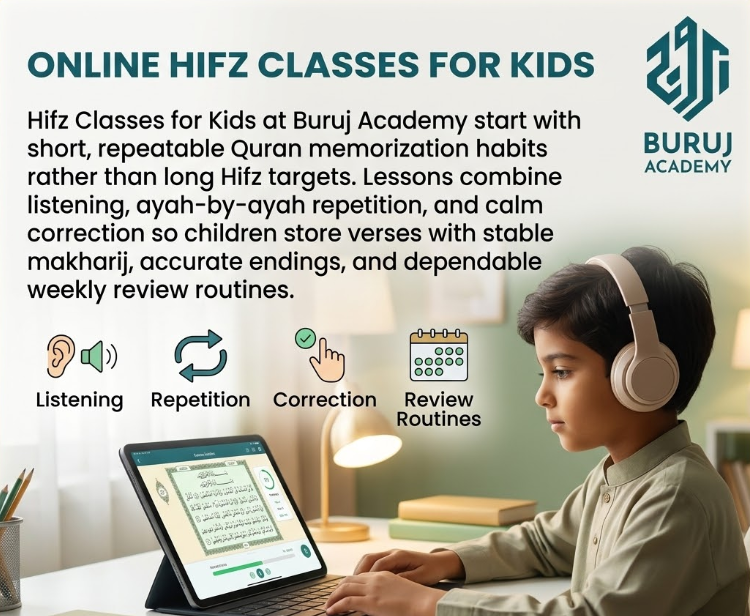
Hifz for Kids course at Buruj Academy is our dedicated memorization pathway, using short daily sessions and structured revision cycles designed around a child’s attention span rather than an adult pace.
In our experience, children retain memorized verses best through frequent, brief exposure rather than long, infrequent sessions. A 20-minute daily session consistently outperforms a single 90-minute weekly block for retention in students under twelve.
The program follows consistency-before-speed, one of the three pillars of the Buruj Method. We would rather a child memorize half a page perfectly with correct Tajweed than a full page riddled with pronunciation errors that later need unlearning.
Start your child’s Hifz classes with a FREE session
Parents new to memorization planning often start with our overview of memorizing the Quran for kids, which explains why early memorization habits matter beyond the verses themselves.
For families targeting a specific portion, our guide to Juz Amma memorization for kids breaks down realistic pacing for the shorter, more frequently recited surahs children typically begin with.
What Age Should a Child Start Memorizing Quran?
There is no single mandated age, though many families begin structured Hifz between ages 5 and 7, once a child can sit through a focused 15 to 20-minute session. Our detailed breakdown in the best age to memorize Quran covers the developmental signals worth watching for rather than relying on age alone.
Which Surahs Should Children Memorize First?
Children typically begin with short, frequently recited surahs before progressing to longer ones. Our guides on easy surahs to memorize and the shortest surahs to memorize outline a sensible starting sequence for young memorizers.
How Can Children Learn Tajweed Rules Correctly Online?
Tajweed for children course teaches the rules governing correct Quranic pronunciation, including makharij al-huruf (articulation points) and core rules like Qalqalah and Ghunnah, adapted for a young learner’s comprehension level.
We introduce Tajweed to children through sound patterns first, then attach rule names once the correct sound is already automatic.
A child who has been trained to hear the echo in Qalqalah letters learns the rule’s name in minutes, because the ear already recognizes what the rule describes.
One pattern we see consistently: children who skip formal Tajweed instruction and learn purely by listening often develop small, persistent errors — flattening a heavy letter, rushing through a Ghunnah — that become harder to correct the longer they go unaddressed.
Book your child’s free Tajweed trial lesson today
| Common Child Tajweed Error | Underlying Cause | Correction Approach |
| Dropping Ghunnah nasalization | Rushing through Noon/Meem sakinah | Slow, isolated drilling with the teacher holding the nasal sound audibly |
| Flattening heavy letters (Tafkhim) | English phonetic habits | Direct articulation-point comparison with light letters |
| Weak Qalqalah echo | Stopping the letter abruptly | Guided release-and-echo practice on isolated letters |
This table reflects patterns we encounter repeatedly across children’s Tajweed sessions, not a formal published error study.
For structured practice beyond live sessions, our collection of Tajweed games and activities for kids offers reinforcement between lessons.
Families wanting the full rule set explained can also read our Tajweed rules for kids guide.
How Long Does It Typically Take a Child to Learn Basic Tajweed?
Most children who attend consistent sessions can apply foundational Tajweed rules — Ghunnah, basic Qalqalah, and Noon sakinah rules — within three to four months, though full fluency across all rules takes considerably longer. Pace varies significantly by age and prior Quran reading exposure.
Discover the Buruj Academy Difference
Step into our virtual classrooms and see how our expert instructors make learning Quran and Arabic intuitive and clear. We focus on overcoming the specific hurdles non-native speakers face, building your confidence and connection with the Quran.
Excel in Your Quranic Studies
Join Buruj Academy and master the Quran with our structured, professional curriculum.
Book Your Free TrialWhat Is the Best Way to Teach a Child Quranic Arabic Vocabulary Online?
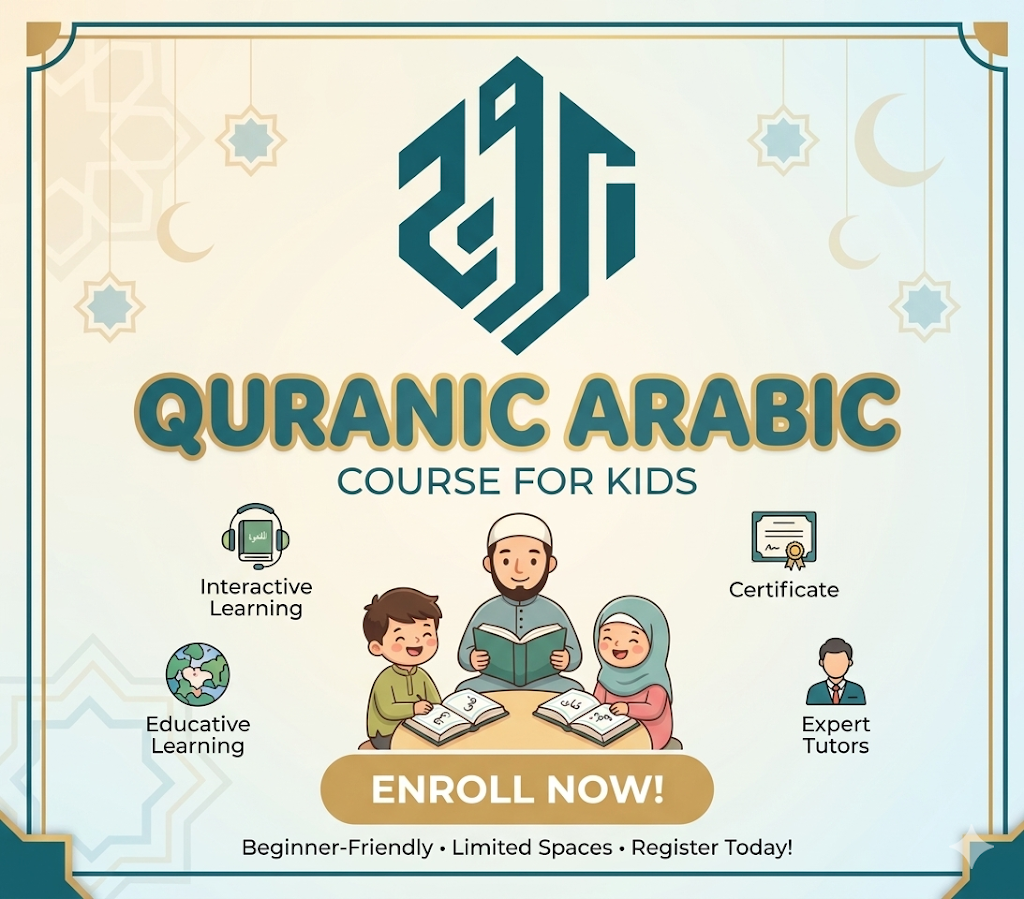
Quranic Arabic classes for children introduces the classical vocabulary and simple grammar patterns children encounter directly in Quranic text, building comprehension alongside recitation ability.
Rather than teaching Arabic grammar as an abstract subject, we anchor every lesson in words the child already recites. A child memorizing Surah Al-Fatiha, for example, learns what الرَّحْمَٰنِ actually means the same week they memorize it, not years later.
This reflects context-before-abstraction, the second pillar of the Buruj Method. Grammar terminology arrives only after a child has internalized the meaning through repeated, contextual exposure — never as the starting point.
We frequently reference quick Arabic word lists for beginners during early sessions, since young children respond better to small, thematic vocabulary sets than comprehensive dictionaries.
Try Buruj’s Quranic Arabic Course for Kids for free now
Why Does Understanding Meaning Matter Alongside Memorization?
A child who understands what they recite tends to retain it longer and connects emotionally to the words, rather than treating Quran memorization as pure sound repetition. This comprehension layer also supports later study of Tafsir, since foundational vocabulary is already familiar.
How Does Noorani Qaida Online Prepare Children to Read the Quran?
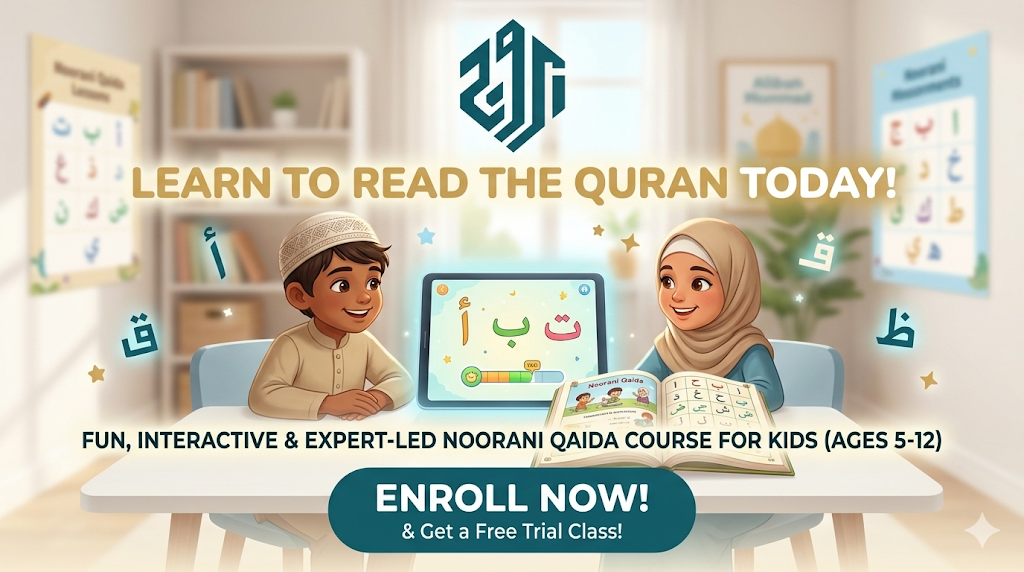
Noorani Qaida for Kids is the foundational reading program that precedes direct Quran reading, teaching Arabic letters, their sounds, and basic joining rules before a child opens the Mushaf itself.
We consider this stage non-negotiable for true beginners. Attempting to read Quranic text before mastering letter shapes and basic vowel marks (harakat) produces guesswork rather than genuine reading, and guesswork habits are difficult to reverse later.
Children typically progress through Qaida in a fixed sequence: isolated letters, letter forms in different positions, basic vowel marks, then simple letter combinations. Skipping stages to “move faster” is the single most common mistake we see well-meaning parents encourage.
| Qaida Stage | What the Child Learns | Typical Focus |
| Stage 1 | Individual letter shapes and sounds | Pronunciation accuracy |
| Stage 2 | Letters in initial, medial, final forms | Visual recognition |
| Stage 3 | Basic harakat (fatha, damma, kasra) | Vowel sound blending |
| Stage 4 | Simple letter-vowel combinations | Reading fluency building |
For families exploring supplementary tools, our roundup of Quran learning tools for kids covers resources that complement structured Qaida instruction between sessions.
Sign up your kid for a free Noorani Qaida lesson
Is Noorani Qaida Necessary if My Child Already Recognizes Some Letters?
Partial letter recognition is common among children raised hearing Quran recitation, but recognition alone rarely means a child can independently sound out unfamiliar word combinations. We generally assess each child individually rather than assuming prior exposure equals readiness.
How Can Parents Build Their Child’s Islamic Identity Through Structured Learning Online?
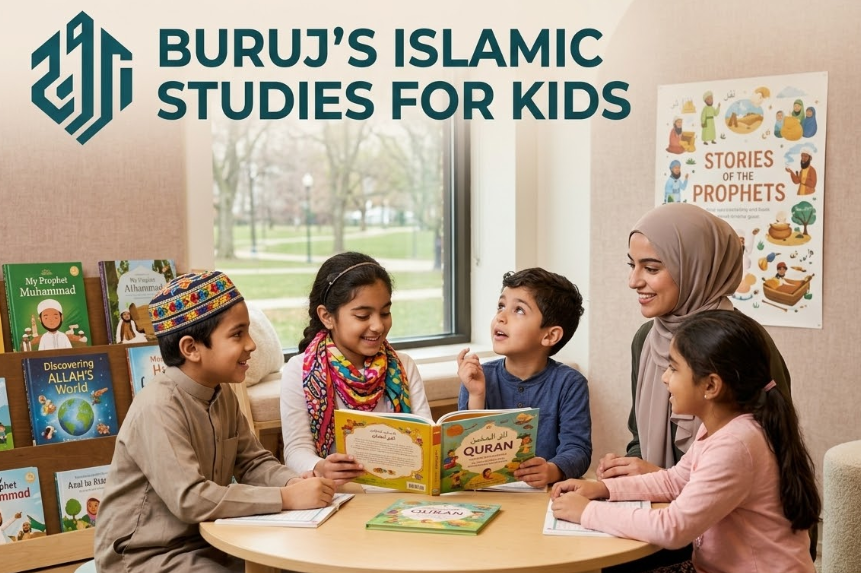
Islamic Studies for Children covers foundational Islamic knowledge — the pillars of Islam, prophetic stories, basic Fiqh, and core beliefs — presented in accessible English for children growing up outside majority-Muslim environments.
Many parents in Western countries tell us their children can recite verses beautifully but struggle to explain basic Islamic concepts to curious classmates. This course addresses that gap directly, building conceptual understanding alongside recitation skill.
We ground every lesson in age-appropriate explanation rather than rote definition. A seven-year-old learning about the Pillars of Islam needs a different explanatory frame than a twelve-year-old preparing for questions from non-Muslim peers.
Parents often pair this course with our articles on keeping Islamic identity strong for kids and teaching Islam to a child for reinforcement outside of lessons.
The first session is free in Buruj’s Islamic Studies Classes for Kids
What Topics Does Children’s Islamic Studies Typically Cover First?
Instruction generally begins with the Pillars of Islam, foundational prophetic stories, and basic character-building concepts, before advancing to more nuanced Fiqh topics as comprehension develops.
Our collection of Islamic topics for kids and youth outlines this progression in more depth.
One relevant reminder we return to often with families beginning this journey comes directly from revelation itself:
فَتَعَالَى اللَّهُ الْمَلِكُ الْحَقُّ ۗ وَلَا تَعْجَلْ بِالْقُرْآنِ مِنْ قَبْلِ أَنْ يُقْضَىٰ إِلَيْكَ وَحْيُهُ ۖ وَقُلْ رَبِّ زِدْنِي عِلْمًا
Fata’ala Allahu-l-Maliku-l-Haqq, wa la ta’jal bil-Qur’ani min qabli an yuqda ilayka wahyuhu, wa qul Rabbi zidni ‘ilma
“So high [above all] is Allah, the Sovereign, the Truth… and say, ‘My Lord, increase me in knowledge.'” (Ta-Ha 20:114)
This verse’s closing dua — “My Lord, increase me in knowledge” — is one we encourage families to teach children early, framing Quranic study itself as a request for increase, not just a task to complete.
Read also:Quran Verses About Children
Let Your Kid Learn the Quran with Buruj Academy’s Certified Children’s Instructors
Choosing the right online Quranic path for your child does not need to be overwhelming. Buruj Academy’s six children’s programs cover every stage, from first letters to full memorization and Islamic understanding.
Our Al-Azhar University graduates and Ijazah-certified instructors bring over 12 years of experience teaching non-Arabic speaking children specifically.
Every child receives a personalized learning plan matched to age and current level, with real-time pronunciation correction in flexible, 1-on-1 sessions available around your family’s schedule.
Book a free trial lesson today and let one of our specialized children’s instructors assess exactly where your child should begin.
Take the next step in your learning journey today by enrolling in one of our specialized programs:
- Online Quran Classes
- Online Quran Classes for Beginners
- Online Quran Classes for Adults
- Online Quran Classes for Ladies
- Online Quran Classes for Kids
- Quran Reading Course
- Quran Recitation Course
- Online Ijazah Course
- Online Qirat Course
Don’t wait to transform your relationship with the Holy Quran. Join our global community of students and book your free evaluation session now!
Discover the Buruj Academy Difference
Step into our virtual classrooms and see how our expert instructors make learning Quran and Arabic intuitive and clear. We focus on overcoming the specific hurdles non-native speakers face, building your confidence and connection with the Quran.
Excel in Your Quranic Studies
Join Buruj Academy and master the Quran with our structured, professional curriculum.
Book Your Free TrialRead also:The Benefits of Reading Quran for Kids
Conclusion
Deciding how your child will build their relationship with the Quran is one of the more consequential choices a Muslim parent outside a majority-Muslim country will make. The six pathways covered here — reading, memorization, Tajweed, Quranic Arabic, foundational Qaida, and Islamic Studies — are not competing options but sequential stages, each preparing a child for the next.
What matters most is starting at the right stage for your specific child rather than the stage that feels most impressive. A structured beginning, guided by a qualified teacher who corrects errors as they happen, shapes habits that stay with a child for a lifetime of recitation.
Frequently Asked Questions About Quranic Studies for Children Online
What Age Should My Child Start Online Quran Classes?
Most children can begin structured online Quran instruction between ages 4 and 6, starting with Noorani Qaida or beginner reading. Actual readiness depends more on attention span and letter recognition than age alone, so an individual assessment is worthwhile.
How Long Are Typical Online Quran Sessions for Kids?
Children’s sessions generally run shorter than adult sessions, often 20 to 30 minutes, to match realistic attention spans. Buruj Academy adjusts session length based on each child’s age and demonstrated focus during initial lessons.
Can Siblings of Different Ages Learn Together Online?
One-on-one sessions are structured individually per child, since reading level and pacing needs typically differ significantly between siblings. Separate sessions allow each child’s specific errors to receive direct, immediate correction.
Do Children Need to Know Arabic Before Starting Quran Lessons?
No prior Arabic knowledge is required. Programs like Noorani Qaida and beginner Quran reading are specifically designed to build letter recognition and pronunciation from a complete starting point.
How Do Online Teachers Correct a Child’s Pronunciation in Real Time?
Live video sessions allow the instructor to hear each attempt and immediately model the correct sound, repeating until the child reproduces it accurately. This immediate feedback loop is the primary advantage over recorded lessons or self-study apps.