 Islamic
| Key Takeaways |
| Building Islamic identity in Western-raised children requires deliberate, consistent daily practices woven into normal family life. |
| Children who memorize short Quranic surahs early develop a spiritual anchor that strengthens identity through peer pressure and adolescence. |
| Islamic values for kids are best taught through stories of the Prophets and Companions, not abstract lectures on rules. |
| A bilingual home environment that includes Arabic exposure — even minimal — reinforces a child’s connection to Quranic language and heritage. |
| Structured Islamic education through qualified online courses sustains learning consistency when local Islamic schooling is unavailable. |
Raising Muslim children in a Western environment is one of the most rewarding and demanding responsibilities a parent carries. The cultural pressure is real, constant, and — if unaddressed — quietly erodes the Islamic identity you have worked to build at home.
The good news is that Islamic identity is not fragile when it is built correctly. Children who grow up with clear Islamic values, Quranic connection, and a loving community around them consistently carry that identity with confidence — through school, through friendships, and into adulthood.
Table of Contents:
1. Start with Tawheed to Teach Your Child Who Allah Is
The foundation of Islamic identity is not rules — it is relationship. A child who knows Allah as the One who created them, loves them, and hears their duas will hold onto Islam far more securely than one who only knows a list of prohibitions.
Introduce Tawheed in age-appropriate language from the earliest years. When your three-year-old asks “Who made the sun?” — that is your moment. Answer simply: “Allah made the sun, and Allah made you.” This is not theology; this is bonding your child to their Creator before the world offers competing answers.
As they grow, deepen this with the Names and Attributes of Allah. Teach them that Allah is Ar-Rahman — the Most Merciful — not an abstract force, but a Being who is present, aware, and responsive to them personally.
2. Make the Quran a Daily Presence in Your Home, Not a Special-Occasion Book
Children form identity through repetition and environment. When the Quran is heard daily — during breakfast, in the car, before sleep — it becomes part of the emotional fabric of a child’s life, not an obligation they dread.
Start by playing verified, beautiful recitations by well-known reciters such as Sheikh Mishary Rashid Al-Afasy or Sheikh Abdul Basit as background sound in the home.
Children absorb what surrounds them. Before they can read a word, they will hum ayaat they have heard dozens of times.
How Do You Teach Little Kids About Islam Through the Quran?
Begin with the shortest, most melodic surahs. Al-Fatiha, Al-Ikhlas, Al-Falaq, and An-Nas are natural starting points that appear in every salah — giving children immediate, functional purpose for what they memorize.
You can explore a curated list of easy surahs of the Quran to memorize to build a structured home memorization sequence.
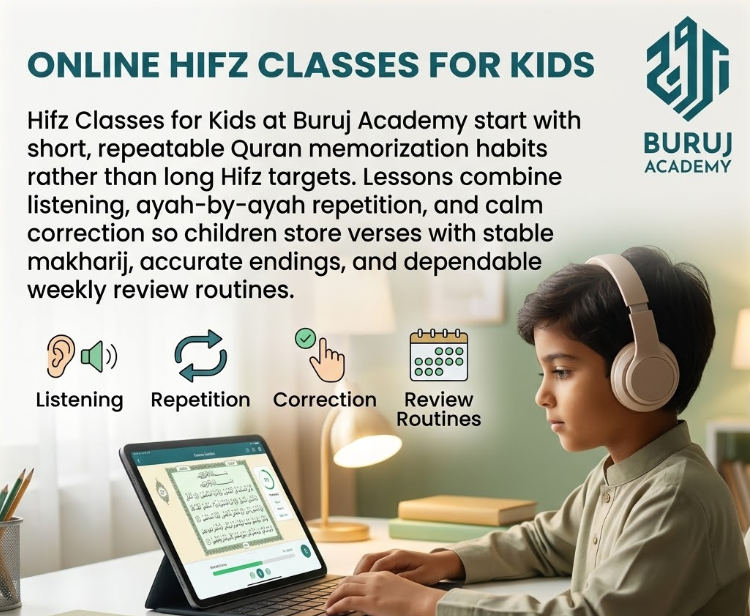
Buruj Academy’s Hifz for Kids course provides age-appropriate memorization sessions guided by Al-Azhar-trained Hifz specialists, using short daily segments and positive reinforcement that match a child’s natural attention span and make Quran time something they look forward to.
Start your child’s Hifz classes with a free session
3. Establish the Five Daily Prayers as the Family’s Non-Negotiable Rhythm
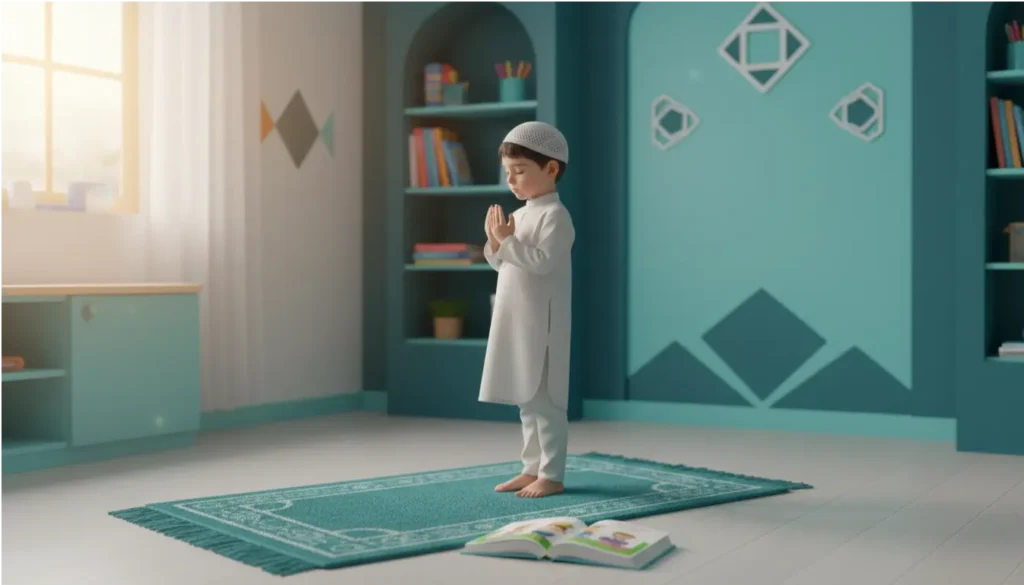
Salah is the most powerful identity anchor available to a Muslim child. It interrupts the day five times, reorients the heart toward Allah, and creates a ritual that says: this family is Muslim, and this is what Muslims do.
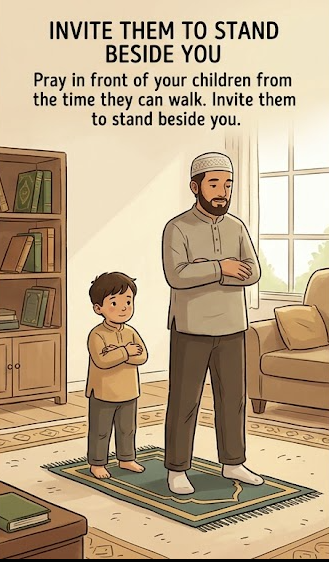
Children do not pray because they are told to pray. They pray because they see their parents pray. Make salah visible. Pray in front of your children from the time they can walk. Invite them to stand beside you.
Let them imitate the motions before they understand the words. This early imitation becomes genuine practice.
By age seven, the Prophet ﷺ indicated that parents should encourage children toward prayer, and by ten, establish it with consistency — a guidance found in Sunan Abi Dawud 495. Structure without warmth becomes rigidity; warmth without structure becomes negligence. Build both.
4. Tell the Stories of the Prophets Regularly and Consistently
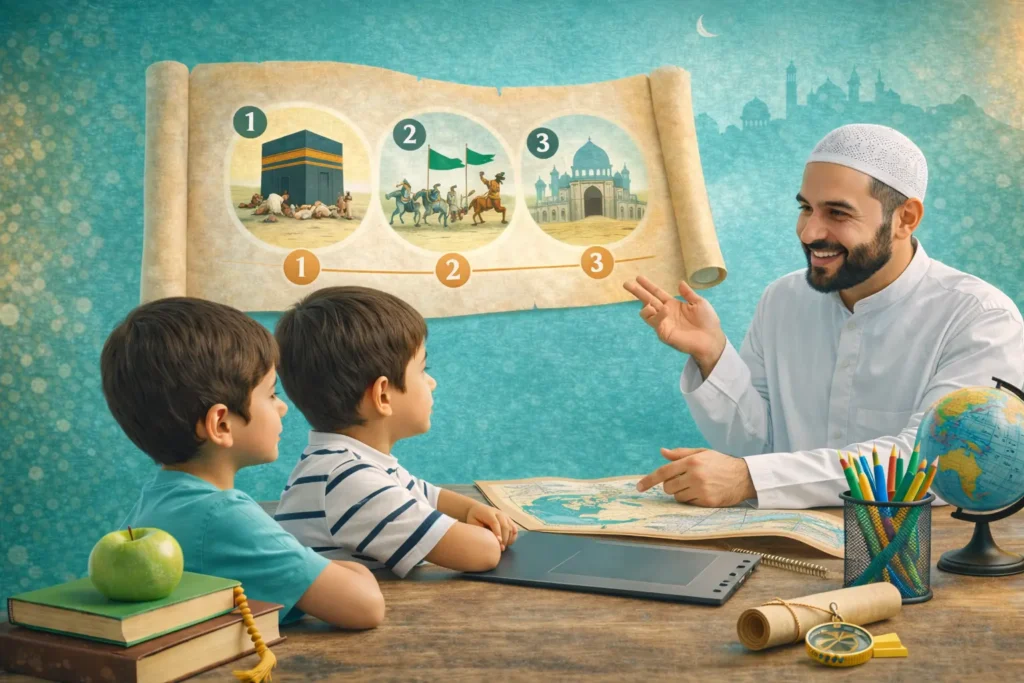
Story is the most ancient and effective teaching tool in Islamic pedagogy. The Quran itself teaches through narrative — the stories of Prophets Ibrahim, Musa, Yusuf, and ‘Isa (peace be upon them all) are not historical footnotes; they are models of identity under pressure.
Children who grow up knowing these stories have internal role models to draw on when facing peer pressure, hardship, or identity confusion. “What would Prophet Yusuf do?” is a more powerful question for a ten-year-old than any abstract lecture on Islamic values.
Our teaching team at Buruj Academy consistently observes that children who engage with prophetic narratives early — whether through bedtime stories, audiobooks, or structured lessons — demonstrate stronger Islamic self-identification in their teenage years. Read our dedicated guide on prophets in Islam for kids for age-appropriate storytelling approaches.
5. Teach Islamic Virtues for Kids Through Daily Behavior, Not Lectures
Islamic virtues — honesty (Sidq), generosity (Karam), patience (Sabr), and respect (Ihtiram) — are caught more than taught. Children learn what they witness, not what they are told in isolation.
When your child sees you return excess change to a cashier and says “We don’t keep what isn’t ours,” they are learning Sidq. When you stop to give food to someone in need, they are learning Karam.
These micro-moments, accumulated over years, construct a moral character that feels authentically Islamic — not externally imposed.
What Are Islamic Virtues for Kids in Practice?
| Islamic Virtue | Arabic Term | Practical Family Example |
| Honesty | Sidq | Admitting a mistake openly in front of the child |
| Patience | Sabr | Naming the feeling when something goes wrong: “This is Sabr” |
| Generosity | Karam | Involving children in Zakat and Sadaqah giving |
| Respect | Ihtiram | Modeling respectful speech toward elders at all times |
| Gratitude | Shukr | Saying Alhamdulillah together after meals, achievements, and difficulties |
Virtue is reinforced when named. When your child does something kind, say: “That was generous — that is Karam, and Allah loves that.” Naming the virtue connects the behavior to their Islamic identity.
Expand Your Islamic Knowledge
Join our structured online courses led by qualified instructors to deepen your understanding of the Deen.
Join a Free Trial Class6. Introduce Arabic Early, Even If You Are Not an Arabic Speaker
A child who hears, reads, or speaks even basic Arabic feels a living connection to the Quran, to prayer, and to the global Muslim community. Arabic does not need to be fluent to be formative — even foundational exposure makes the Quran feel like their language, not a foreign text.
Begin with the language of salah. Teach children what Al-Fatiha means — word by word, if possible. When a child knows that “Iyyaka na’budu” means “You alone we worship” and they are saying it seventeen times a day in their prayers, salah becomes an act of conscious devotion rather than rote repetition.
Buruj Academy’s Quranic Arabic Course for Kids is specifically designed for non-Arabic-speaking families, teaching children Quranic vocabulary and basic classical Arabic structures through engaging, age-appropriate methods — no prior Arabic knowledge required from parents.
Try Buruj’s Quranic Arabic Course for Kids for free now
7. Build a Muslim Community Network Around Your Children
Identity is social. Children who have Muslim friends, attend Islamic gatherings, and see Muslim adults thriving in their professional and family lives develop a positive association with their faith. They stop seeing Islam as something that separates them and begin seeing it as something that connects them.
This does not require a large Islamic community. Even one or two Muslim families for regular gatherings, a weekend Islamic school, or an online class where children interact with Muslim peers globally provides the social reinforcement that home alone cannot fully supply.
Seek out environments where your child’s Islamic identity is normal, not exceptional. When being Muslim is what “people like us do,” children carry it with far less internal conflict.
Read also: Best Islamic Ebooks for Kids
8. Use Age-Appropriate Islamic Media and Learning Tools Strategically
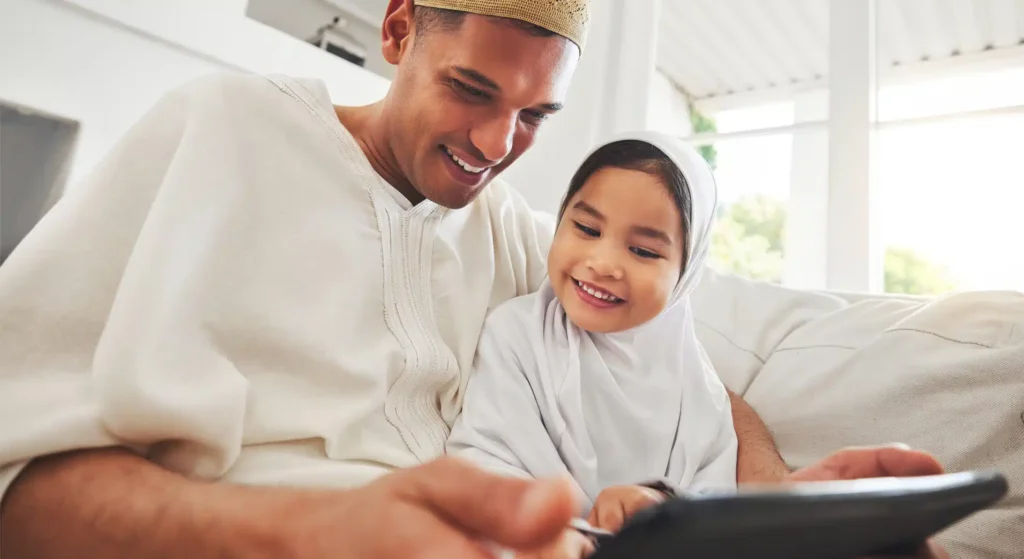
The screen is already part of your child’s life. The question is not whether they consume media — it is which media shapes their imagination and values.
Islamic cartoons, Quran apps, storytelling podcasts, and structured online learning tools can all serve the goal of identity formation when chosen carefully.
Quality matters more than quantity. One well-made Islamic program that your child loves and requests repeatedly is worth far more than a library of material they ignore.
Explore our curated review of Quran learning tools for kids and Quran activities for kids for practical, tested resources that reinforce Islamic learning in engaging formats.
| Age Group | Recommended Islamic Media Type | Learning Focus |
| 3–6 years | Islamic songs, short animated stories | Basic duas, Names of Allah, Prophets |
| 7–10 years | Quran memorization apps, Prophet stories audiobooks | Salah, Surahs, Islamic history |
| 11–14 years | Structured online Islamic studies classes, discussion-based learning | Fiqh foundations, Seerah, Islamic ethics |
9. Address the Identity Conflict Directly and Without Dismissal
Many Muslim children in the West experience a period of identity tension — feeling caught between their Islamic home and their secular school environment. This is normal, and dismissing it only drives it underground.
When your child says “None of my friends fast” or “Why can’t I do what they do?” — that is not a crisis; that is an opportunity.
Meet it with honesty, not anxiety. Validate the difficulty first: “That can feel hard, and we understand.”
Then anchor them: “Being Muslim means we choose differently because we know something beautiful about who we are and why we are here.”
Children who are taught to own their Islamic identity — rather than merely observe family rules — are significantly more likely to carry it through adolescence intact. The goal is internal conviction, not external compliance.
10. Enroll Children in Structured Islamic Education Early
Home learning is essential, but structured Islamic education by qualified teachers provides depth, consistency, and authority that parental teaching alone often cannot sustain — especially as children grow older and questions become more complex.
Whether through weekend Islamic school, an Islamic day school, or online courses, formal Islamic education gives children a framework, vocabulary, and intellectual foundation for their faith. It also signals to the child that Islam is taken seriously — seriously enough for real study, not just occasional reminders.
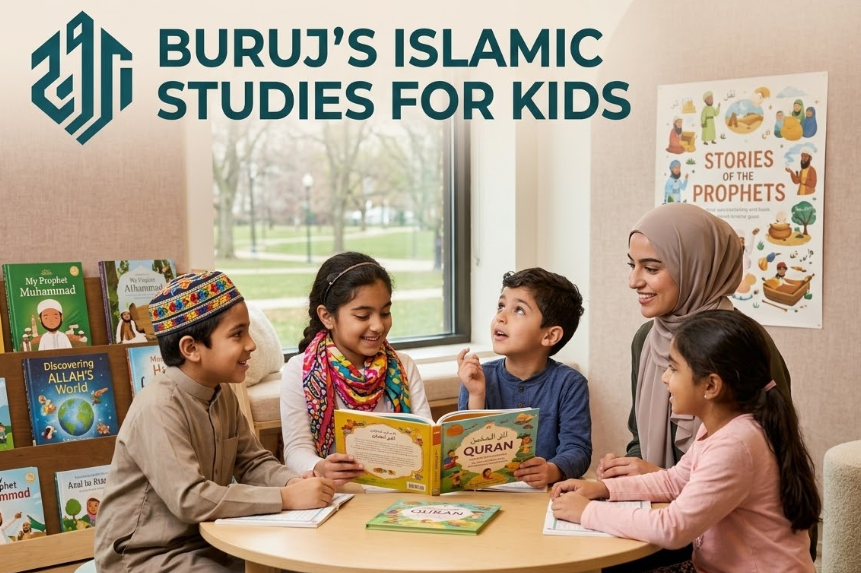
Buruj Academy’s Islamic Studies Classes for Kids course provides structured Fiqh, Seerah, Tafsir, and Islamic ethics instruction by Al-Azhar University graduates in 1-on-1 online sessions, adapted to the child’s age and learning level — without requiring local Islamic schooling access.
The first session is free in Buruj’s Islamic Studies Classes for Kids
11. Celebrate Islamic Occasions as Your Family’s Joyful Highlights
Eid, Ramadan, the birth of the Prophet ﷺ (Mawlid discussions), and other Islamic milestones should be the most memorable, joyful events in your child’s calendar.
If Christmas feels more exciting than Eid in your household, that is a signal — not a failure, but an invitation to invest more deliberately in Islamic celebrations.
Make Ramadan a month children count down to. Make Eid preparation something they participate in. Create family traditions around Islamic occasions that become cherished memories — the kind that adults in their thirties still recall with warmth.
Joy is the most underestimated force in Islamic identity formation. Children hold onto what brought them happiness.
Discover the Buruj Academy Difference
Step into our virtual classrooms and see how our expert instructors make learning Quran and Arabic intuitive and clear. We focus on overcoming the specific hurdles non-native speakers face, building your confidence and connection with the Quran.
12. Model Islamic Identity Yourself
Every step above rests on this foundation: children do not do what they are told; they do what they see. Your Islamic identity is the most powerful teaching tool you possess.
A parent who prays with presence, speaks about Allah with genuine love, handles hardship with Sabr, and treats others with Akhlaq is teaching an entire curriculum without speaking a word.
We have observed this pattern consistently across the families we work with at Buruj Academy: children who internalize Islamic identity most deeply almost always have at least one parent who visibly, joyfully practices their faith — not perfectly, but authentically.
وَٱلَّذِينَ ءَامَنُوا۟ وَٱتَّبَعَتْهُمْ ذُرِّيَّتُهُم بِإِيمَـٰنٍ أَلْحَقْنَا بِهِمْ ذُرِّيَّتَهُمْ
Walladhīna āmanū wattaba’at’hum dhurriyyatuhum bī’imānin alḥaqnā bihim dhurriyyatahum
“And those who believed and whose descendants followed them in faith – We will join with them their descendants” (At-Tur 52:21)
Consistency is not perfection. It is showing up for your faith, day after day, in a way your children can see and one day choose for themselves.
Read also: How to Teach Islam to a Child?
Build Your Child’s Islamic Foundation with Buruj Academy’s Expert Teachers
Protecting your child’s Islamic identity is one of the most important investments you will make as a parent. At Buruj Academy, our teaching team supports Muslim families in the West with structured, expert-led online Islamic education for children of all ages and levels.
Our programs are taught by Al-Azhar University graduates and Ijazah-certified instructors with 12+ years of experience teaching non-Arabic-speaking children globally. We offer:
- Personalized 1-on-1 online sessions — no classroom overwhelm
- Flexible scheduling that fits your family’s routine
- Age-appropriate pedagogy built on patience, encouragement, and genuine engagement
- Courses covering Quran reading, Hifz, Arabic, Quranic Arabic, and Islamic Studies
Book your child’s free trial lesson today and give their Islamic identity a structured, expert foundation — wherever you are in the world.
Enroll your child in one of our specialized, kid-friendly tracks today:
- Online Quran Classes for Kids
- Tajweed Classes for Kids
- Hifz Classes for Kids
- Online Arabic Classes for Kids
- Quranic Arabic Course for Kids
- Noorani Qaida Course for Kids
- Islamic Studies Classes for Kids
Ready to watch your child grow in knowledge and character? Join the Buruj Academy family and book a free trial session for your child today!
Expand Your Islamic Knowledge
Join our structured online courses led by qualified instructors to deepen your understanding of the Deen.
Join a Free Trial ClassConclusion
Raising a Muslim child with a confident Islamic identity in the West is not about shielding them from the world — it is about equipping them for it. The steps above are not a checklist to rush through; they are a long-term investment in who your child becomes when no one is watching.
Start with what is manageable. Build Quran into the home. Name Islamic virtues in daily moments. Celebrate Islamic occasions with genuine joy. Enroll them in structured learning.
And above all — live your faith in a way they can see, feel, and one day choose for themselves. Insha’Allah, the seeds you plant today will be the roots that hold them firm tomorrow.
Frequently Asked Questions About Islamic Identity for Kids
How Do You Teach Little Kids About Islam?
Teach little children about Islam through repetition, story, and sensory experience. Play Quran recitation daily, tell Prophet stories at bedtime, teach simple duas before eating and sleeping, and let them watch you pray. Children under seven absorb environment before abstraction — make Islam the most natural, joyful part of their daily world.
What Is the Islamic Value for Kids That Parents Should Prioritize First?
The most foundational Islamic value to establish first is Tawheed — the knowledge that Allah alone is the Creator, Sustainer, and the One who hears every dua. All other Islamic virtues flow from this. A child anchored in the love of Allah is equipped to develop honesty, patience, gratitude, and respect as natural expressions of that relationship.
What Are Islamic Virtues for Kids and How Are They Taught?
Islamic virtues for kids include Sidq (honesty), Sabr (patience), Karam (generosity), Ihtiram (respect), and Shukr (gratitude). They are most effectively taught through observation and named reinforcement — modeling the virtue yourself, then naming it when your child demonstrates it. Abstract lectures rarely form lasting character; lived examples consistently do.
At What Age Should Islamic Education Begin for Children?
Islamic education begins from birth through environmental exposure — Quran recitation, duas, and Islamic language in the home. Structured learning, such as Quran reading and Islamic Studies, is typically introduced between ages four and six, when children can begin letter recognition and short memorization. The best age to memorize Quran is explored in detail for parents planning their child’s memorization path.
How Do Muslim Parents Keep Islamic Identity Strong During Teenage Years?
The teenage years require a shift from instruction to conversation. Invite your teenager’s questions rather than shutting them down. Connect them to Islamic youth communities, knowledgeable mentors, and structured Islamic studies that engage their intellect — not just their compliance. Identity held by personal conviction survives peer pressure; identity held only by parental rule often does not.