 Arabic
| Key Takeaways |
| Starting Islamic education before age seven builds lifelong habits, as early childhood is the peak window for religious identity formation. |
| Teaching Islam through daily rituals — prayer, du’a, Bismillah — embeds faith naturally before formal instruction begins. |
| Children learn Islamic values most effectively through stories of the prophets, which combine moral lessons with emotional engagement. |
| Quran memorization begun in early childhood is significantly easier, as young minds retain Arabic sounds with remarkable accuracy. |
| Consistency in small daily Islamic practices outweighs occasional intensive lessons for long-term religious understanding and love of faith. |
As a Muslim parent raising children in a Western environment, you face a challenge that is both deeply personal and practically complex: how do you pass on a complete, living faith to a child surrounded by a culture that rarely reinforces it? The question isn’t simply what to teach — it’s how to make Islam feel real, beloved, and natural to your child from the very beginning.
Teaching Islam to a child works best when it starts with love before rules, experience before explanation, and daily habits before formal lessons.
The steps below reflect what Buruj Academy’s teaching team has observed across thousands of student interactions — a structured, gradual approach that builds genuine Islamic identity rather than surface-level compliance.
Table of Contents:
1. Build the Foundation of Love for Allah
The very first step in teaching Islam to a child is not to teach rules — it is to cultivate love. A child who loves Allah will naturally want to pray, recite Quran, and live by Islamic values. A child who fears or resents religion will resist it the moment they have independence.
Speak about Allah in warm, positive terms from your child’s earliest years. When something good happens — a sunny day, a delicious meal, a recovered toy — say “Alhamdulillah, Allah gave us this.”
When your child is afraid at night, remind them gently that Allah is always watching over them. These small, repeated moments build an emotional connection to Allah that no formal lesson can replace.
In our experience at Buruj Academy, children who arrive in our Islamic Studies Classes for Kids with a positive emotional association with Allah progress far faster than those whose first exposure was rule-heavy or fear-based. The heart must open before the mind can learn.
The first session is free in Buruj’s Islamic Studies Classes for Kids
2. Introduce Daily Islamic Rituals as Normal Family Life
Children absorb what they live. If Islamic practices are woven into daily family life — saying Bismillah before eating, making du’a before sleep, greeting with Assalamu Alaikum — children experience Islam as natural and normal rather than imposed or foreign.
Start with the simplest rituals and repeat them consistently. Teach your child to say Bismillah before meals and Alhamdulillah after. Teach them the du’a for entering and leaving the house.
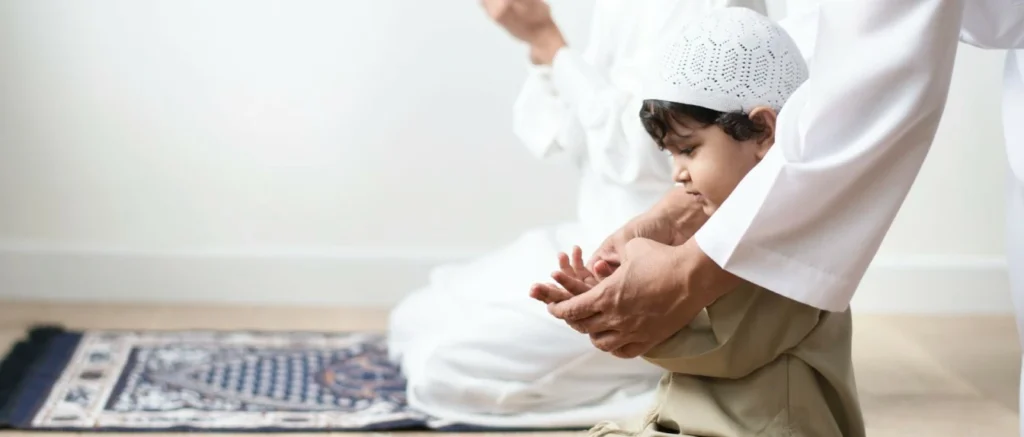
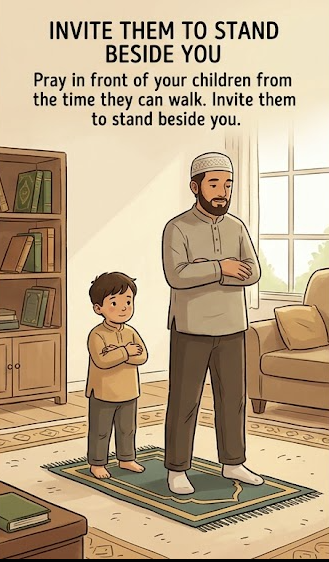
Let them see you pray, and invite them to pray beside you even before they understand the formal requirements. These early experiences create a framework of Islamic rhythm that supports every later step of formal education.
| Ritual | When to Introduce | Age-Appropriate Format |
| Bismillah | From weaning (12–18 months) | Say it together before every meal |
| Alhamdulillah | 18 months+ | Prompted response to good moments |
| Bedtime du’a | 2–3 years | Short, sung or rhythmic repetition |
| Watching Salah | 2–4 years | Invite to sit or stand beside you |
| Joining Salah | 4–5 years | Simple movements, no pressure |
| Full Salah teaching | 7 years | Systematic instruction begins |
The Prophet ﷺ instructed parents to command children to pray at seven years of age, as recorded in Sunan Abu Dawud 495. This hadith establishes that formal religious practice begins at seven — but the preparation begins at birth through family ritual.
3. Tell the Stories of the Prophets to Build Islamic Character
Children are narrative learners. Before they can grasp theology, they can feel the courage of Ibrahim (AS), the patience of Ayyub (AS), the trust of Musa (AS). The stories of the Prophets are the most powerful Islamic educational tool available to parents of young children.
Begin with the stories of Prophet Muhammad ﷺ and the major Prophets — Nuh, Ibrahim, Yusuf, Musa, Isa, and Dawud (peace be upon them all). Tell these stories at bedtime, during car rides, and at mealtimes.
Connect the moral of each story to your child’s daily life: “Remember how Yusuf (AS) was patient when things were hard? We can do that too.”
Our blog on Prophets in Islam for kids offers age-appropriate summaries you can use as starting points. For children aged four to eight, keep stories under five minutes, use expressive voices, and always end with a simple moral takeaway they can remember.
How Do You Make Prophet Stories Engaging for Young Children?
Use three storytelling techniques that consistently work in our classrooms: ask predictive questions (“What do you think Ibrahim (AS) did next?”), connect emotions to the story (“How do you think Yusuf (AS) felt when his brothers left him?”), and relate the lesson to something in your child’s world. These methods transform passive listening into active moral learning.
4. Begin Quran Learning with Letter Recognition and Simple Surahs
Quran education should begin early — ideally between ages four and six — because young children’s phonemic memory is at its most receptive.
Arabic sounds that seem difficult to adults come naturally to young children who are still in their prime language acquisition window.
Start with letter recognition using a structured foundational method. Buruj Academy’s Noorani Qaida for Kids course teaches Arabic letters systematically, from isolated letter recognition to joined forms, using child-appropriate visual methods and patient instructors experienced in early phonetics instruction.
Sign up your kid for a free Noorani Qaida lesson
Once your child can recognize letters, begin with the shortest surahs. Our guide on easy surahs of the Quran to memorize identifies which surahs to prioritize first. Surah Al-Fatiha, Al-Ikhlas, Al-Falaq, and An-Nas are the natural starting point — they are short, frequently heard, and practically used in Salah.
| Surah | Verses | Ideal Starting Age | Memorization Timeline |
| Al-Fatiha | 7 | 4–5 years | 1–2 weeks |
| Al-Ikhlas | 4 | 4–5 years | 3–5 days |
| Al-Falaq | 5 | 5–6 years | 3–5 days |
| An-Nas | 6 | 5–6 years | 3–5 days |
| Al-Kawthar | 3 | 4–5 years | 2–3 days |
For parents interested in supporting a longer memorization path, our guide on the best age to memorize Quran explains why the window between ages five and ten produces the strongest long-term retention.
Expand Your Islamic Knowledge
Join our structured online courses led by qualified instructors to deepen your understanding of the Deen.
Join a Free Trial Class5. Teach the Five Pillars and Core Beliefs Through Lived Experience
Abstract theological concepts need concrete, experience-based anchors for children to understand and retain them. The Five Pillars of Islam are not simply facts to memorize — they are practices to live. Teach each pillar not as information, but as participation.
Shahada becomes real when your child hears it in the Adhan daily and understands what it means.
Salah becomes real when they stand beside you and mimic the movements.
Zakat becomes real when they choose a toy or portion of their Eid money to give to someone in need.
Sawm becomes real when they fast even half a day with the family during Ramadan.
Hajj becomes real through stories, videos, and discussion about the pilgrimage.
Read also: How to Keep Islamic Identity for Kids?
A Practical Age-by-Age Pillars Teaching Guide
| Age | Shahada | Salah | Zakat | Sawm | Hajj |
| 3–4 | Meaning in simple terms | Watch and mimic | Give a toy as charity | See family fasting | Story of Ibrahim (AS) |
| 5–6 | Recite with meaning | Pray alongside parent | Give from Eid money | Fast a short portion | Watch Hajj footage together |
| 7–9 | Full understanding | Begin formal Salah | Understand 2.5% concept | Attempt half-day fasts | Study the rituals |
| 10+ | Theological depth | Consistent five daily prayers | Apply Zakat in family finances | Full-day fasting | Begin Hajj preparation knowledge |
6. Make Quran Recitation a Daily Habit with Fun Reinforcement
Daily Quran recitation must feel like a treasured family habit — not a homework obligation. Children who associate Quran time with warmth, praise, and routine will carry that love into adulthood. Children who associate it with punishment or pressure will often abandon it the moment they have autonomy.
Set a consistent, short daily Quran time — ten to fifteen minutes is sufficient for children under eight. Use positive reinforcement: a sticker chart, a small reward after completing a surah, or simply enthusiastic parental praise.
Our resource on Quran activities for kids offers creative, structured reinforcement ideas that work particularly well for ages four to ten.
Buruj Academy’s Online Quran Classes for Kids use age-appropriate gamification and real-time instructor feedback to make daily Quran practice genuinely enjoyable.
Our instructors — trained in child pedagogy and Quran recitation — understand how to hold a young child’s attention while maintaining proper recitation standards.
For parents building a home revision system alongside formal classes, our Quran memorization schedule guide provides structured daily and weekly templates that work for children.
Help your child start learning the Quran with a FREE trial
7. Introduce Basic Islamic Manners and Akhlaq Through Daily Correction
Islamic character — akhlaq — is taught through consistent, gentle correction and modeling, not through lectures. Children learn that honesty is Islamic when they see their parents tell the truth in a difficult moment. They learn generosity is Islamic when they watch their family give without hesitation.
Focus on one Islamic manner at a time and reinforce it consistently for two to three weeks before introducing another.
Practical akhlaq lessons for young children include: speaking the truth, sharing with siblings, respecting elders, caring for animals and the environment, and apologizing sincerely when wrong.
Connect each manner explicitly to Islam: “We tell the truth because Allah loves truthful people.” “We are kind to animals because the Prophet ﷺ taught us to care for them.”
This labeling builds a child’s internal framework — they begin to categorize good behavior as Islamic behavior, which becomes part of their identity.
8. Use Islamic Learning Tools and Resources Strategically
Western Muslim parents have access to more high-quality Islamic educational resources than any previous generation — and using them strategically accelerates your child’s learning significantly. The key word is “strategically”: curated, supervised, and connected to real learning outcomes.
Our guide on Quran learning tools for kids reviews the most effective digital and physical tools available, including apps, physical flashcards, and audio recitation resources.
For memorization specifically, Quran facts for kids helps build motivational context — children who understand what the Quran is memorize it with greater intention.
What Are the Best Fun Ways to Teach Islam to Children at Home?
Fun ways to teach Islam include: Islamic-themed board games that teach pillars and Prophet stories, halal puppet shows re-enacting Seerah events, Ramadan countdown calendars with daily Islamic facts, collaborative du’a journals where children write or draw their personal supplications, and Quran memorization competitions between siblings with meaningful prizes. These fun ways to teach Islam maintain enthusiasm between formal lessons.
Discover the Buruj Academy Difference
Step into our virtual classrooms and see how our expert instructors make learning Quran and Arabic intuitive and clear. We focus on overcoming the specific hurdles non-native speakers face, building your confidence and connection with the Quran.
9. Enroll Your Child in Structured Islamic Teaching with Qualified Instructors
Parental Islamic education is essential — but it reaches its natural limits. At a certain point, your child needs qualified Islamic instruction delivered by teachers who hold proper credentials, use structured pedagogy, and provide accountability that a parent-child dynamic naturally lacks.
Buruj Academy’s Islamic Studies Classes for Kids course is taught by Al-Azhar University graduates with 9+ years of Islamic education, delivering age-appropriate Fiqh, Seerah, Tafsir, and Aqeedah in clear, engaging English.
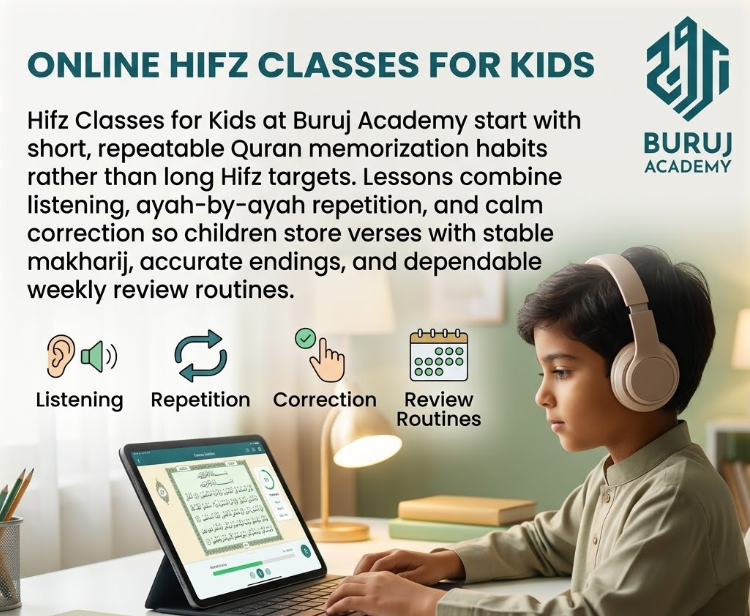
Our Hifz for Kids course pairs children with Ijazah-certified Hifz specialists who use proven retention systems adapted to young learners.
In our classrooms, we consistently observe that children who receive both parental home reinforcement and professional instruction progress at nearly double the rate of those receiving only one or the other. The combination is the standard, not the exception.
Start your child’s Hifz classes with a FREE session
10. Model Islamic Identity Consistently as the Most Powerful Teaching Tool
The research in child development and the wisdom of Islamic scholarship agree: children become what they observe. Your own Islamic practice — your Salah, your Quran recitation, your response to hardship with patience, your honesty in business — is teaching your child Islam more powerfully than any formal lesson.
Make your Islamic practice visible without being performative. Let your child see you making du’a when you’re worried. Let them hear you recite Quran in the morning. Include them in charitable decisions.
Discuss your own learning: “I’m trying to memorize this new surah — want to learn it together?” This models that Islam is a lifelong practice, not a childhood curriculum to be completed and left behind.
As Allah (SWT) reminds us in the Quran:
يَـٰٓأَيُّهَا ٱلَّذِينَ ءَامَنُوا۟ قُوٓا۟ أَنفُسَكُمْ وَأَهْلِيكُمْ نَارًا
Yā ayyuhā alladhīna āmanū qū anfusakum wa-ahlīkum nārā
“O you who have believed, protect yourselves and your families from a fire.” (At-Tahrim 66:6)
This verse is the foundational Islamic mandate for family religious education — and it begins with the parent’s own protection of faith before their family’s.
Read also: Best Islamic Ebooks for Kids
Give Your Child the Best Islamic Start with Buruj Academy’s Expert Instructors
Teaching Islamic values at home is irreplaceable — but structured, expert-led Islamic education multiplies its impact. Buruj Academy’s teaching team includes Al-Azhar University graduates and Ijazah-certified instructors with 12+ years of experience teaching non-Arabic speaking children globally.
Our programs for children cover every dimension of Islamic learning:
- Quran course for kids — phonics-based, age-appropriate recitation
- Hifz course for kids — structured memorization with retention systems
- Islamic Studies course for children — Fiqh, Seerah, Aqeedah in clear English
- Arabic course for kids — foundational language for Quran understanding
All sessions are personalized, 1-on-1, with flexible scheduling. Book your child’s free trial lesson today and let our instructors guide the next step.
Expand Your Islamic Knowledge
Join our structured online courses led by qualified instructors to deepen your understanding of the Deen.
Join a Free Trial ClassConclusion
Teaching Islam to a child in a Western context is not a single act — it is a thousand small, consistent ones. Love for Allah comes before rules. Daily rituals precede formal theology.
Stories of the Prophets build character long before academic lessons can. And your own visible, living Islamic practice remains the most powerful curriculum your child will ever receive.
Begin where you are, with what you have. Even one consistent Islamic habit per month, built intentionally and reinforced warmly, compounds into a deeply rooted Islamic identity over years. Insha’Allah, the steps above give you a clear, practical path forward.
Frequently Asked Questions About Teaching Islam to a Child
What Is the Best Age to Start Teaching Islam to a Child?
Islamic education begins at birth through exposure to the Adhan, du’a, and family rituals. Formal instruction — letters, pillars, Salah — typically begins between ages four and seven. The Prophet ﷺ instructed parents to teach Salah at seven, but the emotional and spiritual foundation must be laid in the earliest years through love, story, and daily Islamic habit.
How Do You Explain Allah to a Young Child?
Explain Allah to a young child through tangible evidence of His blessings: “Who made the sun? Who gave you your eyes? Who made the rain?” Use simple, warm language — Allah is the One who loves us most, who made everything, and who always hears us when we talk to Him. Avoid abstract theological descriptions until children reach the age of concrete reasoning, around seven to nine years.
What Are the Most Effective Islamic Teaching Methods for Children?
The most effective methods for teaching Islam to children combine storytelling (Prophet stories), repetition (daily du’a and dhikr), modeling (visible parental practice), positive reinforcement (praise, sticker charts, small rewards), and structured professional instruction. No single method works alone — the combination of home reinforcement and qualified teacher-led learning produces the strongest, most lasting results.
How Can I Teach My Child Islamic Studies If I Am Not Very Knowledgeable Myself?
Begin with what you know and learn alongside your child — this models lifelong learning as an Islamic value. Use structured resources: age-appropriate Islamic books, authenticated online content, and — most effectively — enroll your child with qualified instructors at an institution like Buruj Academy, where Al-Azhar-trained teachers handle formal Islamic Studies while you reinforce love and practice at home.