 Quran
Quran

| Key Takeaways |
| Juz Amma contains 37 surahs, making it the ideal starting point for children’s Quran memorization before age 10. |
| Starting with the shortest surahs (An-Nas, Al-Falaq, Al-Ikhlas) builds early confidence and establishes consistent daily habits. |
| Children memorize most effectively in short 15–25 minute daily sessions rather than long, infrequent study blocks. |
| Tajweed accuracy during memorization prevents deeply ingrained pronunciation errors that become very difficult to correct later. |
| Consistent parental involvement — listening daily and celebrating milestones — is the single strongest predictor of a child’s memorization success. |
Every Muslim parent in the West carries the same quiet wish: that their child grows up with the Quran in their heart. Juz Amma — the 30th and final Juz — is where that wish becomes an achievable, structured goal for children of nearly any age.
The good news is that Juz Amma memorization for kids is not only possible — it is the most natural entry point into Hifz, precisely because its surahs are short, rhythmically memorable, and heard repeatedly in daily Salah.
With the right sequence, realistic pacing, and consistent support, your child can complete Juz Amma memorization with proper Tajweed, confident retention, and — most importantly — a love for the Quran that lasts a lifetime.
Table of Contents:
1. Begin with the Three Quls to Give Your Child Immediate Confidence
The best starting point for Juz Amma memorization for kids is not the beginning of Juz Amma — it is the end. Surahs An-Nas (6 ayat), Al-Falaq (5 ayat), and Al-Ikhlas (4 ayat) are the shortest, most-heard surahs in the Quran.
Most children already know fragments of them from Salah, which means their first memorization experience feels like completion, not struggle.
This sequencing decision is deliberate pedagogy. When a child memorizes Al-Ikhlas in their first week, they experience immediate success. That success creates the motivational foundation for every harder surah ahead.
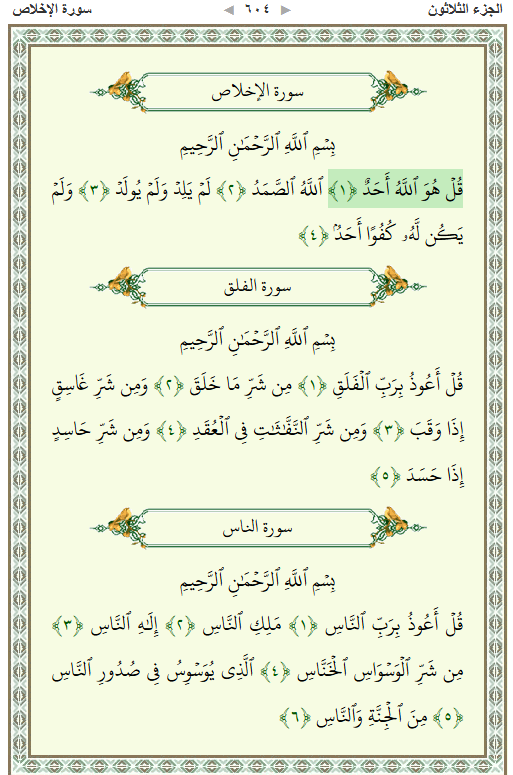
Why Starting at the End of Juz Amma Works Better for Kids
Children’s brains respond to early wins. In our instructors’ experience at Buruj Academy, children who begin with An-Nas and Al-Falaq typically memorize both within their first two sessions — and arrive at their third session visibly excited to continue.
Children who begin with At-Takwir or Al-Inshiqaq, by contrast, often feel overwhelmed before they have built any momentum.
Begin here. The sequence will reverse direction naturally once confidence is established.
Suggested Opening Sequence:
| Week | Surah | Ayat Count | Approximate Memorization Time |
| Week 1 | An-Nas (114) | 6 | 2–3 sessions |
| Week 1–2 | Al-Falaq (113) | 5 | 2–3 sessions |
| Week 2 | Al-Ikhlas (112) | 4 | 1–2 sessions |
| Week 3 | Al-Masad (111) | 5 | 3–4 sessions |
| Week 3–4 | An-Nasr (110) | 3 | 1–2 sessions |
2. Establish a Daily 15-Minute Memorization Routine Before Anything Else
Juz Amma memorization for kids succeeds or fails based on consistency, not session length. Children need short, daily exposure — not long, infrequent study blocks that drain their attention and erode what they learned previously.
A focused 15-minute daily session outperforms a 90-minute weekly session in both retention and motivation.
The best time, in our instructors’ consistent observation, is immediately after Fajr or directly after school before other activities begin. These windows catch children when their minds are freshest and before competing distractions accumulate.
How to Structure Each 15-Minute Session?
A reliable session structure removes decision fatigue for both parent and child:
- Minutes 1–3: Recite all previously memorized surahs from memory (revision)
- Minutes 4–12: Work on the new ayat — listen, repeat, listen, repeat
- Minutes 13–15: Recite the new ayat alone, then combine with yesterday’s portion
This structure — revision before new material — is foundational to the Buruj Method’s Consistency-before-speed principle. Your child is not just memorizing; they are building a living, maintained Hifz from day one.
3. Use Audio Repetition as the Primary Memorization Tool for Young Children
Children below age 10 are auditory memorizers by nature — they learn through sound before they learn through sight. For Juz Amma memorization specifically, this means the most effective tool is not a written Mushaf but a clear, repeated audio recitation by a single qualified reciter.
Consistency in reciter voice is essential; switching between reciters during memorization introduces tonal inconsistency that confuses young learners.
Buruj Academy’s Hifz for Kids course pairs each child with a single Ijazah-certified instructor whose recitation voice becomes the child’s reference point throughout their Juz Amma memorization — preventing the confusion that comes from mixing recitation styles at home.
Start your child’s Hifz classes with free session
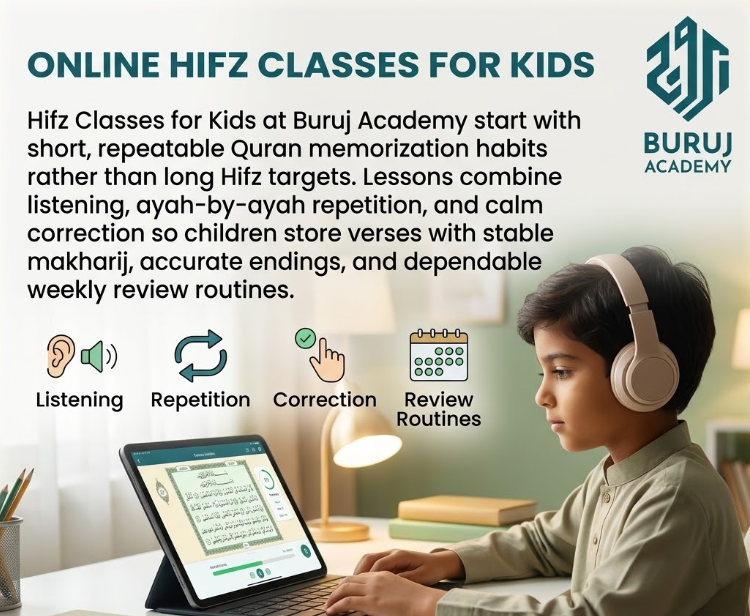
Recommended Audio Repetition Method for Parents
Play the target ayah clearly. Have your child listen without repeating — twice. Then ask them to repeat along with the audio — three times. Then pause the audio and ask them to recite alone.
This listen-first approach trains the ear before the tongue, which is precisely how proper Tajweed habits are built from the beginning.
For a practical breakdown of easy surahs of the Quran to memorize and how to sequence them for children, our team has prepared a dedicated guide with age-specific recommendations.
4. Teach Basic Tajweed Rules Alongside Memorization, Not After
One of the most common mistakes parents make is treating memorization and Tajweed as separate phases — memorize first, correct pronunciation later. This approach guarantees deeply ingrained errors that require months to undo.
When a child memorizes Al-Kawthar with incorrect pronunciation of the letters, they are storing the error in long-term memory.
The rules most relevant to Juz Amma — Ghunnah, Ikhfa, Idgham, and Qalqalah — are not advanced Tajweed. They appear constantly throughout Juz Amma’s surahs and can be introduced to children in child-appropriate language alongside memorization.
Tajweed Rules Your Child Will Encounter Most in Juz Amma
| Tajweed Rule | Simple Explanation for Children | Example in Juz Amma |
| Ikhfa | “Hide the sound lightly in your nose” | مِن شَرِّ — noon before sheen |
| Idgham | “Blend two letters together smoothly” | يَوْمَئِذٍ نَّاعِمَةٌ in Al-Ghashiyah |
| Qalqalah | “Bounce the letter slightly at the end” | الْفَلَقِ — qaf at end of Al-Falaq |
For parents who want to understand these rules clearly before teaching them, our guide to Tajweed rules for kids explains each rule with practical examples from the surahs children memorize first.
5. Follow a Surah-by-Surah Sequence Ordered by Length and Difficulty
After completing the opening surahs (An-Nas through An-Nasr), the most effective approach is to continue working backward through Juz Amma, gradually increasing surah length as your child’s memorization stamina grows.
This progressive difficulty model prevents the discouragement that comes from hitting a long surah before the child has built sufficient stamina.
Below is a recommended full progression sequence for children aged 6–12, designed to be completed over approximately 12–18 months at a pace of 3–5 ayat per day.
Recommended Juz Amma Memorization Sequence for Children
| Phase | Surahs | Total Ayat | Estimated Duration |
| Phase 1 (Confidence Building) | An-Nas, Al-Falaq, Al-Ikhlas, Al-Masad, An-Nasr | 23 | 4–6 weeks |
| Phase 2 (Short Surahs) | Al-Kawthar, Al-Maun, Quraysh, Al-Fil, Al-Humazah | 24 | 5–7 weeks |
| Phase 3 (Medium Surahs) | Al-Asr, At-Takathur, Al-Qari’ah, Al-Adiyat, Az-Zalzalah | 29 | 6–8 weeks |
| Phase 4 (Longer Surahs) | Al-Bayyinah, Al-Qadr, Al-Alaq, At-Tin, Ash-Sharh, Ad-Duha | 38 | 8–10 weeks |
| Phase 5 (Final Surahs) | Al-Layl, Ash-Shams, Al-Balad, Al-Fajr, Al-Ghashiyah, Al-A’la, At-Tariq, Al-Buruj, Al-Inshiqaq, Al-Mutaffifin, Al-Infitar, At-Takwir, Abasa, An-Nazi’at, An-Naba | 247 | 16–22 weeks |
This phased plan means your child builds real memorization capacity before encountering the longer surahs of Juz Amma.
For families who want a detailed Quran memorization schedule mapped across weeks and months, our planning guide offers printable formats you can adapt to your child’s specific pace.
Read also: The Importance of Memorizing Quran for Kids
6. Build a Revision System from Week One to Prevent Forgetting
New memorization without systematic revision is temporary memorization. The most heartbreaking pattern we see in children who attempt Juz Amma without structured guidance is this: a child memorizes 10 surahs over several months, then realizes they have forgotten the first 5 while working on the last 5. Without revision built into the daily routine, Hifz becomes a leaking bucket.
The solution is a simple rolling revision system that takes no more than 5 minutes per day:
- Daily: Recite the 3 most recently memorized surahs from memory
- Weekly: Recite all surahs memorized in the past 4 weeks
- Monthly: Full recitation of everything memorized so far
This system ensures that by the time your child completes Juz Amma, every surah is equally strong — not just the most recent ones.
For a deeper understanding of how to memorize Quran faster with proven retention techniques, our team outlines the neuroscience-grounded methods we apply in live sessions.
Excel in Your Quranic Studies
Join Buruj Academy and master the Quran with our structured, professional curriculum.
Book Your Free Trial7. Match Memorization Targets to Your Child’s Age and Attention Capacity
Juz Amma memorization for kids is not a one-size-fits-all process. A 6-year-old and a 12-year-old are fundamentally different learners — in attention span, phonetic accuracy, reading ability, and motivational drivers.
Applying adult expectations to young children creates frustration; applying child pacing to older children wastes their capacity.
In Buruj’s Azhari Quran tutors, the following daily targets are realistic and sustainable by age group:
| Age Group | Daily New Ayat Target | Session Length | Revision Method |
| Ages 4–6 | 1–2 short ayat | 10 minutes | Parent-led oral only |
| Ages 7–9 | 2–4 ayat | 12–15 minutes | Oral + listening to audio |
| Ages 10–12 | 4–6 ayat | 15–20 minutes | Oral + light written check |
| Ages 13+ | 6–10 ayat | 20–25 minutes | Full independent recitation |
For parents wondering about the best age to memorize Quran, we address this question in detail — including the neurological research that supports early memorization without forcing premature performance.
Book a FREE trial session with one of Buruj’s Azhari Quran tutors

8. Use Meaning-Based Engagement to Deepen Retention and Love for the Quran
Children who understand what they are memorizing retain it significantly longer than those memorizing pure sounds. Meaning-connection is not a supplement to Juz Amma memorization — it is a retention multiplier. When a child knows that قُلْ هُوَ اللَّهُ أَحَدٌ means “Say: He is Allah, the One,” the words carry emotional weight that anchors the memory.
قُلْ هُوَ ٱللَّهُ أَحَدٌ
Qul huwa Allahu ahad
“Say, “He is Allah, [who is] One,” (Al-Ikhlas 112:1)
This ayah — four words — is the ideal first meaning-connection for young children. Ask: “What does Allah tell us to say?” The answer is the ayah itself.
You do not need to teach full Tafsir. One sentence of meaning per surah — delivered as a story or simple explanation — is enough to transform rote memorization into connected knowledge.
Our Quran activities for kids guide offers creative, age-appropriate activities that reinforce surah meanings through art, movement, and conversation — tools parents can use at home without any special materials.
9. Track Progress Visibly and Celebrate Every Completed Surah
Children are motivated by visible progress. A memorization chart on the wall — with each surah represented by a star, sticker, or colored block — transforms an abstract goal into a concrete, daily-rewarding experience.
When a child can see that they have memorized 8 out of 37 surahs, the remaining 29 feel like an exciting count-down rather than an overwhelming distance.
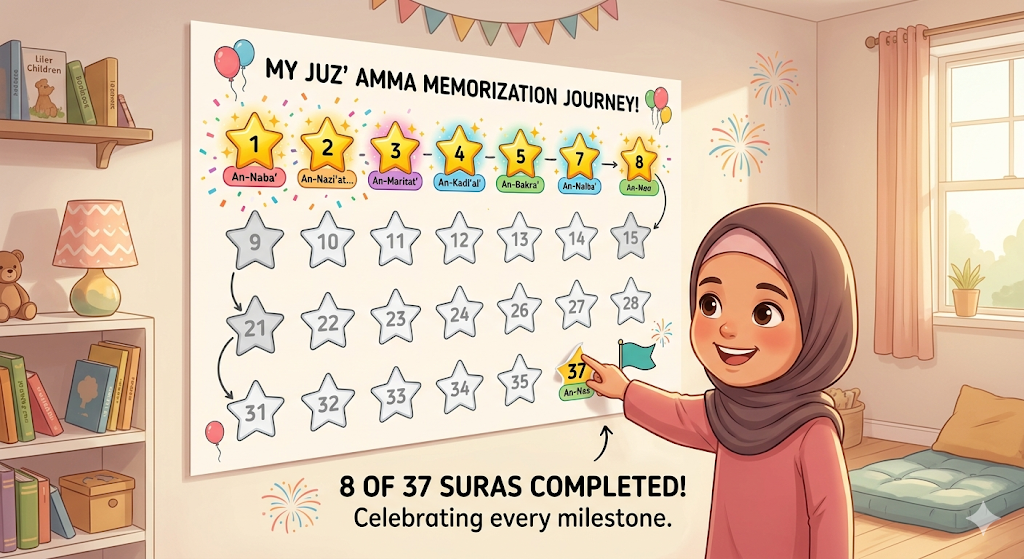
Celebration at every milestone matters profoundly. The Prophet ﷺ praised those who teach and learn the Quran, as recorded in Sahih Al-Bukhari (5023):
“The best among you are those who learn the Quran and teach it.”
Sharing this with your child — at every milestone — connects their memorization to something spiritually meaningful, not just academically demanding.
Small celebration ideas that reinforce rather than distract:
- A special Quran-themed bookmark for each completed surah
- A family recitation of the newly memorized surah after Maghrib
- A “Hifz certificate” printed at home for each completed phase
- A dedicated dua together thanking Allah for the milestone
10. Pair Home Practice with a Qualified Online Instructor for Accuracy and Accountability
Home practice gives your child frequency. A qualified instructor gives your child accuracy. Both are necessary — and neither is sufficient alone. Parents who only practice at home risk reinforcing pronunciation errors they cannot detect.
Children who only attend sessions without daily home practice do not retain between lessons.
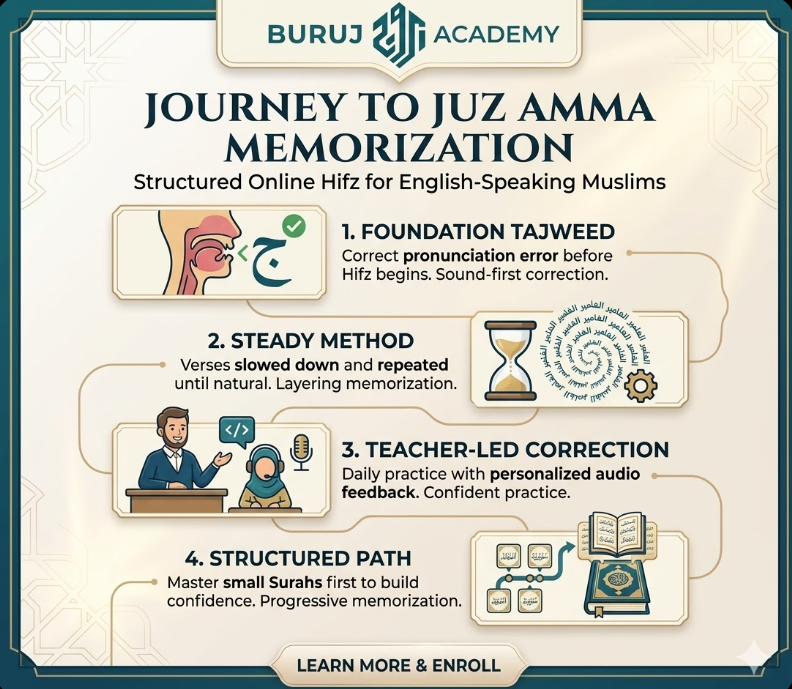
The most effective Juz Amma memorization programs combine short daily home sessions with regular instructor-supervised recitation for real-time correction.
Buruj Academy’s Juz’ Amma Memorization for Kids course provides exactly this structure: Ijazah-certified instructors and Al-Azhar University graduates supervise each child’s recitation in personalized 1-on-1 sessions, correcting Tajweed in real time and maintaining the revision system week by week.
Book Your Kid’s First Session in Buruj’s Juz 30 Memorization Course
For parents who want to explore the full range of Quran learning tools for kids — from apps to physical materials to online platforms — our curated guide covers what actually works and what to avoid.
Read also: How to Make Your Child Memorize the Quran?
Discover the Buruj Academy Difference
Step into our virtual classrooms and see how our expert instructors make learning Quran and Arabic intuitive and clear. We focus on overcoming the specific hurdles non-native speakers face, building your confidence and connection with the Quran.
Start Your Child’s Juz Amma Memorization with Buruj Academy’s Expert Hifz Instructors
Juz Amma memorization is one of the most beautiful gifts you can give your child — a foundation of Quran in their heart that will serve every prayer for the rest of their life. The steps above map the path; a qualified instructor ensures they walk it correctly.
Buruj Academy’s Juz’ Amma Memorization for Kids Course offers:
- Ijazah-certified, Al-Azhar University graduate instructors
- Personalized 1-on-1 sessions tailored to your child’s age and pace
- Built-in revision systems and Tajweed correction in every session
- Flexible 24/7 scheduling for families across all time zones
- The Buruj Method: Consistency-before-speed, meaning-before-rote
Book your child’s free trial lesson today and let our instructors show you exactly where your child stands — and where they can go.
Take the first step toward this lifelong blessing by enrolling in a program tailored to your pace:
- Online Hifz Program (Comprehensive Quran Memorization)
- Juz 30 Memorization Course (Perfect for focused starts)
- Hifz Classes for Kids (Engaging and interactive)
- Hifz Classes for Adults (Flexible scheduling for busy lives)
- Hifz Classes for Sisters (Private, supportive learning)
- Short Surah Memorization Course (Ideal for daily prayers)
- Hifz Ijazah Course (For advanced students seeking certification)
Don’t let another day pass without moving closer to your goal. Join Buruj Academy today and schedule your free trial session to begin your Hifz journey!
Excel in Your Quranic Studies
Join Buruj Academy and master the Quran with our structured, professional curriculum.
Book Your Free TrialConclusion
Juz Amma memorization for kids is not a single event — it is a sequence of small, consistent steps that accumulate into one of the most profound achievements of a child’s early life. The sequence matters. The pacing matters. The revision matters. And above all, the combination of parental presence at home and expert instruction from a qualified teacher matters enormously.
Begin with the shortest surahs. Build the daily habit before you build the daily target. Keep Tajweed accurate from day one.
Celebrate every surah as a genuine milestone. Insha’Allah, with patience and the right guidance, your child’s completion of Juz Amma is not a distant hope — it is a scheduled reality.
Frequently Asked Questions About Juz Amma Memorization for Kids
How Long Does It Take a Child to Memorize All of Juz Amma?
Most children aged 7–10 complete Juz Amma memorization in 7–16 months with consistent daily practice of 15 minutes and regular instructor supervision. Younger children (ages 4–6) may take 11–20 months at a gentler pace. Older children aged 11–13 can often complete it in 5–12 months with stronger focus capacity.
What Is the Best Age to Start Juz Amma Memorization for Kids?
Children can begin Juz Amma memorization as early as age 4 with very short surahs like Al-Ikhlas and An-Nas. Age 6–7 is when most children have sufficient attention span for structured daily sessions. The best age to memorize Quran varies by child, but starting early — even informally — builds phonetic familiarity that makes formal memorization faster later.
Should Kids Learn Tajweed Rules Before Starting Juz Amma Memorization?
Children do not need to study Tajweed rules formally before starting. However, they should memorize with correct pronunciation from the first ayah — guided by a qualified instructor who applies Tajweed naturally during recitation. Learning basic rules like Ghunnah and Qalqalah alongside memorization (not before or after) is the most effective approach. Our Tajweed for beginners guide explains how to introduce these rules accessibly.
Can a Child Memorize Juz Amma Without a Teacher?
A child can memorize the words without a teacher, but they cannot guarantee accuracy without one. Pronunciation errors, Tajweed mistakes, and weak revision habits go uncorrected without instructor oversight — and these errors become deeply embedded over time. Supervised memorization with a qualified instructor is not optional for children who want strong, lasting Hifz with proper recitation.