 Tajweed
| Key Takeaways |
| Tajweed games reduce children’s anxiety around Quran recitation by turning rule practice into structured, reward-based play. |
| Physical movement activities like Qalqalah clapping help children internalize echo sounds before they can name the rule. |
| Flashcard matching and color-coding systems build letter recognition for Noon sakinah and Meem sakinah rules in under 10 minutes daily. |
| Competitive team games work best for children aged 7–12, while sensory activities suit younger beginners aged 4–6. |
| Consistent short sessions of 10–15 minutes using games outperform longer passive recitation drills for children’s Tajweed retention. |
Getting children to sit still for Tajweed practice is one of the most common challenges parents and teachers face. When recitation feels like a chore, children resist — and resistance kills consistency, which is the single most important factor in any child’s Quran learning.
The solution is not more drilling — it is smarter engagement. The right Tajweed games and activities for kids turn rule practice into something children ask for.
Table of Contents:
1. Colour-Coding Tajweed Flashcards
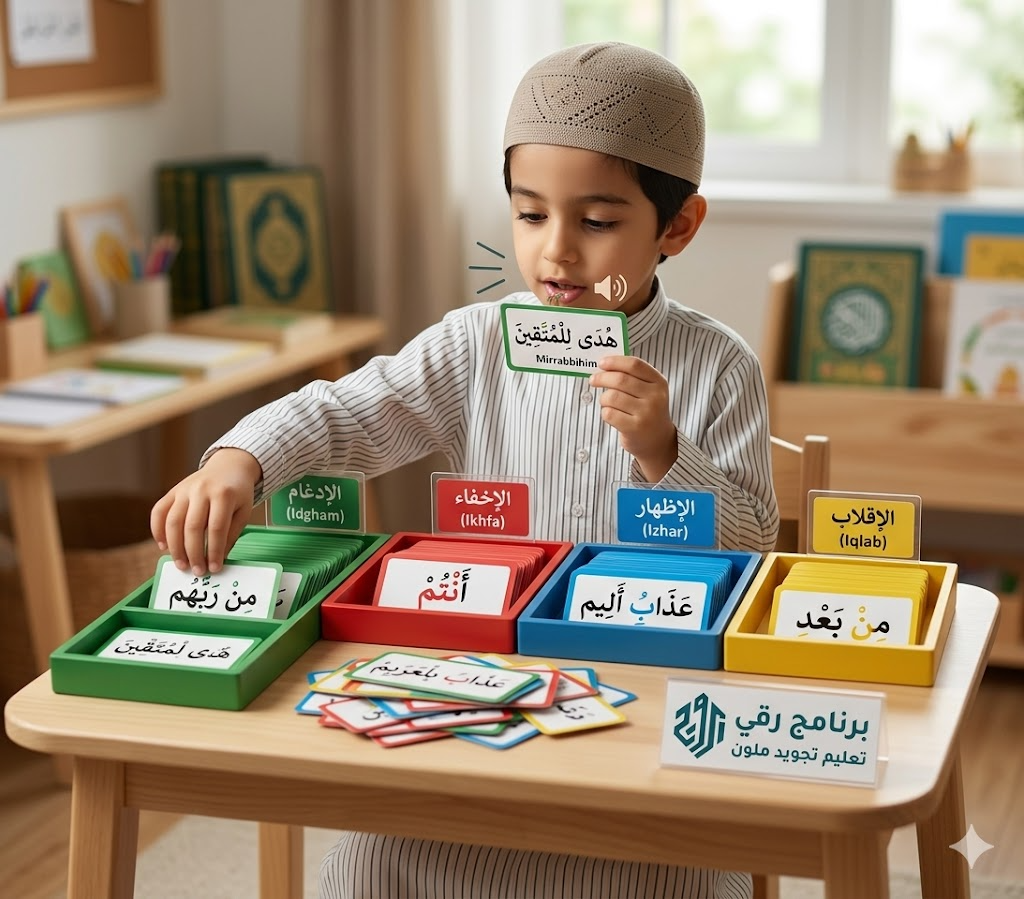
Give each Tajweed rule a consistent color — green for Idgham, red for Ikhfa, blue for Izhar, yellow for Iqlab. Write Quranic words containing those rules on flashcards in their corresponding color. The child’s task is to sort mixed cards into color groups, then read each word aloud with the correct application.
This works especially well for Noon sakinah rules, where the same letter (ن) behaves differently depending on what follows it.
Children who struggle to hear the difference can see it instantly. In our experience, children aged 6–9 who use color-coded cards for two weeks consistently outperform peers who only drill by ear.
Color-to-rule association also speeds up the transition from card reading to live recitation recognition.
For a solid grounding in Ikhfa specifically, our detailed guide to Ikhfa letters in Tajweed is a useful parent resource.
2. Clapping to Qalqalah Letters Teaches Children to Feel the Echo Sound Before Naming It
Qalqalah — the bouncing echo produced on the five letters ق ط ب ج د when they carry a sukoon — is one of the first rules children encounter. Rather than explaining it abstractly, have children clap once sharply every time they hear a Qalqalah letter during recitation.
Start with short surahs like Al-Falaq, which contains الفلق — children clap on the “q” sound and immediately feel the rule rather than just memorizing it.
After a few rounds, ask them: “Did you feel your hands bounce? That’s what your voice should do.”
This physical anchoring is something we return to repeatedly in our sessions — it works because the body remembers what the brain sometimes forgets.
| Qalqalah Letter | Example Word |
| ق | الفلق |
| ط | يَطْمَعُ |
| ب | تبّ |
| ج | الْحَجّ |
| د | أَحَد |
For more on this rule, our article on Qalqalah letters covers every position and application in detail.
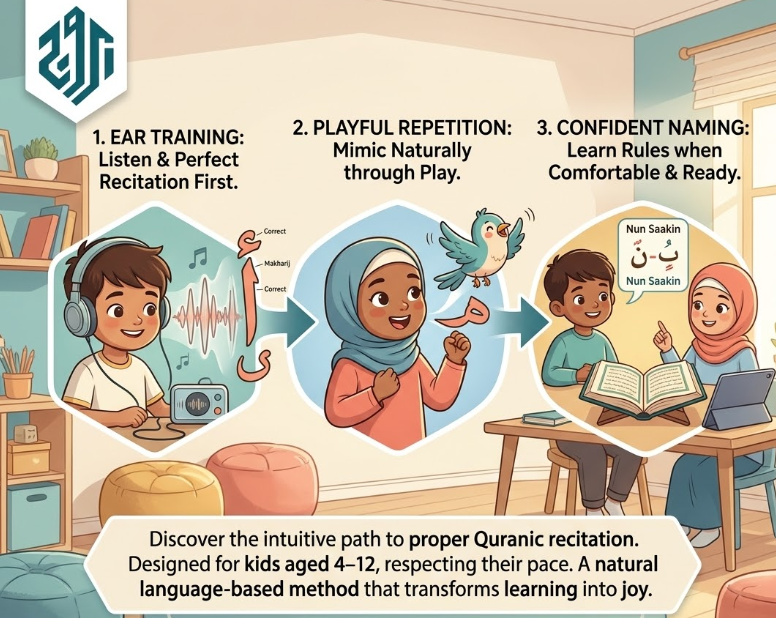
At Buruj Academy, our Tajweed for Kids course is built around the principle that children learn Tajweed rules most durably when they first experience the rule through play, then attach the name to something they already know how to do.
Book your child’s free Tajweed trial lesson today
3. The Tajweed Treasure Hunt Game
Write individual Tajweed rules or Arabic letters on small cards and hide them around the room. Each card has a rule name on one side and a Quranic example on the other.
When a child finds a card, they must recite the example correctly to “keep” the card. The child with the most cards at the end wins.
This game works well for mixed groups of siblings or a small class. It removes the seated pressure of a traditional lesson and channels children’s natural energy productively.
The competitive element is healthy — children motivate each other. We recommend hiding no more than 10–12 cards per round to keep sessions under 15 minutes and maintain focus.
4. Ghunnah Humming Races
Ghunnah is the nasal resonance held for two counts (two Harakah) on Noon Mushaddad (نّ) and Meem Mushaddad (مّ). Children often rush through it. A humming race solves this directly.
Two children face each other. One recites a word containing Ghunnah while the other holds up two fingers, lowering one finger per count. If the reciter finishes before both fingers drop, they lose the round.
This simple countdown mechanic forces the correct duration without the teacher needing to repeat “hold it longer” dozens of times. For a thorough explanation of this rule and its conditions, our complete guide to Ghunnah is worth reviewing alongside this activity.
Read also: Islamic Studies Books for Kids
5. Arabic Letter Articulation Point Charades
Makharij al-huruf — the precise articulation points of Arabic letters — is foundational to correct Tajweed. For children, the concept becomes concrete through imitation games. Write a letter on a card, and the child must produce it while the teacher (or parent) exaggerates the mouth position. Other children guess which letter is being made.
Letters from different articulation zones work best as contrast pairs: ق (back of throat) versus ك (palate) — children can feel immediately that these come from different places.
Letters like ث ذ ظ (produced with the tongue tip near the upper teeth) are often mispronounced by non-Arabic speakers.
Making a game of the mouth position removes self-consciousness. Our complete guide to Makharij al-Huruf provides the full articulation map for parents who want to guide this activity accurately.
Buruj Academy’s Online Quran Classes for Kids complement this practice by ensuring children recognize the same words in live recitation.
Help your child start learning the Quran with a FREE trial
6. Tajweed Bingo Keeps Group Sessions
Create bingo cards with Tajweed rule names (Ikhfa, Idgham, Izhar, Iqlab, Madd, Qalqalah) in the grid squares. The teacher recites a Quranic word, and children mark the rule that applies. First child to complete a row calls out and must correctly name all marked rules to win.
This game is highly effective for children aged 8–12 who have already been introduced to rule names. It builds rule identification speed — the same skill needed for fluent recitation.
We recommend using words from the surahs children are actively memorizing, so the game directly reinforces their current learning material rather than introducing unfamiliar vocabulary.
For children who are also working on Quran memorization alongside Tajweed, our resource on easy surahs to memorize helps parents choose the right material to use in this game.
Excel in Your Quranic Studies
Join Buruj Academy and master the Quran with our structured, professional curriculum.
Book Your Free Trial7. Madd Stretching Activities
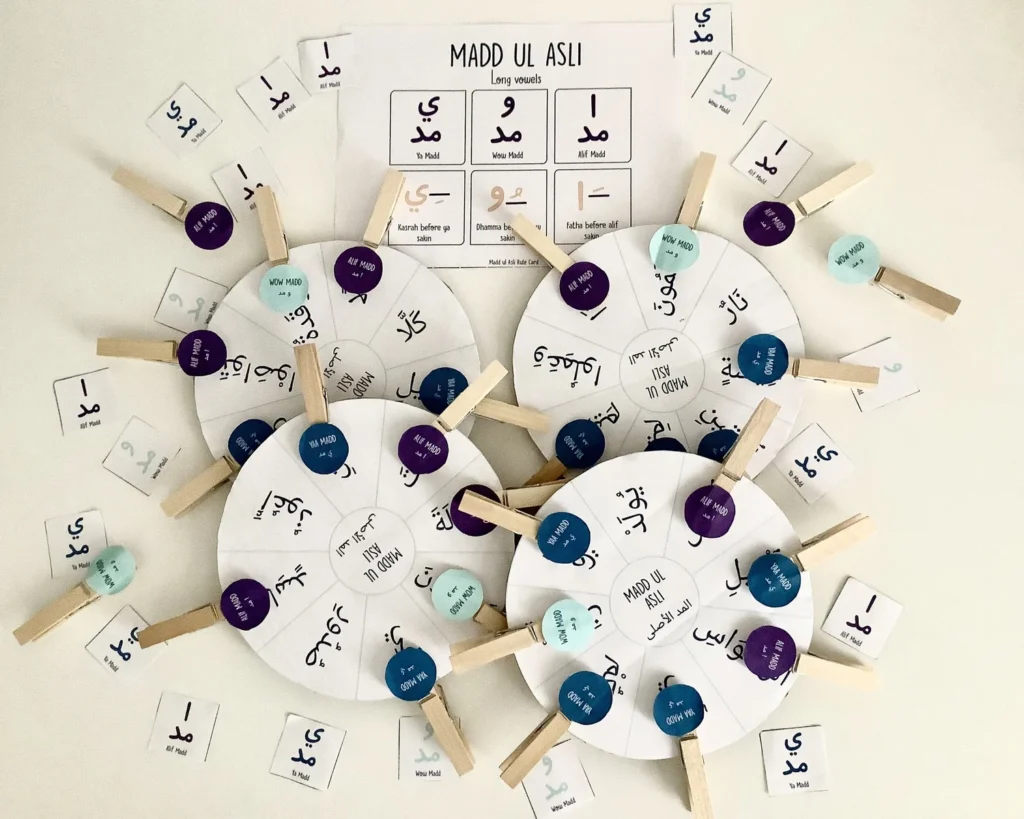
Madd (elongation) rules require children to extend certain vowel sounds for two, four, or six counts — and the most common beginner error is under-extending. A stretching activity solves this physically.
As children recite a word with Madd, they physically stretch a rubber band or stretch their arms apart. Longer Madd = wider stretch. For Madd Asli (natural elongation of two counts), they open their arms slightly. For Madd Munfasil or Madd Muttasil (four or six counts), they stretch fully wide.
Children remember the sensation of “far apart” and unconsciously replicate it in recitation. Our article on Madd Asli explains the foundational elongation rules that underpin this activity.
8. Heavy and Light Letter Sorting Games Train Children to Distinguish Tafkhim From Tarqiq
The distinction between heavy (Tafkhim — مُفَخَّم) and light (Tarqiq — مُرَقَّق) letters is one of the most nuanced Tajweed skills. For children, sorting activities build this distinction without requiring technical vocabulary.
Give children two boxes labeled “Heavy” (draw a heavy weight symbol) and “Light” (draw a feather). Read letters aloud — children physically place a card in the correct box after hearing the sound.
The seven always-heavy letters (خ ص ض غ ط ق ظ) go in the heavy box; children feel the back-of-throat fullness in heavy letters versus the forward, light production of Tarqiq letters.
Our guide to heavy and light letters in Tajweed gives the full rule set for parents facilitating this game.
| Category | Letters | Mouth Feel |
| Always Heavy (Tafkhim) | خ ص ض غ ط ق ظ | Full, back-of-throat resonance |
| Always Light (Tarqiq) | Most remaining letters | Forward, clear, crisp |
| Context-dependent | ر ل ا | Changes based on vowel/position |
9. Izhar Clarity Challenges
Izhar Halqi requires Noon sakinah or Tanwin before one of the six throat letters (ء ه ع ح غ خ) to be pronounced clearly and completely — no merging, no nasal resonance. Children often blur the Noon into the following letter out of habit.
A clarity challenge works as follows: the teacher recites a word with Izhar, then recites the same word with deliberate Idgham (incorrectly). Children raise a green card for correct Izhar and a red card for wrong.
This discrimination training sharpens the ear before it sharpens the tongue — which is the correct sequence. Our Izhar letters guide provides the complete letter list and examples for parents preparing this activity.
10. Tajweed Sticker Chart Systems
Children are motivated by visible progress. A weekly Tajweed sticker chart — with one sticker per correct recitation session — provides a tangible reward system that keeps practice consistent without external pressure.
Divide the chart into rule categories: Qalqalah, Madd, Ghunnah, Idgham, Ikhfa. Each rule has its own row.
When a child correctly applies a rule during recitation, they earn a sticker in that row.
Full rows unlock small rewards — a favorite snack, extra screen time, or a special du’a session together.
In our instructors’ experience, children who use visual progress systems maintain daily practice three times longer than those without one. Consistency, not intensity, is what builds lasting Tajweed.
Our article on Tajweed rules for kids pairs well with this system as a parent reference guide.
Read also: Prophet Muhammad Story for Kids
Discover the Buruj Academy Difference
Step into our virtual classrooms and see how our expert instructors make learning Quran and Arabic intuitive and clear. We focus on overcoming the specific hurdles non-native speakers face, building your confidence and connection with the Quran.
Start Your Child’s Tajweed Learning With Buruj Academy’s Expert Online Instructors
Tajweed games work best when a child has an expert foundation to build on. Games reinforce what a qualified teacher has correctly introduced first.
Buruj Academy’s Tajweed for Kids course offers:
- Ijazah-certified instructors and Al-Azhar University graduates with 12+ years teaching non-Arabic speakers
- The Buruj Method: Sound-before-rules — children hear and feel Tajweed before they name it
- Personalized 1-on-1 online sessions with flexible scheduling across all time zones
- Real-time correction with age-appropriate patience and encouragement
- Clear progression from letter recognition to full surah recitation with Tajweed
Book your child’s free trial lesson today and let our expert instructors build the foundation that makes every game in this list work even better.
Enroll your child in one of our specialized, kid-friendly tracks today:
- Online Quran Classes for Kids
- Tajweed Classes for Kids
- Hifz Classes for Kids
- Online Arabic Classes for Kids
- Quranic Arabic Course for Kids
- Noorani Qaida Course for Kids
- Islamic Studies Classes for Kids
Ready to watch your child grow in knowledge and character? Join the Buruj Academy family and book a free trial session for your child today!
Excel in Your Quranic Studies
Join Buruj Academy and master the Quran with our structured, professional curriculum.
Book Your Free TrialConclusion
Tajweed does not have to feel like a test — for children, it should feel like a game they happen to be getting better at every week. The fifteen activities above are not decorative extras. They are pedagogically grounded tools that train articulation, rule recognition, and listening discrimination in ways that passive drilling cannot replicate.
The key is pairing structured games with expert instruction. Games reinforce; teachers introduce. When both are present, children progress faster, retain longer, and — Alhamdulillah — build a genuine love for Quranic recitation that stays with them into adulthood.
Frequently Asked Questions About Tajweed Games and Activities for Kids
At What Age Can Children Start Learning Tajweed Through Games?
Children as young as 4–5 can begin Tajweed through sensory and movement-based games focused on sound awareness and letter articulation, without formal rule names. Structured rule-based games with named Tajweed terms are most effective from age 7 onward, when children can hold rule concepts in working memory while simultaneously reciting.
How Long Should Each Tajweed Game Session Be for Young Children?
Sessions of 10–20 minutes are optimal for children under 8. Children aged 8–12 can sustain focused Tajweed game practice for 20–25 minutes before concentration drops. Multiple short daily sessions outperform one long weekly session for building both rule retention and recitation habits.
Can Tajweed Games Replace Formal Lessons With a Teacher?
Games are reinforcement tools, not replacements for qualified instruction. A certified teacher correctly introduces a rule and monitors pronunciation; games then deepen and consolidate what was taught. Children who use games without formal instruction often reinforce incorrect habits unknowingly, which become harder to correct later.