 Tajweed
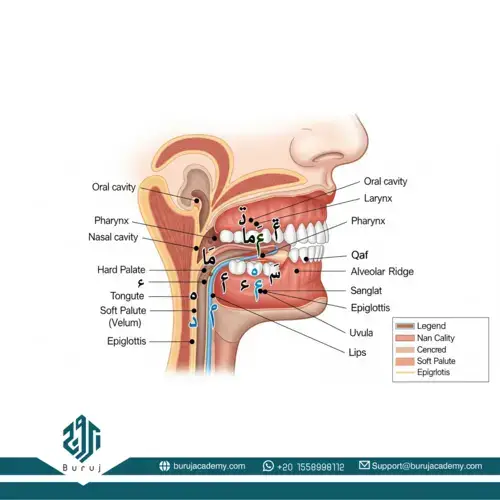
| Key Takeaways |
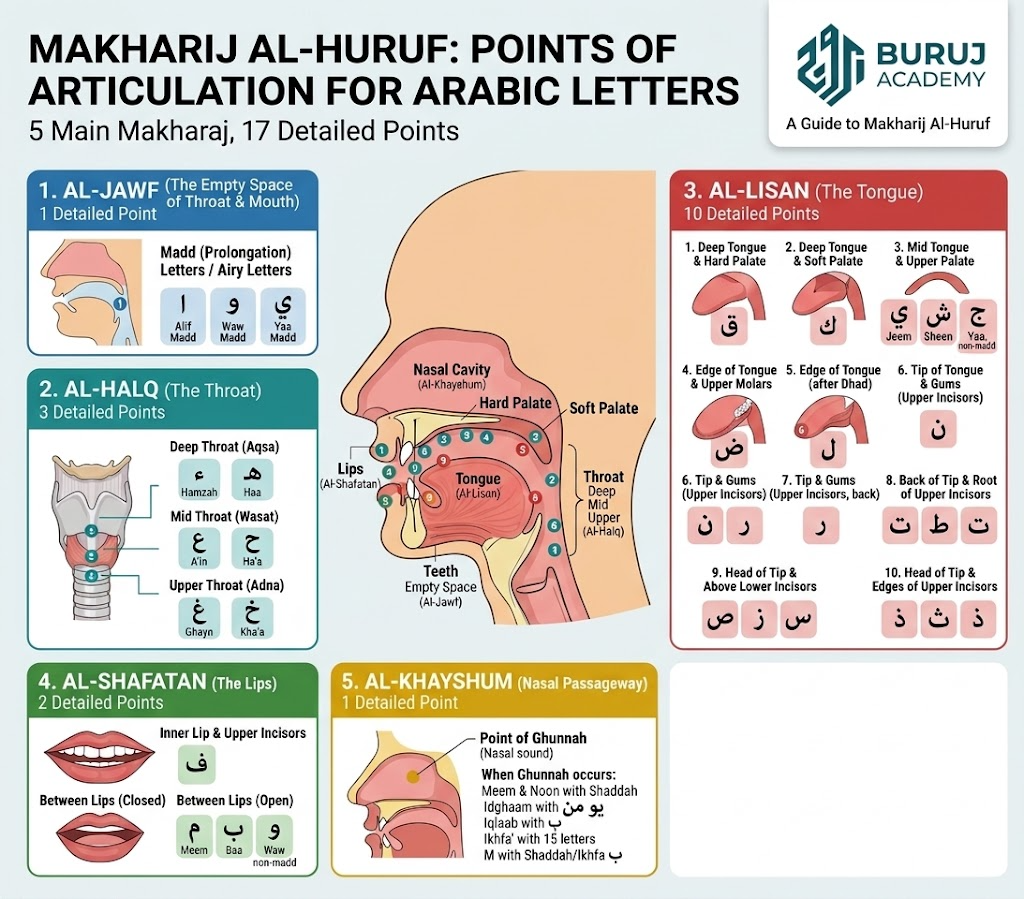
| Makharij Al-Huruf refers to the 17 specific articulation points grouped under 5 main regions where Arabic letters are produced. |
| The five main articulation regions are Al-Jawf, Al-Halq, Al-Lisan, Al-Shafatan, and Al-Khayshum — each producing distinct letter sounds. |
| Al-Lisan (the tongue) contains the most articulation points — ten sub-locations producing 18 different Arabic letters. |
| Mispronouncing a letter by ignoring its correct makhraj can alter word meaning in the Quran, making this knowledge obligatory for reciters. |
| Ghunnah is the only letter attribute (sifah) with its own independent articulation point — the nasal cavity (Al-Khayshum). |
Every letter in the Quran has a precise origin point — a location in the mouth, throat, or nose where the sound is born. Miss that point, and the letter changes. Change the letter, and the word’s meaning shifts.
Makharij Al-Huruf — the articulation points of Arabic letters — is the foundational science that governs where and how each of the 28 Arabic letters is correctly produced. Scholars have identified 17 detailed articulation points nested within 5 main regions.
Table of Contents:
What Are Makharij Al-Huruf in Tajweed?
Makharij Al-Huruf are the specific physical locations inside the vocal tract — the throat, tongue, lips, and nasal cavity — from which individual Arabic letters originate.
How many Makharij are in Tajweed?
Classical Tajweed scholars, including Imam Ibn Al-Jazari, established that there are 17 detailed articulation points (makhraj tafseeli) organized under 5 main articulation regions (makhraj ra’eesi).
Understanding makharij is a practical necessity. In our Online Tajweed Classes at Buruj Academy, taught by Ijazah-certified instructors and Al-Azhar University graduates, we consistently observe that most pronunciation errors students bring to their first session trace directly to confusion between adjacent articulation points — particularly the letters ح/هـ, ق/ك, and ذ/ز.
When a student mispronounces ق (Qaf) as ك (Kaf), they have shifted from one makhraj to another.
When they replace ع (Ain) with a glottal stop, they have moved from the middle throat to the deepest throat point. Each of these errors is a violation of Makharij Al-Huruf.
Book Your FREE Trial Lesson to Begin Your Tajweed Journey

What Are the 5 Main Articulation Regions in Makharij Al-Huruf?
The 5 main regions and their subdivisions are as follows:
| Main Region | Arabic Name | Number of Detailed Points | Number of Letters |
| The Hollow/Empty Space | Al-Jawf (الجوف) | 1 | 3 |
| The Throat | Al-Halq (الحلق) | 3 | 6 |
| The Tongue | Al-Lisan (اللسان) | 10 | 18 |
| The Two Lips | Al-Shafatan (الشفتان) | 2 | 4 |
| The Nasal Cavity | Al-Khayshum (الخيشوم) | 1 | Ghunnah sound |
This table gives you the architecture of the entire system at a glance. Each region is a neighborhood; each detailed point is an address. We will now move through each region in full detail.
1. The First Region is Al-Jawf
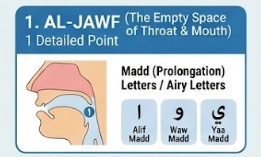
Al-Jawf refers to the open hollow space extending from behind the throat through the mouth. It contains one articulation point — and from it emerge the three letters of Madd (prolongation):
- Alif Maddiyah — a silent Alif preceded by a Fathah (ـَا)
- Waw Maddiyah — a silent Waw preceded by a Dammah (ـُو)
- Ya Maddiyah — a silent Ya preceded by a Kasrah (ـِي)
These three are gathered in the word نُوحِيهَا in the verse:
تِلْكَ مِنْ أَنۢبَآءِ ٱلْغَيْبِ نُوحِيهَآ إِلَيْكَ
Tilka min anbaa’il-ghaybi nooheeha ilayk
“These are some accounts of the unseen which We reveal to you.” (Hud 11:49)
This makhraj is considered taqdeeri — estimated or approximate — because the letters of Madd do not originate at one defined physical point.
They begin in the throat and extend outward as the sound flows freely through the open space, ending wherever the voice ends in the air. This is why they are also called Al-Huruf Al-Hawaa’iyyah — the letters of air.
For a deeper understanding of how these letters interact with prolongation rules, see our guide on Madd Asli and the foundational rules of prolongation.
2. The Second Region is Al-Halq
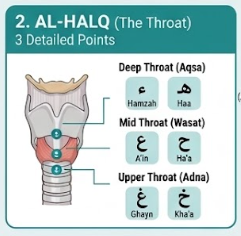
Al-Halq (the throat) contains three detailed articulation points producing six letters. These are ordered from deepest to closest to the mouth:
| Throat Location | Arabic | Letters Produced | Notes |
| Deepest part (nearest the chest) | Aqsa Al-Halq | ء (Hamzah), هـ (Ha) | Hamzah is slightly deeper than Ha |
| Middle of the throat | Wasat Al-Halq | ع (Ain), ح (Ha) | Ain is slightly deeper than Ha |
| Nearest part to the mouth | Adna Al-Halq | غ (Ghain), خ (Kha) | Kha is slightly closer to the mouth than Ghain |
How to Distinguish the Deep Throat Letters ء and هـ?
Hamzah (ء) and Ha (هـ) both originate from the deepest point of the throat, but Hamzah requires a complete closure — a glottal stop — before release. Ha is produced with open, breathy airflow from the same location.
In our experience at Buruj Academy, non-Arabic speakers most commonly confuse هـ with the English “h” sound, which is actually produced higher up in the vocal tract and lacks the proper depth of the Arabic Ha.
The Middle Throat: Ain and Haa
ع (Ain) is one of the most challenging letters for English speakers. It requires constriction at the middle of the throat — a sound that simply does not exist in English phonology.
ح (Muhmal Ha) is produced at the same location with less constriction and a stronger breath release. Mixing these two in recitation is a serious error, as demonstrated in verses like:
وَٱلْعَصْرِ
Wal-‘asr
“By time.” (Al-Asr 103:1)
The Ain in الْعَصْرِ must emerge from the middle throat with full constriction — not as a glottal stop (Hamzah) and not as the breathy Ha.
3. The Third Region is Al-Lisan
Al-Lisan is the most active articulation region, containing ten detailed points and producing 18 letters. We cover these from the back of the tongue forward:
| # | Tongue Location | Letters | Key Detail |
| 1 | Furthest back — against upper palate | ق (Qaf) | Deepest tongue point |
| 2 | Slightly forward from Qaf point | ك (Kaf) | Closer to the mouth than Qaf |
| 3 | Middle of tongue — against upper palate | ج، ش، ي (non-Madd) | Jaw fully contacts palate for Jim; Shin/Ya with spacing |
| 4 | One edge of tongue — against upper molars | ض (Dad) | Left edge more common; right also valid |
| 5 | Either/both edges — against upper gum line | ل (Lam) | Most forward of the edge letters |
| 6 | Tip of tongue — against upper gum line | ن (Nun) | Close to but distinct from Lam |
| 7 | Tip + slight back of tongue — upper gum | ر (Ra) | Slightly more retracted than Nun |
| 8 | Tip of tongue — against base of upper teeth | ط، د، ت | Taa furthest back, then Dal, then Ta |
| 9 | Tip of tongue — below upper front teeth | ص، ز، س | Air escapes through narrow channel |
| 10 | Tip of tongue — against edges of upper front teeth | ث، ذ، ظ | Interdental letters |
Why Qaf ق and Kaf ك Are Not Interchangeable?
ق and ك share the same general region — the back of the tongue against the upper palate — but Qaf is produced further back, against the soft palate (velum), while Kaf contacts the hard palate slightly forward. Confusing them in recitation changes words entirely. Consider:
قَلْبٌ (Qalbun — heart) vs. كَلْبٌ (Kalbun — dog)
One makhraj error separates a noble word from an insult. This is precisely why Buruj Academy’s Tajweed for Beginners course dedicates focused time to back-of-tongue letter discrimination before advancing to rules.
Book Your FREE Trial Lesson to Begin Your Tajweed Journey
The Unique Challenge of Dad (ض) Makharij
ض is historically recognized as one of the most distinctive sounds in the Arabic language. It originates from one edge of the tongue — typically the left — pressed against the upper back molars.
The left-edge production is both more common and considered easier by most students and scholars.
In our classes, we find that students who try to produce Dad from the tongue tip (confusing it with a heavy د) consistently produce a distorted sound that qualified instructors can identify within seconds.
Excel in Your Quranic Studies
Join Buruj Academy and master the Quran with our structured, professional curriculum.
Book Your Free TrialThe Interdental Letters: Tha, Dhal, and Dha
ث، ذ، ظ are produced by placing the tip of the tongue lightly against — or just between — the upper front teeth. These are the interdental letters, similar in position (though not identical in sound) to the English “th” in “think” (ث) and “this” (ذ).
The letter ظ carries the additional attribute of Tafkhim (heaviness), which distinguishes it from ذ even though their articulation points are adjacent.
For a full treatment of the heavy and light letter distinction, see our guide on heavy and light letters in Tajweed.
4. The Fourth Region is Al-Shafatan
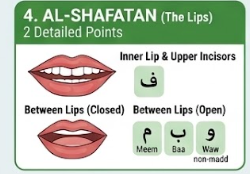
Al-Shafatan (the two lips) contains two detailed articulation points producing four letters:
| Lip Location | Letters | Production Method |
| Between both lips | ب (Ba), م (Mim), و non-Madd (Waw) | Ba & Mim: full lip closure; Waw: lips open with rounding |
| Inner lower lip + upper front teeth | ف (Fa) | Lower lip meets upper teeth edges |
Ba, Mim, and the Strength of Closure
Both ب and م require complete closure of both lips, but they differ in the degree of force. Ba carries stronger lip pressure upon release — producing the characteristic Qalqalah echo when sukoon — while Mim is softer and accompanied by Ghunnah through the nasal cavity.
For an in-depth look at how Qalqalah functions across its five letters, visit our dedicated guide on Qalqalah letters.
The non-Madd و (Waw) is produced from the same lip region but with the lips gently rounded and open — never closed. This distinguishes it clearly from م and ب.
5. The Fifth Region is Al-Khayshum
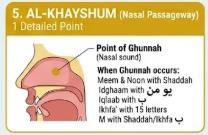
Al-Khayshum refers to the nasal passage — the channel connecting the top of the nasal cavity down to the throat. It is the articulation point for Ghunnah — the resonant nasal sound that accompanies ن (Nun) and م (Mim) in specific conditions.
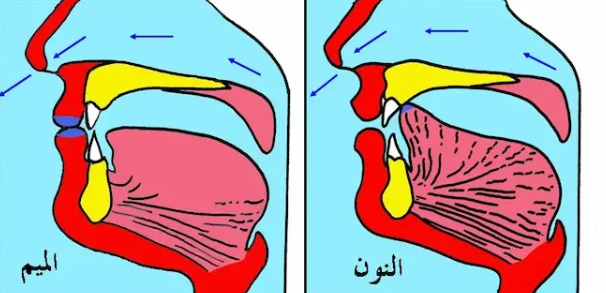
Ghunnah is unique: it is the only sifah (attribute) among all letter attributes that has its own independent makhraj, separate from the makhraj of the letter it accompanies.
All other attributes emerge from the same place as their letter — but Ghunnah exits through the nose regardless of where Nun or Mim are otherwise articulated.
The Five Levels of Ghunnah and When They Apply
| Level | Condition | Example |
| 1st (Strongest) | Shadda on Nun or Mim | وَأَنَّا, لَمَّا |
| 2nd | Nun with Idgham bi-Ghunnah | فَمَن يُؤْمِن |
| 3rd | Ikhfa (Nun or Mim concealed) | كُنتُمْ بِهِ |
| 4th | Sakin Nun or Mim — clearly pronounced | مِنْ خَيرٍ (with Idhar) |
| 5th (Weakest) | Moving Nun or Mim | نَعَم، مَعَ |
Ghunnah in the first three levels must be held for two counts (harakatayn). For a detailed breakdown of Ghunnah across its rules and applications, see our guide on Ghunnah and its rules for Quran learners.
Some scholars additionally hold that when Ghunnah is fully manifest — as in Shaddah or Idgham bi-Ghunnah — the makhraj of Nun and Mim themselves shifts to Al-Khayshum, making the nasal cavity both the point of the letter and its attribute simultaneously.
A Complete Reference Table: All 17 Articulation Points
| Main Region | Detailed Point | Letters | |
| 1 | Al-Jawf | Open hollow space | ا، و، ي (Madd letters) |
| 2 | Al-Halq | Deepest throat | ء، هـ |
| 3 | Al-Halq | Middle throat | ع، ح |
| 4 | Al-Halq | Nearest throat | غ، خ |
| 5 | Al-Lisan | Back tongue + soft palate | ق |
| 6 | Al-Lisan | Back tongue + hard palate | ك |
| 7 | Al-Lisan | Middle tongue + palate | ج، ش، ي |
| 8 | Al-Lisan | Tongue edge + upper molars | ض |
| 9 | Al-Lisan | Tongue edges + upper gum | ل |
| 10 | Al-Lisan | Tongue tip + upper gum | ن |
| 11 | Al-Lisan | Tongue tip + back — upper gum | ر |
| 12 | Al-Lisan | Tongue tip + base of upper teeth | ط، د، ت |
| 13 | Al-Lisan | Tongue tip below upper front teeth | ص، ز، س |
| 14 | Al-Lisan | Tongue tip + upper front tooth edges | ث، ذ، ظ |
| 15 | Al-Shafatan | Between both lips | ب، م، و |
| 16 | Al-Shafatan | Lower lip inner + upper teeth | ف |
| 17 | Al-Khayshum | Nasal passage | Ghunnah (ن، م) |
Discover the Buruj Academy Difference
Step into our virtual classrooms and see how our expert instructors make learning Quran and Arabic intuitive and clear. We focus on overcoming the specific hurdles non-native speakers face, building your confidence and connection with the Quran.
Master Makharij Al-Huruf with Buruj Academy’s Expert Instructors
Correct articulation is the foundation of every Tajweed rule you will ever learn. At Buruj Academy, our Online Tajweed Classes are taught by Ijazah-certified instructors and Al-Azhar University graduates with 12+ years of experience teaching non-Arabic speakers worldwide.
We apply the Buruj Method — Sound-before-rules — training your ear and tongue to recognize correct articulation before introducing rule terminology.
Every session is personalized 1-on-1, with real-time correction and flexible scheduling.
Whether you are a complete beginner or refining advanced recitation, our instructors guide you from your current level to confident, accurate Quranic recitation.
Book your free trial lesson today and discover the difference correct Makharij instruction makes in your recitation.
Join a supportive learning environment tailored to your pace and lifestyle. Start your journey toward excellence by enrolling in one of our specialized tracks:
- Online Tajweed Classes
- Tajweed Classes for Beginners
- Tajweed Classes for Adults
- Tajweed Classes for Sisters
- Tajweed Classes for Kids
- Advanced Tajweed Course
- Amli Tajweed Course (Practical Application)
Ready to transform your recitation? book your free assessment and start your path to Tajweed mastery today!
Excel in Your Quranic Studies
Join Buruj Academy and master the Quran with our structured, professional curriculum.
Book Your Free TrialConclusion
Makharij Al-Huruf is the map every Quran reciter needs before they can truly begin. The 17 articulation points across 5 main regions — Al-Jawf, Al-Halq, Al-Lisan, Al-Shafatan, and Al-Khayshum — give each Arabic letter a precise physical home. Understanding this system does not just improve pronunciation; it protects the meaning of Allah’s words.
Whether you are working through the throat letters or training your tongue across its ten distinct positions, consistent practice under qualified instruction is what converts knowledge of Makharij into natural, accurate recitation.
Frequently Asked Questions About Makharij Al-Huruf
How many articulation points are there in Makharij Al-Huruf?
There are 17 detailed articulation points (makharij tafseeliyyah) organized under 5 main regions. This is the position adopted by the majority of classical Tajweed scholars, including Imam Ibn Al-Jazari. Some earlier scholars counted 16 points by not counting Al-Jawf independently, but the 17-point system is the widely accepted standard today.
Which articulation region produces the most letters?
Al-Lisan (the tongue) produces the most letters — 18 letters across 10 distinct articulation points. This makes the tongue the most active and complex organ in Arabic phonetics, requiring the most targeted practice to master, particularly for non-Arabic speakers whose native languages do not use many of the same tongue positions.
Why is Al-Jawf considered a taqdeeri (estimated) articulation point?
Al-Jawf is called taqdeeri because the three Madd letters — Alif, Waw, and Ya — do not originate from a single definable point of contact. They flow from the throat outward through the open space of the mouth, ending wherever the extended sound naturally fades. There is no physical contact or constriction, making the point approximate rather than fixed.
What is the difference between makharij and sifat Al-Huruf?
Makharij Al-Huruf refers to where each letter is physically produced — the articulation point. Sifat Al-Huruf refers to the characteristics or qualities of the letter’s sound — such as Hams (whisper), Jahr (voicing), Shiddah (strength), or Tafkhim (heaviness). Both sciences work together: the makhraj tells you where to produce the letter; the sifah tells you how to produce it correctly. For a full introduction to both sciences, explore our Tajweed rules essential guide.
Can I learn Makharij Al-Huruf without a qualified teacher?
While written guides and charts are helpful for understanding the theory, correct makhraj production requires real-time audio correction from a qualified instructor. Many errors in articulation sound correct to the student’s own ear — only a trained teacher can identify and correct the precise tongue or throat position. This is why our Tajweed for Beginners course at Buruj Academy prioritizes live, one-on-one instruction from the very first session.
Related Articles
Tajweed


Leave a Reply