 Tajweed
| Key Takeaways |
| Tajweed contains four rules for Noon Sakinah and Tanween: Izhar, Idgham, Iqlab, and Ikhfa, each triggered by specific letters. |
| Meem Sakinah carries three distinct rules: Ikhfa Shafawi before Baa, Idgham Shafawi before Meem, and Izhar Shafawi before all other letters. |
| Madd (prolongation) rules govern how long vowel sounds are held, ranging from 2 to 6 counts depending on the cause. |
| Qalqalah produces a required echo on five letters (ق ط ب ج د) when they appear as Sakin, with greater echo at word endings. |
| Tafkhim (heaviness) and Tarqiq (lightness) govern every Arabic letter’s tonal quality, with seven letters always pronounced heavy. |
Reciting the Quran is not simply reading Arabic — it is an act of worship with its own precise science, preserved letter by letter since the time of the Prophet ﷺ. That science is Tajweed, and every Muslim who opens the Quran is called to apply it.
The complete Tajweed rules cover articulation points, letter attributes, vowel prolongation, nasal sounds, and assimilation — forming a structured system that any serious learner can master with proper instruction. This guide explains every major category with verified Quranic examples, so you know exactly what to apply and where.
Table of Contents:
What Are Tajweed Rules?
Tajweed rules are the established principles governing the correct pronunciation of every letter, vowel, and sound in the Quran. These rules were practiced by the Prophet ﷺ himself and transmitted through an unbroken chain of oral teaching to every qualified reciter today.
Applying Tajweed rules is obligatory (Wajib) during recitation, according to the consensus of Tajweed scholars.
Many students we teach at Buruj Academy arrive assuming Tajweed is an advanced skill reserved for scholars. In reality, the foundational rules — Noon Sakinah, Meem Sakinah, Madd, and Qalqalah — can be understood clearly within weeks when they are taught in the right sequence.
Our Online Tajweed Classes follow the Buruj Method: sound recognition before rule memorization, ensuring students hear and feel each rule before they name it.
Book Your FREE Trial Lesson to Begin Your Tajweed Journey

If you are starting from the very beginning, our guide on Tajweed for beginners will give you a clear roadmap before going deeper into each rule category.
What Are Makharij al-Huruf (Articulation Points) in Tajweed?
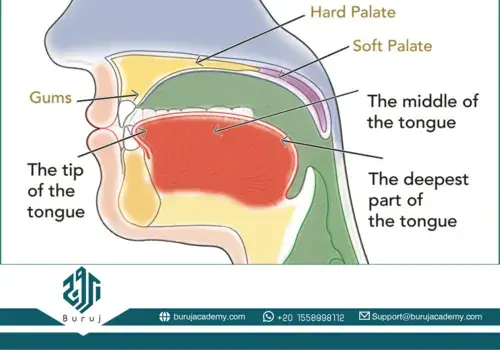
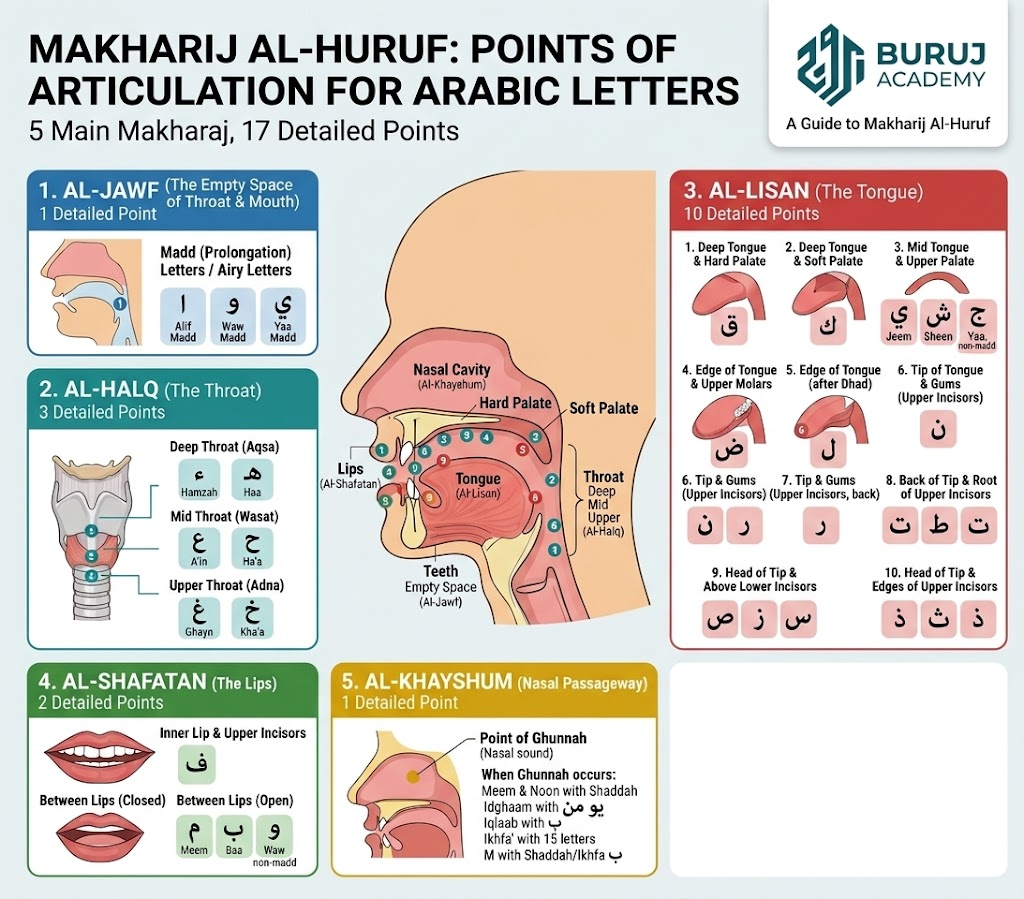
Makharij al-Huruf are the precise physical locations in the mouth and throat from which each Arabic letter originates. Tajweed scholars identify five primary articulation zones, each containing specific letters.
Without correct Makhraj, a letter cannot be pronounced correctly — regardless of how well other Tajweed rules are applied.
| Zone (Makhraj) | Letters | Location |
| Al-Jawf (Cavity) | ا و ي (Madd letters) | Open chest-throat cavity |
| Al-Halq (Throat) | ء ه ع ح غ خ | Three levels of throat |
| Al-Lisan (Tongue) | ق ك ج ش ي ض ل ن ر ط د ت ص س ز ث ذ ظ | Multiple tongue positions |
| Al-Shafatain (Lips) | ب و م ف | Lip contact and rounding |
| Al-Khayshoom (Nasal passage) | Ghunnah sound | Nasal cavity |
Our complete guide to Makharij al-Huruf covers every sublocation with diagrams and the most common placement errors non-Arabic speakers make.
What Are the Sifat al-Huruf (Letter Attributes) in Tajweed?
Sifat al-Huruf are the inherent qualities each letter possesses as it exits its Makhraj. These attributes determine the texture, flow, and character of each sound. Sifat are divided into two categories: those that have opposites (Sifat Mutadaddah) and those that stand alone (Sifat Ghayr Mutadaddah).
1. Sifat With Opposites
| Sifat | Opposite | Description |
| Hams (breathiness) | Jahr (voicing) | Air flows with Hams letters; stops with Jahr |
| Shiddah (tension) | Rakhawah (softness) | Sound stops sharply; flows freely |
| Isti’la (elevation) | Istifal (lowering) | Tongue rises; tongue stays low |
| Itbaq (closure) | Infitah (openness) | Tongue seals against palate; opens away |
Quranic example of Hams:
فَصَبَّ عَلَيْهِمْ رَبُّكَ
Fasabba ‘alayhim rabbuk
“And your Lord poured upon them…” (Al-Fajr 89:13)
Fa and Sad both carry Hams — notice the breath-like quality when these letters are pronounced correctly.
Quranic example of Shiddah:
قَدْ أَفْلَحَ الْمُؤْمِنُونَ
Qad aflaha al-mu’minoon
“Certainly will the believers have succeeded.” (Al-Mu’minun 23:1)
Qaf and Dal both carry Shiddah — the sound is briefly stopped before being released
2. Sifat Without Opposites
These include Safeer (whistling — ص س ز), Qalqalah (echo — ق ط ب ج د), Ghunnah (nasality — ن م), and Tafasshi (spreading — ش), among others. Each attribute operates independently and cannot be described by contrast with an opposite.
Quranic example of Safeer:
وَالسَّمَاءِ ذَاتِ الصَّدْعِ
Was-samaaa’i dhaatis-sad’
“By the sky which returns.” (At-Tariq 86:11)
Seen and Sad in close proximity — both demonstrate Safeer with their characteristic sharpness.
Quranic example of Tafasshi:
إِنَّ اللَّهَ اشْتَرَىٰ مِنَ الْمُؤْمِنِينَ
Innallaha ashtaraa minal-mu’mineen
“Indeed, Allah has purchased from the believers…” (At-Tawbah 9:111)
Shin in اشْتَرَىٰ — the breath spreads visibly across the mouth
Understanding Sifat is what separates a student who can recite from one who can truly beautify recitation. I
n our Tajweed for Beginners course, we introduce Sifat through listening exercises before asking students to apply them — because the ear must recognize a quality before the tongue can reproduce it.
Book Your FREE Trial Lesson to Begin Your Tajweed Journey

What Are the Rules of Noon Sakinah and Tanween?
Noon Sakinah (نْ) and Tanween (ً ٍ ٌ) share four governing rules determined entirely by the letter that follows them. These four rules — Izhar, Idgham, Iqlab, and Ikhfa — apply every time a Noon Sakinah or Tanween appears before another letter in recitation, making them among the most frequently applied rules in the entire Quran.
| Rule | Trigger Letters | Pronunciation | Example |
| Izhar (Clear) | ء ه ع ح غ خ | Noon pronounced clearly, no merging | مَنْ آمَنَ |
| Idgham (Merging) | ي ر م ل و ن | Noon merges into following letter | مَن يَعمَل |
| Iqlab (Conversion) | ب only | Noon converts to Meem sound | أَنبَتْنَا |
| Ikhfa (Concealment) | 15 remaining letters | Noon partially hidden with Ghunnah | مِنكُم |
1. What is Izhar?
Izhar means pronouncing the Noon Sakinah or Tanween with complete clarity when one of the six throat letters (ء ه ع ح غ خ) follows. No merging, no prolonged nasal sound — the Noon stands fully pronounced.
Examples of Izhar
مَنْ آمَنَ
Man āmana
“Whoever believed”
Noon Sakinah followed by Hamza — Izhar applies; Noon is fully clear.
كُلٌّ آمَنَ
Kullun āmana
“Each has believed” (Al-Baqarah 2:285)
Tanween followed by Hamza — Izhar applies equally.
2. What is Idgham?
Idgham means merging the Noon Sakinah or Tanween completely into the following letter, which must be one of the six letters collected in the word يَرْمَلُون (Yarmaloon). Idgham divides into two types: with Ghunnah (nasal resonance, covering ي ن م و) and without Ghunnah (clean merge, covering ر ل).
Examples of Idgham
ومَن يَعمَل
Waman ya’mal
“Whoever does” (Ta-Ha 20:112)
Noon Sakinah before Yaa — Idgham with Ghunnah; Noon disappears into Yaa with nasal resonance
مِن لَدُنهُ
Min ladunhu
“From Him” (Al-Kahf 18:2)
Noon Sakinah before Lam — Idgham without Ghunnah; clean, direct merge
One consistent pattern we observe in our classes: students frequently apply Ghunnah on the Raa and Lam when practicing Idgham, treating all six letters identically.
Catching and correcting this early — before the habit sets — is one of the most important early milestones in Tajweed instruction.
3. What is Iqlab?
Iqlab has a single trigger letter: the Baa (ب). When Noon Sakinah or Tanween precedes a Baa, the Noon converts to a Meem sound and is held with Ghunnah for two counts before the Baa is pronounced.
Examples of Iqlab
أَنبَتْنَا
Anbatnā
“We caused to grow” (Qaf 50:7)
Noon Sakinah before Baa — converts to Meem sound with Ghunnah
زَوْجٍ بَهِيجٍ
Zawjin bahīj
“Beautiful pair” (Qaf 50:7)
Tanween before Baa — same Iqlab conversion applies
4. What is Ikhfa?
Ikhfa is a middle state between full pronunciation (Izhar) and full merging (Idgham). The Noon is partially concealed with Ghunnah when followed by any of the 15 Ikhfa letters. Our detailed guide on Ikhfa letters in Tajweed covers all 15 letters with their individual examples.
Example of Ikhfa
مِنكُم
Minkum
“Among you”
Noon Sakinah before Kaaf — Ikhfa applies; nasal resonance held for two counts
Excel in Your Quranic Studies
Join Buruj Academy and master the Quran with our structured, professional curriculum.
Book Your Free TrialWhat Are the Rules of Meem Sakinah?
Meem Sakinah (مْ) carries three rules that depend on the letter immediately following it. These rules apply wherever a Meem with a Sukoon appears at the end of a word before the next word begins. Unlike Noon Sakinah, Meem Sakinah only responds to two specific letters for its special rulings — before all other letters, it is pronounced clearly.
| Rule | Trigger | Description | Example |
| Ikhfa Shafawi | ب (Baa) | Meem concealed with lips slightly apart + Ghunnah | رَبَّهُم بِالْغَيْبِ |
| Idgham Shafawi | م (Meem) | First Meem merges into second with Ghunnah | لَكُم مَّا فِي |
| Izhar Shafawi | All other letters | Meem pronounced clearly, lips fully closed | لَعَلَّكُمْ تَتَّقُونَ |
The name “Shafawi” (شفوي) comes from the Arabic word for lips (شفة), because both Meem and Baa are labial letters — articulated at the lips.
1. What is Ikhfa Shafawi?
Ikhfa Shafawi occurs when a Meem Sakinah is followed by a Baa (ب). The lips are held slightly apart — not fully closed as in a normal Meem — while Ghunnah (nasal resonance) is sustained for two counts before the Baa is released. This partial concealment is what distinguishes it from both full clarity (Izhar) and full merging (Idgham).
Example of Ikhfa Shafawi
رَبَّهُم بِالْغَيْبِ
Rabbahum bil-ghayb
“Their Lord in the unseen.” (Al-Mulk 67:12)
Meem Sakinah in هُم immediately before Baa — lips held slightly apart, Ghunnah held two counts
2. What is Idgham Shafawi?
Idgham Shafawi occurs when a Meem Sakinah is followed by another Meem carrying a vowel. The first Meem merges completely into the second, producing a single heavy, doubled Meem with Ghunnah sustained for two counts. It is also called Idgham al-Mutamathalain (merging of identical letters) in this specific case.
Example of Idgham Shafawi
لَكُم مَّا فِي الْأَرْضِ جَمِيعًا
Lakum mā fil-arḍi jamī’ā
“For you is all that is on the earth.” (Al-Baqarah 2:29)
Meem Sakinah in لَكُم followed by Meem — first Meem merges into second, producing one doubled Meem with Ghunnah
3. What is Izhar Shafawi?
Izhar Shafawi is the default ruling for Meem Sakinah before any letter other than Baa or Meem. The Meem is pronounced with complete clarity — lips fully closed and released cleanly — with no nasal resonance and no blending into the following letter. Special care is required before Waw (و) and Faa (ف), where students frequently allow the Meem to blur.
Examples of Izhar Shafawi
لَعَلَّكُمْ تَتَّقُونَ
La’allakum tattaqūn
“So that you may become righteous.” (Al-Baqarah 2:183)
Meem Sakinah before Taa — fully clear, no Ghunnah, lips closed and released cleanly
For a deeper study of Ghunnah itself — the nasal resonance that underlies both Ikhfa Shafawi and Idgham Shafawi — our guide on Ghunnah and its rules explains how to produce and sustain it correctly in live recitation.
Our Amli Tajweed course regularly enroll adult beginners with zero prior Arabic background who achieve accurate recitation within structured programs.
Book Your FREE Trial Lesson in Buruj’s Amli Tajweed Course

What Is Qalqalah?
Qalqalah is a required echoing vibration produced when any of the five Qalqalah letters appears with a Sukoon (either inherently or due to stopping).
What Are the Letters of Qalqalah?
The five letters are collected in the phrase قُطُبُ جَدٍّ (Qutbu Jadd): ق ط ب ج د. Qalqalah is not optional — omitting it on these letters constitutes a recitation error.
What are the Levels of Qalqalah?
Qalqalah divides into two levels of intensity. Qalqalah Kubra (Major): When the Qalqalah letter appears at the very end of a word where you stop — the echo is strongest here. Qalqalah Sughra (Minor): When the Qalqalah letter is Sakin in the middle of a word — the echo is lighter but still present.
Examples of Qalqalah
قُلْ أَعُوذُ بِرَبِّ الْفَلَقِ
Qul a’ūdhu bi-rabbil-falaq
“Say, I seek refuge in the Lord of daybreak.” (Al-Falaq 113:1)
Qalqalah Kubra on the Qaaf at the end — strongest echo when stopping on الْفَلَقِ
يَطْمَعُونَ
Yatma’ūn
“They hope”
Qalqalah Sughra — Taa is Sakin within the word
Our full article on Qalqalah letters covers the nuances of echo intensity and common application errors in detail.
What Are the Rules of Madd (Prolongation) in Tajweed?
Madd means extending a vowel sound beyond its natural length using one of three Madd letters: Alif (ا preceded by Fatha), Waw (و preceded by Damma), or Yaa (ي preceded by Kasra). Every Madd rule specifies how many counts (Harakaat) the vowel must be held, ranging from 2 to 6 counts.
Madd rules are among the most nuanced in Tajweed, requiring both ear training and consistent practice to internalize.
| Madd Type | Cause | Duration | Ruling |
| Madd Asli (Natural) | Madd letter with no Hamza or Sukoon after it | 2 counts | Obligatory |
| Madd Muttasil (Connected) | Madd letter followed by Hamza in same word | 4–5 counts | Obligatory |
| Madd Munfasil (Separated) | Madd letter at end of word, Hamza begins next word | 4–5 counts | Permitted |
| Madd Lazim (Necessary) | Madd letter followed by permanent Sukoon | 6 counts | Obligatory |
| Madd ‘Arid lil-Sukoon | Madd letter before a letter made Sakin by stopping | 2, 4, or 6 counts | Permitted |
What Is Madd Asli?
Madd Asli (المد الأصلي) is the foundational natural prolongation — 2 counts — present wherever a Madd letter appears without any Hamza or Sukoon immediately after it. It is the baseline against which all other Madd types are measured.
بَلَى إِنَّ رَبَّهُ كَانَ بِهِ بَصِيرًا
Balā inna rabbahu kāna bihī baṣīrā
“But yes — indeed his Lord was ever of him Aware.” (Al-Inshiqaq 84:15)
كَانَ — Alif Madd Asli, held for 2 counts only
Our dedicated article on Madd Asli breaks down this foundational Madd type with additional examples and common beginner errors.
What Is the Difference Between Madd Muttasil and Madd Munfasil?
Madd Muttasil occurs when the Madd letter and the Hamza are inside the same word — the connection is mandatory and the extension is obligatory at 4–5 counts. Madd Munfasil occurs when the Madd letter ends one word and the Hamza begins the next word — the two are separated across a word boundary, making extension permitted rather than obligatory.
قُرُوءٌ
Madd Muttasil (Waw Madd followed by Hamza in same word, held 4–5 counts)
إِنَّا أَعْطَيْنَاكَ الْكَوْثَرَ
Innā a’ṭaynākal-kawthar
“Indeed, We have granted you al-Kawthar.” (Al-Kawthar 108:1)
Madd Munfasil — Alif at end of إِنَّا, Hamza begins أَعْطَيْنَاكَ
What Are Tafkhim and Tarqiq (Heavy and Light Letters)?
Tafkhim (تفخيم) means pronouncing a letter with a fullness and heaviness in the mouth cavity. Tarqiq (ترقيق) means pronouncing a letter with lightness and thinness, keeping the tongue low.
Every Arabic letter is governed by one of these two qualities — either consistently, or depending on context. This distinction is what gives Quranic recitation its characteristic resonance and beauty.
| Category | Letters | Pronunciation |
| Always Tafkhim (Isti’la letters) | خ ص ض غ ط ق ظ | Always heavy, regardless of vowel |
| Always Tarqiq | All other letters (except Raa, Lam, Alif) | Always light |
| Variable — Raa (ر) | Depends on vowel and position | Heavy when Fatha/Damma; light when Kasra |
| Variable — Lam (ل) | Depends on context | Heavy only in the Lafz al-Jalalah (الله) after Fatha or Damma |
When Is the Raa Pronounced Heavy or Light?
Raa is the most nuanced letter in Tafkhim and Tarqiq. The governing principle: Raa is heavy (Mufakhkham) when it carries a Fatha or Damma, or when it is Sakin preceded by a Fatha or Damma. It is light (Muraqqaq) when it carries or is preceded by a Kasra.
رَؤُوفٌ رَّحِيمٌ — Raa is heavy (Fatha on both)
الْفَجْرِ — Raa at end with Kasra, light (Muraqqaq)
الْفِرْدَوْسِ — Raa Sakin preceded by Kasra, light
Our full article on heavy and light letters in Tajweed maps every scenario with additional Quranic examples.
What Are the Rules for Shadda (Mushaddad Letters)?
A letter carrying Shadda (ّ) is a doubled letter — the first carries a Sukoon and the second carries a vowel. When a Noon or Meem carries a Shadda, Ghunnah (nasal resonance) becomes obligatory for 2 counts. These are called the Huroof Ghunnah, and many students underestimate how significant a role they play in every Surah of the Quran.
هَمَّازٍ
Hammāz
“A slanderer” (Al-Qalam 68:11)
Meem Mushaddada — obligatory Ghunnah for 2 counts
إِنَّ
Inna
“Indeed”
Noon Mushaddada — Ghunnah for 2 counts every single occurrence
Discover the Buruj Academy Difference
Step into our virtual classrooms and see how our expert instructors make learning Quran and Arabic intuitive and clear. We focus on overcoming the specific hurdles non-native speakers face, building your confidence and connection with the Quran.
Master Tajweed with Buruj Academy’s Expert Instructors
Tajweed is both a science and a lived skill — and knowing the rules is only half the work. Applying them in real recitation requires trained ears, patient correction, and consistent practice under qualified guidance.
At Buruj Academy, our Online Tajweed Classes are taught by Ijazah-certified instructors and Al-Azhar University graduates with 12+ years of experience teaching non-Arabic speakers worldwide. We offer:
- The Buruj Method: Sound-before-rules progression
- Personalized 1-on-1 online sessions
- Flexible 24/7 scheduling
- Real-time pronunciation correction
Whether you are starting from zero or refining advanced rules, our Tajweed for Beginners course provides the structured foundation every reciter needs.
Book your free trial lesson today.
Join a supportive learning environment tailored to your pace and lifestyle. Start your journey toward excellence by enrolling in one of our specialized tracks:
- Online Tajweed Classes
- Tajweed Classes for Beginners
- Tajweed Classes for Adults
- Tajweed Classes for Sisters
- Tajweed Classes for Kids
- Advanced Tajweed Course
- Amli Tajweed Course (Practical Application)
Ready to transform your recitation? book your free assessment and start your path to Tajweed mastery today!
Excel in Your Quranic Studies
Join Buruj Academy and master the Quran with our structured, professional curriculum.
Book Your Free TrialConclusion
Tajweed is not an optional refinement — it is the established science through which the Quran has been preserved in its original sound and meaning for over 1,400 years. Every rule in this guide, from the four Noon Sakinah rulings to the subtleties of Tafkhim and Tarqiq, exists to protect the integrity of each letter as it was revealed.
What often surprises students is how quickly these rules begin to feel natural with consistent, structured practice. The rules are finite, the Quranic examples are everywhere, and qualified guidance makes the difference between knowing theory and reciting with confidence. Alhamdulillah, this knowledge is accessible to every Muslim willing to seek it.
Frequently Asked Questions About Tajweed Rules
What Are the Most Important Tajweed Rules for Beginners to Learn First?
The four rules of Noon Sakinah and Tanween (Izhar, Idgham, Iqlab, Ikhfa) are the highest priority for beginners because they appear on nearly every page of the Quran. Mastering these four rules alongside Madd and Qalqalah gives any new student a functional Tajweed foundation for reciting with basic accuracy within the first few weeks of study.
How Many Tajweed Rules Are There in Total?
Classical Tajweed science does not define a fixed number of “rules” — rather, it organizes Tajweed into chapters covering Noon Sakinah, Meem Sakinah, Madd, Tafkhim and Tarqiq, Makharij, Sifat, Idgham types, and Waqf (stopping rules). Each chapter contains multiple specific rulings. In our instructors’ experience, students who learn these systematically rather than as an isolated list apply them far more consistently in live recitation.
Can Adults Learn Tajweed Rules Without Prior Arabic Knowledge?
Yes — Tajweed and Arabic literacy are separate skills. Many of our students learn Tajweed rules while still building their Arabic reading fluency. The rules are taught using transliteration examples and direct Quranic application, making them fully accessible to non-Arabic speakers. Our Online Tajweed Classes regularly enroll adult beginners with zero prior Arabic background who achieve accurate recitation within structured programs.
What Is the Difference Between Tajweed and Tarteel?
Tajweed refers to the set of rules governing correct pronunciation of each letter and sound. Tarteel refers to the measured, unhurried pace of recitation — reciting slowly and clearly, giving each letter its right. Allah commands Tarteel directly in the Quran (Al-Muzzammil 73:4). Tajweed rules are applied during Tarteel recitation; Tarteel is the manner, Tajweed is the standard within that manner.
Is It Sinful to Recite the Quran Without Tajweed?
Scholars distinguish between deliberate abandonment of Tajweed and genuine inability due to lack of instruction. Deliberate neglect of known rules is considered blameworthy, while a sincere learner who is actively seeking to improve is rewarded for the effort itself. The Prophet ﷺ said that the one who recites the Quran with difficulty receives a double reward (Sahih Muslim 798). This makes seeking proper Tajweed instruction both an act of worship and a protection against recitation errors.






Leave a Reply