 Quran
Quran
| Key Takeaways |
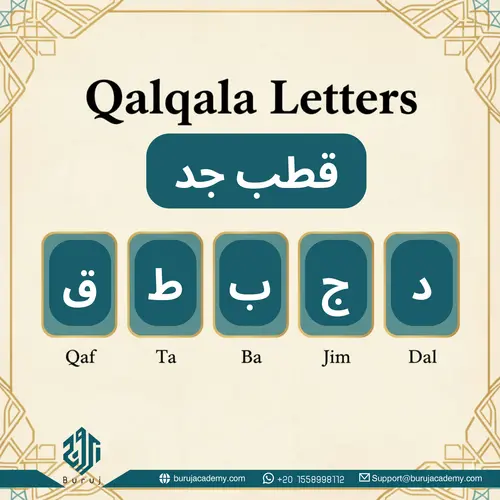
| Qalqalah applies to five specific Arabic letters — ق، ط، ب، ج، د — collectively remembered by the mnemonic QaTBaJaD. |
| The Qalqalah rule has three grades of strength: Qalqalah Sughra (weakest), Kubra, and Akbar (strongest) — each applied in different positions. |
| Qalqalah Akbar, the strongest grade, occurs when a doubled (mushaddad) Qalqalah letter falls at the end of a word during Waqf (pause). |
When you hear a skilled reciter pause at the end of an ayah and a short, clean echo bounces off the final letter — that is Qalqalah. It is one of the most distinctive sounds in Quranic recitation, and learning it correctly changes how your Quran sounds almost immediately.
Qalqalah applies to five Arabic letters that share two phonetic qualities — shiddah (complete obstruction of airflow) and jahr (full voicing) — which combine to produce that characteristic echoing rebound when the letter is sakin (vowel-less).
Table of Contents:
What Are the Qalqalah Letters?
The five Qalqalah letters are ق، ط، ب، ج، د, memorized through the classical mnemonic قُطْبُ جَدٍّ (QaTBuJaDd), coined by Imam Ibn al-Jazari.
Every Tajweed student we teach at Buruj Academy learns this mnemonic in their first lesson on the rule — it stays with you for life.
Why Do Qalqalah Letters Echo?
The echo occurs because these five letters possess two simultaneous sifat (attributes) that create an acoustic conflict. Shiddah completely blocks airflow at the makhraj (articulation point), while jahr requires full vibration of the vocal cords.
When the letter is sakin, the blocked sound cannot escape cleanly — it rebounds, producing the audible echo. This is not a stylistic choice; it is a phonetic consequence of how these letters are physically produced.
| Letter | Makhraj (Articulation Point) | Sifah Relevant to Qalqalah |
| ق | Back of the tongue meeting the soft palate | Shiddah + Jahr |
| ط | Tip of tongue on upper gum ridge (with Isti’la) | Shiddah + Jahr |
| ب | Both lips pressed together | Shiddah + Jahr |
| ج | Middle of the tongue on the hard palate | Shiddah + Jahr |
| د | Tip of tongue on upper gum ridge | Shiddah + Jahr |
Among these five, ط carries the strongest Qalqalah, followed by ج, then the remaining three. This ranking matters in advanced recitation — and our Tajweed for Beginners course addresses these distinctions systematically from the very first module.
Book Your FREE Trial Lesson to Begin Your Tajweed Journey

What Are the Three Grades of Qalqalah?
Qalqalah is not a single fixed sound — it has three grades of strength, determined by where the letter appears and whether it is paused upon. Classical Tajweed scholars, including Imam Ibn al-Jazari and later Sheikh Ibrahim Shahatah in Al-Tuhfah al-Samnudiyyah, established this three-tier classification.
| Grade | Arabic Name | When It Applies | Strength of Echo |
| Weakest | Qalqalah Sughra | Letter is sakin in the middle of a word, or sakin at the end without Waqf | Lightest echo |
| Middle | Qalqalah Kubra | Letter is moving (mutaharrik) at the end of a word, paused upon during Waqf | Moderate echo |
| Strongest | Qalqalah Akbar | Letter is doubled (mushaddad) at the end of a word, paused upon during Waqf | Most pronounced echo |
Understanding this table is not enough on its own — you need to hear each grade produced correctly before you can reproduce it.
This is precisely why Buruj Academy’s Online Tajweed Classes use an audio-first approach: our Ijazah-certified instructors model each grade before explaining the rule behind it.
Book Your FREE Trial Lesson to Begin Your Tajweed Journey

What is Qalqalah Sughra?
Qalqalah Sughra — the lightest grade — applies when a Qalqalah letter is originally sakin (not paused upon) inside a word or at the end of a word during continued recitation. The echo is present but restrained.
Examples of Qalqalah Sughra in the Middle of a Word
خَلَقْنَا
Khalaq-na
“We created”
The ق is sakin mid-word; a light echo is applied before the na continues.
يَدْخُلُونَ
Yad-khulun
“They enter”
The د is sakin; light Qalqalah before khulun.
يَبْتَغُونَ
Yab-tagħun
“They seek”
The ب is sakin mid-word, producing a light Sughra echo.
| Quranic Word | Qalqalah Letter | Position | Grade |
| خَلَقْنَا | ق (sakin) | Middle of word | Sughra |
| يَدْخُلُونَ | د (sakin) | Middle of word | Sughra |
| يَبْتَغُونَ | ب (sakin) | Middle of word | Sughra |
| وَاجْتَبَاهُ | ج (sakin) | Middle of word | Sughra |
| قِطْمِير | ط (sakin) | Middle of word | Sughra |
In our sessions at Buruj Academy, this is where beginners make their first common error — they produce no echo at all on mid-word Qalqalah letters, treating them as ordinary sakin letters. The Sughra echo is subtle, but omitting it entirely is a Tajweed mistake.
Excel in Your Quranic Studies
Join Buruj Academy and master the Quran with our structured, professional curriculum.
Book Your Free TrialWhat is Qalqalah Kubra?
Qalqalah Kubra applies when a Qalqalah letter falls at the end of a word with a vowel (mutaharrik), and the reciter pauses (makes Waqf) on that word. The vowel is dropped during Waqf, leaving the letter sakin — and the echo is noticeably stronger than Sughra.
Examples of Qalqalah Kubra
الْوَقُودِ
Al-Waqud
“The fuel”
Pausing on the د produces a clear Kubra echo.
الْحَمِيدِ
Al-Hamid
“The Praiseworthy”
Pausing on final د with Kubra Qalqalah.
مُحِيطٌ
Muhit
“Encompassing”
The ط at the end, paused upon, produces a strong Kubra echo.
| Quranic Word | Qalqalah Letter | Condition | Grade |
| الْوَقُودِ | د (paused upon) | End of word, Waqf | Kubra |
| الْحَرِيقِ | ق (paused upon) | End of word, Waqf | Kubra |
| مُحِيطٌ | ط (paused upon) | End of word, Waqf | Kubra |
| الْمَوْعُودِ | د (paused upon) | End of word, Waqf | Kubra |
The Kubra echo should be clearly audible and distinct from the Sughra — it is approximately double the strength.
Many students who are comfortable reading Quran for the first time underestimate how pronounced this echo needs to be.
Read also: Rules of Waqf and Ibtida in the Quran
What is Qalqalah Akbar?
Qalqalah Akbar is the most powerful grade and the most recognizable sound in Quranic recitation. It applies when a Qalqalah letter is doubled (mushaddad) at the end of a word, and the reciter pauses on it. During Waqf, a mushaddad letter is simplified to a single strong sakin — and the resulting echo is the most emphatic of all three grades.
Examples of Qalqalah Akbar
الْحَقُّ
Al-Haqq
“The Truth”
The doubled ق at end of word, paused upon, produces a powerful Akbar echo.
تَبَّ
Tabb
“He perished”
The doubled ب with Waqf creates the strongest Qalqalah.
الْحَجُّ
Al-Hajj
“The Pilgrimage”
Pausing on the doubled ج gives a strong Akbar rebound.
| Quranic Word | Qalqalah Letter | Condition | Grade |
| الْحَقُّ | ق (mushaddad, Waqf) | End of word, doubled, paused | Akbar |
| تَبَّ | ب (mushaddad, Waqf) | End of word, doubled, paused | Akbar |
| الْحَجُّ | ج (mushaddad, Waqf) | End of word, doubled, paused | Akbar |
| الْجِبِّ | ب (mushaddad, Waqf) | End of word, doubled, paused | Akbar |
Students who have worked through our Amli Tajweed course often tell us that Akbar was the last grade they truly mastered — not because it is theoretically complex, but because producing a bold, clean echo without adding a vowel sound takes real practice under live correction.
Book Your FREE Trial Lesson in Buruj’s Amli Tajweed Course
What Are the Most Common Qalqalah Mistakes to Avoid?
The most common Qalqalah mistakes fall into five clear patterns, and we encounter all of them regularly in our Buruj Academy sessions with students new to learning Tajweed.
1. Adding a Full Vowel After the Echo
Some reciters turn the Qalqalah echo into a full fathah, kasrah, or dammah — effectively adding a short vowel to a sakin letter. This is incorrect and changes the letter’s status from sakin to mutaharrik, which is a recitation error. The echo must remain a rebound, not a new vowel.
2. Adding an Audible Hamzah at the End
A widespread error — particularly at the ends of words like الفلق and يعيد — is closing the Qalqalah with an audible Hamzah. Classical Tajweed scholarship is unanimous that no Hamzah should be added; the echo must terminate cleanly.
3. Following the Preceding Vowel Instead of Applying Pure Echo
Some older opinions held that the Qalqalah echo should follow the preceding vowel — a kasrah before the sakin letter produces a kasrah-colored echo, a fathah produces fathah-colored, and so on.
This view is considered rejected (marjuh) by most contemporary Tajweed scholars, including Sheikh Ayman Suwaid, who notes that the echo should tend toward fathah rather than assimilating to surrounding vowels.
4. Stretching the Echo Too Long
Qalqalah is a brief rebound — it has a fixed duration that should not be elongated. Stretching it crosses into an error that resembles adding a Madd, which changes the acoustic character of the letter entirely.
5. Weakening Qalqalah When Two Letters Appear Together
When two Qalqalah letters follow each other in a word — such as رَطْبٍ (ratb, meaning “fresh”) — students often reduce one echo dramatically. Both echoes must be present and correct, even if the first is Sughra and the second is paused upon.
Discover the Buruj Academy Difference
Step into our virtual classrooms and see how our expert instructors make learning Quran and Arabic intuitive and clear. We focus on overcoming the specific hurdles non-native speakers face, building your confidence and connection with the Quran.
Master Qalqalah with Buruj Academy’s Expert Tajweed Instructors
Qalqalah is one of the most rewarding rules to master — once your ear is trained and your articulation is precise, it transforms the sound of your recitation immediately.
Buruj Academy’s Online Tajweed Classes are designed by Al-Azhar University graduates and Ijazah-certified instructors with 12+ years of experience teaching non-Arabic speakers.
Our Buruj Method trains your ear before your intellect — you hear correct Qalqalah dozens of times before you analyze why it works that way.
Every session is 1-on-1, live, and fully personalized. Scheduling is flexible across all time zones.
Book your free trial lesson today and hear the difference expert correction makes from your very first class.
Join a supportive learning environment tailored to your pace and lifestyle. Start your journey toward excellence by enrolling in one of our specialized tracks:
- Online Tajweed Classes
- Tajweed Classes for Beginners
- Tajweed Classes for Adults
- Tajweed Classes for Sisters
- Tajweed Classes for Kids
- Advanced Tajweed Course
- Amli Tajweed Course (Practical Application)
Ready to transform your recitation? book your free assessment and start your path to Tajweed mastery today!
Excel in Your Quranic Studies
Join Buruj Academy and master the Quran with our structured, professional curriculum.
Book Your Free TrialConclusion
Qalqalah is both precise and beautiful — five letters, three grades, and a set of clear conditions that govern when and how strongly the echo appears. Mastering Sughra, Kubra, and Akbar requires more than memorizing the table: it requires trained ears and live correction from someone who can hear exactly what you are producing. The Quran deserves that level of care, and so does your recitation.
Read also: Types of Madd in Tajweed with Examples
Frequently Asked Questions About Qalqalah in Tajweed
What Are the Five Qalqalah Letters in Tajweed?
The five Qalqalah letters are ق، ط، ب، ج، د, remembered through the classical mnemonic QaTBuJaD (قُطْبُ جَدٍّ). These letters share two sifat — shiddah (obstruction) and jahr (voicing) — that create the echoing rebound when the letter is sakin. All five are obligatory Qalqalah letters in Hafs ‘an ‘Asim recitation.
When Does Qalqalah Apply During Recitation?
Qalqalah applies whenever one of the five letters is sakin — either originally sakin in the middle of a word (Sughra), or made sakin by Waqf (pause) at the end of a word (Kubra or Akbar). It does not apply when the letter carries a full vowel and recitation continues without pause.
What Is the Difference Between Qalqalah Kubra and Akbar?
Qalqalah Kubra applies when a Qalqalah letter is moving (mutaharrik) at the end of a word and the reciter pauses on it. Qalqalah Akbar applies when that same end-of-word letter is also mushaddad (doubled). The Akbar produces a stronger echo than Kubra because the doubled letter carries greater phonetic weight upon Waqf.






Leave a Reply