 Tajweed
| Key Takeaways |
| Advanced Tajweed rules in Hafs ‘an ‘Asim include Rawm, Ishmam, Sakt, Imalah, and Tasheel — each requiring direct teacher instruction. |
| Rawm produces one-third of a vowel sound at pause; Ishmam signals a Dammah through lip shape alone, invisible to the ear. |
| Hafs ‘an ‘Asim has four mandatory Sakt positions in the Quran, where breath must stop briefly without disconnecting recitation intention. |
| The Maqtu’ and Mawsul system governs where to pause mid-phrase, requiring knowledge of the Uthmani script’s written conventions. |
| Advanced letter attributes like Istitaalah (Daad), Tafasshi (Sheen), and Takrir (Raa) distinguish mastery-level recitation from intermediate reading. |
Reaching the advanced levels of Tajweed is a sign that your relationship with the Quran has deepened — and so has your responsibility toward its recitation. Most students arrive at this point having mastered Noon Sakinah, Meem Sakinah, and the standard Madd categories, yet they sense that something is still missing in their recitation when compared with a qualified Sheikh.
Advanced Tajweed rules represent the science of precision — the layer of knowledge that separates correct recitation from genuinely beautiful, authenticated recitation.
These rules govern stopping positions, unique Hafs narrations, subtle letter qualities, and the system of the Uthmani script itself, all of which must be learned through consistent, guided practice rather than self-study alone.
Table of Contents:
What Are Advanced Tajweed Rules?
Advanced Tajweed rules are the specialized rulings in Quranic recitation science that go beyond foundational rules to govern pause conventions, unique narrator-specific pronunciations, precise letter attributes, and script-based recitation decisions in the riwayah of Hafs ‘an ‘Asim.
Advanced Tajweed rules rules are documented in classical Tajweed texts and cannot be accurately acquired without a qualified teacher.
Why Do Advanced Tajweed Rules Matter?
They matter because the Quran was revealed with a specific sound — preserved through an unbroken chain of oral transmission reaching back to the Prophet Muhammad ﷺ. The Prophet himself received Quran from Jibreel (AS) with these precise acoustic details intact.
As the authentic hadith in Sahih Bukhari confirms, the best among people are those who learn the Quran and teach it. That learning, at its highest level, includes every nuance these advanced rules define.
At Buruj Academy, our Al-Azhar University graduates holding Ijazah in Hafs ‘an ‘Asim consistently observe one pattern: students who skip the advanced layer produce recitation that is technically error-free yet acoustically incomplete.
If you are ready to close that gap, our Online Tajweed Classes provide structured progression from intermediate to mastery level under Ijazah-certified instructors.
Book Your FREE Trial Lesson to Begin Your Tajweed Journey

What Is Rawm in Advanced Tajweed?
Rawm is the production of approximately one-third of a vowel’s sound — with a faint, almost imperceptible voice — when stopping on a word that carries a Dammah (Dammah) or Kasrah in its fully vowelled state. It signals to the listener that the paused word is not originally silent; it carries a vowel in connected speech.
The classical scholars defined Rawm as a subtle acoustic indicator — not silence, and not full pronunciation. It applies only to two vowel categories:
| Vowel Type | Rawm Permitted? | Ishmam Permitted? |
| Marf’oo (Dammah) | ✅ Yes | ✅ Yes |
| Majroor (Kasrah) | ✅ Yes | ❌ No |
| Mansoob (Fathah) | ❌ No | ❌ No |
| Mabniy ‘ala al-Fath | ❌ No | ❌ No |
In our sessions at Buruj Academy, we find that non-Arabic speaking students initially confuse Rawm with a weak Ghunnah. The difference is acoustic and positional: Rawm occurs only at pause positions, while Ghunnah occurs mid-recitation on Noon and Meem.
Read also:Tajweed Rules Explained With Examples
What Is Ishmam in Advanced Tajweed?
Ishmam is the act of rounding the lips into a Dammah shape immediately after fully silencing the final consonant at a pause position, signaling that the paused letter carries an original Dammah in connected recitation. Ishmam is visible to the eye but produces no sound whatsoever.
This is one of the most refined skills in advanced Tajweed. The distinction from Rawm is absolute:
- Rawm → produces a faint sound; heard by the attentive, not the distant listener
- Ishmam → produces no sound; seen by the observer, invisible to the hearing
Both apply to pausing on Marf’oo’ or Madmoom (Dammah-bearing) words. Neither applies to Fathah positions, and only Rawm applies to Kasrah.
Classical scholars like Ibn al-Jazari documented both rulings in Al-Muqaddimah al-Jazariyyah, the foundational advanced Tajweed text studied across Islamic institutions.
Read also: Learning the Tajweed Rules of Noon and Meem Mushaddad
What Is Sakt?
Sakt is a brief cessation of voice — shorter than a full pause (Waqf) — during which the breath is held and recitation intention maintained, before continuing without taking a new breath. In the riwayah of Hafs ‘an ‘Asim, Sakt is obligatory (wajib) in exactly four specific positions in the Quran.
Where Are Sakt’s Four Positions in Hafs?
These four positions are uniquely authenticated through the chain of Hafs from ‘Asim from Abu ‘Abd al-Rahman al-Sulami from ‘Ali ibn Abi Talib (RA). They are not rules derived from general Tajweed theory — they are transmitted narration-specific rulings that must be applied exactly as received.
| Sakt Position | Surah | Verse | Word Before Sakt | Word After |
| 1 | Al-Kahf | 18:1 | عِوَجًا | قَيِّمًا |
| 2 | Ya-Sin | 36:52 | مَرْقَدِنَا | هَٰذَا |
| 3 | Al-Qiyamah | 75:27 | مَنْ | رَاقٍ |
| 4 | Al-Mutaffifin | 83:14 | بَلْ | رَانَ |
The fourth position — بَلْ ۜ رَانَ — demonstrates a critical technical reason for Sakt: without the brief stop, the Laam of بَلْ and the Raa of رَانَ would naturally merge into an Idgham, which would alter the meaning. Sakt here preserves both the narration’s transmission and the text’s semantic clarity.
Consider the first position: pausing between عِوَجًا and قَيِّمًا in Surah Al-Kahf (Al-Kahf 18:1-2) allows the listener to comprehend that the Quran is described as having no crookedness — a meaning that flows perfectly when separated from the following description of its uprightness.
Read also: A Complete Guide to Tajweed Rules with Examples
What Are the Special Hafs-Specific Pronunciations?
Hafs ‘an ‘Asim narrates several unique pronunciation features that apply to specific words in the Quran — features not shared by other major narrators.
These are called the Khasaa’is Hafs (Distinguishing Features of Hafs) and require study from a qualified instructor through Mushafahah (face-to-face or live transmission).
What Is Imalah and Where Does Hafs Apply It?
Imalah (Imaalah Kubra) is the tilting of a Fathah toward a Kasrah and an Alif toward a Yaa in pronunciation. In the narration of Hafs, this is applied to exactly one word in the entire Quran:
مَجْرَاهَا
Majraahaa
“Its course” (Hud 11:41)
The Raa is recited with a tilted Fathah approaching Kasrah — a unique transmitted feature of Hafs.
Students frequently attempt to apply Imalah elsewhere by analogy, which is an error. Hafs’s Imalah is singular and transmitted — not a productive rule applied across similar words.
What Is Tasheel and Where Does Hafs Apply It?
Tasheel means “facilitation” — the pronunciation of a Hamzah with a softened, intermediate sound between full Hamzah and Alif. In Hafs, this applies to one position:
ءَا۬عْجَمِىٌّ
A’jamiyyun
“Foreign [language]” (Fussilat 41:44)
The second Hamzah in the opening of this word is softened — not eliminated, not fully pronounced.
What Is the Special Pronunciation of “Laa Ta’manna” in Surah Yusuf?
The word لَا تَأْمَنَّا in Surah Yusuf (Yusuf 12:11) contains a unique Idgham with Ishmam in the middle of a word.
The underlying root form includes three Noon letters — two merge through Idgham — and the Ishmam signals the original vowel of the absorbed Noon.
This is the only instance of mid-word Ishmam in the entire Quran and cannot be taught through text alone.
If you want to master all Khasaa’is Hafs under qualified transmission, Buruj Academy’s Advanced Tajweed Course addresses each feature systematically, guided by Ijazah-certified instructors trained in authentic sanad.
Master Tajweed at Buruj with a free lesson.
What Is the System of Maqtu’ and Mawsul in Tajweed?
The Maqtu’ (written separately) and Mawsul (written joined) system governs recitation decisions based on the Uthmani rasm — the specific written form of the Quran preserved in the Uthmani mushaf. In advanced Tajweed, the ruling is: recitation follows the written form.
Understanding this system prevents errors in Waqf (pause) and Wasl (continuation) at positions where the visual text differs from modern Arabic conventions.
| Category | Definition | Waqf Rule | Example |
| Maqtu’ | Two words written separately in Uthmani rasm | May pause on first word | أَن لَّا in [Al-A’raf 7:169] |
| Mawsul | Two words joined in Uthmani rasm | Pause only at end of joined word | أَلَّا in [Al-Naml 27:31] |
| Ta’ Marbuta (ة) | Closed Ta — paused as Haa | Pause with Haa sound | Standard across Quran |
| Ta’ Maftuha (ت) | Open Ta in specific words | Pause with silent Taa | رَحْمَت, نِعْمَت, امْرَأَت |
The open Ta’ (Ta’ Maftuha) positions require memorization of specific words. When pausing on رَحْمَتَ رَبِّكَ (Al-Zukhruf 43:32), the correct pause is on a silent Taa — not Haa.
A student reading casually will default to Haa as with standard Ta’ Marbuta — an error traceable directly to insufficient study of the Uthmani rasm.
For foundational reading skills that prepare you for this level, our Tajweed for beginners guide provides the necessary groundwork.
Read also: What Is Harakat in Tajweed?
Discover the Buruj Academy Difference
Step into our virtual classrooms and see how our expert instructors make learning Quran and Arabic intuitive and clear. We focus on overcoming the specific hurdles non-native speakers face, building your confidence and connection with the Quran.
Excel in Your Quranic Studies
Join Buruj Academy and master the Quran with our structured, professional curriculum.
Book Your Free TrialWhat Are the Advanced Letter Attributes That Define Mastery-Level Recitation?
The Sifat al-Huruf (letter attributes) studied at the advanced level are those without opposites — not Jahrah vs. Hams, not Shiddah vs. Rakhawah, but singular qualities that exist only in specific letters and profoundly shape their correct pronunciation.
How Is Istitaalah Applied in the Letter Daad?
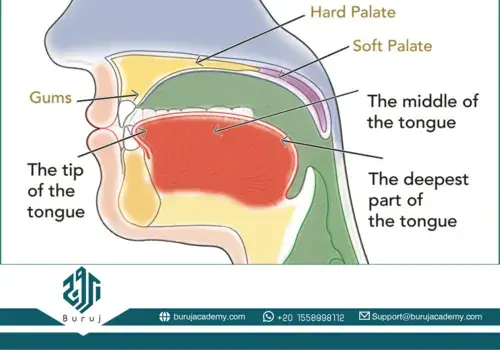
Istitaalah (elongation within the articulation point) is the exclusive attribute of الضاد. When pronouncing Daad, the sound travels from the front edge of the lateral tongue all the way to the back along the upper molars.
This elongated articulation point is what gives Daad its distinctive sound. Shortening it produces either a Dhaa or a distorted Daad — both errors.
Read also:Learning the Rules of Alif Lam in Tajweed
How Does Tafasshi Shape the Sheen Correctly?
Tafasshi (the spreading of air inside the mouth) is the exclusive attribute of الشين. When reciting Sheen, the air disperses broadly across the upper palate. A Sheen without Tafasshi sounds like a compressed, thin sound.
Students from English-speaking backgrounds often under-apply Tafasshi, producing a sound closer to English “sh” in “shoe” — which lacks the full spread of Arabic شـ.
Why Is Takrir Taught as a Quality to Suppress in the Raa?
Takrir (the potential for the tongue tip to vibrate) is the attribute of الراء. It is studied not to be performed but to be consciously suppressed.
Classical scholars taught that the Raa contains the potential for multiple bounces — but the correct recitation produces a single, clean Raa with no visible trill.
Students who over-roll the Raa are, ironically, displaying an error by allowing the Takrir attribute to manifest. Understanding this nuance separates genuine mastery from surface-level familiarity with rule names.
For a deeper understanding of all letter articulation points, our complete guide to Makharij al-Huruf provides detailed foundation-level coverage of each letter’s source.
Who Is Qualified to Begin Studying Advanced Tajweed Rules?
A student is ready for advanced Tajweed study when they can recite the full Quran with consistent application of all foundational rules — including Noon Sakinah, Meem Sakinah, Madd categories, Qalqalah, and basic Waqf rules — with real-time self-correction ability. Prerequisites matter here.
Three reliable readiness indicators our instructors at Buruj Academy consistently observe:
- The student can recite a full page without external correction for foundational rules
- The student recognizes their own errors before the teacher identifies them
- The student has completed at least one full Quran recitation under a qualified teacher’s supervision
Advanced Tajweed is not a shortcut layer added onto weak foundations — it is a refinement layer built upon solid ones.
Students who skip foundations and attempt Sakt, Rawm, or Khasaa’is Hafs without mastery of the basics typically produce recitation that is technically disordered at every level simultaneously.
If you are building toward Ijazah certification, our Online Ijazah Course structures the complete progression from foundational Tajweed to authenticated certification under Ijazah-certified scholars with a verified chain of transmission.
Book your FREE trial lesson in your path to Ijazah
How to Learn Advanced Tajweed Rules Effectively?
Advanced Tajweed cannot be self-taught from books alone — this is not a limitation of the student but a feature of the science. The rules of Rawm, Ishmam, Sakt, and Imalah were transmitted orally through an unbroken chain, and their acoustic reality only becomes clear through live demonstration and immediate correction.
A structured learning path our Al-Azhar-trained instructors recommend:
1. Complete intermediate Tajweed review
Verify every foundational rule is applied consistently before beginning advanced material
2. Study Al-Muqaddimah al-Jazariyyah
Study Al-Muqaddimah al-Jazariyyah is the primary classical text governing advanced Tajweed and Matn-level rules, ideally with a qualified commentary
Read also:How to Apply Idgham Shafawi?
3. Work through Khasaa’is Hafs systematically
Work through Khasaa’is Hafs systematically one feature at a time, with live correction at each stage
4. Practice Sakt positions in context
Not as isolated exercises but within the actual Surah, maintaining recitation flow around each position
5. Apply Maqtu’/Mawsul and Ta’ rules
Apply Maqtu’/Mawsul and Ta’ rules using a colour-coded Tajweed Quran that marks these positions
6. Record and self-audit recitation
Record and self-audit recitation then bring recordings to your teacher for correction
For related Tajweed skill-building, our articles on Qalqalah letters and Madd Asli provide excellent parallel study material.
Read also: Quranic Verses and Hadiths About Tajweed
Master Advanced Tajweed with Buruj Academy’s Ijazah-Certified Instructors
Advanced Tajweed demands more than a good textbook — it demands a living teacher with an authenticated chain of transmission. Buruj Academy’s Advanced Tajweed Course delivers exactly that.
Our Al-Azhar University graduates and Ijazah-certified instructors bring 12+ years of experience teaching non-Arabic speakers globally.
Every session is personalized 1-on-1, with real-time pronunciation correction and a customized progression plan built around your current level.
Flexible 24/7 scheduling means you never have to compromise your commitments to pursue mastery.
Book your free trial lesson with Buruj Academy today and recite with the precision the Quran deserves.
Join a supportive learning environment tailored to your pace and lifestyle. Start your journey toward excellence by enrolling in one of our specialized tracks:
- Online Tajweed Classes
- Tajweed Classes for Beginners
- Tajweed Classes for Adults
- Tajweed Classes for Sisters
- Tajweed Classes for Kids
- Advanced Tajweed Course
- Amli Tajweed Course (Practical Application)
Ready to transform your recitation? book your free assessment and start your path to Tajweed mastery today!
Excel in Your Quranic Studies
Join Buruj Academy and master the Quran with our structured, professional curriculum.
Book Your Free TrialConclusion
Advanced Tajweed rules represent the highest level of care a reciter can bring to the words of Allah. From the silence of Sakt to the lip-shape of Ishmam, from the single Imalah of Hafs to the precise articulation of Daad’s Istitaalah — each rule reflects centuries of preserved, authenticated scholarship.
These are not academic extras. They are the acoustic inheritance of the Quran’s original recitation. Studying them seriously, under qualified guidance, is itself an act of worship — and a gift to every listener who hears you recite.
Frequently Asked Questions About Advanced Tajweed Rules
What Is the Difference Between Rawm and Ishmam in Tajweed?
Rawm produces approximately one-third of a vowel’s sound — faintly audible — when pausing on a Dammah or Kasrah position. Ishmam produces no sound at all; it signals a Dammah through lip rounding only, visible to the eye. Both apply at pause positions, but only Rawm applies to Kasrah-bearing words.
How Many Special Sakt Positions Exist in the Recitation of Hafs ‘an ‘Asim?
Hafs ‘an ‘Asim has exactly four obligatory Sakt positions: in Surah Al-Kahf (18:1-2), Surah Ya-Sin (36:52), Surah Al-Qiyamah (75:27), and Surah Al-Mutaffifin (83:14). These are transmitted narration-specific rulings — not derived rules — and must be applied exactly as received through the chain of transmission.
Can Advanced Tajweed Rules Be Learned Online or Only In Person?
Advanced Tajweed rules can absolutely be learned online — provided the sessions are live, 1-on-1, with a qualified Ijazah-certified instructor who can demonstrate and correct in real time. Pre-recorded video content is insufficient for rules like Rawm, Ishmam, and Tasheel, which require acoustic demonstration and immediate feedback.