Tajweed

| Key Takeaways |
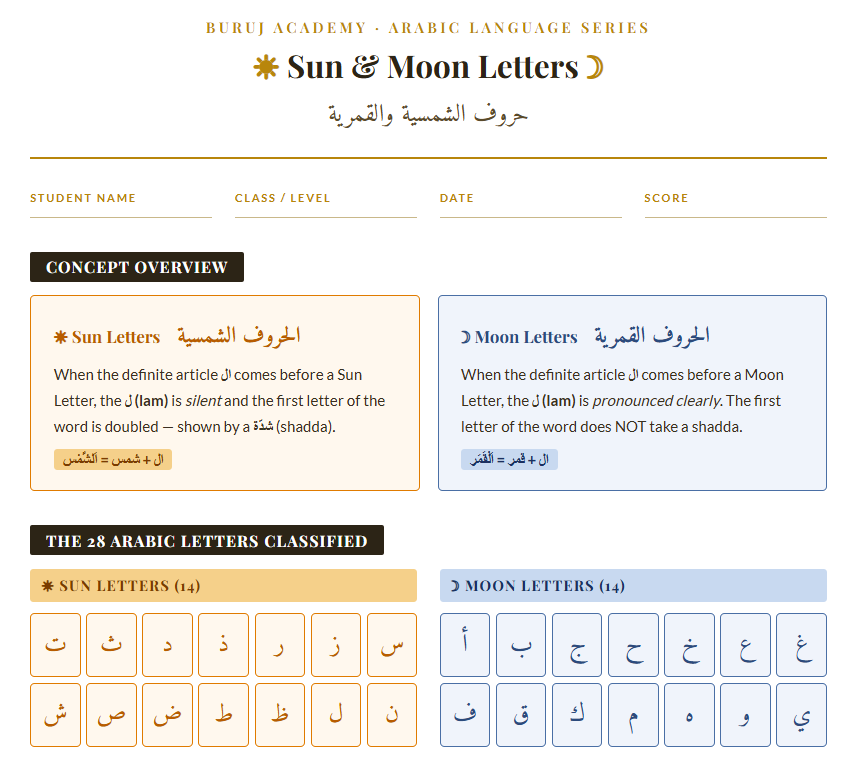
| Alif Lam (ال) has two rules in Tajweed: Shamsiyyah (solar), where the Lam assimilates into the following letter, and Qamariyyah (lunar), where the Lam is pronounced clearly. |
| Solar letters number 14 and include ت، ث، د، ذ، ر، ز، س، ش، ص، ض، ط، ظ، ل، ن — the Lam merges completely into each of these. |
| Lunar letters also number 14 and include ب، ج، ح، خ، ع، غ، ف، ق، ك، م، و، ه، ء، ي — the Lam is read with full clarity before these. |
The rule of Alif Lam in Arabic and Quran recitation divides into two categories — Lam Shamsiyyah (solar) and Lam Qamariyyah (lunar) — determined entirely by the letter that follows ال.
Table of Contents:
What Does Alif Lam (ال) Mean in Arabic?
Alif Lam in Arabic is the definite article, equivalent to “the” in English. It attaches to a noun to make it definite — so كِتَابٌ (kitābun, “a book”) becomes الْكِتَابُ (al-kitābu, “the book”).
What Does Alif Lam (ال) Mean in Tajweed?
In terms of Tajweed, the Alif of ال carries a Hamzat al-Wasl, meaning it is dropped in pronunciation when preceded by another word in continuous recitation. The Lam, however, behaves differently depending on what follows it.
What is the Rule of Alif Lam?
The two rules of Alif Lam in Arabic and in Tajweed are Lam Shamsiyyah (Assimilation) and Lam Qamariyyah (Clear Pronunciation). Every word in the Arabic language beginning with ال follows one of these two rules, with no exceptions.
The governing factor is always the first letter of the word’s root that comes after ال — not the Alif itself.
| Rule | Arabic Name | Lam Pronunciation | Shaddah on Next Letter? |
| Solar | لام شمسية | Silent (assimilated) | ✅ Yes |
| Lunar | لام قمرية | Clear (pronounced) | ❌ No |
Understanding this distinction is not optional — it affects every sentence a student reads, speaks, or recites.
In our Online Arabic Classes at Buruj Academy, this is among the first rules our Al-Azhar-trained instructors introduce, because mispronouncing the definite article creates errors in every single definite phrase a student produces.
Book your FREE Arabic trial online Arabic class at Buruj

What Is Lam Shamsiyyah?
Lam Shamsiyyah (لام شمسية), or the Solar Lam, is the rule where the Lam of ال is fully assimilated into the following letter, making it silent. The following letter receives a Shaddah (ّ) as written evidence of this assimilation. The name “Shamsiyyah” comes from the Arabic word شمس (shams, meaning “sun”) — because in الشَّمْسُ (ash-shamsu), the Lam disappears into the Shin, just as the sun overpowers and absorbs light around it.
In practical terms: when ال is followed by any solar letter, you pronounce zero Lam sound. The following letter is doubled (strengthened) in its place.
What Are the 14 Solar Letters in Arabic?
The 14 solar letters are: ت، ث، د، ذ، ر، ز، س، ش، ص، ض، ط، ظ، ل، ن
A reliable memory aid used by Buruj Academy instructors is the phrase: طِبْ ثُمَّ صِلْ رَحِمًا تَفُزْ ضِفْ ذَا نِعَمْ دَعْ سُوءَ ظَنٍّ زُرْ شَرِيفًا لِلْكَرَمْ — a classical mnemonic sentence containing all 14 solar letters, used in traditional Tajweed pedagogy for centuries.
| Solar Letter | Example Word | Transliteration | Meaning |
| ت | التَّوْبَةُ | at-tawbah | Repentance |
| ر | الرَّحْمَنُ | ar-rahmān | The Most Merciful |
| س | السَّمَاءُ | as-samā’ | The sky |
| ش | الشَّمْسُ | ash-shams | The sun |
| ن | النَّاسُ | an-nās | Mankind |
| ل | اللَّيْلُ | al-layl | The night |
| ض | الضَّالِّينَ | adh-dhāllīn | Those who go astray |
Notice in every example: the Lam is silent, and the following letter carries a Shaddah.
Read also:Advanced Tajweed Rules Explained
Quranic Examples of Lam Shamsiyyah
بِسْمِ اللَّهِ الرَّحْمَٰنِ الرَّحِيمِ
Bismillāhi ar-rahmāni ar-rahīm
“In the name of Allah, the Most Gracious, the Most Merciful.” (Al-Fatihah 1:1)
Both الرَّحْمَٰنِ and الرَّحِيمِ begin with Raa — a solar letter — so the Lam fully assimilates in each.
وَالشَّمْسِ وَضُحَاهَا
Wash-shamsi wa duhāhā
“By the sun and its brightness.” (Ash-Shams 91:1)
الشَّمْسِ — Shin is solar, Lam is silent, Shaddah on Shin.
وَاللَّيْلِ إِذَا يَغْشَى
Wal-layli idhā yaghshā
“By the night when it covers.” (Al-Layl 92:1)
اللَّيْلِ — Lam itself is a solar letter, so the first Lam of ال merges into it with a Shaddah.
In our sessions at Buruj Academy, this last example — Lam merging into Lam — is the one that surprises students most. They often expect it to be an exception, but classical Tajweed scholarship treats it identically to all other solar assimilations.
Read also: Sifaat Al Huroof in Tajweed
Discover the Buruj Academy Difference
Step into our virtual classrooms and see how our expert instructors make learning Quran and Arabic intuitive and clear. We focus on overcoming the specific hurdles non-native speakers face, building your confidence and connection with the Quran.
Excel in Your Quranic Studies
Join Buruj Academy and master the Quran with our structured, professional curriculum.
Book Your Free TrialWhat Is Lam Qamariyyah?
Lam Qamariyyah (لام قمرية), or the Lunar Lam, is the rule where the Lam of ال is pronounced clearly and distinctly. No assimilation occurs. The name comes from قمر (qamar, “moon”) — because in الْقَمَرُ (al-qamaru), the Lam is clearly sounded before the Qaف, just as the moon remains visibly distinct in the sky. A Sukoon (ْ) appears over the Lam in the written Mushaf as confirmation of its clear pronunciation.
What Are the 14 Lunar Letters?
The 14 lunar letters are: ب، ج، ح، خ، ع، غ، ف، ق، ك، م، و، ه، ء، ي
The classical mnemonic for these is: اِبْغِ حَجَّكَ وَخَفْ عَقِيمَهْ — another traditional pedagogical phrase containing all 14 lunar letters that our Al-Azhar-trained instructors at Buruj Academy introduce early in the Tajweed for Beginners course.
Book Your FREE Trial Lesson to Begin Your Tajweed Journey

| Lunar Letter | Example Word | Transliteration | Meaning |
| ق | الْقَمَرُ | al-qamar | The moon |
| ك | الْكِتَابُ | al-kitāb | The Book |
| ب | الْبَقَرَةُ | al-baqarah | The cow |
| م | الْمُؤْمِنُونَ | al-mu’minūn | The believers |
| ح | الْحَمْدُ | al-hamdu | Praise |
| ع | الْعَالَمِينَ | al-‘ālamīn | The worlds |
| ف | الْفَاتِحَةُ | al-fātihah | The opening |
Notice the Sukoon over the Lam in each — that is your visual confirmation to pronounce the Lam clearly.
Quranic Examples of Lam Qamariyyah
الْحَمْدُ لِلَّهِ رَبِّ الْعَالَمِينَ
Al-hamdu lillāhi rabbil-‘ālamīn
“All praise is due to Allah, Lord of all the worlds.” (Al-Fatihah 1:2)
الْحَمْدُ — Haa is lunar, Lam is clearly pronounced. الْعَالَمِينَ — ‘Ayn is lunar, Lam is clearly pronounced.
قُلْ أَعُوذُ بِرَبِّ الْفَلَقِ
Qul a’ūdhu bi-rabbil-falaq
“Say, I seek refuge in the Lord of daybreak.” (Al-Falaq 113:1)
الْفَلَقِ — Faa is lunar, the Lam carries Sukoon and is clearly sounded.
How to Differentiate Between Alif and Lam?
Differentiating between Alif and Lam requires attention to two signals: the written Mushaf and the sound itself. In the written Mushaf (Uthmani script), a Shaddah on the first root letter after ال signals Shamsiyyah, while a Sukoon on the Lam itself signals Qamariyyah. In terms of sound, the diagnostic test is simple: if you hear the Lam at all, it is Qamariyyah; if the following letter sounds doubled or strengthened, it is Shamsiyyah.
| Differentiating Marker | Shamsiyyah (Solar) | Qamariyyah (Lunar) |
| Written mark | Shaddah on next letter | Sukoon on Lam |
| Sound of Lam | Silent / absent | Clearly audible |
| Letter following ال | Solar (14 letters) | Lunar (14 letters) |
| Example | الرَّحِيمُ | الْكَرِيمُ |
This is a rule our Ijazah-certified instructors teach through listening exercises before introducing the written rules — consistent with the Buruj Method of training the ear before teaching theory. Students who hear the difference first internalize it far more reliably than those who memorize tables alone.
For a broader foundation in recitation rules, our guide on Tajweed for beginners explains how rules like Alif Lam fit within the full Tajweed framework.
Read also: What Is the Rule for Lam Alif?
Master Tajweed Alif Lam with Buruj Academy’s Expert Instructors
The Alif Lam rules are among the most frequently occurring Tajweed rules in the Quran — and one of the first we address in structured recitation training. Correct application from the start prevents deeply embedded habits that are difficult to reverse.
At Buruj Academy, our Online Tajweed Classes are led by Al-Azhar University graduates and Ijazah-certified instructors with 12+ years teaching non-Arabic speakers.
Through the Buruj Method — sound-before-rules, ear-before-theory — students internalize distinctions like Shamsiyyah and Qamariyyah through guided listening before systematic rule study.
We offer personalized 1-on-1 sessions with flexible 24/7 scheduling. Book your free trial lesson today.
Join a supportive learning environment tailored to your pace and lifestyle. Start your journey toward excellence by enrolling in one of our specialized tracks:
- Online Tajweed Classes
- Tajweed Classes for Beginners
- Tajweed Classes for Adults
- Tajweed Classes for Sisters
- Tajweed Classes for Kids
- Advanced Tajweed Course
- Amli Tajweed Course (Practical Application)
Ready to transform your recitation? book your free assessment and start your path to Tajweed mastery today!
Excel in Your Quranic Studies
Join Buruj Academy and master the Quran with our structured, professional curriculum.
Book Your Free TrialConclusion
The rule of Alif Lam is not a single rule — it is two complementary systems governing every definite noun in the Arabic language and the Quran. Whether the Lam assimilates into a solar letter or stands clearly before a lunar one, the principle is consistent, learnable, and directly impactful on recitation quality. Alhamdulillah, the classical Tajweed tradition has preserved precise tools — mnemonics, written markers, and audio examples — that make this distinction accessible to every sincere student.
Frequently Asked Questions About the Rule of Alif Lam
What Is the Rule of Alif Lam in English?
The rule of Alif Lam in English refers to the two Tajweed rules governing the Arabic definite article ال (“the”). When ال precedes a solar letter, the Lam sound disappears and the following letter is strengthened (Shamsiyyah). When ال precedes a lunar letter, the Lam is pronounced clearly (Qamariyyah). The distinction is marked in the Mushaf by Shaddah or Sukoon.
What Is the Rule of Alif Lam in Arabic?
In Arabic, the rule is called حُكْمُ اللَّامِ الشَّمْسِيَّةِ وَالْقَمَرِيَّةِ. The Lam Shamsiyyah requires full assimilation (Idgham) of the Lam into the following letter, while Lam Qamariyyah requires clear pronunciation .
What Is the Rule of Alif Lam in the Quran?
In the Quran, the rule of Alif Lam appears in thousands of words. The Uthmani Mushaf marks the rule explicitly: a Shaddah on the letter after ال confirms Shamsiyyah (silent Lam), while a Sukoon over the Lam confirms Qamariyyah (clear Lam). Students can verify the rule visually on every page without memorizing all 28 letters by reading these diacritical marks.
How Do You Differentiate Between Alif and Lam in Quran?
Differentiating Alif from Lam in ال relates to pronunciation, not separate letters. The Alif carries Hamzat al-Wasl and is dropped in connected recitation. The Lam is the operative letter — either assimilated or clearly pronounced. Practically, readers identify the rule by checking the first root letter after ال: solar letter means silent Lam (Shamsiyyah); lunar letter means clear Lam (Qamariyyah).