 Islamic
| Key Takeaways |
| The six foundational Islamic topics every child needs include Aqeedah, Salah, Quran, Seerah, Islamic manners, and Halal/Haram boundaries. |
| Children aged 7–10 learn Islamic concepts best through stories, visual aids, and short repetitive activities lasting 10–15 minutes daily. |
| Teenagers engage more deeply with Islamic topics when discussions connect faith to real-life decisions, identity questions, and peer challenges. |
| Quran memorization combined with meaning-based teaching produces stronger long-term retention than rote repetition alone for children. |
| Online Islamic Studies courses with qualified instructors provide structured, age-appropriate Islamic education for children in Western contexts. |
Raising Muslim children in the West means navigating a unique challenge: giving your child a strong Islamic identity while they live, learn, and grow in a largely secular environment. The topics you teach them — and how you teach them — shape the foundation of their faith for life.
The most effective approach covers six core Islamic topics, each taught progressively according to your child’s age, with methods that make Islam feel relevant, meaningful, and genuinely theirs — not a set of rules imposed from outside.
Table of Contents:
1. Teaching Children the Correct Belief in Allah (Aqeedah) Builds an Unshakeable Foundation
Aqeedah — Islamic creed — is the single most important topic for children to learn first. Before rituals, rules, or recitation, a child needs to know who Allah is, why we worship Him alone, and what it means to be Muslim. Without this anchor, every other Islamic practice lacks roots.
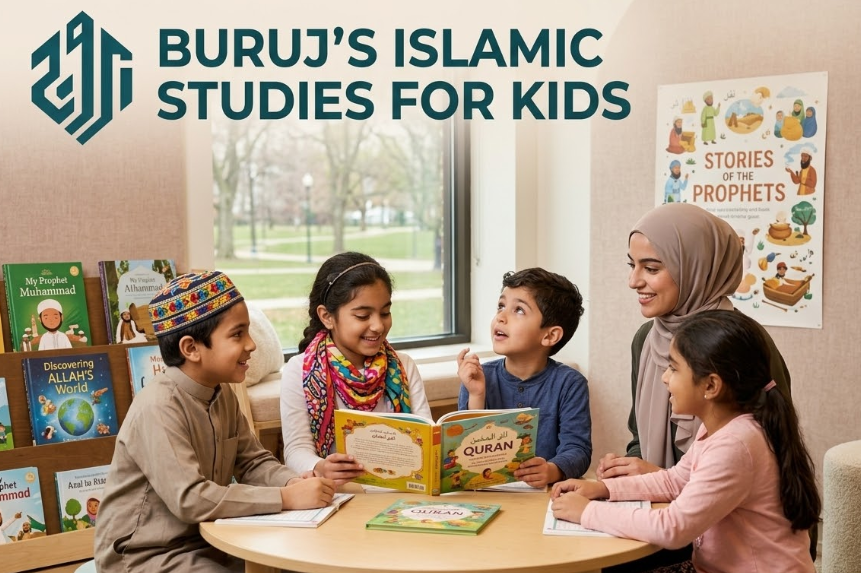
For younger children (ages 4–7), Aqeedah teaching is beautifully simple. We focus on three questions in our Islamic Studies Classes for Kids: Who is your Lord? Who is your Prophet? What is your religion? These map directly to the three questions answered in the grave — a powerful, age-appropriate motivator even young children grasp naturally.
The first session is free in Buruj’s Islamic Studies Classes for Kids
How Do You Teach Aqeedah to Children at Different Ages?
| Age Group | Core Aqeedah Concept | Teaching Method |
| 4–6 years | Allah created everything; He loves us | Stories, nature walks, simple conversation |
| 7–10 years | Tawheed, angels, the unseen | Illustrated books, Q&A sessions, short videos |
| 11–14 years | The six pillars of Iman in depth | Discussion, reasoning, Islamic texts |
| 15+ years | Addressing doubts, comparative religion | Socratic dialogue, scholarly sources |
Teenagers in Western schools frequently encounter atheist arguments or peer pressure challenging their belief. In our experience at Buruj Academy, young people who were taught why Islam is true — not just that it is — navigate these challenges with far greater confidence. Planting rational Aqeedah seeds early pays dividends later.
2. Teaching Children to Pray Correctly Requires Starting Well Before the Age of Seven
The Prophet ﷺ instructed: “Command your children to pray when they are seven years old, and discipline them for not praying when they are ten.” (Sunan Abi Dawud 495)
This means Salah preparation begins before seven — not at seven. Children who grow up watching their parents pray, who know the movements and simple phrases before they are formally taught, transition into regular prayer naturally and joyfully.
What Are the Most Effective Steps for Teaching Children Salah?
Break Salah teaching into three stages. First, teach love for prayer through imitation and participation — let toddlers stand next to you and copy movements freely.
Second, teach form — the correct positions, essential Arabic phrases, and order of prayer. Third, teach meaning — what each position expresses and what the words say.
Buruj Academy’s Online Islamic Studies Classes include dedicated Salah modules where Al-Azhar-trained instructors teach children and youth the correct pronunciation of prayer phrases with Tajweed accuracy — a detail many parents overlook entirely.
The Quranic command is clear:
وَأْمُرْ أَهْلَكَ بِٱلصَّلَوٰةِ وَٱصْطَبِرْ عَلَيْهَا
Wa’mur ahlaka bis-salati wastabiр ‘alayhā
“And enjoin prayer upon your family and be steadfast therein.” (Ta-Ha 20:132)
This verse is directed at parents — the responsibility begins at home, with us.
3. Quran Learning for Children Should Begin with Letter Foundations Before Memorization
Many parents jump straight to memorization without ensuring their child can read Arabic confidently. This produces children who memorize sounds without letter recognition — a fragile foundation that creates serious gaps in later years.
The correct sequence is: Noorani Qaida → Quran Reading → Tajweed → Memorization. Each stage builds on the last, and rushing any stage costs time overall.
What Is the Right Age to Start Quran Learning with Children?
Children as young as four can begin learning Arabic letters through Noorani Qaida for Kids with qualified instructors. The Noorani Qaida method uses a letter-by-letter phonetic progression perfectly suited to young learners. By age six or seven, most children who started at four are already reading connected Arabic text.
For memorization specifically, research and our instructors’ experience consistently confirm that ages 5–10 represent the peak window for Quran retention. Our detailed guide on the best age to memorize Quran explains the neuroscience and practical strategy behind this window.
Parents asking where to start with short surahs will find our easy surahs of Quran to memorize guide practically useful — it ranks surahs by length, phonetic difficulty, and repetition patterns to make early memorization rewarding.
How Do You Make Quran Learning Engaging for Children?
| Strategy | Age Group | How It Works |
| Repetition songs and rhythm | 4–7 years | Melody aids memory; children retain rhymed patterns effortlessly |
| Competition with siblings | 7–12 years | Friendly review races build motivation without pressure |
| Star charts and rewards | 5–10 years | Visual progress tracking creates momentum and pride |
| Meaning-based discussion | 10+ years | Understanding verses deepens emotional connection to text |
| Dedicated memorization time | All ages | Consistency before speed — 15 minutes daily beats 2 hours weekly |
Our article on Quran activities for kids offers parent-friendly, practical activity ideas that make daily Quran engagement genuinely enjoyable rather than a chore.
Help your child start learning the Quran with a FREE trial
4. The Prophet’s Seerah Is the Most Powerful Islamic Topic for Building Children’s Identity and Love of Islam
No Islamic topic produces stronger emotional connection to faith than the Seerah — the life of Prophet Muhammad ﷺ. Children who know his story deeply do not experience Islam as a list of rules. They experience it as a living tradition with a human heart at its centre.
The Seerah should be taught as a story, not a lecture. Children aged 4–8 love the early Makkan period — the Prophet ﷺ as a child, his kindness to animals, his honesty in trade.
Older children (9–13) engage powerfully with the battles, migration, and leadership. Teenagers need the political, ethical, and spiritual dimensions.
Which Seerah Stories Engage Children and Youth Most Effectively?
Our instructors consistently find that four narrative clusters produce the deepest engagement across age groups:
A. For young children:
The story of the Prophet ﷺ as an orphan — Allah’s care for the vulnerable resonates universally. Children who feel different, lonely, or uncertain find profound comfort here.
B. For middle-school age:
The Hijra — courage, sacrifice, trust in Allah, and strategic wisdom. This story teaches that faith and intelligence work together, not against each other.
C. For teenagers:
The Conquest of Makkah — forgiveness over revenge. In a social media culture obsessed with public humiliation, this story lands with startling relevance.
Our dedicated resource on prophets in Islam for kids extends this foundation across all the Anbiya, providing age-appropriate storytelling frameworks parents can use directly.
Excel in Your Quranic Studies
Join Buruj Academy and master the Quran with our structured, professional curriculum.
Book Your Free Trial5. Islamic Manners and Character (Akhlaq) Should Be Taught as the Living Expression of Faith
Akhlaq — Islamic character and manners — is not a separate subject from Aqeedah. It is Aqeedah expressed in daily behaviour. A child who believes in Allah genuinely will reflect that belief in how they speak, treat others, and handle difficulty.
The Prophet ﷺ said: “The best of you are those with the best character.” (Sahih al-Bukhari 3559)
What Are the Core Akhlaq Topics Every Muslim Child Should Learn?
| Akhlaq Topic | Age to Introduce | Practical Teaching Method |
| Honesty (Sidq) | 3–5 years | Praise truthfulness immediately and specifically |
| Respect for parents | 4–6 years | Role-play scenarios; Quranic emphasis on birr |
| Kindness to animals | 5–8 years | Stories of the Prophet ﷺ with animals |
| Handling anger | 8–12 years | The Prophet’s ﷺ advice on sitting/lying down when angry |
| Guarding the tongue | 10+ years | Hadith on backbiting; social media application |
| Gratitude (Shukr) | All ages | Daily Alhamdulillah habit; journaling for older children |
In our sessions at Buruj Academy, we observe that children who are taught why Islamic manners matter — because Allah sees everything, because the Prophet ﷺ embodied these qualities — build genuine internal motivation. Children taught manners purely through punishment comply temporarily and rebel later.
Read also: Rules of Noon Saakin and Tanween
6. Teaching Youth Halal and Haram Boundaries Requires Age-Appropriate Reasoning, Not Just Rules
Youth need to understand Islamic boundaries — around food, entertainment, relationships, and behaviour. But how this is taught matters enormously. Rules without reasoning produce either blind compliance or quiet rebellion, particularly in teenagers.
The correct approach introduces why before what at every age. Young children accept “we don’t eat pork because Allah told us not to, and Allah always wants what is best for us.”
Teenagers need the deeper engagement: what does it mean that something is haram? What is the wisdom behind a ruling? How do I handle peer pressure when a boundary is challenged?
How Should Parents Address Haram Topics with Muslim Teenagers?
Teenagers in Western environments face specific pressures their parents often did not encounter: alcohol at social events, music at school dances, relationships before marriage, online content, and questions about gender and identity.
Silence from parents does not protect teenagers — it simply means they process these questions without Islamic guidance.
Buruj Academy’s Online Islamic Studies Classes include age-specific modules where qualified Al-Azhar graduates address these questions with scholarly grounding and genuine empathy. Teenagers respond to instructors who take their questions seriously rather than dismissing them.
Begin Your Islamic Knowledge Journey With a FREE Trial Lesson
The key principle: make your home the place where difficult questions are welcomed. A teenager who brings their doubts to you is a teenager whose faith you can support. A teenager who hides their doubts from you may resolve them far from Islam.
7. Islamic History Beyond the Seerah Gives Muslim Youth a Sense of Civilisational Pride and Belonging
Muslim children in Western schools often encounter a distorted or absent picture of Islamic civilisation. They learn about ancient Greece and Rome, medieval Europe, the Renaissance — and Islam appears, if at all, only in the context of conflict or conquest.
Teaching Islamic history corrects this imbalance and builds something precious: a sense of belonging to a great, living tradition.
The contributions of Muslim scholars to mathematics, medicine, astronomy, philosophy, and jurisprudence are not a footnote — they are a chapter that shaped the modern world.
Which Islamic History Topics Resonate Most with Children and Teenagers?
For children aged 8–12, the Golden Age of Islamic Civilisation — the Abbasid period, scholars like Ibn Sina and Al-Khawarizmi — offers concrete, fascinating examples.
“A Muslim invented algebra” lands differently with a child struggling through maths homework than any abstract religious appeal.
For teenagers, the history of Islamic jurisprudence and the diversity of scholarly opinion demonstrates that Islam has always engaged thoughtfully with changing circumstances — a powerful counter-narrative to the idea that Islam is rigid or medieval.
Discover the Buruj Academy Difference
Step into our virtual classrooms and see how our expert instructors make learning Quran and Arabic intuitive and clear. We focus on overcoming the specific hurdles non-native speakers face, building your confidence and connection with the Quran.
8. Teaching Children and Youth About the Day of Judgment
The Day of Judgment (Yawm al-Qiyamah) is one of the six pillars of Iman and shapes how a Muslim understands the purpose of every action.
For children, this topic requires sensitive, age-calibrated teaching — the goal is accountability and hope, not terror.
Young children (5–8) are taught the simple, comforting version: Allah is Just. Good deeds are rewarded. We will meet our Prophet ﷺ.
For older children (9–14), the fuller picture emerges — the scales of deeds, intercession, Jannah and its descriptions.
For teenagers, the philosophical dimensions become relevant: justice in a world that often seems unjust will be perfectly restored.
وَنَضَعُ ٱلْمَوَٰزِينَ ٱلْقِسْطَ لِيَوْمِ ٱلْقِيَٰمَةِ
Wa naḍa’ul-mawāzīnal-qisṭa li-yawmil-qiyāmah
“And We place the scales of justice for the Day of Resurrection.” (Al-Anbiya 21:47)
This verse alone, explained with care, addresses a teenager’s deepest questions about fairness and divine justice more powerfully than almost any other Islamic argument.
Read also: Rules of Meem Saakin With Clear Examples
Build Your Child’s Islamic Foundation with Buruj Academy’s Expert Instructors
Every topic in this guide can be taught more effectively with qualified, structured guidance. Buruj Academy’s Islamic Studies Classes for Kids course covers Aqeedah, Fiqh, Seerah, Akhlaq, and Quranic topics through personalized 1-on-1 online sessions with Al-Azhar University graduates who have 12+ years of experience teaching children in Western contexts.
- Ijazah-certified Quran instructors and Al-Azhar-trained Islamic Studies teachers
- Personalized learning plans tailored to your child’s age, level, and learning style
- Flexible scheduling for busy Western families
- Real-time feedback and age-appropriate methods
- Structured progression from foundational to advanced topics
Book your child’s free trial lesson today and let our team build the right learning path for your family.
Enroll your child in one of our specialized, kid-friendly tracks today:
- Online Quran Classes for Kids
- Tajweed Classes for Kids
- Hifz Classes for Kids
- Online Arabic Classes for Kids
- Quranic Arabic Course for Kids
- Noorani Qaida Course for Kids
- Islamic Studies Classes for Kids
Ready to watch your child grow in knowledge and character? Join the Buruj Academy family and book a free trial session for your child today!
Excel in Your Quranic Studies
Join Buruj Academy and master the Quran with our structured, professional curriculum.
Book Your Free TrialConclusion
Islamic education for children and youth in the West is not about covering maximum content — it is about building roots. A child who knows Allah, loves the Prophet ﷺ, understands why they pray, and feels proud of their Islamic identity will carry that foundation through every challenge their environment presents.
The eight topics covered here form a complete, progressive framework — from Aqeedah at the core to Islamic history at the horizon. Taught with patience, reasoning, and genuine engagement, they do not burden children with religion.
They gift children with identity, purpose, and an unshakeable sense of belonging to something far greater than themselves.
Frequently Asked Questions About Islamic Topics for Kids and Youth
What Are the Most Important Islamic Topics to Teach Children First?
Aqeedah — correct belief in Allah — should always come first. Before rituals, rules, or recitation, children need to understand who they worship and why. Once Tawheed is established, Salah and Quran learning build naturally on that foundation. Starting with rules before belief produces compliance without conviction.
At What Age Should Children Begin Learning Islamic Studies?
Islamic learning begins informally from birth — through the Adhan, hearing Quran, and watching parents pray. Structured Islamic Studies can begin as early as age four, starting with letter recognition, simple Aqeedah, and Seerah stories. Formal Fiqh and more complex topics are introduced progressively from age seven onwards.
How Do You Keep Teenagers Engaged with Islamic Education?
Teenagers disengage when Islam is presented as rules without reasoning. Engagement comes through dialogue — taking their questions seriously, connecting Islamic principles to real decisions they face, and showing how the Seerah addresses modern challenges. Platforms like Buruj Academy’s Islamic Studies Classes for Kids course include teenage-specific modules with instructors trained in youth engagement.
How Can Western Muslim Parents Teach Islamic Topics Without Formal Madrasah Access?
Online Islamic education has made structured learning accessible regardless of location. Buruj Academy provides 1-on-1 online sessions covering Quran, Tajweed, Arabic, and Islamic Studies — fully adapted to Western family schedules. Supplementing with Quran learning tools for kids and consistent home routines builds a strong daily learning culture.
Is It Better to Teach Islamic Topics in Arabic or English for Children Raised in the West?
For conceptual understanding — Aqeedah, Seerah, Akhlaq, Fiqh — English is the primary teaching language for Western-raised children. Arabic is taught in parallel as a dedicated skill for Quran reading and Salah. Mixing both languages without structure confuses children. Clear, sequential separation of English understanding and Arabic recitation produces the best long-term outcomes.