 Tajweed
| Key Takeaways |
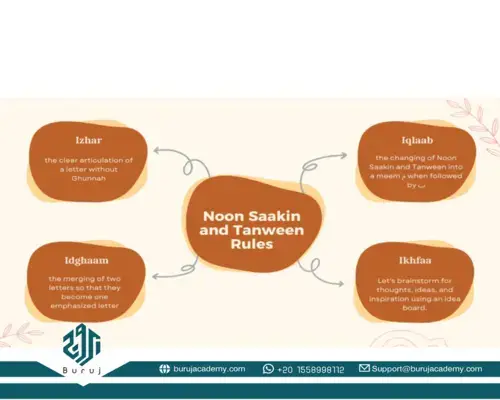
| Noon saakin and tanween both carry four governing rules: Izhar, Idgham, Iqlab, and Ikhfa, based on the following letter. |
| Izhar applies before six throat letters (ء هـ ع ح غ خ), requiring clear, unghosted pronunciation with no nasalization. |
| Idgham merges the noon into the next letter; with ghunnah for (ي و م ن) and without ghunnah for (ل ر). |
| Iqlab converts noon saakin or tanween into a concealed meem with ghunnah exclusively before the letter Baa (ب). |
| Ikhfa partially conceals the noon before 15 letters, holding nasal resonance for two counts between full clarity and full merging. |
Reciting the Quran correctly requires more than recognizing letters — it requires knowing how those letters behave when they meet one another. One of the first and most frequently tested rules every student encounters is what happens to the noon saakin (نْ) or tanween (ـً ـٍ ـٌ) when followed by specific letters.
The rules of noon saakin and tanween fall into four categories — Izhar, Idgham, Iqlab, and Ikhfa — each triggered by the letter that immediately follows. Mastering these four rules transforms a student’s recitation from hesitant guesswork into confident, flowing Quran reading.
Table of Contents:
What Is the Difference Between Noon Saakin and Tanween?
Noon saakin and tanween share the same ruling system, but they are distinct in nature and placement. Understanding the difference prevents common application errors from the very first lesson.
Noon saakin is an actual written letter — the noon (ن) without any vowel — appearing in nouns, verbs, and particles. It occurs both inside a single word and at its end.
Tanween, by contrast, is a pronunciation addition only. It is a silent noon sound appended to the end of indefinite nouns, represented graphically by doubled vowel markers (ـً ـٍ ـٌ). It is never written as a noon letter and never appears in verbs or particles.
| Feature | Noon Saakin | Tanween |
| Written in Mushaf? | Yes | No |
| Position in word | Middle or end | End only |
| Word types | Nouns, verbs, particles | Nouns only |
| Present when pausing? | Yes | No — drops at pause |
Both carry identical rulings when followed by the 28 remaining letters. The four rules apply equally to both.
If you are starting out, our Tajweed for Beginners course provides structured, one-on-one instruction covering every one of these rules from the ground up.
Book Your FREE Trial Lesson to Begin Your Tajweed Journey

What Is Izhar in Tajweed?
Izhar (الإظهار) means producing the noon saakin or tanween clearly and distinctly, without any nasalization extending into the following letter. It applies when noon saakin or tanween is followed by one of the six throat letters: ء، هـ، ع، ح، غ، خ.
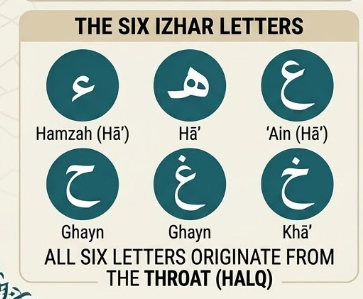
These are called the huruf al-halq (letters of the throat) because all six originate from the throat area. The physical distance between the noon’s articulation point — the tip of the tongue against the gum — and the throat letters creates a natural separation, making merging impossible and clarity obligatory.
A widely used memory aid combines the six letters into the opening letters of this phrase: أَخِي هَاكَ عِلْمًا حَازَهُ غَيْرُ خَاسِرٍ (“My brother, here is knowledge acquired by one who is not a loser”).
Quranic Examples of Izhar
مَنْ آمَنَ
Man āmana
“Whoever believed” (Al-Baqarah 2:62)
Noon saakin before Hamzah — clear noon, zero nasalization into the Alef
وَيَنْهَوْنَ
Wa yanhaun
“And they forbid” (Al-An’am 6:26)
Noon saakin before Haa — noon is fully pronounced before moving to the haa
عَلِيمٌ حَكِيمٌ
ʿAlīmun Ḥakīm
“All-Knowing, All-Wise” (Al-Baqarah 2:32)
Tanween Damm before Haa — the tanween noon sounds clearly before the haa
In our sessions at Buruj Academy, the most consistent error beginners make with Izhar is adding a slight nasal hum before the Haa or Hamzah.
Ijazah-certified instructors trained in makharij correction identify and eliminate this habit early — usually within two to three sessions of focused drill. Our Online Tajweed Classes address exactly these micro-errors that self-study often misses.
Book Your FREE Trial Lesson to Begin Your Tajweed Journey

How Does Idgham Work in the Rules of Noon Saakin and Tanween?
Idgham (الإدغام) merges the noon saakin or tanween completely into the following letter, so that only one stressed (shaddah-like) sound is produced. It applies when noon saakin or tanween is followed by one of six letters collected in the word يَرْمَلُونَ (Yarmaloon): ي، ر، م، ل، و، ن.
Idgham operates across two words only — it never applies within a single word. This is a key distinction that students frequently overlook.
1. Idgham with Ghunnah: Letters ي، و، م، ن
When the following letter is one of the four letters in يَوْمَنُونَ (Yaw-manoon) — Yaa, Waw, Meem, or Noon — the merger happens with sustained nasal resonance (ghunnah) for two counts. The noon disappears into the letter, but the nasal hum continues.
مِنْ مَّالٍ
Min māl
“From wealth” (Al-Fajr 89:20)
Noon saakin merges into Meem with ghunnah — pronounced “mimmāl”
يَوْمَئِذٍ نَّاعِمَةٌ
Yawma’idhin nāʿimah
“That Day, in ease” (Al-Ghashiyah 88:8)
Tanween Kasr before Noon — merges into the noon of nāʿimah with ghunnah
Excel in Your Quranic Studies
Join Buruj Academy and master the Quran with our structured, professional curriculum.
Book Your Free Trial2. Idgham without Ghunnah: Letters ل، ر
When followed by Laam or Raa, the noon merges completely with no nasal resonance — the ghunnah is entirely absent. This is called Idgham Kamil (complete merging).
مِنْ رَّبِّهِمْ
Min Rabbihim
“From their Lord” (Al-Baqarah 2:5)
Noon saakin before Raa — fully absorbed, no ghunnah, pronounced “mirRabbihim”
بَظَلَّامٍ لِّلْعَبِيدِ
Biẓallāmil-lil ʿabīd
“Unjust to [His] servants” (Al-Hajj 22:10)
Tanween Kasr before Laam — complete merging without ghunnah
| Type | Letters | Ghunnah? | Merger Type |
| Idgham with Ghunnah | ي، و، م، ن | Yes — 2 counts | Partial (nasal remains) |
| Idgham without Ghunnah | ل، ر | No | Complete absorption |
For more detail on the mechanics of Idgham and its subdivisions, see our dedicated article on Idgham rules in Tajweed.
Our Ijazah-certified instructors train students to feel the complete absence of resonance by first exaggerating the Ra’s roll, then gradually softening it while keeping the Noon silent.
Book a FREE trial session with one of Buruj’s Azhari Quran tutors

What Is Iqlab?
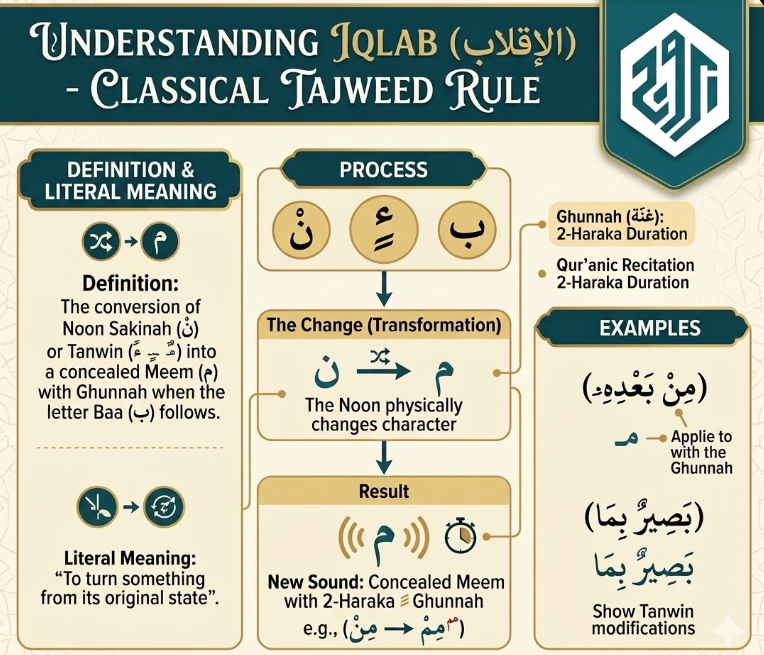
Iqlab (الإقلاب) means converting the noon saakin or tanween into a concealed meem (م), pronounced with ghunnah, when followed by the letter Baa (ب). The noon sound changes entirely — it is neither pronounced as noon nor merged — but substituted with a nasal meem held for two counts before the Baa is articulated.
This is the narrowest of the four rules, having only one triggering letter. In the Mushaf, the letter (م) placed above the noon or tanween before Baa signals this rule visually.
Read also: Rules of Meem Saakin With Clear Examples
Quranic Examples of Iqlab
أَنْبَأَكَ
Amba’aka
“Who informed you” (At-Tahrim 66:3)
Noon saakin before Baa within one word — noon converts to meem: “Amba’aka”
مِنْ بَعْدِ
Mim baʿd
“After” (Al-Baqarah 2:27)
Noon saakin before Baa across two words — pronounced “mimbaʿd” with nasal ghunnah
سَمِيعٌ بَصِيرٌ
Samīʿum Baṣīr
“All-Hearing, All-Seeing” (Al-Isra 17:1)
Tanween Damm before Baa — pronounced “Samīʿumbaṣīr” with nasal meem and ghunnah
The physical reason for this substitution is elegant: Baa is a labial letter (lips close), and Meem is also labial. Pronouncing noon — a nasal tip-of-tongue sound — before Baa creates articulatory tension. The meem substitution eases the transition while preserving the nasal quality.
What is Ikhfa?
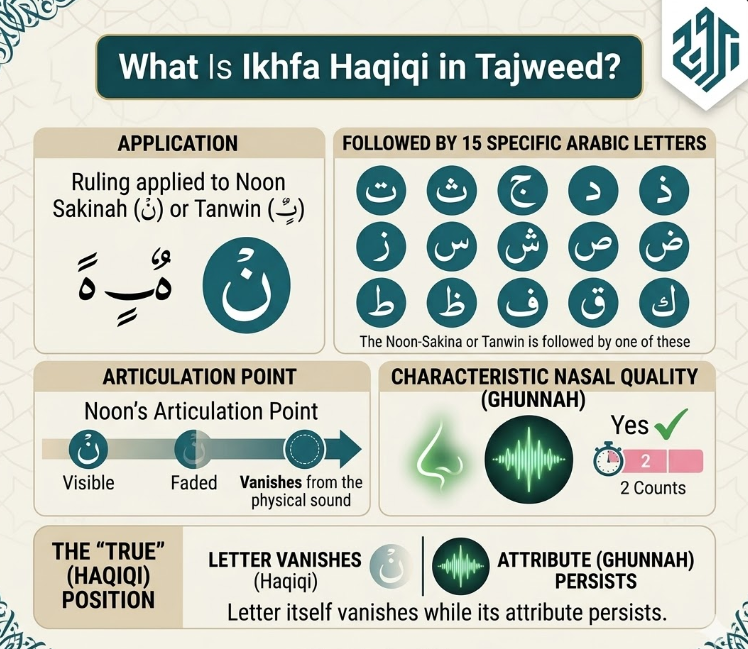
Ikhfa (الإخفاء) is a sound state between full Izhar (clear noon) and full Idgham (merged noon) — a partial concealment of the noon saakin or tanween, with ghunnah sustained for two counts, applied before 15 specific letters.
The noon is not pronounced fully, nor does it disappear. Instead, the tongue approaches — but does not complete — the position of the following letter, while nasal resonance continues. For a thorough breakdown of this rule and its letters, see our detailed article on the Ikhfa letters in Tajweed.
The 15 Ikhfa Letters
These 15 letters are everything remaining after removing Izhar letters (6), Idgham letters (6), and Iqlab’s letter Baa (1) from the Arabic alphabet. Classical scholars gathered them in the opening letters of this verse:
صِفْ ذَا ثَنَا كَمْ جَادَ شَخْصٌ قَدْ سَمَا — دُمْ طَيِّبًا زِدْ فِي تُقَى ضَعْ ظَالِمَا
The 15 letters: ص ذ ث ك ج ش ق س د ط ز ف ت ض ظ
Quranic Examples of Ikhfa
أَنصَارَ اللَّهِ
Anṣāral-lāh
“Helpers of Allah” (As-Saff 61:14)
Noon saakin before Saad — concealed with nasal ghunnah
مِنْ ذَهَبٍ
Min dhahab
“Of gold” (Al-Kahf 18:31)
Noon saakin before Dhaal — partial concealment, ghunnah maintained)
قَاعًا صَفْصَفًا
Qāʿan Ṣafṣafā
“A level plain” (Ta-Ha 20:106)
Tanween Fath before Saad — concealed noon sound with sustained nasality
خَلْقٍ جَدِيدٍ
Khalqin jadīd
“New creation” (Saba 34:7)
Tanween Kasr before Jeem — Ikhfa with ghunnah for two counts
| Letter Category | Count | Rule Applied |
| Throat letters (ء هـ ع ح غ خ) | 6 | Izhar — clear noon |
| Yarmaloon letters (ي ر م ل و ن) | 6 | Idgham — merged noon |
| Baa only (ب) | 1 | Iqlab — noon becomes meem |
| Remaining letters | 15 | Ikhfa — concealed noon |
Understanding ghunnah is central to applying Ikhfa correctly. Our article on ghunnah and its rules explains the nasal resonance mechanics in detail.
Read also: Islamic Topics for Kids and Youth
Discover the Buruj Academy Difference
Step into our virtual classrooms and see how our expert instructors make learning Quran and Arabic intuitive and clear. We focus on overcoming the specific hurdles non-native speakers face, building your confidence and connection with the Quran.
Start Applying Noon Saakin Rules with Buruj Academy’s Expert Instructors
Knowing the four rules is only the beginning — applying them correctly during live recitation requires trained ears and consistent correction.
Buruj Academy’s Online Tajweed Classes are designed specifically for non-Arabic speakers at every level, from first-time learners to those refining advanced rule interactions.
Our instructors are Al-Azhar University graduates and Ijazah-certified in Hafs ‘an ‘Asim recitation, with 12+ years of experience teaching students globally.
Every session is 1-on-1, flexible, and built around your pace and goals using the Buruj Method.
Book your free trial lesson today and experience the difference of learning Tajweed with qualified, patient, practitioner instructors.
Join a supportive learning environment tailored to your pace and lifestyle. Start your journey toward excellence by enrolling in one of our specialized tracks:
- Online Tajweed Classes
- Tajweed Classes for Beginners
- Tajweed Classes for Adults
- Tajweed Classes for Sisters
- Tajweed Classes for Kids
- Advanced Tajweed Course
- Amli Tajweed Course (Practical Application)
Ready to transform your recitation? book your free assessment and start your path to Tajweed mastery today!
Excel in Your Quranic Studies
Join Buruj Academy and master the Quran with our structured, professional curriculum.
Book Your Free TrialConclusion
The rules of noon saakin and tanween — Izhar, Idgham, Iqlab, and Ikhfa — form a complete, logical system that governs one of the most frequently occurring sounds in Quran recitation. Each rule is triggered by the letter that follows, and together they cover every letter in the Arabic alphabet with no overlap and no gaps.
Mastering these rules does not require years of study — it requires correct instruction, genuine Quranic examples, and consistent practice. When these three elements align, the rules stop feeling like memorized labels and start sounding like natural recitation. That is the point where Tajweed becomes internalized rather than performed.
Frequently Asked Questions About Noon Saakin and Tanween Rules
What Are the Four Rules of Noon Saakin and Tanween?
The four rules are Izhar (clear pronunciation before 6 throat letters), Idgham (merging into 6 specific letters), Iqlab (converting to meem before Baa), and Ikhfa (partial concealment before 15 letters). Together, these four rules account for every letter in the Arabic alphabet following noon saakin or tanween.
What Is the Difference Between Ikhfa and Idgham?
Idgham fully merges the noon into the following letter, producing one stressed sound. Ikhfa partially conceals the noon — the tongue does not complete the noon’s articulation point, while nasal resonance (ghunnah) continues for two counts. Idgham eliminates the noon; Ikhfa suspends it between two states.
Does Tanween Follow the Same Rules as Noon Saakin?
Yes. Both tanween and noon saakin share identical rulings — Izhar, Idgham, Iqlab, and Ikhfa — when followed by the corresponding letters. The key difference is that tanween appears only at word endings on nouns, while noon saakin appears in nouns, verbs, and particles in any position.
Can Idgham Occur Within a Single Word?
Idgham of noon saakin never occurs within a single word — only across two separate words. Classical Tajweed scholarship identifies exceptions like دُنْيَا (Dunya) and بُنْيَان (Bunyan), where noon saakin precedes a Yaa or Waw within one word, yet Idgham does not apply; instead, Izhar is required.






Leave a Reply