 Tajweed
| Key Takeaways |
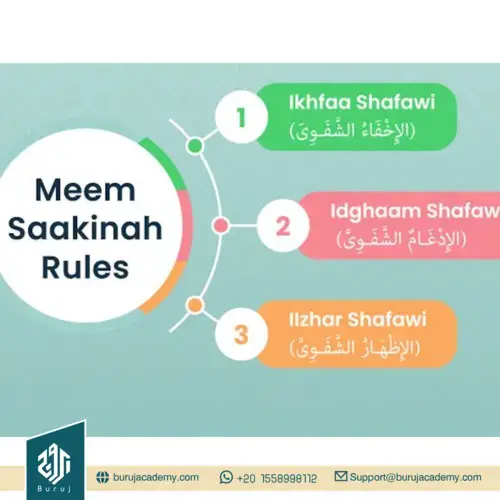
| Meem saakin has three rules: Idgham Shafawi, Ikhfa Shafawi, and Izhar Shafawi, each triggered by specific letters. |
| Ikhfa Shafawi applies exclusively before the letter Baa, requiring labial concealment with extended ghunnah of two counts. |
| Idgham Shafawi occurs only when meem saakin is followed by another meem, producing one doubled meem with ghunnah. |
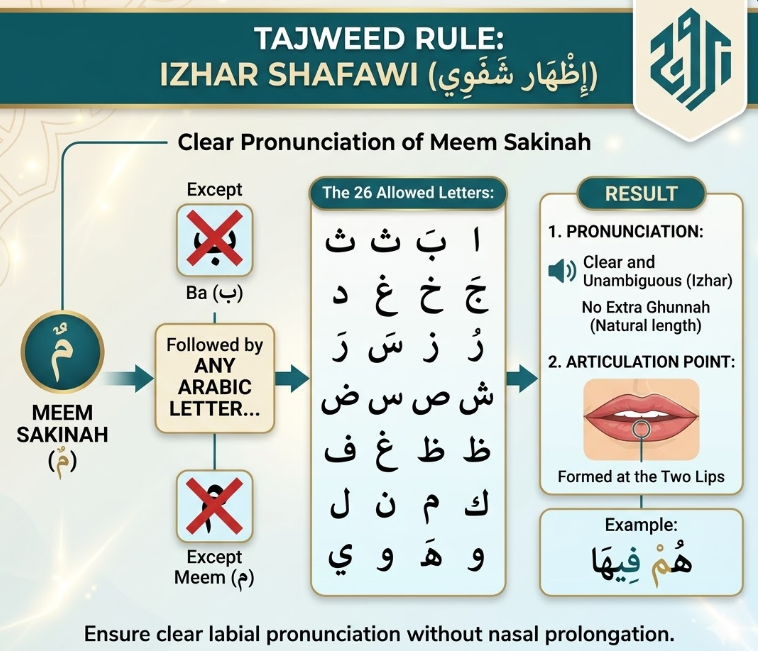
| Izhar Shafawi applies before all remaining 26 letters, requiring clear pronunciation with lips firmly closed then released. |
| Meem saakin rules are called “shafawi” because meem exits from the two lips, distinguishing them from noon saakin rules. |
Every student of Tajweed eventually reaches a point where they realize the rules of meem saakin are just as precise — and just as beautiful — as the rules of noon saakin. Far from being a minor detail, meem saakin governs recitation in hundreds of verses across the Quran.
The rules of meem saakin are three: Idgham Shafawi, Ikhfa Shafawi, and Izhar Shafawi. Each rule is triggered by a different following letter, and understanding which rule applies — and why — is what separates correct Tajweed from guesswork. This guide breaks down all three rules with verified Quranic examples so you can apply them immediately in your recitation.
Table of Contents:
What Is Meem Saakin in Tajweed?
Meem saakin is the letter meem (م) that carries a sukoon (ـْ) — meaning it has no vowel (no fatha, kasra, or damma). It appears in nouns, verbs, and particles throughout the Quran, and it can occur in the middle of a word or at its end. Its articulation point (makhraj) is the two lips pressed together, which is precisely why all three of its rules are classified as shafawi — a term derived from shafa, meaning lip.
What makes meem saakin rules unique is that they arise from a phonetic proximity between the meem and the letter that follows it.
When a specific letter comes after a meem saakin, the mouth naturally wants to merge, conceal, or clearly separate the sounds. Classical Tajweed scholarship codified these natural tendencies into three distinct rules that every reciter must master.
If you are building your Tajweed foundation systematically, our Tajweed for Beginners course at Buruj Academy covers meem saakin rules in structured, sequential lessons taught by Ijazah-certified instructors trained at Al-Azhar University.
Book Your FREE Trial Lesson to Begin Your Tajweed Journey

What Is the Rule of Idgham Shafawi for Meem Saakin?
Idgham Shafawi occurs when a meem saakin is immediately followed by another meem. The first meem is absorbed into the second, producing a single doubled (mushaddad) meem pronounced with a full, extended ghunnah of two counts.
This is called “idgham of the likenesses” (idgham al-mutamathalain) and it is the only letter that triggers this rule.
Why Does Idgham Happen With Meem?
Idgham (إدغام) means “insertion” or “merging” — linguistically, it describes placing one letter inside another until they become a single letter of the second type. When two identical letters meet — the first saakin and the second mutaharrik (voweled) — complete merging is both phonetically natural and Tajweed-mandated.
The result is one strongly pronounced, lengthened meem with clear nasal resonance.
In the Mushhaf (written Quran), you recognize Idgham Shafawi by the absence of sukoon over the first meem and the presence of a shaddah (ـّ) over the second meem.
Quranic Examples of Idgham Shafawi:
الَّذِي أَطْعَمَهُمْ مِنْ جُوعٍ
Allathii at’amahum-min juu’
“Who has fed them, [saving them] from hunger.” (Quraysh 106:4)
The meem of “ahum” merges into the meem of “min” — the two meems become one shaddah-bearing meem.
كَمْ مِنْ فِئَةٍ قَلِيلَةٍ
Kam-min fi’atin qaliila
“How many a small company.” (Al-Baqarah 2:249)
Classic cross-word Idgham Shafawi — “kam” ends with meem saakin, “min” begins with meem.
In our Online Tajweed Classes at Buruj Academy, we consistently observe that students initially rush through the ghunnah in Idgham Shafawi — holding it for one count instead of two.
Our Ijazah-certified instructors train students to hold the nasal resonance fully before releasing the meem, which makes all the difference in a polished, accurate recitation.
Book Your FREE Trial Lesson to Begin Your Tajweed Journey
What Is the Rule of Ikhfa Shafawi for Meem Saakin?
Ikhfa Shafawi is triggered when a meem saakin is followed by the letter Baa (ب) — and only Baa. The meem is neither fully pronounced (Izhar) nor fully merged (Idgham).
Instead, it is concealed: the lips approach each other without pressing completely shut, while a ghunnah of two counts is maintained. This intermediate state is the defining characteristic of ikhfa.
How Is Ikhfa Shafawi Pronounced Correctly?
The lips are brought close together — not tightly sealed as in full Izhar — and not open as they would be for another letter. The sound of the meem is “hidden” within a nasal resonance while the mouth transitions toward the Baa.
There is no shaddah on the Baa, and the meem carries no sukoon mark in the Mushhaf — the absence of both symbols is how Ikhfa Shafawi is identified in the written text.
The reason Baa specifically triggers this concealment is phonetic proximity. Both meem and Baa share the same makhraj (exit point) — the two lips — which creates a natural tendency to blend. Classical scholars identified this tendency and classified it as ikhfa rather than full idgham because the meem retains its ghunnah independently.
For a deeper look at how ikhfa operates across different contexts in Tajweed, our article on Ikhfa letters in Tajweed provides detailed parallel explanations.
Quranic Examples of Ikhfa Shafawi:
نَحْنُ نَقُصُّ عَلَيْكَ نَبَأَهُمْ بِالْحَقِّ
Nahnu naqussu ‘alayka naba’ahum-bilhaqq
“We relate to you their story in truth.” (Al-Kahf 18:13)
The meem of “ahum” is concealed before the Baa of “bil” — lips approach without full closure, ghunnah held for two counts.
قُلْ إِنَّمَا أُنذِرُكُمْ بِالْوَحْيِ
Qul innamaa unthirukum-bilwahyi
“Say: I only warn you by revelation.” (Al-Anbiya 21:45)
Meem saakin before Baa — Ikhfa Shafawi with ghunnah sustained through the concealment.
فَاحْكُمْ بَيْنَهُمْ بِمَا أَنزَلَ اللَّهُ
Fahkum baynahum-bimaa anzalallah
“So judge between them by what Allah has revealed.” (Al-Ma’idah 5:48)
Two instances of Ikhfa Shafawi in one phrase — “baynahum” before “bima” — an excellent practice verse.
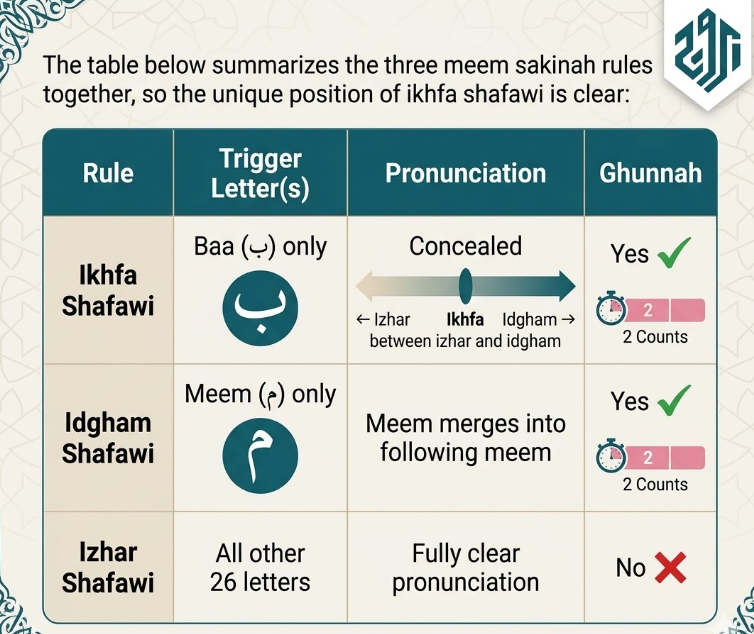
| Feature | Ikhfa Shafawi | Idgham Shafawi | Izhar Shafawi |
| Triggering letter | Baa (ب) only | Meem (م) only | All other 26 letters |
| Lip position | Approaching, not sealed | Fully sealed then released | Fully sealed then clearly opened |
| Shaddah on next letter? | No | Yes | No |
| Ghunnah? | Yes — two counts | Yes — two counts | No — none |
Excel in Your Quranic Studies
Join Buruj Academy and master the Quran with our structured, professional curriculum.
Book Your Free TrialWhat Is the Rule of Izhar Shafawi for Meem Saakin?
Izhar Shafawi applies when a meem saakin is followed by any letter of the Arabic alphabet except meem and Baa. That covers 26 letters in total. The meem is pronounced clearly and distinctly — the lips press together to form the meem, then open crisply — with no ghunnah and no merger into the following letter.
Which Letters Require Special Attention in Izhar Shafawi?
Among the 26 letters, two deserve particular care: Waaw (و) and Faa (ف). Classical Tajweed scholarship explicitly emphasized extra clarity when meem saakin precedes these two letters:
1. Before Waaw:
Meem and Waaw share the same makhraj (the lips), so there is a natural tendency to let the meem slide into the Waaw. Correct Izhar requires deliberately releasing the meem clearly before forming the Waaw.
2. Before Faa:
The Faa is articulated near the lips (upper teeth touching lower lip), making careless reciters prone to blurring the meem into it. The meem must be fully audible before the Faa begins.
This extra emphasis is not a separate rule — it is Izhar Shafawi in both cases — but our instructors at Buruj Academy flag it as one of the most common errors among intermediate students, particularly those who have learned rules theoretically without sufficient oral correction.
Read also: Rules of Noon Saakin and Tanween
Quranic Examples of Izhar Shafawi:
أَنْعَمْتَ عَلَيْهِمْ
An’amta ‘alayhim
“You have bestowed favor upon them.” (Al-Fatihah 1:7)
Meem saakin before the taa — Izhar Shafawi from within a single word.
أَمْ يَقُولُونَ افْتَرَاهُ
Am yaqooloona iftaraah
“Or do they say, ‘He has invented it’?” (Hud 11:13)
Meem saakin before Yaa — clear Izhar required, with no ghunnah added.
Understanding how all three rules interact within a single verse is part of what makes Tajweed study genuinely rewarding. Our article on Idgham rules in Tajweed explores the broader merging principles that connect to what you have studied here.
How Do Meem Saakin Rules Compare to Noon Saakin Rules?
Meem saakin rules and noon saakin rules are related in structure but distinct in application. Understanding how they differ prevents one of the most common Tajweed confusions we see in Buruj Academy classrooms.
| Feature | Meem Saakin Rules | Noon Saakin / Tanween Rules |
| Total rules | 3 | 4 (Izhar, Idgham, Ikhfa, Iqlab) |
| Ikhfa trigger | Baa only | 15 specific letters |
| Idgham trigger | Meem only | 6 letters (ي ر م ل و ن) |
| Izhar trigger | 26 letters | 6 throat letters (ء ه ع ح غ خ) |
| Named “shafawi”? | Yes — all three rules | Only Ikhfa of noon called Shafawi when Baa follows in Iqlab |
| Ghunnah source | From meem itself | From noon or tanween |
The most important distinction: in noon saakin, there are four rules with many triggering letters. In meem saakin, there are three rules with very few triggering letters — making it, in many ways, simpler to master once the principle is clear.
For a connected discussion of ghunnah and its role across both meem and noon rules, our article on ghunnah and its rules is a natural next step.
A Practical Summary Table of All Three Meem Saakin Rules
| Rule | Arabic Name | Triggering Letter(s) | Ghunnah | Key Pronunciation Feature |
| Idgham Shafawi | الإدغام الشفوي | Meem (م) | Yes — 2 counts | Two meems merge into one shaddah meem |
| Ikhfa Shafawi | الإخفاء الشفوي | Baa (ب) only | Yes — 2 counts | Lips approach without full closure; concealment |
| Izhar Shafawi | الإظهار الشفوي | All other 26 letters | None | Meem pronounced clearly; extra care before Waaw and Faa |
This three-rule system can be memorized efficiently: one letter for Idgham, one letter for Ikhfa, everything else for Izhar.
The challenge, as with all Tajweed, lies not in memorizing the rule names but in applying them correctly mid-recitation — which requires consistent oral practice with a qualified instructor. If you want structured, live practice, explore our online Tajweed classes at Buruj Academy.
Discover the Buruj Academy Difference
Step into our virtual classrooms and see how our expert instructors make learning Quran and Arabic intuitive and clear. We focus on overcoming the specific hurdles non-native speakers face, building your confidence and connection with the Quran.
Master Rules of Meem Saakin With Buruj Academy’s Expert Instructors
Knowing the rules of meem saakin is one step — applying them correctly in live recitation requires trained ears and consistent correction.
At Buruj Academy, our Online Tajweed Classes are led by Al-Azhar University graduates and Ijazah-certified instructors with 12+ years of experience teaching non-Arabic speakers worldwide.
Our Buruj Method — sound-before-rules — ensures you hear the correct articulation before you memorize a single definition.
Sessions are personalized, 1-on-1, and flexibly scheduled around your life.
Book your free trial lesson today and recite with confidence, insha’Allah.
Join a supportive learning environment tailored to your pace and lifestyle. Start your journey toward excellence by enrolling in one of our specialized tracks:
- Online Tajweed Classes
- Tajweed Classes for Beginners
- Tajweed Classes for Adults
- Tajweed Classes for Sisters
- Tajweed Classes for Kids
- Advanced Tajweed Course
- Amli Tajweed Course (Practical Application)
Ready to transform your recitation? book your free assessment and start your path to Tajweed mastery today!
Excel in Your Quranic Studies
Join Buruj Academy and master the Quran with our structured, professional curriculum.
Book Your Free TrialConclusion
The rules of meem saakin are a precise, elegant system built on phonetic logic: one letter merges, one letter conceals, and everything else demands clarity. Mastering Idgham Shafawi, Ikhfa Shafawi, and Izhar Shafawi does not require years of study — but it does require correct practice from the start.
The Quranic examples throughout this guide are not decorative; they are your training material. Return to verses like Al-Fatihah, Al-Kahf, and Quraysh repeatedly, and you will internalize these rules through recitation itself.
Read also: Islamic Topics for Kids and Youth
Frequently Asked Questions About Meem Saakin Rules
How Many Rules Does Meem Saakin Have?
Meem saakin has exactly three rules in Tajweed: Idgham Shafawi (before meem), Ikhfa Shafawi (before Baa), and Izhar Shafawi (before all remaining 26 letters). These rules are called “shafawi” because meem’s articulation point is the two lips, distinguishing these rules from the four rules that govern noon saakin and tanween.
What Is the Difference Between Ikhfa Shafawi and Izhar Shafawi?
Ikhfa Shafawi applies only before Baa and requires the meem to be concealed — lips approaching but not fully sealed — with a ghunnah of two counts. Izhar Shafawi applies before all other letters and requires the meem to be fully and clearly pronounced with the lips sealing and releasing distinctly, with no ghunnah held afterward.
Why Is Extra Care Required When Meem Saakin Comes Before Waaw or Faa?
Both Waaw and Faa are articulated close to the lips — Waaw at the lips themselves, and Faa at the lower lip with the upper teeth. This proximity creates a natural tendency to blur or absorb the meem. Classical Tajweed scholarship specifically emphasized clear Izhar Shafawi before these two letters to prevent inadvertent concealment.
Related Articles
Tajweed





Leave a Reply