 Islamic
| Key Takeaways |
| Islamic parenting is a structured, staged process starting from before birth through the child’s teenage years. |
| The Prophet ﷺ instructed parents to command children to pray from age seven, with accountability increasing at ten. |
| Surah At-Tahrim 66:6 places direct responsibility on parents to protect their children from spiritual harm through active guidance. |
| Structured Quran and Islamic studies instruction works best when introduced early and paired with consistent home reinforcement. |
| Age-appropriate pacing prevents burnout — young children need short, joyful sessions rather than long, rigid lessons. |
Raising a child with strong Islamic identity while living in a Western, non-Muslim-majority environment brings real, everyday tension. Parents want their children to memorize Quran, understand their faith, and hold onto their identity — without constant friction against the surrounding culture.
Islamic parenting is not a single event but a sequential process, beginning before birth and continuing through adolescence.
Each stage — from early Tawheed instruction to formal Quran learning to identity reinforcement — builds on the one before it, with the Quran and Sunnah offering clear guidance at every step.
Table of Contents:
Step 1: Build the Foundation of Faith Before the Child Can Speak
Islamic parenting begins the moment a child enters the family, not when they turn school age. The earliest years are for exposure — the sound of Quran, the rhythm of daily prayer, and the name of Allah spoken warmly and often, long before a toddler understands any of it.
This exposure period matters more than most parents realize. In our experience working with families at Buruj Academy, children raised hearing Quranic recitation in the home from infancy tend to develop faster comfort with Arabic sounds once formal lessons begin. The ear is trained before the mind is ready to analyze.
Surah At-Tahrim places this responsibility squarely on parents: believers are commanded to protect themselves and their families from spiritual harm (At-Tahrim 66:6).
Classical commentary on this verse explains that protecting one’s family means actively teaching them what Allah has commanded and warning them against what He has forbidden — not simply hoping they absorb faith on their own.
Practical steps for this stage include reciting short surahs aloud during daily routines, saying “Bismillah” before meals with the child present, and normalizing the Arabic call to prayer as background sound. None of this requires formal teaching — it requires consistency.
Read also: The Islamic Way to Boost Children’s Brain
Step 2: Begin Actively Teaching Prayer Around Age Four to Six as a Gentle Introduction
Muslim parents should begin actively teaching prayer around age four to six as a gentle introduction, then formally command it at age seven per explicit Prophetic instruction. This timeline comes directly from an authentic hadith, not parental preference or convenience.
The Prophet ﷺ instructed that children be commanded to pray once they reach seven years old, with accountability measures increasing by age ten, and that siblings’ sleeping arrangements be separated once this stage of maturity begins.
The age-seven mark is not about punishment — it is about building a rhythm before the child reaches religious accountability at puberty. Waiting until the teenage years to introduce prayer as a serious obligation almost always creates resistance.
In our sessions with families enrolled in our Online Islamic Studies Classes for Kids, we consistently observe that children introduced to short, joyful prayer routines by age six adapt far more smoothly to the age-seven expectation than children encountering it for the first time.
The first session is free in Buruj’s Islamic Studies Classes for Kids
| Age Range | Parental Approach | Expected Outcome |
| 3–5 years | Model prayer, involve child physically | Familiarity and comfort with movements |
| 5–7 years | Teach short surahs for prayer, explain basics | Understanding of what prayer is |
| 7 years | Command prayer directly, per Prophetic instruction | Consistent independent practice begins |
| 10 years | Reinforce accountability, address neglect firmly | Prayer becomes internalized habit |
Step 3: Parents Should Introduce the Quran Through Short, Joyful Listening and Repetition Sessions
Parents should introduce the Quran through short, joyful listening and repetition sessions of five to ten minutes daily, beginning with the shortest and most rhythmic surahs before moving toward structured reading. The goal at this stage is love of the Quran, not mastery.
Short surahs like Al-Ikhlas, Al-Falaq, and An-Nas are ideal starting points because of their brevity and repetitive rhythm, which supports natural memorization even before a child can read Arabic script.
Our guide on easy surahs of the Quran to memorize breaks down age-appropriate starting points in more depth.
A common mistake we see among well-intentioned parents is treating early Quran exposure like a school subject — rigid, timed, and graded. This backfires.
Children disengage when the sacred text feels like an academic burden rather than a source of comfort.
Instead, pairing recitation with daily life — playing Quran audio during car rides, reciting together before bed — builds positive association. Our article on making Quran reading fun for kids offers additional practical techniques parents can apply immediately at home.
Step 4: Move From Listening to Structured Letter Recognition
Once a child shows comfort with Quranic sounds through repeated listening, the next step is structured letter recognition — typically beginning around age five or six, depending on the individual child’s readiness. This is where informal exposure transitions into formal foundational learning.
Noorani Qaida remains the traditional starting point for non-Arabic speaking children, teaching Arabic letters, their sounds, and basic joining rules before any Quranic verse is introduced. This sequencing matters because children who skip straight to Quranic text without letter mastery tend to memorize by sound alone, without true reading ability.
In our classrooms, the most consistent pattern among young beginners is confusing similarly shaped letters — particularly Ba, Ta, and Tha — until repeated visual drilling separates them clearly. This is completely normal and resolves within weeks of consistent practice, not a sign of struggle.
Parents raising children in Western households, where Arabic script has zero environmental reinforcement outside the home, benefit significantly from structured guidance rather than self-teaching.
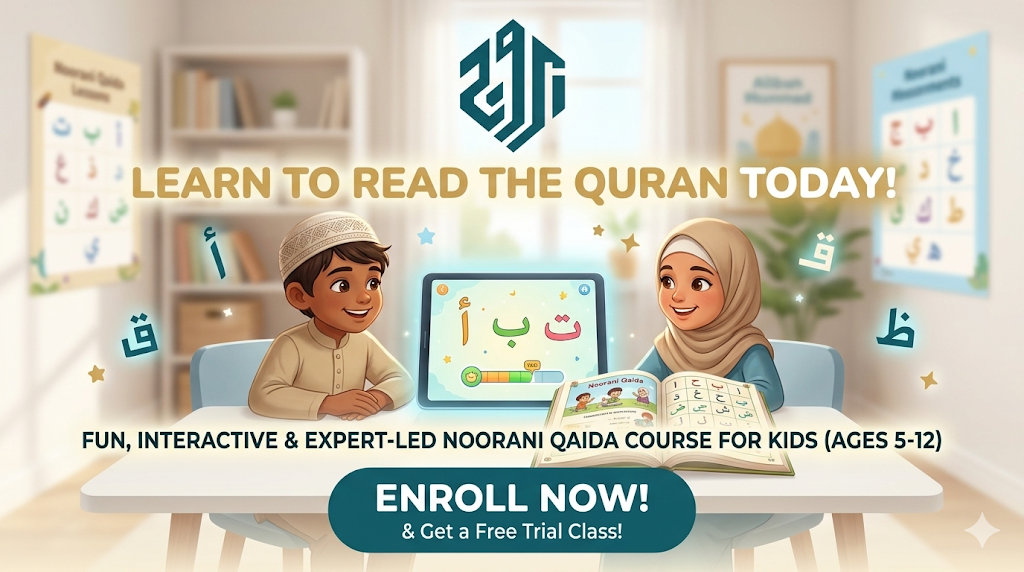
Our Noorani Qaida Online Course for children was designed specifically around this early letter-recognition stage, using phonetic drilling suited to non-Arabic speaking learners.
Sign up your kid for a free Noorani Qaida lesson
Step 5: Consistent Quran Memorization Matter More Than Speed for Children
Consistent, unhurried Quran memorization builds stronger long-term retention in children than rushed, high-volume memorization schedules, because young memory consolidates through repetition and spaced review rather than one-time intensity. Speed-focused approaches often produce fragile memorization that fades quickly.
This principle sits at the heart of what we call Consistency-before-speed within the Buruj Method — one of three pedagogical pillars guiding how we structure children’s memorization pathways.
A child memorizing fifteen minutes daily retains far more over a year than a child cramming for an hour sporadically.
Before adopting this consistency-first approach, we regularly saw students who could recite a surah perfectly in one session but lose it entirely within a month due to insufficient review cycles. The fix was never more memorization time — it was better-structured revision.
Parents can apply this at home by treating daily revision as non-negotiable, even on days when new memorization doesn’t happen.
Our resource on the best time to memorize Quran explains why certain daily windows support better retention than others.
What Does a Realistic Weekly Memorization Rhythm Look Like for Young Children?
| Day | Activity | Duration |
| Mon–Thu | New memorization (2–3 verses) | 10–15 minutes |
| Friday | Light revision, no new content | 10 minutes |
| Sat–Sun | Cumulative review of the week’s portion | 15 minutes |
This kind of pacing prevents burnout while ensuring nothing memorized is ever left unreviewed for more than a few days.
Read also:Islamic Topics for Children
Discover the Buruj Academy Difference
Step into our virtual classrooms and see how our expert instructors make learning Quran and Arabic intuitive and clear. We focus on overcoming the specific hurdles non-native speakers face, building your confidence and connection with the Quran.
Expand Your Islamic Knowledge
Join our structured online courses led by qualified instructors to deepen your understanding of the Deen.
Join a Free Trial ClassStep 6: Muslim Parents Teach Islamic Manners Alongside Religious Knowledge
Islamic manners should be taught through consistent modeling and correction in daily interactions, not as a separate curriculum disconnected from religious knowledge. Akhlaq, or character, was central to the Prophet’s ﷺ own mission and cannot be treated as secondary to memorization or ritual.
Children absorb manners largely through what they observe repeatedly, not what they are told once.
A parent who says “Bismillah” before eating, greets others with “Assalamu Alaikum,” and speaks gently under stress teaches more through repetition than through any single lecture.
We consistently notice that children enrolled in our Islamic Studies Classes for Kids retain manners-based lessons — honesty, kindness to parents, patience — far more effectively when the same values are visibly reinforced at home during the same week the lesson was taught.
Structured Islamic studies content designed specifically for children can support this reinforcement process.
Our collection of Islamic topics for kids and youth provides age-appropriate discussion material parents can use alongside daily interactions.
Step 7: Anchor Identity Through the Stories of the Prophets
Prophetic stories serve as one of the most effective tools for building a child’s Islamic identity, because narrative naturally holds a child’s attention in ways abstract religious instruction often cannot. The Quran itself uses this method extensively, dedicating entire surahs to prophetic narratives.
Starting with the story of Prophet Muhammad ﷺ himself gives children a relatable entry point — a human being who faced real challenges with patience and trust in Allah.
Our detailed resource on the Prophet Muhammad story for kids presents this narrative in an age-appropriate sequence.
From there, expanding into the broader chain of prophets — Ibrahim, Musa, Yusuf, and others — helps children understand Islam as a continuous message rather than an isolated set of rules.
Our guide covering the prophets in Islam for kids organizes these narratives clearly for younger readers.
Children raised in Western environments, where cultural stories and holidays constantly compete for their imagination, particularly benefit from prophetic stories told with the same energy and detail as any other story they encounter.
Step 8: Keep Their Child’s Islamic Identity Strong in a Non-Muslim Environment
Parents preserve their child’s Islamic identity in non-Muslim environments by creating strong home-based religious rhythms that outweigh external cultural pressure, while giving children confident, age-appropriate language to explain their faith to peers. Isolation is not the answer — preparation is.
Children who understand why they practice certain things — fasting, modest dress, dietary boundaries — handle questions from classmates with far more confidence than children who were only told what to do without explanation.
We find that identity struggles intensify most sharply around early adolescence, when peer belonging becomes a primary concern.
Families who established open, ongoing conversations about faith earlier navigate this stage with noticeably less friction than families addressing it for the first time at that point.
Our article on how to keep Islamic identity for kids expands on specific strategies for maintaining this balance, particularly for families raising children as a religious minority.
Step 9: Teach the Pillars of Islam as a Practical Framework, Not Abstract Theology
The five pillars of Islam should be taught to children as a practical life framework they actively participate in, not as abstract theological concepts memorized for a test. Each pillar has a tangible, age-appropriate entry point long before a child reaches full religious accountability.
Shahada can be introduced through simple, repeated affirmation from toddlerhood.
Salah becomes tangible once a child physically joins prayer movements, even before they understand the words.
Zakat can be taught through small acts of sharing, and fasting can begin with partial-day practice runs well before puberty.
Our comprehensive breakdown of the pillars of Islam for kids structures each pillar with concrete, child-friendly explanations parents can use directly in conversation.
Teaching the pillars this way — through participation rather than memorized definitions — produces children who understand Islam as something they do, not merely something they know about.
Step 10: Make Learning Interactive Through Games and Structured Activities
Interactive learning through games and structured activities significantly increases a young child’s engagement with Quran and Islamic studies compared to passive instruction alone. Children under ten generally retain concepts better when learning involves movement, competition, or hands-on interaction.
This applies directly to Tajweed instruction, where abstract rule names mean little to a child until practiced through repetition games.
Our resource on Tajweed games and activities for kids offers structured examples parents can implement without any formal teaching background.
Broader Quranic engagement benefits from the same principle. Our collection of the best Quranic games for kids and general Quran activities for kids gives parents ready-made tools rather than requiring them to design lessons from scratch.
For families balancing school, extracurriculars, and Islamic education simultaneously, gamified learning also reduces the resistance children often show toward “one more lesson” at the end of a long day.
Step 11: Involve the Child in Community and Collective Worship
Regular involvement in Muslim community life reinforces everything taught at home by showing children that their family’s practices are shared, not isolated. Children raised as a religious minority particularly need visible proof that other families live the same way theirs does.
Attending congregational prayers, community gatherings, and Islamic events — even occasionally — gives children a sense of belonging that home instruction alone cannot fully replicate. This matters most for children in areas with smaller Muslim populations.
Community involvement also naturally exposes children to Quran recitation and Islamic knowledge from voices beyond their immediate household, reinforcing the same values through a different, credible source.
Interactive resources such as our Quran learning tools for kids can supplement community involvement by extending engagement between in-person gatherings, keeping momentum consistent throughout the week.
Step 12: Formalize Structured Learning as the Child Matures
As a child grows from early childhood into the pre-teen years, informal home instruction should gradually transition into structured, consistent formal learning — whether through community programs or dedicated online instruction. Ad-hoc teaching reaches a ceiling that structured curriculum does not.
This transition typically becomes necessary once a child moves beyond basic letter recognition and short-surah memorization into full Quran reading, Tajweed application, and deeper Islamic studies content requiring qualified instruction.
Parents attempting to teach increasingly complex Tajweed rules or Arabic grammar without structured guidance often unintentionally pass on inconsistent habits, which become harder to correct the longer they persist. Our guide on how to teach Islam to a child discusses this transition point in more detail.
At Buruj Academy, our Online Quran Classes for Kids are built specifically for this formalization stage, using age-appropriate gamification and instructors trained specifically in child pedagogy to carry children from foundational reading into confident, accurate recitation.
Help your child start learning the Quran with a FREE trial
Expand Your Islamic Knowledge
Join our structured online courses led by qualified instructors to deepen your understanding of the Deen.
Join a Free Trial ClassRaise Your Child’s Islamic Foundation with Buruj Academy’s Expert Instructors
Every stage covered here — from early exposure to formal Quran learning — becomes far more effective with qualified, structured guidance rather than isolated parental effort alone.
Buruj Academy connects your child with Al-Azhar University graduates and Ijazah-certified instructors experienced in teaching non-Arabic speaking children across the West.
Our Buruj Method applies Sound-before-rules pedagogy and Consistency-before-speed memorization pacing, tailored through Personalized Learning Plans built around your child’s age and pace.
With flexible 1-on-1 online sessions and real-time correction, your child receives the same structured foundation outlined in this guide — delivered by instructors trained specifically for young, non-Arabic speaking learners.
Book a free trial lesson today and give your child a confident start on their Quran and Islamic studies journey.
Join a global community of learners and find the path that best supports your spiritual and intellectual growth:
- Online Studies Islamic Classes (General & Flexible)
- Islamic Studies Course for Beginners (Foundational Knowledge)
- Islamic Studies Classes for Kids (Engaging & Values-Based)
- Islamic Studies Classes for Adults (In-Depth Theological Discussion)
- Islamic Studies Classes for Ladies (Sisterhood & Specialized Learning)
- Islamic Studies Classes for New Muslims (Guided Support & Essentials)
- Tafseer Al Quran Course (Unlocking Divine Meanings)
- Quranic Sciences (Uloom Al Quran) Course (Advanced Linguistic & Historical Context)
Ready to enrich your life with sacred knowledge? Connect with Buruj Academy today and book your free introductory session to begin your journey!
Discover the Buruj Academy Difference
Step into our virtual classrooms and see how our expert instructors make learning Quran and Arabic intuitive and clear. We focus on overcoming the specific hurdles non-native speakers face, building your confidence and connection with the Quran.
Conclusion
Raising a child within an Islamic framework while living in the West is not a single decision but a sequence of deliberate, age-matched steps — beginning with early exposure and progressing through formal Quran instruction, character building, and identity reinforcement.
Each stage outlined here builds directly on the one before it, meaning skipped steps often surface as gaps years later. Consistency, not intensity, remains the thread connecting every stage of this process.
Parents who pair home reinforcement with structured, qualified instruction give their children the strongest possible foundation for lifelong Islamic identity, regardless of the surrounding cultural environment.
Frequently Asked Questions About Raising Children the Islamic Way
At What Age Should a Muslim Child Start Learning to Read the Quran?
Most children can begin structured letter recognition around age five to six, following a period of informal listening exposure from infancy. Formal reading instruction, typically through Noorani Qaida, usually follows once basic Arabic letter familiarity is established.
Is It Necessary to Force a Young Child to Pray Before Age Seven?
No — the prophetic instruction specifically commands prayer at age seven, not before. Earlier years are better spent on gentle familiarization through modeling and participation, rather than formal obligation or correction.
How Can Busy Western Parents Fit Islamic Education Into a Packed Schedule?
Short, consistent daily sessions of ten to fifteen minutes are more sustainable and effective than infrequent long sessions. Structured online programs also remove the burden of lesson planning from already-stretched parents.
Should Islamic Manners Be Taught Separately From Quran and Prayer Instruction?
No — manners are most effectively absorbed through daily modeling alongside religious instruction, not as an isolated subject. Children learn character primarily by observing consistent parental behavior over time.
What Is the Biggest Mistake Parents Make When Teaching Quran at Home?
The most common mistake is treating early Quran exposure like rigid academic homework rather than a joyful, low-pressure daily habit. This approach frequently causes disengagement rather than the intended love for the Quran.