 Islamic
| Key Takeaways |
| Children build Islamic identity fastest through short, age-matched topics rather than long abstract lessons. |
| The Six Articles of Faith and Five Pillars of Islam form the essential foundation every child needs first. |
| Prophet stories, short Surahs, and daily duas give children practical, memorable entry points into faith. |
| Character topics like honesty and patience reinforce Quranic values through relatable, everyday family scenarios. |
| Consistent, bite-sized exposure across these 18 topics builds lasting religious confidence, not memorized facts alone. |
Parents raising Muslim children outside Muslim-majority countries often feel a quiet pressure. Will their child feel connected to Islam, or distant from it?
We answer that question with structure, not guesswork. Below are 18 specific Islamic topics for children, sequenced so any parent can begin teaching immediately, in the right order, at the right depth.
Table of Contents:
Why Do Children Need Structured Islamic Topics Instead of Random Lessons?
Children retain Islamic knowledge best when topics move from foundational belief to practical application, not taught randomly. A scattered approach leaves gaps in core concepts like Tawheed or Salah, and children end up memorizing facts without understanding their purpose.
In our sessions at Buruj Academy, children taught topics in isolation — a Prophet story one week, a random dua the next — consistently struggle to connect concepts later.
Our online Islamic studies classes for kids follow a deliberate sequence instead: belief first, then worship, then character. Parents can also explore our guide on how to teach Islam to a child for a broader framework before starting.
The first session is free in Buruj’s Islamic Studies Classes for Kids
1. The Six Articles of Faith for Children
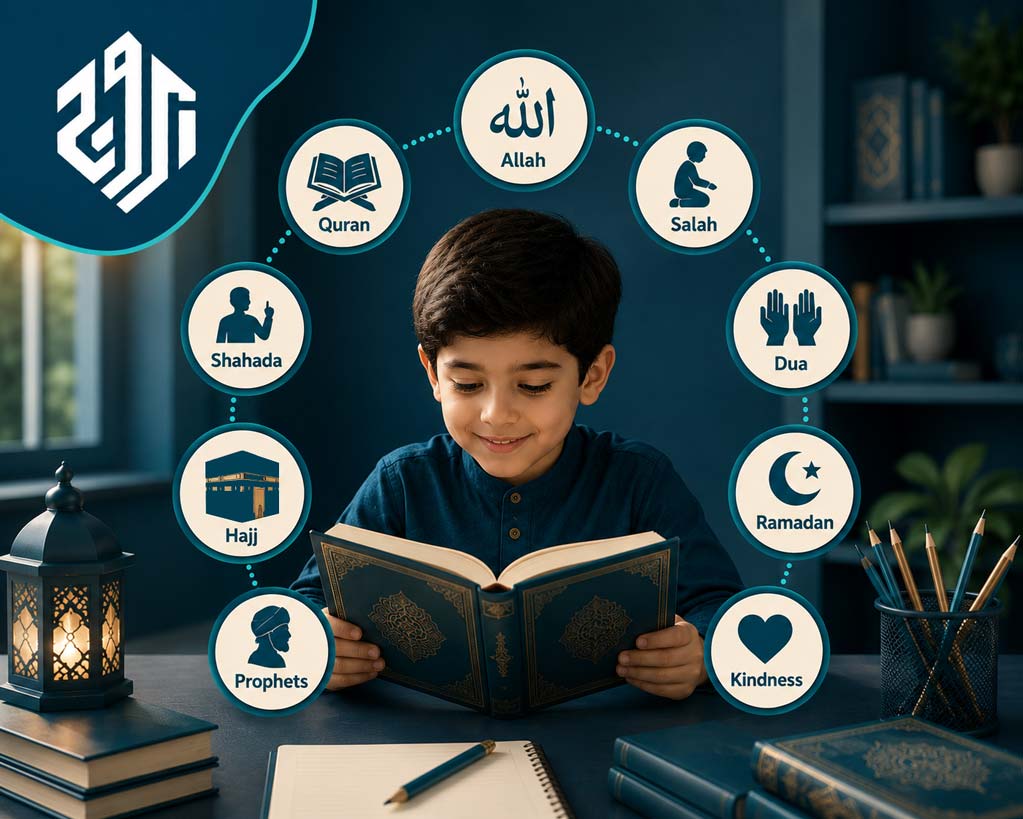
The Six Articles of Faith are the core beliefs every Muslim child must grasp first: Allah, His angels, His revealed books, His prophets, the Day of Judgment, and divine decree. Together they answer a child’s biggest question — what do Muslims actually believe, and why?
Introduce these one at a time rather than all six together. Younger children absorb belief in Allah and angels quickly; save Qadar for once they already understand cause and effect.
2. The Five Pillars of Islam Explained for Young Learners
The Five Pillars — Shahada, Salah, Zakat, Sawm, and Hajj — are the practical framework of daily and yearly Muslim life. Children grasp these fastest through demonstration rather than lecture, especially Salah, which they can watch and imitate directly.
Our detailed pillars of Islam for kids guide walks through each pillar by age and learning style.
3. Simple Stories From the Life of Prophet Muhammad ﷺ
Seerah stories for young children work best when focused on relatable moments — his honesty as a young trader, his kindness to animals, his patience with difficult neighbors. These give children a model of character they can imitate directly, not just facts to recall.
We find children under eight connect most with three or four short, vivid episodes repeated often. Our Prophet Muhammad story for kids resource offers age-matched sequences.
4. Stories for Kids of the Prophets Before Muhammad ﷺ
Stories of earlier prophets teach children that Islam connects to a long chain of guidance. Start with five or six whose lessons are clearest: Yunus and the whale, Ibrahim and the fire, Musa and Pharaoh are the stories children retell most accurately weeks later.
Our full prophets in Islam for kids guide sequences the major prophetic narratives by age group.
5. Everyday Duas Children Can Memorize and Use Immediately
Everyday duas — for waking up, eating, and sleeping — give children an immediate, practical connection to worship. Unlike abstract topics, duas are used the same day they’re taught, which reinforces retention through repetition rather than isolated memorization.
Teach no more than one new dua weekly for children under seven, attaching each to an existing daily action for faster habit formation.
6. Short Surahs Every Muslim Child Should Memorize First
Short Surahs like Al-Fatiha, Al-Ikhlas, Al-Falaq, and An-Nas are the most efficient entry point into memorization. Their brevity and rhythm make them easier to retain than longer passages, while still carrying complete theological meaning.
In our experience, children starting with Surah Al-Ikhlas typically memorize its four verses within one or two focused sessions. Our easy Surahs of the Quran to memorize guide lists the full starting sequence.
7. What Is the Best Age to Start Quran Memorization?
Most children can begin structured memorization between ages four and six, once they can repeat short phrases accurately and sit focused for five to ten minutes. Starting earlier without this readiness often causes frustration rather than retention.
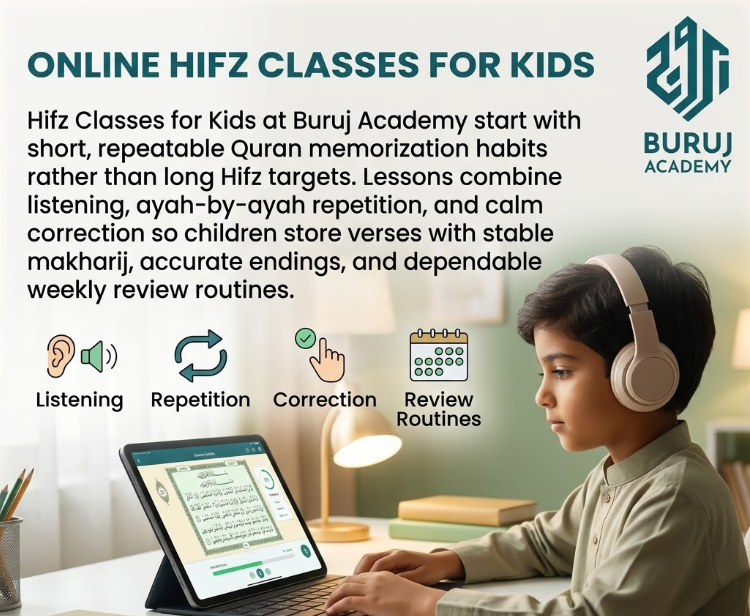
Readiness matters more than age alone. Our full answer on the best age to memorize Quran breaks down readiness signs by stage, and our Hifz for Kids program paces revision around sustainable daily habits rather than aggressive targets.
Start your child’s Hifz classes with a FREE session
8. Basic Tajweed Rules Introduced Through Sound Before Rule Names
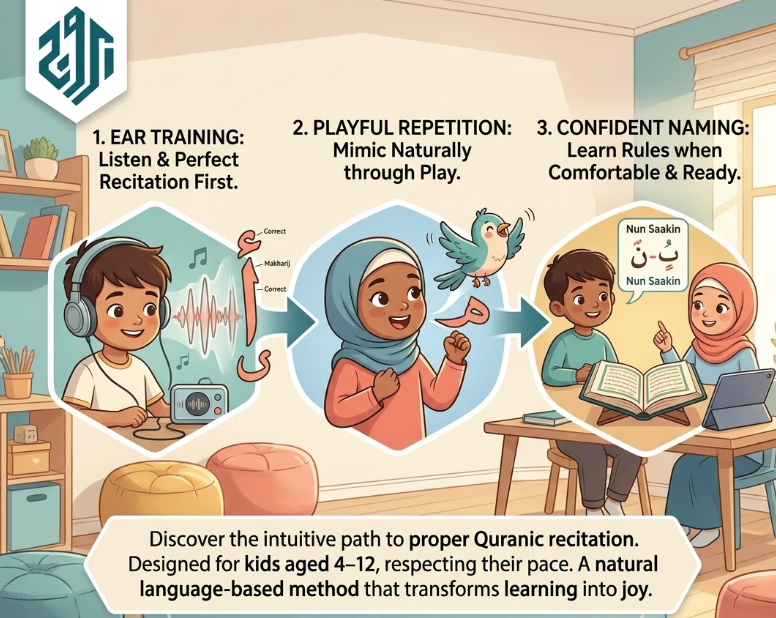
Basic Tajweed for children begins with correct sound production, not memorized terminology. A five-year-old does not need the word “Qalqalah” to produce the correct echo on ق ط ب ج د when they carry sukoon — hearing and repeating comes first.
The most common early mistake we observe is children rushing Madd letters, shortening elongations that should hold for two counts.
Our Tajweed for Kids course corrects this through listening and repetition, and our tajweed games and activities for kids guide offers exercises for home practice.
Book your child’s free Tajweed trial lesson today
Discover the Buruj Academy Difference
Step into our virtual classrooms and see how our expert instructors make learning Quran and Arabic intuitive and clear. We focus on overcoming the specific hurdles non-native speakers face, building your confidence and connection with the Quran.
Expand Your Islamic Knowledge
Join our structured online courses led by qualified instructors to deepen your understanding of the Deen.
Join a Free Trial Class9. Islamic Manners (Adab) for Everyday Situations
Adab topics — greeting with Salaam, eating with the right hand, respecting elders — translate belief into visible daily behavior. These are often the most immediately practical topics for young children, since they apply in nearly every interaction.
Children absorb adab fastest when parents model it themselves. A child who hears “Assalamu Alaikum” exchanged naturally at home uses it confidently outside within weeks.
Read also:Islamic Manners for Kids
10. Why Do Muslims Pray Five Times a Day?
Salah connects a Muslim to Allah five times daily, structuring the entire day around remembrance rather than confining worship to one moment. For children, this becomes meaningful once they can name each prayer and its approximate time.
Children learn Salah’s movements most reliably through side-by-side practice. We recommend one week focused purely on movements, then a second week adding spoken phrases, to reduce cognitive load.
Read also:The Islamic Way to Boost Children’s Brain
11. Understanding Ramadan and Fasting at a Child’s Level
Ramadan introduces Sawm, fasting from dawn to sunset, alongside increased Quran reading, charity, and family gathering. Children too young to fast full days can still participate through partial fasts or symbolic practices matched to their ability.
Framing Ramadan around what children gain — family time, special foods, shared achievement — builds more genuine enthusiasm than framing it primarily around restriction.
12. What Is Zakat and How Can Children Practice Giving?
Zakat is obligatory charity for financially able Muslims, but children benefit from an age-adjusted version: voluntary sadaqah. Giving allowance money, donating outgrown toys, or helping prepare charity boxes teaches the underlying principle early.
Children who practice small, consistent giving generally show less resistance to formal Zakat obligations as adults, since giving already feels like a normal, positive habit.
Read also: Teaching Islamic Manners to Children
13. Islamic Character Traits Every Child Should Practice
Character topics translate Quranic values into daily behavior children can practice immediately: honesty in small matters, kindness to siblings, patience during frustration. These traits appear repeatedly throughout Seerah stories, reinforcing multiple topics at once.
Character lessons land best tied to a specific recent incident rather than taught abstractly — a conversation about honesty right after a child admits a small mistake works far better than a general lesson in isolation.
Read also:Islamic Stories for Kids
Why Respecting Parents Holds Such a High Place in Islam
Respecting parents holds an elevated status in Islamic teaching, often mentioned near worship of Allah Himself.
The Quran directs believers to safeguard themselves and their households from the Hellfire, a command found in At-Tahrim 66:6 that places responsibility on parents to actively guide their households, not simply issue rules.
14. Simple Explanations of Halal and Haram for Young Children
Children need a basic framework for halal and haram before encountering food, media, and behavior choices independently. Keep early explanations concrete — certain foods, actions, and speech fall into each category, with reasons matched to the child’s age.
Avoid overwhelming young children with edge cases early on. A solid grasp of clear-cut examples matters more initially than full Fiqh detail, which can layer in gradually.
Read also: Bedtime Stories from the Quran for Kids
15. Building Islamic Identity When Surrounded by a Different Culture
Children raised as religious minorities in Western countries often need explicit conversations about balancing Islamic identity with surrounding cultural norms. Left unaddressed, this tension can quietly erode confidence rather than resolve on its own.
Frame differences positively, explaining why a practice exists rather than only noting it differs from peers.
Our how to keep Islamic identity for kids guide addresses common school and social scenarios directly.
16. Why Learning Arabic Alongside Quran Study Matters
Arabic literacy allows children to eventually read and understand the Quran directly, rather than relying solely on translation. Even basic alphabet recognition accelerates later Tajweed learning, since children already recognize letter shapes before articulation rules begin.
Our Noorani Qaida for Kids course builds this exact foundation, sequencing letter recognition before word formation so children read confidently before advancing further.
Sign up your kid for a free Noorani Qaida lesson
17. How to Make Islamic Learning Fun Instead of a Chore
Islamic learning sustains itself long-term only when children experience genuine enjoyment alongside structured instruction. Games, storytelling, and friendly memorization challenges transform repetitive practice into something children look forward to rather than resist.
Our how to make reading Quran fun for kids guide and our best Quranic games for kids resource both offer ready-to-use activity ideas for home practice.
Building a Consistent Weekly Islamic Learning Routine at Home
A sustainable weekly routine matters more than any single topic on this list, since consistency determines whether knowledge actually sticks. Rotating through belief, worship, character, and Quran topics across a structured week prevents any single area from being neglected.
| Day Focus | Suggested Activity |
| 2 days | Quran memorization review |
| 2 days | Prophet or character story |
| 1 day | Fiqh or practical topic |
| Weekend | Flexible, family-paced review |
Our how to learn the Quran for kids guide offers a fuller structural framework for building this routine from scratch.
Give Your Child a Strong Islamic Foundation With Buruj Academy
Eighteen topics only build lasting faith when taught consistently by someone trained to teach children specifically.
Buruj Academy’s Online Islamic Studies Classes for Kids, Hifz for Kids, and Quranic Arabic Course for Kids are taught by Al-Azhar University graduates and Ijazah-certified instructors with 12+ years teaching non-Arabic speaking children.
Every child receives a Personalized Learning Plan matched to age and pace, built on the Buruj Method’s patience-before-performance approach, with flexible 1-on-1 scheduling for families anywhere.
Book a free trial lesson today and see how expert-led Islamic education transforms your child’s confidence and connection to faith.
Join a global community of learners and find the path that best supports your spiritual and intellectual growth:
- Online Studies Islamic Classes (General & Flexible)
- Islamic Studies Course for Beginners (Foundational Knowledge)
- Islamic Studies Classes for Kids (Engaging & Values-Based)
- Islamic Studies Classes for Adults (In-Depth Theological Discussion)
- Islamic Studies Classes for Ladies (Sisterhood & Specialized Learning)
- Islamic Studies Classes for New Muslims (Guided Support & Essentials)
- Tafseer Al Quran Course (Unlocking Divine Meanings)
- Quranic Sciences (Uloom Al Quran) Course (Advanced Linguistic & Historical Context)
Ready to enrich your life with sacred knowledge? Connect with Buruj Academy today and book your free introductory session to begin your journey!
Expand Your Islamic Knowledge
Join our structured online courses led by qualified instructors to deepen your understanding of the Deen.
Join a Free Trial ClassDiscover the Buruj Academy Difference
Step into our virtual classrooms and see how our expert instructors make learning Quran and Arabic intuitive and clear. We focus on overcoming the specific hurdles non-native speakers face, building your confidence and connection with the Quran.
Conclusion
Raising a religiously confident child rarely comes down to one dramatic lesson. It comes from steady exposure to the right topics, in the right order, taught with patience.
The eighteen topics above give parents a complete starting map, from core belief through Quran memorization to daily character habits. Each builds on the last, creating a foundation that deepens naturally as your child grows.
Frequently Asked Questions About Islamic Topics for Children
What Is the Easiest Islamic Topic to Start Teaching a Young Child?
Short Surahs like Al-Ikhlas and daily duas are typically the easiest starting points, combining brevity, repetition, and immediate practical use. Children see results within days, which builds early motivation for continued learning.
How Many Islamic Topics Should Be Taught Per Week?
Most children retain material best when parents focus on one or two core topics weekly, reinforced daily through short review sessions. Overloading a child with too many new concepts at once typically reduces retention rather than accelerating it.
At What Age Should Children Start Learning About the Day of Judgment?
Children generally handle this concept best from around age seven or eight, once they have a foundational understanding of Allah’s mercy. Introducing it earlier, without that context, can create unnecessary anxiety rather than understanding.
Should Islamic Studies and Quran Memorization Be Taught Together?
Yes — Islamic studies and Quran memorization work best when taught in parallel, since Quran verses often reinforce the belief and character topics being studied simultaneously. This mirrors how our Online Islamic Studies Classes for Kids structure weekly lessons.
What if My Child Resists Islamic Learning at Home?
Resistance often stems from lessons feeling repetitive or disconnected from daily life, not a lack of interest in faith itself. Incorporating games, stories, and real-life application, as outlined above, typically re-engages reluctant learners effectively.