 Quran
Quran
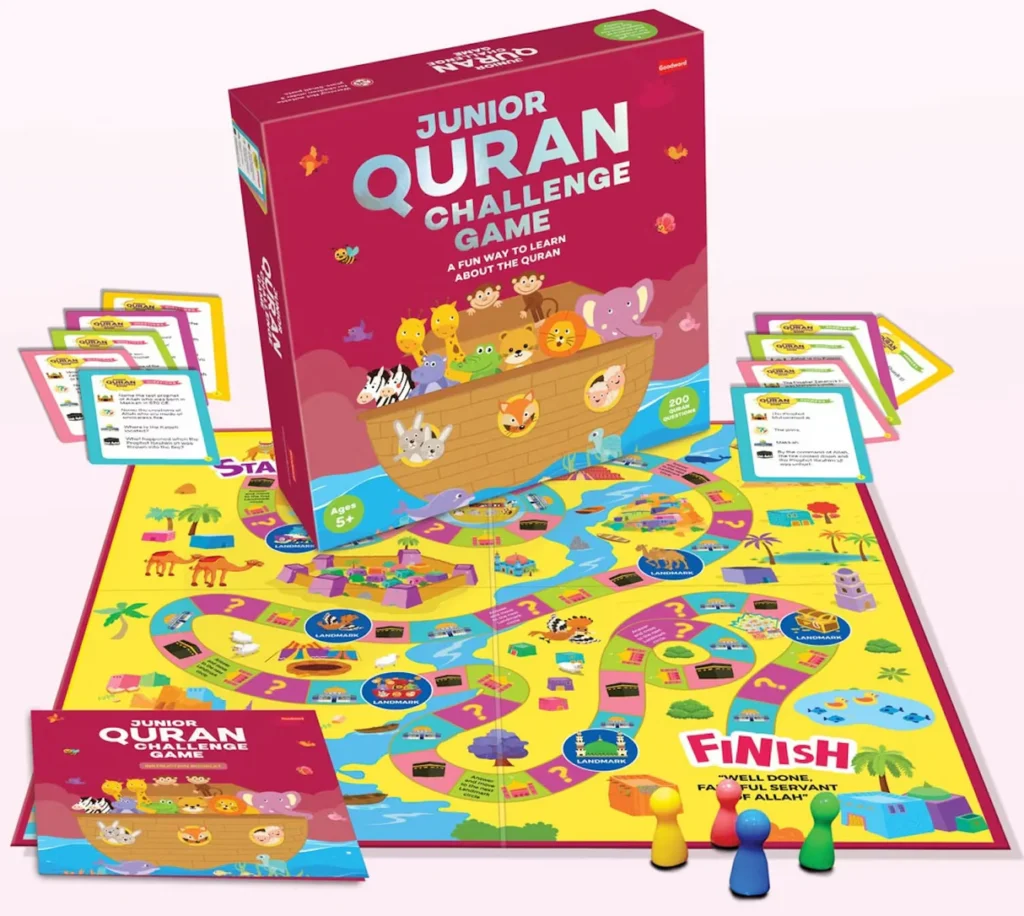
| Key Takeaways |
| Quranic games reduce screen-time resistance by channeling children’s natural play instincts toward meaningful Islamic learning. |
| Quran puzzle games reinforce surah recognition and Arabic letter sequencing through hands-on, tactile engagement for younger learners. |
| Quran quiz games with answers build competitive motivation while testing memorization accuracy in a low-pressure, rewarding environment. |
| Free online Quran games for kids offer accessible supplemental practice between structured lessons, particularly for busy Western families. |
| The most effective Quranic games combine recitation practice with visual or movement-based rewards, reinforcing retention through multiple senses. |
Every parent knows the look — a child’s eyes glazing over mid-lesson, their attention wandering to anything except the Quran in front of them. This is not a sign of disinterest in Islam; it is a sign that children learn through play, and our teaching methods need to meet them there.
The best Quranic games for kids make the Quran feel exciting, not obligatory. From interactive Quran quiz games with answers to tactile Quran puzzle games, the right tools transform daily Quran time into something children actually look forward to — while preserving every ounce of the reverence the Quran deserves.
Table of Contents:
1. Surah Flashcard Memory Match Is One of the Most Effective Quranic Games for Young Children
Surah flashcard memory match pairs surah names with their meanings or short ayahs, placed face-down in a grid. Children flip two cards at a time, trying to find matching pairs — and every successful match earns a recitation moment.
This game builds surah recognition, Arabic vocabulary, and short-term recall simultaneously.
In our sessions at Buruj Academy, we observe that children aged 5–8 retain surah names roughly 40% faster when paired with a visual-matching activity than through repetition alone.
The game mechanics trigger the brain’s reward pathway — matching creates a small victory, and victory creates motivation.
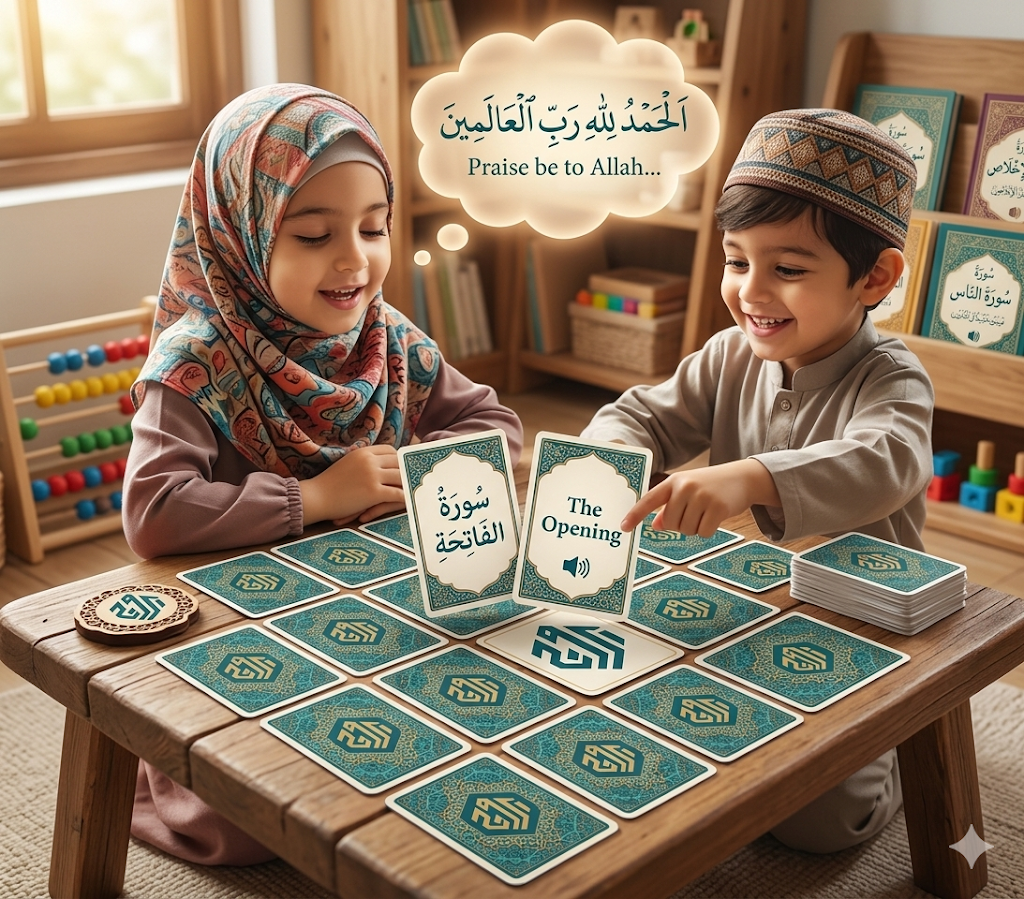
How to set it up at home:
- Write surah names in Arabic on one set of cards and English meanings on another
- For beginners, limit to 5–6 surahs from Juz 30 — the short, commonly recited ones
- When a match is found, the child recites the surah aloud before claiming the pair
This works beautifully as a weekly family activity after Maghrib, keeping the atmosphere warm, light, and connected to worship.
2. The Quran Puzzle Game Builds Letter Recognition and Surah Sequencing in Early Learners
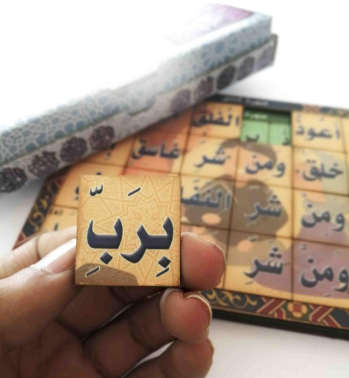
Quran puzzle games involve assembling ayahs or surah titles from individual Arabic word or letter pieces. The physical act of fitting pieces together encodes the visual shape of Arabic script in a child’s memory — something that passive listening simply cannot replicate.
For children just beginning their reading journey, we recommend starting with Noorani Qaida-level puzzles — individual Arabic letters with their isolated, initial, medial, and final forms. Once letter shapes are secure, progress to ayah-level puzzles using short surahs like Al-Ikhlas or Al-Kawthar.
| Puzzle Type | Age Range | Learning Target |
| Arabic letter shape puzzles | 3–5 years | Letter recognition, shape distinction |
| Surah title puzzles | 5–7 years | Surah name familiarity, Arabic reading |
| Short ayah puzzles | 7–10 years | Word-level Quran reading, sequencing |
| Full surah assembly | 10+ years | Memorization reinforcement, review |
Physical Quran puzzle sets are available from Islamic education suppliers, and printable versions can be made at home from free Arabic font templates. Buruj Academy’s Online Quran Classes for Kids complement puzzle practice by ensuring children recognize the same words in live recitation.
Help your child start learning the Quran with a FREE trial

3. The Quran Quiz Game with Answers Sharpens Memorization Through Friendly Competition
A Quran quiz game with answers is one of the most scalable Quranic activities for kids across all ages.
Questions can range from “Which surah comes after Al-Fatiha?” for young beginners to “What does the word al-falaq mean?” for older students — making it adaptable to every level.
The key is structure. A well-run quiz about Quran with answers is not a test; it is a game with points, rounds, and celebration. Frame it that way, and children lean forward rather than shrinking back.
How to Run a Home Quran Quiz Competition
Set up a simple three-round format:
- Round 1 — Surah identification: Play a recitation clip and ask the child to name the surah
- Round 2 — Meaning round: Give the English meaning and ask for the Arabic surah name
- Round 3 — Recitation challenge: Name a surah and ask for the first three ayahs from memory
Award points for each correct answer and introduce a small, halal reward for the winner — extra story time, a favorite snack, or choosing the next family activity.
For families with multiple children, this naturally becomes a Quran quiz competition that everyone anticipates each week.
We find that exploring interesting Quran facts for kids before the quiz session gives children conversational confidence — they arrive knowing something, which lowers anxiety and raises participation.
4. Free Quran for Kids Games Online Offer Accessible Daily Practice Between Structured Lessons
Free Quran for kids games online fill the gap between formal lessons — the 10–15 minutes after school when a child is not ready for structured study but is perfectly happy to play on a device.
Platforms like Zaky World, Muslim Kids TV, and several Islamic app stores offer free Quran games online covering letter recognition, surah memorization, and basic tajweed sounds.
When evaluating free Quran for kids games online, we apply three filters at Buruj Academy:
| Filter | What to Look For | Red Flag |
| Recitation accuracy | Audio from a certified reciter | Unclear or mispronounced audio |
| Age appropriateness | Level-adjusted content | Same difficulty for all ages |
| Reverence in design | Calm, respectful visual tone | Overly cartoon-ified Quran text |
The best free Quran games online treat the Quran’s text with dignity — they do not animate Quranic script or present ayahs as “obstacles” in action games.
Supplemental screen-based games work best when capped at 15–20 minutes per session and followed by offline recitation practice.
Excel in Your Quranic Studies
Join Buruj Academy and master the Quran with our structured, professional curriculum.
Book Your Free Trial5. Quran for Kids Games Online Featuring Tajweed Audio Train the Ear Before the Eye
Quran for kids games online that incorporate correct tajweed audio are significantly more valuable than text-only games. When children hear a properly recited ayah repeated in a game context — matching it, completing it, or identifying it — their ears are calibrated to the correct sound before they ever read the rule.
This is the foundation of the Buruj Method: sound before rules. A child who has heard ghunnah correctly in a game will recognize it instantly when their teacher names it later. The ear leads; the mind follows.
Look specifically for online Quran games that include:
- Native Arabic recitation audio (not computer-generated voice)
- Repetition mechanics — hearing the same ayah 5–7 times per game session
- Completion games where children finish the next word of an ayah after hearing the first
Buruj Academy’s Tajweed Rules for Kids resource helps parents understand which tajweed sounds to listen for when evaluating game audio quality.
Read also: Arabic Quiz for Kids
6. Prophets and Quran Trivia Games Connect Islamic Knowledge to Quranic Context
Trivia games that link Quranic surahs to their broader Islamic context — stories of prophets, names of companions, historical events — build what educators call “meaningful hooks.”
When a child learns that Surah Al-Fil describes the Year of the Elephant, the surah becomes a story, and stories are remembered.
A simple Prophets Trivia game might ask:
- “Which prophet is mentioned most in the Quran?” (Musa, peace be upon him)
- “Which surah is named after the mother of Isa?” (Surah Maryam)
- “How many prophets are mentioned by name in the Quran?” (25 prophets)
These questions are factually grounded and contextually rich. For deeper background, our blog on prophets in Islam for kids provides age-appropriate summaries that families can use to prepare quiz material together.
7. Movement-Based Quran Recitation Games Make Learning Physical and Memorable
Children’s bodies are not designed to sit still — and forcing stillness during Quran time often creates negative associations with the Quran itself. Movement-based recitation games solve this without compromising reverence.
One effective format is Ayah Relay:
Children stand in a line, and each child recites one word of an ayah before sitting down. The next child picks up the next word. The group completes the ayah as a relay team — and every child is responsible for their word.
Another proven format is Stop and Recite:
Play halal nasheed-style background audio, and when it pauses, a child must recite the next ayah from their current memorization portion. This builds the reflex of Quran recitation as a natural, spontaneous act.
| Game | Movement Type | Best For |
| Ayah Relay | Standing, passing | Group settings, siblings |
| Stop and Recite | Walking, freezing | Individual or pairs |
| Surah Hopscotch | Jumping, pointing | Ages 4–7, outdoor settings |
| Arabic Letter Run | Running to letter cards | Alphabet learners |
These games respect the Quran fully — children are reciting correctly, not playing with the text itself. The movement is the game mechanic; the recitation is always treated with care.
8. Structured Quran Activities for Kids at Home Reinforce What Online Games Cannot Replace
Online games and quiz formats are powerful supplements, but they cannot replace the structured Quran activities for kids that build genuine reading and recitation skill. The most effective home Quran environment combines:
- Daily game-based review (10–15 minutes) using the formats above
- Structured recitation practice (15–20 minutes) with a qualified instructor
- Weekly family quiz competition to consolidate weekly learning
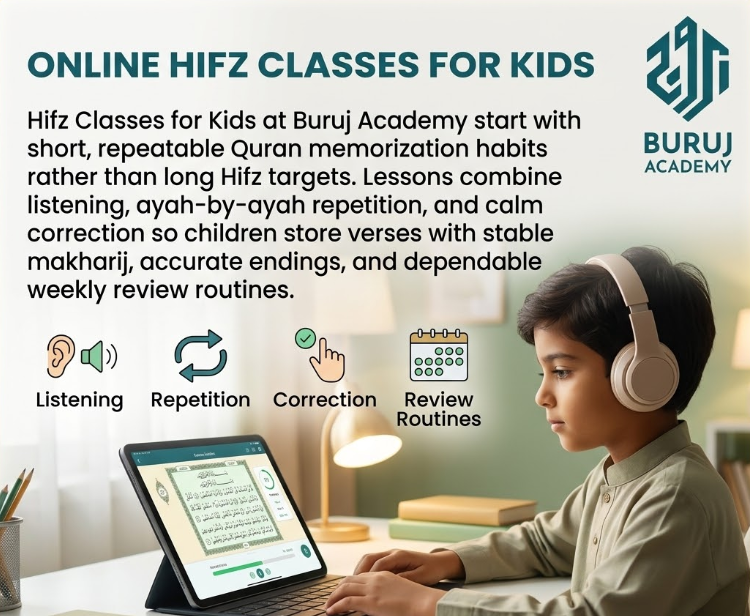
Buruj Academy’s Hifz for Kids course integrates gamified review techniques directly into the memorization curriculum — instructors use call-and-response, timed recitation challenges, and surah sequencing games within 1-on-1 sessions to keep young learners engaged across every session.
Start your child’s Hifz classes with a FREE session
The best age to memorize Quran research confirms what we observe in practice: children aged 5–12 absorb Quranic Arabic with remarkable speed when their learning environment is both structured and joyful. Games are what create the joy half of that equation.
Discover the Buruj Academy Difference
Step into our virtual classrooms and see how our expert instructors make learning Quran and Arabic intuitive and clear. We focus on overcoming the specific hurdles non-native speakers face, building your confidence and connection with the Quran.
Start Your Child’s Quranic Learning with Buruj Academy’s Expert Kids Instructors
The games above give your child momentum — Buruj Academy gives them direction. Our Online Quran Classes for Kids and Hifz for Kids course are taught by Al-Azhar University graduates and Ijazah-certified instructors with 12+ years teaching non-Arabic speaking children worldwide.
Every session uses the Buruj Method — age-appropriate pacing, sound-before-rules recitation training, and real-time feedback in personalized 1-on-1 classes. Flexible scheduling means lessons fit around school, weekends, and family life.
Enroll your child in one of our specialized, kid-friendly tracks today:
- Online Quran Classes for Kids
- Tajweed Classes for Kids
- Hifz Classes for Kids
- Online Arabic Classes for Kids
- Quranic Arabic Course for Kids
- Noorani Qaida Course for Kids
- Islamic Studies Classes for Kids
Ready to watch your child grow in knowledge and character? Join the Buruj Academy family and book a free trial session for your child today!
Book your child’s free trial lesson today and see the difference structured, expert teaching makes alongside the games you play at home.
Excel in Your Quranic Studies
Join Buruj Academy and master the Quran with our structured, professional curriculum.
Book Your Free TrialConclusion
Quranic games are not a distraction from serious learning — they are the entry point to it. When children associate the Quran with excitement, reward, and play, they bring that same positive energy into their memorization sessions, their recitation practice, and eventually, their personal relationship with Allah’s Book.
The games in this guide are tools, not replacements. Pair them with qualified instruction, consistent daily practice, and a home atmosphere of love for the Quran — and Insha’Allah, your child will not just memorize it, but cherish it.
Read also: 5 Pillars of Islam for Kids
Frequently Asked Questions About Quranic Games for Kids
What Age Can Children Start Playing Quran Games?
Children as young as 3 years old can engage with Arabic letter puzzle games and surah matching activities. Structured quiz formats suit ages 6 and above, while full Quran quiz competition formats work best from age 8 onward, once a child has memorized enough material to draw on confidently.
Are Free Quran for Kids Games Online Reliable for Learning?
Free Quran games online vary significantly in audio quality and recitation accuracy. The most reliable options feature audio from certified reciters, not computer-generated voice. Always test the audio yourself before introducing any platform to your child, and use online games as a supplement — not a replacement — for structured lessons.
How Do Quran Puzzle Games Help with Memorization?
Quran puzzle games reinforce the visual shape of Arabic words and the sequential order of ayahs through hands-on manipulation. When children physically assemble an ayah, their spatial and tactile memory engages alongside auditory memory — creating multiple retrieval pathways that significantly strengthen long-term retention.
How Can We Run a Quran Quiz Competition at Home?
A home Quran quiz competition works best with three clear rounds: surah identification, meaning recognition, and recitation challenge. Assign points per round, keep time pressure light, and celebrate every correct answer. Rotate which child acts as quiz host — this deepens their own knowledge while building confidence.
Do Quranic Games Replace the Need for a Formal Quran Teacher?
Quranic games reinforce learning — they do not replace it. A qualified teacher corrects pronunciation errors, applies tajweed rules accurately, and builds systematic progression that games alone cannot provide. Games are most effective when they consolidate what a certified instructor has already taught in structured sessions.