 Quran
Quran

| Key Takeaways |
| Reciting and reflecting on Quran daily strengthens memory pathways through repetition, rhythm, and structured recall practice. |
| Consistent Salah builds a child’s focus and self-regulation through five daily anchors of stillness and concentration. |
| Storytelling through Seerah and Prophet stories builds sequencing, memory, and moral reasoning skills simultaneously. |
| Structured, age-appropriate learning environments outperform unstructured self-study for both retention and religious identity. |
Watching a child struggle to focus during homework while reciting last week’s Quran lesson flawlessly is a pattern many Western Muslim parents notice early. It raises a real question: does the same practice shaping a child’s faith also shape their mind?
The Islamic tradition offers a coherent answer. Quran memorization, structured prayer, disciplined sleep, and moral storytelling each engage attention, memory, and self-regulation — the core building blocks of a sharp, resilient young mind.
Table of Contents:
1. Establish Daily Quran Recitation as a Memory-Building Habit for Your Kid
Daily Quran recitation is the single most effective Islamic practice for strengthening a child’s memory, because it combines repetition, rhythm, and active recall in one activity. Even five to ten minutes daily builds neural pathways associated with pattern recognition and long-term retention.
In our sessions at Buruj Academy, we consistently observe that children who recite even a few verses daily — rather than cramming once weekly — retain material far more reliably.
This mirrors how memory consolidation works: short, spaced repetition outperforms long, infrequent sessions.
Consistency matters more than volume here. A child reciting three verses every day for a month will typically out-retain a child who recites thirty verses once and doesn’t return to them.
This is precisely why families exploring how to learn the Quran for kids are encouraged to start small, structured, and daily rather than ambitious and sporadic.
Why Short Surahs Work Best for Young Beginners
Short surahs like Al-Fatiha, Al-Ikhlas, and An-Nas give children an achievable daily win, which reinforces motivation alongside memory. Choosing from a list of easy surahs of Quran to memorize removes the guesswork for parents unsure where to begin.
Once early surahs feel secure, families can progress through structured Juz Amma memorization for kids, building confidence one small surah at a time.
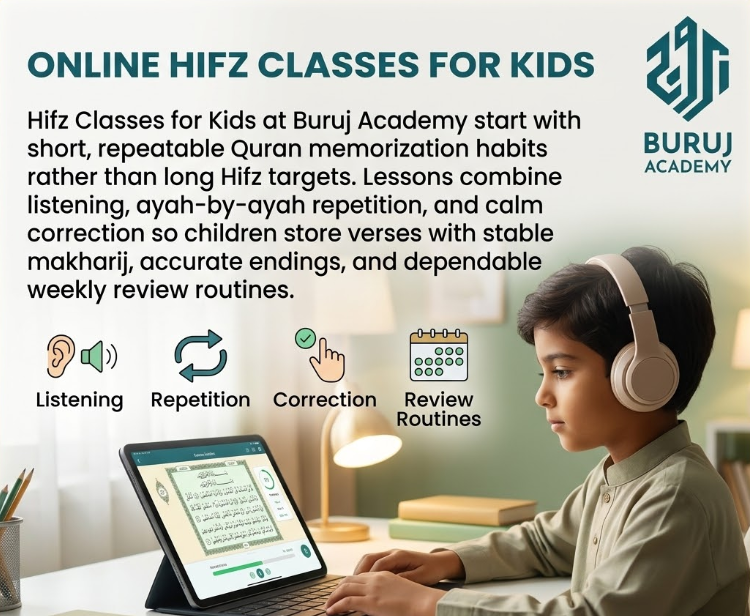
At Buruj Academy, our Online Hifz Program uses this exact sequencing — starting small, celebrating each surah completed, and layering new material only once the previous portion is secure.
Start your child’s Hifz classes with a FREE session
2. Anchor the Child’s Day Around the Five Daily Prayers for Focus Training
Salah performed five times daily trains a child’s brain to shift attention deliberately, hold stillness, and return focus after distraction — a skill directly transferable to schoolwork and daily tasks. Each prayer functions as a structured mental reset.
Children who pray consistently often show improved transition skills between activities, because Salah itself is a practiced transition — from play, distraction, or frustration into calm, focused stillness five times a day.
We’ve noticed in our classes that students who maintain regular prayer habits tend to settle into recitation sessions more quickly than those without an established prayer rhythm. The stillness required in Salah appears to carry over.
Parents building this habit alongside Quran learning often find our guide on how to teach Islam to a child useful for sequencing prayer alongside other foundational practices.
Linking Salah Timing to Natural Attention Rhythms
Younger children benefit from praying at consistent times tied to daily routines — after waking, after school, before bed — rather than rigid clock-watching. This routine-based approach reduces resistance and builds automatic habit formation faster than reminders alone.
Read also:Islamic Quiz Games for Kids
3. Prioritize Sleep and Reduce Screen Time Following Prophetic Guidance
Adequate sleep is essential for memory consolidation, and Islamic tradition consistently emphasizes early rest and early rising. The Prophet ﷺ discouraged unnecessary conversation after Isha, prioritizing rest that modern neuroscience now confirms is critical for learning.
Sleep is when the brain consolidates the day’s learning — including anything memorized that day. A child who recites Quran then stays up late on a screen is undermining the very retention that recitation built hours earlier.
Reducing evening screen exposure, particularly in the hour before sleep, supports both better sleep quality and the quiet reflection time the Islamic tradition encourages before bed.
| Practice | Cognitive Benefit | Islamic Basis |
| Early, consistent bedtime | Memory consolidation during sleep | Discouraging idle talk after Isha |
| Reduced screen time before bed | Better sleep onset, reduced overstimulation | Encouragement of quiet reflection before sleep |
| Regular sleep-wake schedule | Sustained daytime attention span | Structure around Fajr and daily prayer times |
This table summarizes how three sleep-related habits connect directly to Islamic practice.
Read also: Islamic Topics for Children
4. Use Prophet Stories and Seerah to Build Your Child’s Memory and Moral Reasoning
Storytelling through Seerah and Prophet narratives strengthens a child’s sequencing memory, cause-and-effect reasoning, and moral judgment simultaneously — three cognitive skills rarely developed together through a single activity. Stories are inherently more memorable than isolated facts.
Children retain sequenced narratives — beginning, challenge, resolution — far more easily than disconnected information, because the brain naturally organizes memory around story structure.
We’ve found that students who hear the Prophet Muhammad story for kids regularly can often recall specific lessons months later, tied to the story that taught them.
Broader collections of prophets in Islam for kids extend this same sequencing benefit across multiple narratives, reinforcing pattern recognition over time.
Turning Stories Into Active Recall Exercises for Your Kid
Asking a child to retell a story in their own words — rather than simply listening passively — converts passive exposure into active recall, which is significantly more effective for long-term retention.
Parents can pair storytelling sessions with our list of Islamic topics for kids and youth to keep a steady rotation of new material feeding this recall habit.
5. Introduce Nooraani Qaida or Structured Arabic Letters Early for Your Child
Learning Arabic letters through a structured system like Nooraani Qaida builds foundational phonemic awareness, which research consistently links to stronger reading skills across any language a child later learns. Letter-sound mapping is a core early literacy skill.
Children who master Arabic letter-sounds early often transition into reading fluency faster, because the phonemic awareness built through Qaida transfers to decoding skills generally.
In our experience, non-Arabic speaking children typically need consistent, short daily sessions — not lengthy weekly ones — before letter recognition becomes automatic and effortless.
At Buruj Academy, our Noorani Qaida for Kids course uses visual aids, repetition, and gamified review specifically designed for this early developmental window.
Sign up your kid for a free Noorani Qaida lesson

Discover the Buruj Academy Difference
Step into our virtual classrooms and see how our expert instructors make learning Quran and Arabic intuitive and clear. We focus on overcoming the specific hurdles non-native speakers face, building your confidence and connection with the Quran.
Expand Your Islamic Knowledge
Join our structured online courses led by qualified instructors to deepen your understanding of the Deen.
Join a Free Trial Class6. Teach Tajweed Rules to Strengthen Auditory Discrimination Skills
Tajweed training requires children to distinguish subtle sound differences — like the nasal resonance of Ghunnah or the articulation points of similar letters — which sharpens auditory discrimination broadly, not just for Quranic recitation.
This kind of careful listening practice has real transfer value. A child trained to hear the difference between similar Arabic sounds often becomes more attentive to subtle differences in spoken language generally.
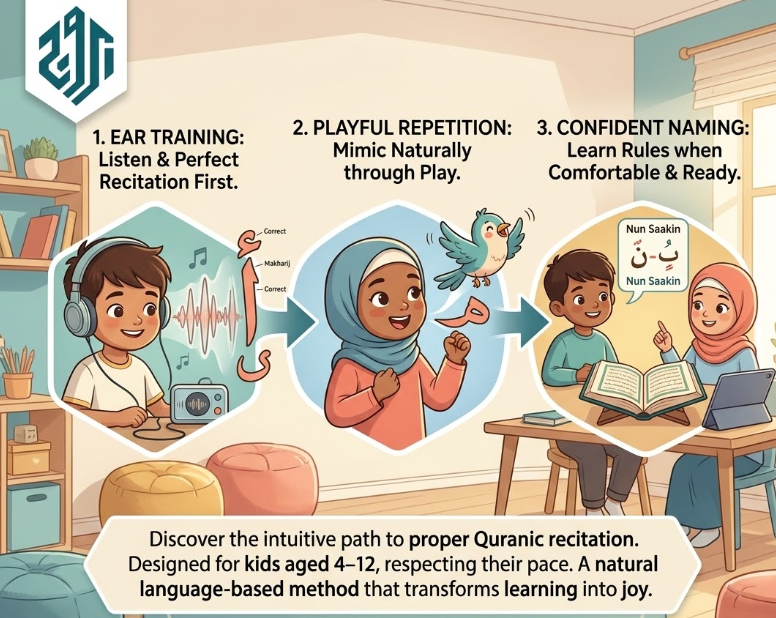
Our Ijazah-certified instructors at Buruj Academy teach through our Online Tajweed Classes, applying the Buruj Method’s sound-before-rules approach so children build the ear before memorizing terminology.
Families ready to formalize this skill find our guide on Tajweed rules for kids a useful starting reference.
Making Tajweed Practice Playful Rather Than Rigid
Games and interactive Tajweed games and activities for kids keep auditory discrimination practice engaging rather than tedious, which sustains attention far longer than repetitive drilling alone.
Book your child’s free Tajweed trial lesson today
7. Build Sustainable Routines for Your Kid Instead of Relying on Motivation Alone
Children’s brains respond better to predictable structure than to inconsistent bursts of enthusiasm, because habits formed through routine require less conscious effort to maintain than habits dependent on daily motivation. Routine reduces the mental friction of getting started.
A fixed time and place for Quran review — even ten minutes after Asr — removes the daily decision-making that often derails good intentions.
We consistently see that families who build a Quran memorization schedule around fixed daily windows sustain progress longer than families who “find time when they can.”
Making Learning Enjoyable Sustains Long-Term Engagement
Approaches drawn from how to make reading Quran fun for kids — games, rewards, and playful variation — keep children returning to practice willingly rather than resentfully.
8. Provide Structured Guidance Rather Than Unstructured Self-Teaching
Structured instruction from a qualified teacher consistently outperforms unstructured self-study for children, because a trained instructor corrects errors immediately before they become ingrained habits that are harder to unlearn later.
Self-taught pronunciation errors, once repeated hundreds of times, become significantly harder to correct than errors caught early by an attentive teacher.
At Buruj Academy, our Online Quran Classes for Kids pair each child with an instructor trained specifically in child pedagogy, ensuring real-time correction rather than reinforced mistakes.
This structured approach also protects a child’s Islamic identity, giving them consistent access to qualified guidance regardless of where the family lives.
Help your child start learning the Quran with a FREE trial

Expand Your Islamic Knowledge
Join our structured online courses led by qualified instructors to deepen your understanding of the Deen.
Join a Free Trial ClassRead also:Islamic Motivation for Kids: Inspiring Young Hearts
Strengthen Your Child’s Mind and Faith Together with Buruj Academy
Every practice above — recitation, prayer, sleep, storytelling, Tajweed — builds cognitive skill while deepening faith simultaneously.
Buruj Academy brings these practices together through Ijazah-certified instructors and Al-Azhar University graduates with 12+ years teaching non-Arabic speakers worldwide.
Our Buruj Method — sound-before-rules, context-before-abstraction, consistency-before-speed — builds lasting skill rather than surface memorization. Personalized 1-on-1 sessions adapt to your child’s age, pace, and learning style, with flexible scheduling for busy Western households.
Book a free trial lesson and see how structured, faith-centered learning strengthens both your child’s mind and their connection to the Quran.
Join a global community of learners and find the path that best supports your spiritual and intellectual growth:
- Online Studies Islamic Classes (General & Flexible)
- Islamic Studies Course for Beginners (Foundational Knowledge)
- Islamic Studies Classes for Kids (Engaging & Values-Based)
- Islamic Studies Classes for Adults (In-Depth Theological Discussion)
- Islamic Studies Classes for Ladies (Sisterhood & Specialized Learning)
- Islamic Studies Classes for New Muslims (Guided Support & Essentials)
- Tafseer Al Quran Course (Unlocking Divine Meanings)
- Quranic Sciences (Uloom Al Quran) Course (Advanced Linguistic & Historical Context)
Ready to enrich your life with sacred knowledge? Connect with Buruj Academy today and book your free introductory session to begin your journey!
Conclusion
Sharpening a child’s mind and strengthening their faith were never separate goals in the Islamic tradition — they were always one integrated practice. Daily recitation, structured prayer, disciplined rest, and meaningful storytelling each pull double duty, building cognitive skill while anchoring belief.
Parents don’t need to choose between raising a capable learner and raising a grounded believer. The habits outlined above, applied consistently and supported by qualified instruction, build both at once — steadily, and Insha’Allah, for life.
Frequently Asked Questions About Islamic Ways to Boost Children’s Brain Development
What Is the Best Islamic Practice for Improving a Child’s Memory?
Daily Quran recitation, even five to ten minutes, is widely considered the most effective single practice. It combines repetition, rhythm, and active recall — three elements proven to strengthen long-term memory retention in children.
Does Praying Five Times a Day Really Help Children Focus Better?
Yes, indirectly but meaningfully. Each Salah requires a deliberate shift into stillness and concentration, practiced five times daily. This repeated attention-shifting builds transferable focus skills useful for schoolwork and daily tasks.
At What Age Should Children Start Learning Quran for Cognitive Benefits?
Most instructors recommend beginning simple recitation and listening around ages four to six, adjusting pace to the child’s readiness. Our guide on the best age to memorize Quran offers detailed, age-specific guidance.
Can Screen Time Undo the Benefits of Quran Memorization?
Excessive screen time, especially before bed, can interfere with the sleep quality needed for memory consolidation. Reducing evening screens supports both better rest and stronger retention of material learned earlier that day.
Is It Better to Teach Children Quran at Home or with a Structured Course?
Structured instruction generally outperforms self-teaching, because qualified instructors catch pronunciation and memorization errors immediately, before they become difficult-to-unlearn habits. This is especially valuable for non-Arabic speaking families.