 Tajweed

The Prophet ﷺ said that the one who recites the Quran proficiently will be with the noble, righteous scribes (Sahih Muslim 798). That proficiency begins with learning Tajweed from qualified teachers in a structured setting.
A Tajweed institute is where correct recitation becomes a permanent habit rather than an occasional effort. Whether you are reading the Quran for the first time or working to eliminate long-held errors, the right institute provides the expert feedback, systematic curriculum, and consistent practice that no app or self-study method can replicate.
Table of Contents:
What Is a Tajweed Institute?
A Tajweed institute is a dedicated educational institution — online or offline — that provides structured instruction in the rules of Tajweed, the system governing proper Quranic pronunciation, articulation, and melodic recitation.
Tajweed institutes follow established curricula rooted in classical scholarship, with qualified instructors who hold recognized credentials.
The core purpose is simple: to help students recite the Quran the way it was revealed and transmitted — precisely, beautifully, and consistently.
For non-Arabic speakers in particular, this kind of specialized environment is essential, because general language learning cannot address the nuances of Quranic phonology.
If you are new to this subject, our guide on Tajweed for beginners provides a solid orientation before you begin formal enrollment.
What is the Best Online Tajweed Institute?
The best online Tajweed institute combines scholarly credibility, pedagogical structure, and genuine care for student outcomes. Buruj Academy was built specifically around these three pillars.
Our teaching team consists of Al-Azhar University graduates and Ijazah-certified instructors who have spent 12+ years teaching non-Arabic speaking students across Europe, North America, and Australia.
This specific experience matters: teaching Tajweed to native Arabic speakers is fundamentally different from teaching it to English speakers who must overcome completely different phonetic habits.
Book Your FREE Trial Lesson to Begin Your Tajweed Journey
Buruj Academy’s Tajweed for Beginners course introduces foundational rules systematically, starting with sound recognition before progressing to rule application — ensuring correct habits are built from the first lesson. For students who want to advance further, our Tajweed rules essential guide outlines the full progression roadmap.
Students asking how long the learning process takes will find our detailed breakdown in how long to learn Tajweed — with realistic timelines based on actual student data from our programs.
Book Your FREE Trial Lesson to Begin Your Tajweed Journey
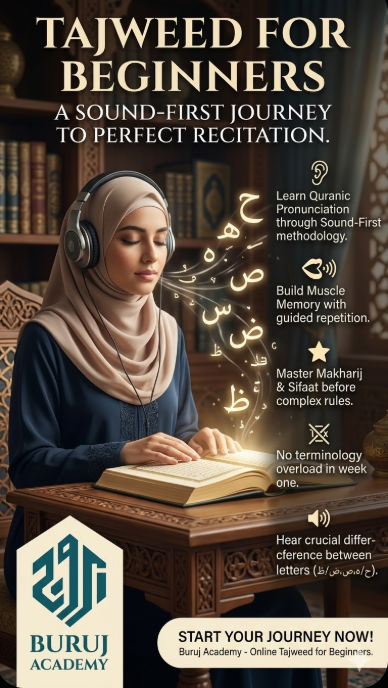
The Buruj Method: Sound Before Rules
Most Tajweed programs teach rules as abstract labels — students memorize “Ikhfa occurs when Noon sakinah is followed by one of 15 letters” without developing the physical sensation of correct nasal resonance.
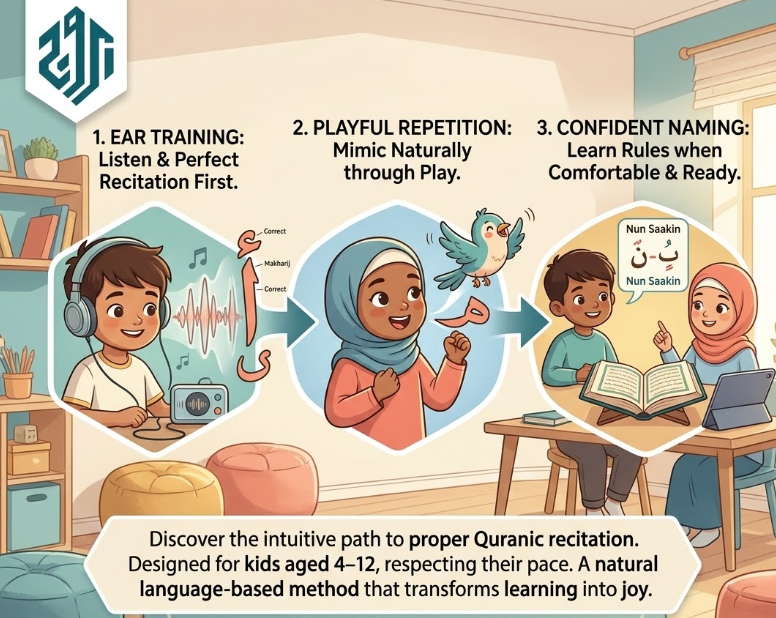
The Buruj Method inverts this sequence. We train the ear and the articulators first — students hear and produce the correct sound before being given the rule name.
In our experience, this approach reduces the time to consistent application by several weeks compared to rule-first methods.
What Buruj Academy’s Tajweed Courses Offer
| Feature | Buruj Academy |
| Instructor qualification | Al-Azhar graduates + Ijazah holders |
| Session format | 1-on-1 live video |
| Scheduling | Flexible 24/7 global availability |
| Curriculum | Structured, sequential rule progression |
| Feedback | Real-time correction during recitation |
| Progression tracking | Regular assessments with instructor feedback |
| Advanced pathway | Leads to Ijazah program eligibility |
For students with children, our Tajweed for Children course applies age-appropriate methods that make articulation practice engaging without losing rigor. Parents looking to support their children’s learning can also explore our guide on Tajweed rules for kids.
Book your child’s free Tajweed trial lesson today
Read also: What is Tajweed?
Why Is Enrolling in a Tajweed Institute Important?
Enrolling in a Tajweed institute matters because Tajweed rules govern meaning, not just sound. Mispronouncing a single letter — confusing ح (ha) with هـ (ha), for example — can distort the meaning of a verse entirely.
1. Self-Study Cannot Replace Qualified Correction
In our Tajweed for Beginners course sessions at Buruj Academy, the most consistent pattern we observe is this: students who learned from videos or apps for months arrive with deeply ingrained errors they cannot hear themselves.
This happens because proper Tajweed requires a trained ear providing real-time external feedback. Without it, incorrect habits solidify — and become significantly harder to correct later.
2. The Islamic Obligation Behind Tajweed
Allah ﷻ commands in the Quran:
وَرَتِّلِ ٱلْقُرْءَانَ تَرْتِيلًا
Wa rattil il-Qur’āna tartīlā
“And recite the Quran with measured recitation.” (Al-Muzzammil 73:4)
Classical scholars of Tajweed, including Ibn al-Jazari, considered Tajweed an individual obligation (fard ‘ayn) upon every Muslim who recites the Quran. A structured Tajweed institute is the most reliable path to fulfilling this obligation correctly.
Read also:Learn Tajweed Rules Through Practical Examples
3. Structured Progression Versus Scattered Learning
| Learning Method | Feedback Quality | Rule Retention | Error Detection | Progression Speed |
| Self-study / apps | None | Low | Very low | Unpredictable |
| Group classes | Occasional | Moderate | Moderate | Slow |
| Tajweed institute (1-on-1) | Immediate | High | High | Consistent |
A dedicated institute ensures rules are taught in the right sequence — Noon sakinah before Meem sakinah, basic Madd before extended Madd types — building correct habits at every stage.
What Do You Study at a Tajweed Institute?
A well-structured Tajweed institute covers the full science of Tajweed systematically, from foundational phonetics to advanced recitation refinement. Students progress through interconnected layers of knowledge, each building on the last.
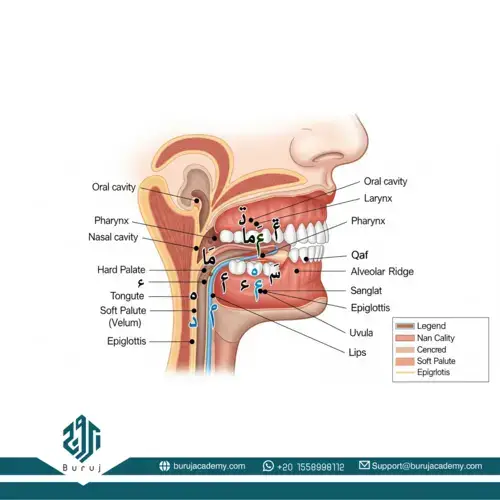
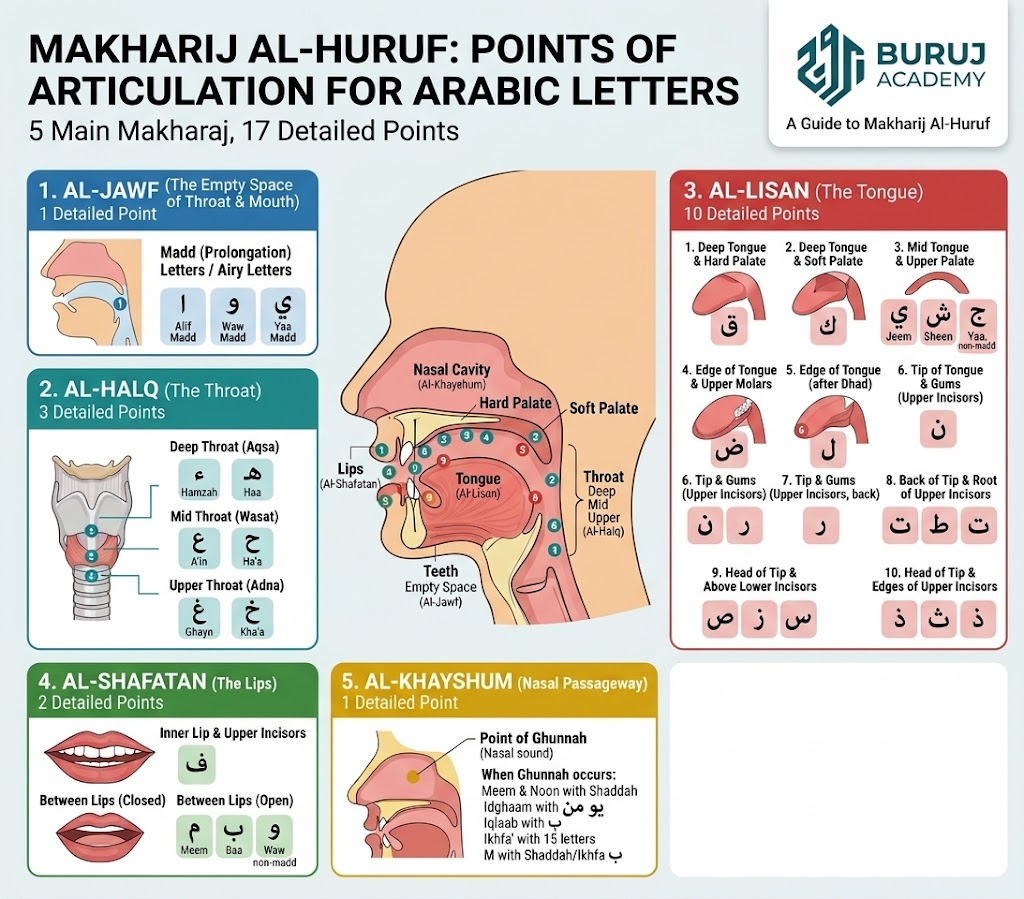
1. Makharij Al-Huruf — The Articulation Points
Before rules are introduced, students learn precisely where each Arabic letter is produced in the vocal tract. The 17 primary articulation points are grouped across five regions: the chest (الجوف, al-jawf), the throat (الحلق, al-halq), the tongue (اللسان, al-lisān), the lips (الشفتان, ash-shaftān), and the nasal passage (الخيشوم, al-khayshūm).
For a deep study of this topic, our guide on makharij al-huruf covers each point with precision.
2. Sifat Al-Huruf — Letter Attributes
Each letter carries permanent characteristics (sifat lazimah) — such as hams (breathiness), jahr (vibration), shiddah (complete stop) — that determine how it sounds regardless of context.
These attributes must be applied consistently, and a qualified instructor identifies when a student is softening a strong letter or over-emphasizing a light one.
Read also: The Best Tajweed Tutors
Discover the Buruj Academy Difference
Step into our virtual classrooms and see how our expert instructors make learning Quran and Arabic intuitive and clear. We focus on overcoming the specific hurdles non-native speakers face, building your confidence and connection with the Quran.
Excel in Your Quranic Studies
Join Buruj Academy and master the Quran with our structured, professional curriculum.
Book Your Free Trial3. The Core Tajweed Rule System
| Rule Category | What It Governs | Key Examples |
| Noon Sakinah & Tanween | 4 rules: Idhar, Idgham, Iqlab, Ikhfa | Idgham with ghunnah, Ikhfa letters |
| Meem Sakinah | 3 rules: Ikhfa Shafawi, Idgham Shafawi, Idhar Shafawi | Meem before Ba, Meem |
| Madd (Prolongation) | Natural and secondary lengthening rules | Madd Asli (2 counts), Madd Muttasil (4–5 counts) |
| Tafkhim & Tarqiq | Heavy vs. light letter pronunciation | Letters of استعلاء vs. light letters |
| Qalqalah | Echo sound on 5 letters at sukoon | ق ط ب ج د |
| Waqf & Ibtida | Rules for stopping and starting | Correct stopping points in recitation |
A strong institute also teaches Idgham rules, Ghunnah, and Qalqalah letters as distinct modules with dedicated practice time.
4. Applied Recitation — Amali Tajweed
Theory without application produces students who can state rules but cannot apply them mid-recitation. Serious Tajweed institutes dedicate an Amli Tajweed course with substantial class time to supervised recitation, where instructors correct errors in real time using the actual Quranic text.
Book Your FREE Trial Lesson in Buruj’s Amli Tajweed Course
How to Choose the Best Tajweed Institute?
Choosing the right Tajweed institute is one of the most important decisions a student makes for their Quranic education. Several criteria separate excellent institutes from average ones.
1. Instructor Credentials Are Non-Negotiable
The minimum qualification for a Tajweed instructor is an Ijazah — a certified chain of transmission connecting the teacher directly to the Prophet ﷺ through an unbroken line of qualified reciters.
Ijazah-certified instructors who are also Al-Azhar University graduates represent the highest standard available. Always verify credentials before enrolling.
Book a FREE trial session with one of Buruj’s Azhari Quran tutors

2. Curriculum Structure and Methodology
| Quality Indicator | Strong Institute | Weak Institute |
| Instructor credentials | Ijazah + University degree | No formal certification |
| Curriculum sequence | Rule-by-rule with applied practice | Rules taught randomly |
| Feedback mechanism | Real-time correction in 1-on-1 session | Pre-recorded or group only |
| Student assessment | Regular recitation tests | No formal evaluation |
| Pedagogical approach | Sound-before-rules (Buruj Method) | Rules memorized abstractly |
3. Student-Teacher Ratio
1-on-1 sessions are dramatically more effective than group classes for Tajweed. Errors are personal — a student’s specific mispronunciation of ض (daad) requires individual attention, not a general lesson on the letter. The best institutes prioritize personalized sessions with flexible scheduling.
4. Flexible Online Access Without Quality Compromise
The question of offline versus online has largely been settled. Online Tajweed institutes that use live 1-on-1 video instruction, certified teachers, and structured curricula now deliver results equal to or better than local options — with the added benefit of global access.
Our article on how to read Quran with Tajweed outlines what consistent practice looks like across both formats.
At Buruj Academy, our Online Tajweed Classes help students master makharij and sifat through the Buruj Method — training the ear before introducing rules — guided by Ijazah-certified instructors with 12+ years of experience teaching non-Arabic speakers.
Book Your FREE Trial Lesson to Begin Your Tajweed Journey
Read also: The 10 Best Reciters to Learn Tajweed From (With Audio Links)
What are the Best Offline Tajweed Institutes?
Offline Tajweed institutes remain valuable for students who prefer in-person learning environments. The most respected institutions globally include those affiliated with Al-Azhar University in Cairo, the Quran and Sunnah centers in Madinah, and established Islamic centers in Western countries with certified teaching staff.
When evaluating offline options, the same credential-based criteria apply: Ijazah certification, structured curriculum, and a supervised recitation component.
Geography should not lower standards — a local masjid class taught by an unqualified volunteer is not a substitute for certified instruction, regardless of convenience.
For students in regions without access to qualified offline teachers, online institutes have become the primary — and often superior — alternative. The critical factor remains instructor quality, not physical location.
Start Your Recitation with Buruj Academy’s Expert Tajweed Instructors
Proper Tajweed recitation is a lifelong gift — and it begins with choosing the right teachers. Buruj Academy offers the structured, credential-backed Tajweed instruction that non-Arabic speaking students around the world deserve.
Our programs offer:
- Ijazah-certified instructors and Al-Azhar University graduates
- 12+ years of experience teaching non-Arabic speakers globally
- The Buruj Method: Sound-before-rules for lasting recitation accuracy
- Personalized 1-on-1 sessions with flexible 24/7 scheduling
- Real-time correction and individualized learning plans
- Clear progression from beginner foundations to advanced Tajweed mastery
Book your free trial lesson today and experience the Buruj Academy difference firsthand.
Join a supportive learning environment tailored to your pace and lifestyle. Start your journey toward excellence by enrolling in one of our specialized tracks:
- Online Tajweed Classes
- Tajweed Classes for Beginners
- Tajweed Classes for Adults
- Tajweed Classes for Sisters
- Tajweed Classes for Kids
- Advanced Tajweed Course
- Amli Tajweed Course (Practical Application)
Ready to transform your recitation? book your free assessment and start your path to Tajweed mastery today!
Excel in Your Quranic Studies
Join Buruj Academy and master the Quran with our structured, professional curriculum.
Book Your Free TrialConclusion
The difference between a qualified institute and an informal class is the difference between permanently corrected recitation and permanently reinforced errors. Credential verification, 1-on-1 instruction, and sound-first pedagogy are what separate serious institutions from well-meaning but insufficient alternatives. Buruj Academy was built to meet exactly this standard — combining scholarly authority with genuine, experienced care for every student’s recitation. Alhamdulillah, that commitment is what makes the difference.
Frequently Asked Questions About Tajweed Institutes
Do I Need Prior Arabic Knowledge to Enroll in a Tajweed Institute?
No prior Arabic knowledge is required for most Tajweed institutes, including Buruj Academy. Beginner Tajweed courses begin with letter recognition, basic articulation points, and foundational sounds. Many of our most successful students had no Arabic background whatsoever when they enrolled in our Tajweed for Beginners course.
Is Online Tajweed Instruction as Effective as In-Person Learning?
Yes — provided the online institute uses live 1-on-1 sessions with qualified instructors and real-time feedback. Pre-recorded courses are not equivalent. At Buruj Academy, our live video sessions allow instructors to identify and correct mispronunciations in the same session where they occur, replicating and often exceeding the precision of in-person correction.
How Long Does It Take to Complete a Tajweed Course?
Completion timelines vary based on starting level, session frequency, and individual progress. In our instructors’ experience at Buruj Academy, students attending three sessions per week typically achieve functional Tajweed proficiency within four to eight months. Advanced Tajweed, including Ijazah preparation, requires significantly longer with more intensive practice.
What Qualifications Should a Tajweed Teacher Hold?
A qualified Tajweed teacher should hold an Ijazah — a certified transmission license — and ideally a university degree from a recognized Islamic institution such as Al-Azhar. The Ijazah guarantees the teacher’s recitation has been verified through an unbroken chain of qualified reciters tracing back to the Prophet ﷺ. All Buruj Academy instructors meet this standard.
Related Articles
Tajweed