 Tajweed
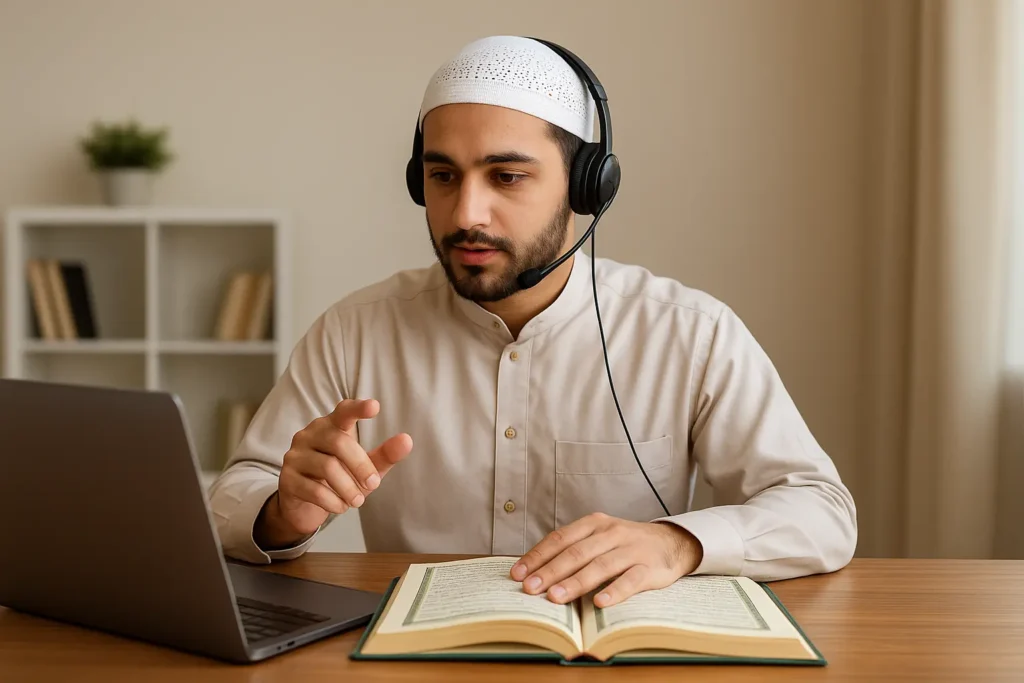
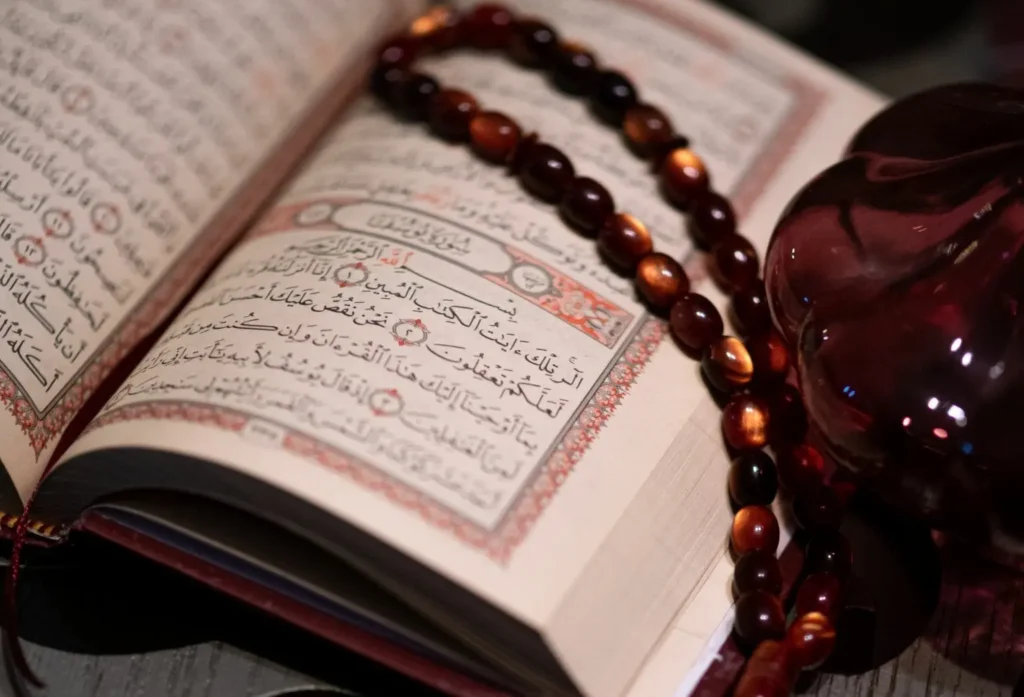
Finding a qualified tajweed tutor is one of the most consequential decisions a Muslim non-Arabic speaker will make in their Quran learning journey.
The difference between a good teacher and the wrong one can mean years of mispronunciation hardwired into your recitation.
The right tajweed tutor does more than explain rules — they train your ear, correct your articulation in real time, and build the sound habits that make beautiful recitation possible. At Buruj Academy, our Online Tajweed Classes are built entirely around this standard.
Table of Contents:
What Qualifications Should Tajweed Tutors Have?
Qualified tajweed tutors must hold at minimum an Ijazah in Quranic recitation — a certified chain of transmission linking the teacher back, through verified narrators, to the Prophet Muhammad ﷺ himself. Beyond this, they need formal training in makharij al-huruf, sifat, and the applied rules of Hafs ‘an ‘Asim or another recognized riwayah.
Teaching experience with non-Arabic speakers is a separate and equally necessary qualification.
An Ijazah is not merely an academic degree. It represents verified oral transmission — the teacher has recited the entire Quran to a qualified sheikh who corrected them letter by letter, and only then were they authorised to teach. This standard is what separates authentic tajweed instruction from YouTube tutorials.
Why Al-Azhar Training Matters for Tajweed Teachers
Al-Azhar University is the oldest continuously operating Islamic university in the world, and its Faculty of Quranic Studies sets the global standard for tajweed pedagogy. Graduates of Al-Azhar’s Quran programs receive rigorous training in the theoretical science of tajweed (‘ilm al-tajweed) alongside years of applied recitation practice.
At Buruj Academy, the majority of our tajweed tutors are Al-Azhar University graduates and Ijazah-certified instructors — not one or the other, but both. This combination ensures students receive academically grounded and orally transmitted instruction.
Book a FREE trial session with one of Buruj’s Azhari Quran tutors
What Teaching Non-Native Speakers Actually Requires
Non-Arabic speakers face pronunciation challenges that native Arabs never encounter. The letters ع (Ayn), خ (Kha), غ (Ghayn), ح (Ha), and the distinction between emphatic and non-emphatic letters represent entirely foreign sounds for English speakers.
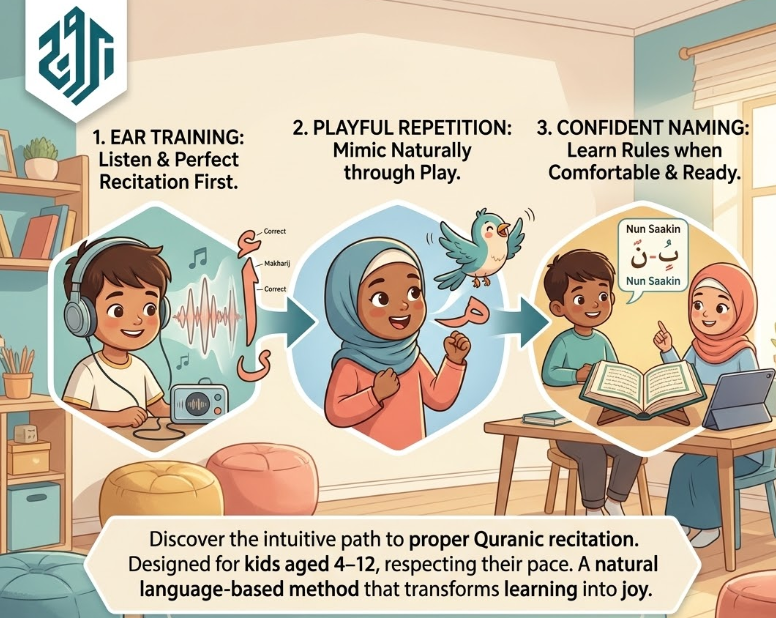
In our instructors’ experience at Buruj Academy, students who have studied with tutors untrained in non-native speaker pedagogy often arrive with one specific problem: they have memorized rule names but cannot apply them during live recitation. The Buruj Method addresses this directly — sound before rules, always.
Male Tajweed Tutors
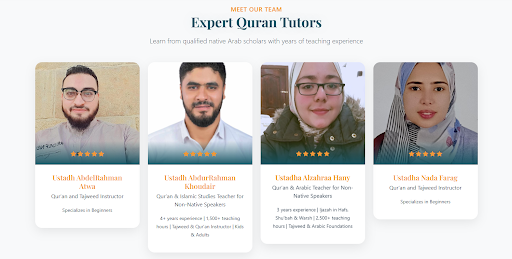
Buruj Academy employs male tajweed tutors serving all students — men, mixed-family households, and children. Each instructor below brings verified credentials and real classroom hours with non-native speakers.
| Ustadh | Credentials | Teaching Hours | Specialization |
| Ustadh Muhammed Nasser | Al-Azhar Graduate, 16+ years Al-Azhar education | 1,400+ | Tajweed for non-native speakers, ages 4+ |
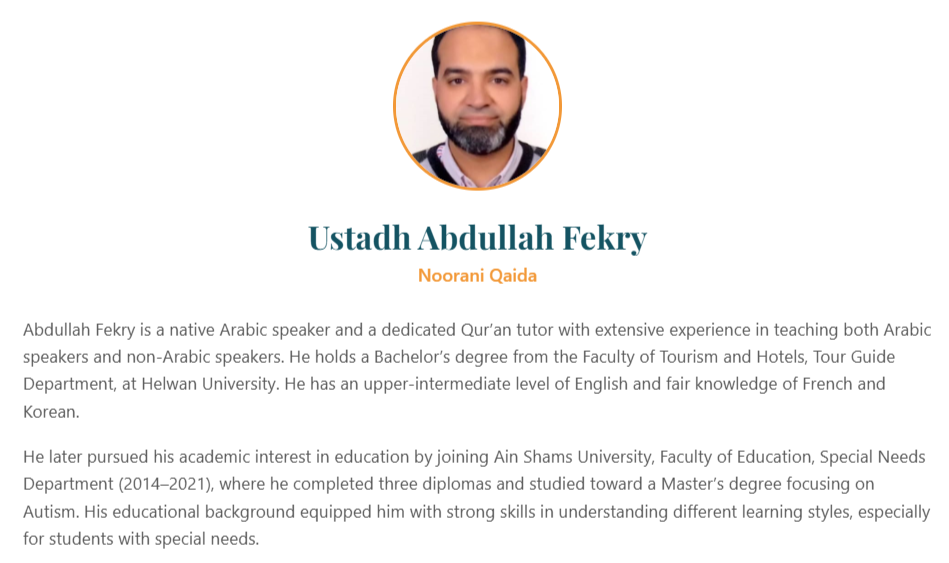
| Ustadh Abdullah Fekry | Ijazah in Hafs, Ibn ‘Amer & Abu ‘Amr | 4,500+ | Special needs students, Arabs & non-native speakers |
| Ustadh AbdurRahman Khoudair | Tajweed & Qur’an Instructor | 1,500+ | Kids & adults, non-native speakers |
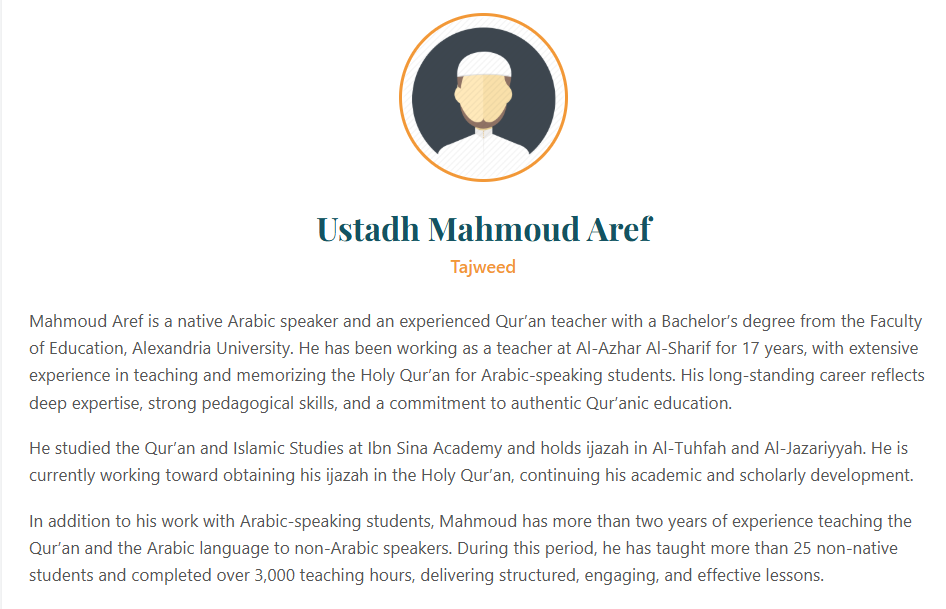
| Ustadh Mahmoud Aref | Al-Azhar Teacher, 17 years experience | 3,000+ | Non-native student specialization |
| Ustadh Anas Elgayyar | Memorized 26 Juz’, Noor Al-Bayan specialist | 400+ | Interactive lessons, Tajweed foundations |
Ustadh Abdullah Fekry is notable among our team for holding multiple Ijazahs — in Hafs, Ibn ‘Amer, and Abu ‘Amr — with over 4,500 teaching hours. His additional specialization in special needs students makes him a rare and valuable instructor.
Ustadh Mahmoud Aref brings 17 years of experience and over 3,000 hours specifically with non-native students — a depth of repetition with this learner group that produces finely tuned pedagogical instincts.
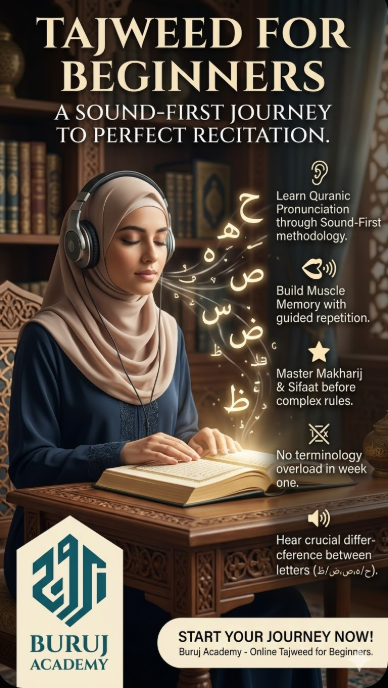
Buruj Academy’s Tajweed for Beginners course pairs beginners with instructors matched to their level, learning style, and age — ensuring the right male tutor for every student profile.
Book Your FREE Trial Lesson to Begin Your Tajweed Journey
Female Tajweed Tutors
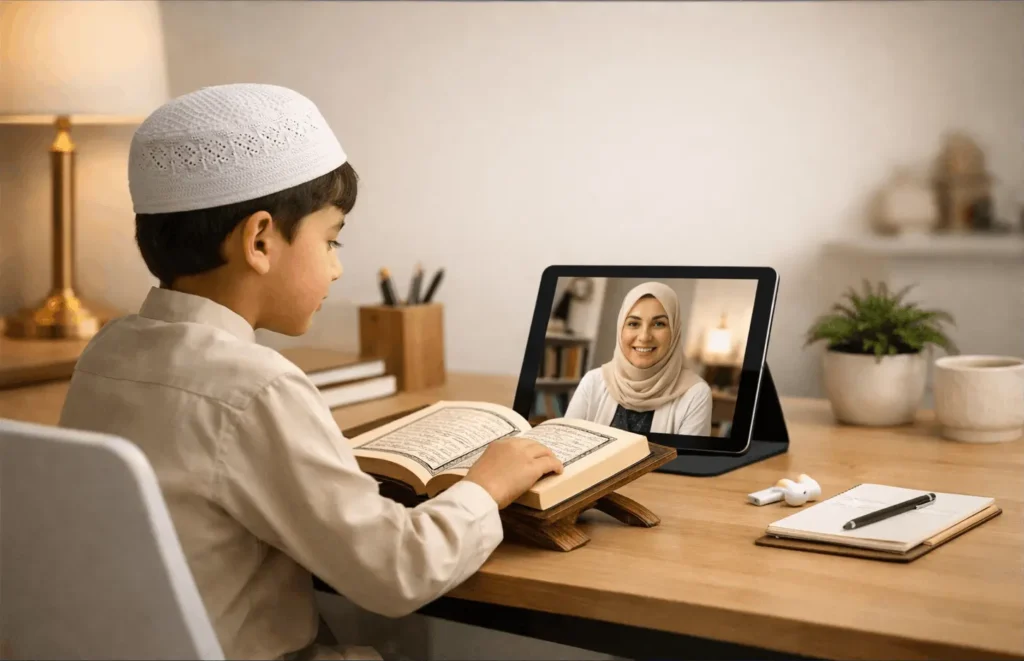
For sisters, children learning with female teachers, and families who prefer female-only instruction, Buruj Academy offers a dedicated team of qualified women tajweed tutors — all certified, experienced, and trained in non-native speaker pedagogy.
| Ustadha | Credentials | Teaching Hours | Specialization |
| Ustadha Rehab Adel Allam | Al-Azhar Graduate, Ijazah in Tajweed | 3,700+ | Non-native speakers, ages 5+ |
| Ustadha Alzahraa Hany | Ijazah in Hafs, Shu’bah & Warsh | 2,500+ | Tajweed & Arabic Foundations |
| Ustadha Abeer Sayed | Qur’an, Arabic & English Teacher | 2,600+ | Kids & adults, simplified Tajweed |
| Ustadha Mariam Abohammer | Memorized Qur’an | 1,700+ | Recitation, memorization & Tafsir for non-Arabs |
| Ustadha Sara Amgad Mahmoud | Hafidhah, Languages Graduate with Honors | 1,000+ | Kids (6+), teens & women |
| Ustadha Nessma Sayed | Al-Azhar Graduate, Educational Diploma | — | Tajweed & Noor Al-Bayan, kids & adults |
| Ustadha Rahma Melegy | Noor Al-Bayan Certified, English Major (B2) | — | Kids & adults, interactive online teaching |
| Ustadha Khadija Ahmed | Tajweed & Noor Al-Bayan Specialist | 2,000+ | Multilingual instruction, non-native speakers |
| Ustadha Eman Khattab | Hafidh, English Medium | — | Tajweed & Arabic for kids and women |
Ustadha Rehab Adel Allam stands out with over 3,700 teaching hours, an Al-Azhar degree, and a specific Ijazah in Tajweed — one of the most complete credential profiles in our female faculty.
Read also: Free Tajweed Resources
Discover the Buruj Academy Difference
Step into our virtual classrooms and see how our expert instructors make learning Quran and Arabic intuitive and clear. We focus on overcoming the specific hurdles non-native speakers face, building your confidence and connection with the Quran.
Excel in Your Quranic Studies
Join Buruj Academy and master the Quran with our structured, professional curriculum.
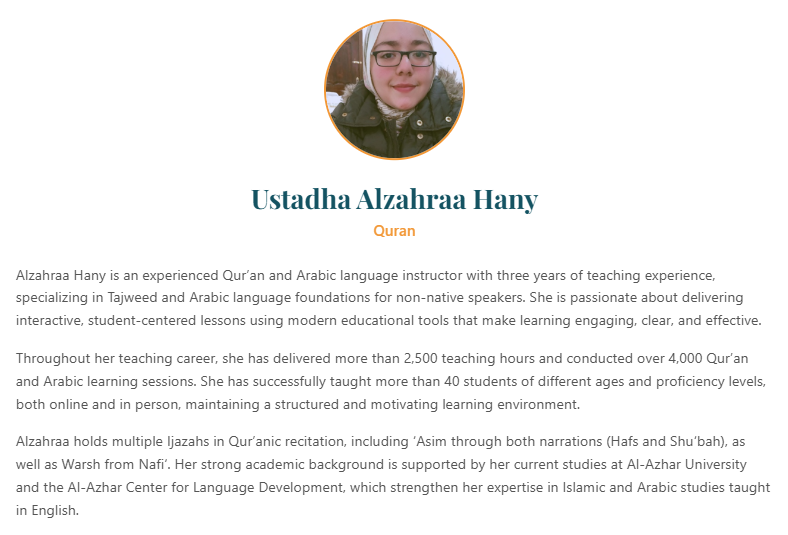
Book Your Free TrialUstadha Alzahraa Hany holds Ijazahs in three riwayat — Hafs, Shu’bah, and Warsh — making her particularly equipped to teach students interested in recitation variety beyond Hafs.
Buruj Academy’s Tajweed for Children course connects young learners with female instructors skilled in age-appropriate methods — building correct sound habits before rules become relevant.
Book your child’s free Tajweed trial lesson today
Read also: What is Tajweed?
What Are the Core Skills Every Tajweed Tutor Must Be Able to Teach?
Every qualified tajweed tutor must be able to teach the full spectrum of tajweed science: makharij al-huruf (the 17 articulation points), sifat al-huruf (letter attributes such as jahr, hams, shiddah, and rakhawah), Noon and Meem rules (Ikhfa, Idgham, Iqlab, Izhar, Ikhfa Shafawi, Idgham Shafawi), Madd rules, Waqf and Ibtida, and Tafkhim and Tarqiq.
These categories are not optional modules — they form the complete architecture of proper recitation. A tutor who teaches Ikhfa and Idgham but glosses over makharij al-huruf is building your recitation on an incomplete foundation.
Understanding Makharij Before Rules
The most common error we see in students who have had previous tajweed instruction is misplaced focus. They can recite the definition of Qalqalah but produce the echo from the wrong part of the throat. Rules without correct articulation points produce technically named but practically incorrect recitation.
A skilled tajweed tutor spends the first several sessions solely on articulation — mouth positioning, throat engagement, nasal resonance. Only after the student can produce the sounds correctly does rule application become meaningful.
| Tajweed Domain | What a Qualified Tutor Must Teach | Common Student Error |
| Makharij al-Huruf | 17 articulation points, throat/mouth/nasal positions | Approximating sounds instead of precise placement |
| Sifat al-Huruf | Letter attributes (strength, softness, echo, nasality) | Ignoring sifat in live recitation despite knowing them |
| Noon & Meem Rules | Ikhfa, Idgham, Iqlab, Izhar and their Shafawi variants | Confusing Ikhfa with Idgham Naaqis |
| Madd Rules | 6 Madd types, their counts (2, 4, 5, or 6 harakahs) | Inconsistent Madd lengths across a single recitation |
| Tafkhim & Tarqiq | Heavy and light letters, contextual rules | Applying Tafkhim to Raa’ when Tarqiq is required |
Understanding Ikhfa letters in tajweed and Idgham rules is foundational — your tutor should be able to explain not just what the rule is, but where in the mouth and throat it is produced.
What Mistakes Do Tajweed Tutors Help Students Avoid Most Often?
Qualified tajweed tutors most commonly correct six recitation errors: substituting familiar sounds for unfamiliar Arabic ones (e.g., replacing ع with a glottal stop), inconsistent Madd lengths, omitting Ghunnah in Ikhfa positions, applying Tafkhim where Tarqiq is required, ignoring Waqf rules at verse ends, and rushing recitation speed beyond articulation accuracy.
The heavy and light letters in tajweed — Tafkhim and Tarqiq — are among the most frequently miscorrected areas.
The letter Raa’ alone has multiple rules governing when it must be heavy and when it must be light, depending on vowels, adjacent letters, and Waqf position.
A tutor who does not actively monitor and correct these distinctions will allow incorrect habits to become permanent.
For students beginning their tajweed study, our tajweed for beginners guide provides a structured overview of where to start and what to prioritize.
Read also: The 10 Best Reciters to Learn Tajweed From (With Audio Links)
Start Perfecting Your Recitation with Buruj Academy’s Tajweed Tutors
Proper Tajweed recitation requires a qualified teacher — authenticated by Ijazah, trained in non-native speaker instruction, and experienced enough to correct what you cannot hear yourself.
Buruj Academy offers:
- Ijazah-certified instructors and Al-Azhar University graduates
- 12+ years of experience teaching non-Arabic speakers globally
- The Buruj Method: Sound-before-rules — ear training before rule memorization
- Male and female tajweed tutors matched to your profile, age, and learning style
- Personalized 1-on-1 online sessions with real-time pronunciation correction
- Flexible 24/7 scheduling for students worldwide
Book your free trial lesson with a Buruj Academy tajweed specialist today — and hear the difference qualified instruction makes from your very first session.
Join a supportive learning environment tailored to your pace and lifestyle. Start your journey toward excellence by enrolling in one of our specialized tracks:
- Online Tajweed Classes
- Tajweed Classes for Beginners
- Tajweed Classes for Adults
- Tajweed Classes for Sisters
- Tajweed Classes for Kids
- Advanced Tajweed Course
- Amli Tajweed Course (Practical Application)
Ready to transform your recitation? book your free assessment and start your path to Tajweed mastery today!
Excel in Your Quranic Studies
Join Buruj Academy and master the Quran with our structured, professional curriculum.
Book Your Free TrialConclusion
Choosing the right tajweed tutor is not a secondary decision — it shapes everything that follows in your Quranic recitation. The qualifications that matter most are verifiable: Ijazah, Al-Azhar training, and demonstrated experience with non-native speakers. These are not interchangeable with enthusiasm or general Islamic knowledge.
Buruj Academy’s teaching team — both male and female — meets these standards with combined teaching hours in the thousands and credentials verified through authentic chains of transmission. Whether you are reading the Quran for the first time or refining a recitation you have practised for years, the right tutor changes everything. Alhamdulillah, that standard of instruction is available to you — one free trial lesson away.
Read also: What Happens if You Accidentally Drop the Quran?
Frequently Asked Questions About Tajweed Tutors
What Is the Difference Between a Tajweed Tutor and a Quran Teacher?
A Quran teacher may focus on reading fluency, memorization, or general Islamic instruction. A tajweed tutor specifically trains correct letter articulation, applies the rules of Hafs ‘an ‘Asim recitation, and corrects pronunciation at the level of individual sounds. The best instructors combine both roles, ensuring recitation is both accurate and beautiful.
Do Tajweed Tutors Need to Hold an Ijazah?
Yes — for authentic tajweed instruction, an Ijazah is the minimum credential. It certifies that the teacher’s recitation has been verified through an unbroken chain back to the Prophet ﷺ. Without this, there is no guarantee the rules being taught reflect the oral tradition as it has been preserved across generations.
Can Adults Learn Tajweed from Scratch with a Private Tutor?
Adults can and do learn tajweed from scratch with a qualified private tutor. In our experience at Buruj Academy, adult beginners typically require 3–6 months of consistent weekly sessions to establish correct foundational habits. Progress depends on session frequency, home practice, and the tutor’s ability to address English-speaker-specific pronunciation challenges.
How Do I Know If a Tajweed Tutor Is Qualified to Teach Non-Arabic Speakers?
Ask directly about their experience with non-native students, their familiarity with common English-speaker errors, and whether they have taught students whose mother tongue shares no phonetic overlap with Arabic. An Ijazah certifies recitation quality — teaching non-native speakers requires an additional layer of pedagogical training that not every Ijazah holder possesses.
What Should I Expect in a First Tajweed Lesson?
A qualified tajweed tutor will begin by assessing your current recitation — listening to your pronunciation of individual letters and short passages. Expect correction of foundational sounds before any formal rule is introduced. The Buruj Method starts with sound training: your ear and tongue must recognise correct articulation before the rules governing them become teachable.