 Tajweed

Every Muslim wants to recite the Quran the way it was revealed — with precision, care, and beauty. For non-Arabic speakers especially, finding reliable guidance that is both accessible and affordable is one of the first practical challenges on the path to correct recitation.
The good news is that today’s free Tajweed resources are genuinely varied and high-quality. Whether you are a complete beginner working through Makharij al-Huruf for the first time, or an intermediate student refining Ghunnah and Madd rules, the 10 resources below will give you structured, verified material to work with — at no cost.
Table of Contents:
How to Use This List of Free Tajweed Resources?
These resources are organized by type: YouTube channels, websites, apps, and reference tools. Each serves a different learning need. Before starting, it helps to understand one key principle we teach our students at Buruj Academy: free resources are most effective when you use them as a structured supplement — not as a replacement for live correction.
Tajweed is a sound-based science, and errors in pronunciation can go unnoticed for months without an experienced teacher listening and correcting in real time.
That said, these 10 tools are among the strongest free options available for non-Arabic speaking Muslims seeking to learn Tajweed for beginners and beyond.
Free Tajweed Resources on YouTube Channels
YouTube is an excellent starting point for learning Tajweed, offering visual demonstrations and detailed explanations that make complex rules easier to grasp. These channels provide structured lessons that can help you build a solid foundation in your recitation practice at no cost.
1. Buruj Academy YouTube Channel
Buruj Academy’s YouTube channel is one of the most accessible free Tajweed channels specifically designed for English-speaking Muslims. Our Al-Azhar-trained instructors recite surahs with accurate Tajweed rules like Ikhfa letters, Idgham, Ghunnah, and Qalqalah letters using clear audio demonstrations, on-screen text, and precise instruction.

Videos are suitable for beginners and intermediate students, and the channel regularly adds content on specific rules and recitation tips. Subscribe and watch videos in playlist order for the most structured free experience.
If you want to go further, Buruj Academy’s Tajweed for Beginners course takes you from zero to confident recitation with Ijazah-certified instructors in live 1-on-1 sessions.
Book Your FREE Trial Lesson to Begin Your Tajweed Journey
2. Learn Quran TV (YouTube)
Learn Quran TV is a long-standing YouTube channel offering structured Tajweed tutorials with a focus on practical Quranic application.
Rather than presenting rules in isolation, videos typically demonstrate each rule within actual Quranic recitation, which reinforces the connection between theory and practice.
Lessons cover Noon Sakinah rules, Meem Sakinah, Madd Asli (natural elongation), and heavy and light letters (Tafkhim and Tarqiq).
Best for: Beginners who want to see rules in real Quranic context rather than isolated drills.
Websites That Provide Free Tajweed Resources
Beyond video lessons, several specialized websites offer structured learning tools, color-coded Mushafs, and detailed written guides to deepen your Tajweed study.
These platforms provide excellent supplementary resources to reinforce theory, visualize rules in real-time, and practice at your own pace.
3. Quran.com — Color-Coded Tajweed Mushaf
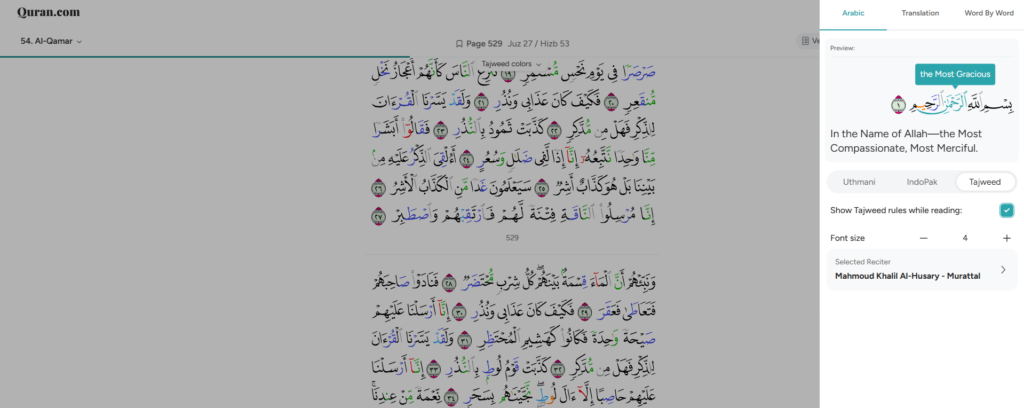
Quran.com is one of the most widely used free Quranic platforms in the world. The platform’s Tajweed Mushaf feature color-codes every letter and word in the Quran according to the specific rule that applies, making it immediately visual: Ghunnah letters appear in one color, Madd in another, Qalqalah letters in another.
This allows students to identify rules as they read in real time, which accelerates pattern recognition significantly.
The platform also provides recitations from dozens of master Quranic reciters — listening alongside the color-coded text is one of the most effective free learning habits we recommend.
Best for: Visual learners and anyone practicing reading the Quran with Tajweed.
| Quran.com Feature | What It Teaches |
| Color-coded Tajweed Mushaf | Visual rule identification while reading |
| Multiple Qari recitations | Ear training through model recitation |
| Word-by-word audio | Isolation of individual word pronunciation |
| Verse repeat function | Repeated listening for rule absorption |
4. Buruj Academy Blog — Free Tajweed Articles
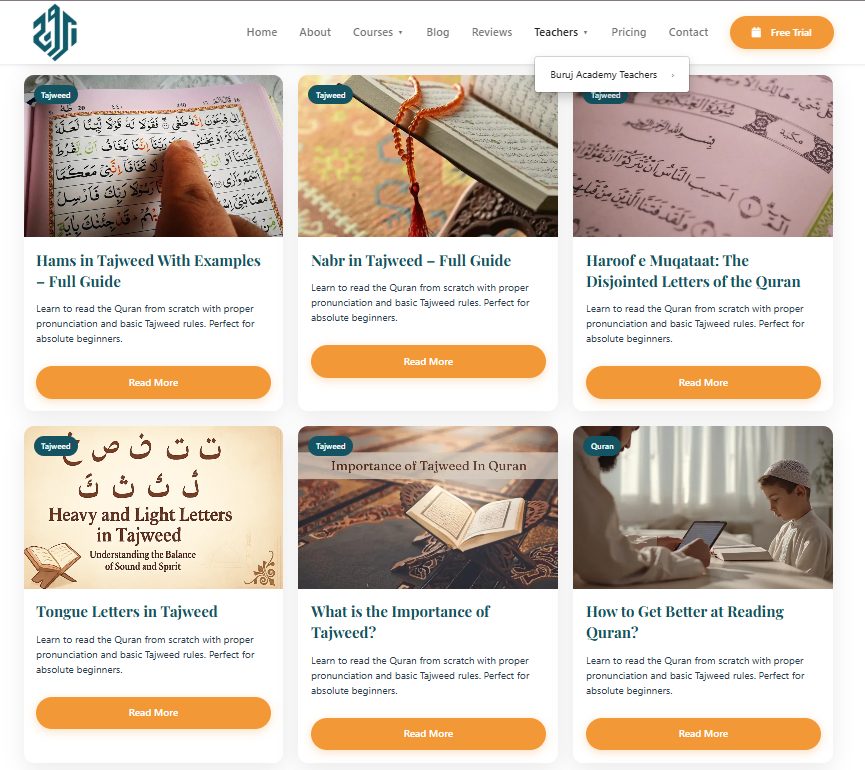
Buruj Academy’s blog contains an extensive and growing library of free, detailed Tajweed articles written by our Al-Azhar-qualified instructors. Articles cover individual rules in depth — each written specifically for non-Arabic speakers with no assumed prior knowledge.
| Article | Topic Covered |
| Ikhfa Letters in Tajweed | All 15 Ikhfa letters and their application |
| Idgham Rules in Tajweed | Assimilation with and without Ghunnah |
| Ghunnah and Its Rules | Nasal resonance rules in detail |
| Qalqalah Letters | The five echo letters and their levels |
| Heavy and Light Letters | Tafkhim and Tarqiq explained |
| Makharij al-Huruf | Full articulation point guide |
| Izhar Letters | Clear pronunciation rules for Noon Sakinah |
| Tajweed Rules Guide | Essential rules overview |
Best for: Students who want accurate, rule-specific reference reading from verified Islamic scholarship.
5. Al-Qasas Learning — Free Tajweed Resources and Games
Al-Qasas Learning offers free interactive Tajweed resources including games, rule-finding exercises within specific Surahs (such as Al-Fatiha, Ayat al-Kursi, and Surah Al-Qadr), and digital Tajweed materials.
This is one of the more engaging free options for children or visual learners who benefit from interactive formats rather than passive video watching.
Best for: Children and younger beginners, or adults who prefer interactive, gamified practice. The Surah-based exercises — identifying rules in context — are a genuinely useful pedagogical format.
Read also: What Is the Rule for Lam Alif?
Free Apps to Learn Tajweed
Mobile applications offer a convenient, on-the-go way for students to practice Tajweed through interactive exercises and bite-sized lessons.
Discover the Buruj Academy Difference
Step into our virtual classrooms and see how our expert instructors make learning Quran and Arabic intuitive and clear. We focus on overcoming the specific hurdles non-native speakers face, building your confidence and connection with the Quran.
Excel in Your Quranic Studies
Join Buruj Academy and master the Quran with our structured, professional curriculum.
Book Your Free Trial6. Tarteel AI
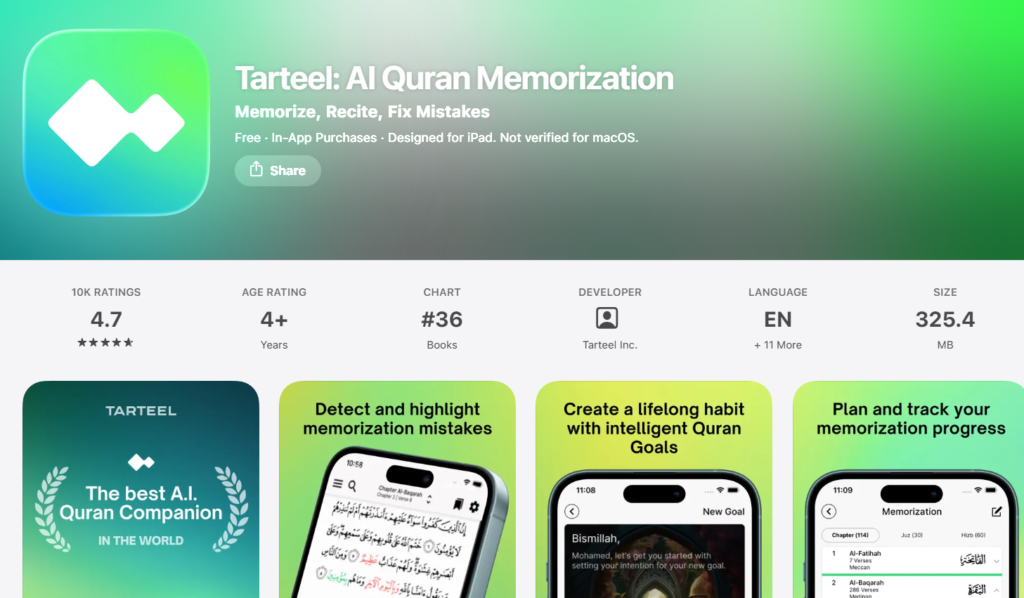
Tarteel AI is the most technologically advanced free Quran app available today. Its AI-powered recitation feature listens to your voice in real time and highlights mistakes in your recitation — including Tajweed errors — as you read.
The free version includes voice search, a color-coded Tajweed Mushaf, recitation tracking, and progress goals.
This is one of the few free tools that provides any form of real-time feedback — though it is not a substitute for a qualified human teacher who can diagnose root causes and correct Makhraj errors at their source. Tarteel is available on iOS and Android.
Best for: Students who want a progress-tracking tool and basic automated recitation feedback between teacher sessions.
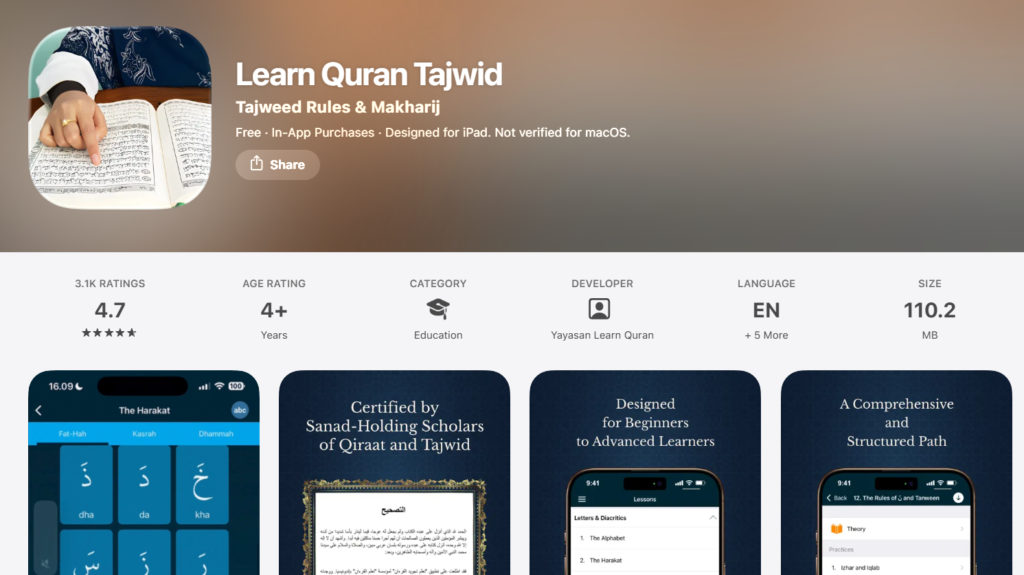
7. Learn Quran Tajwid App
The Learn Quran Tajwid app (iOS and Android) has been available since 2013 and is trusted by millions of learners. It provides structured lessons from absolute beginner level — covering Arabic letters, vowels, basic Tajweed rules, Makharij, and rule application.
The lesson progression is methodical, starting from foundational reading mechanics before introducing rule layers — a sequence consistent with the Buruj Method’s “sound-before-rules” philosophy.
Best for: Complete beginners who need a step-by-step structured app experience covering both Qaida-level reading and entry-level Tajweed rules.
Free PDF & Reference Tools to Learn Tajweed
Structured PDF textbooks and comprehensive reference materials provide essential, in-depth scholarly context for serious learners.
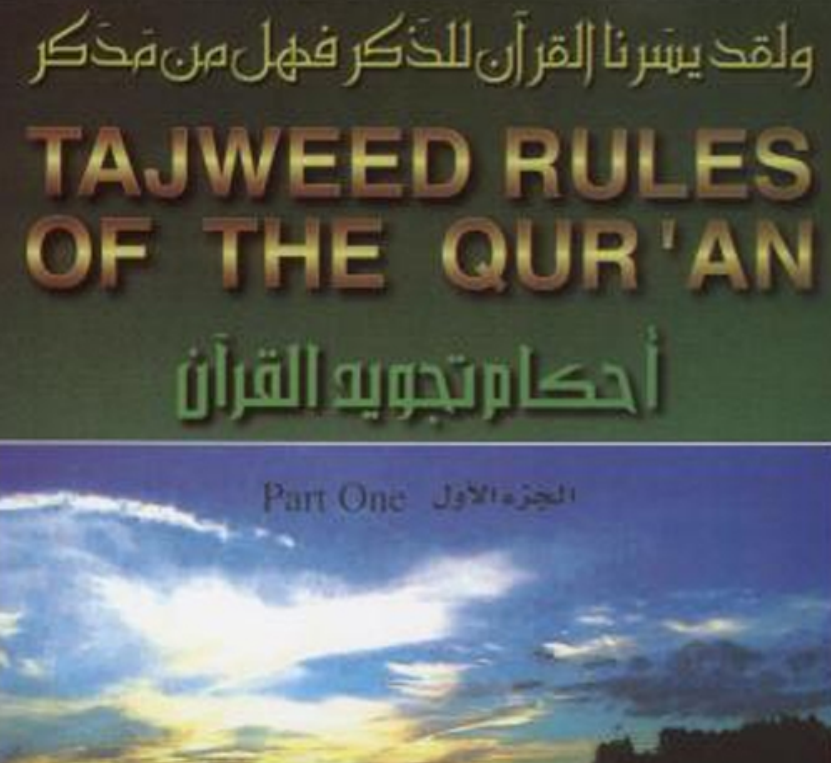
8. Tajweed Rules of the Quran — Free PDF (Kareema Carol Czerepinski)
Tajweed Rules of the Quran by Kareema Carol Czerepinski is widely regarded as the most thorough English-language Tajweed textbook available. Parts One and Two are available in PDF format through Islamic educational websites.
The book provides detailed coverage of every major rule category, with Arabic examples from the Quran, transliterations, and clear explanations in English. It is written according to the Hafs ‘an ‘Asim reading tradition — the standard recitation taught worldwide.
Best for: Intermediate to advanced students wanting a scholarly reference text. Search for the PDF by title on Islamic educational resource sites.
Read also: Is Tajweed Obligatory?
9. Color-Coded Tajweed Quran (Printed or PDF)
A color-coded Tajweed Quran is one of the most practical tools any student can have. Different colors mark different rules throughout the entire Mushaf — Ghunnah letters, Madd types, Qalqalah letters, and more — allowing you to see rules in context while reading.
Free PDF versions are available through several Islamic educational sites. For beginners who have asked us how to learn Tajweed from the Quran itself rather than through isolated rule study, this is always our first recommendation.
Best for: Any student at any level. Using it during daily recitation is one of the highest-yield free habits possible.
10. Buruj Academy Free Trial Lesson
Buruj Academy offers a free trial lesson with a qualified Ijazah-certified instructor — giving students a direct, live experience of what structured 1-on-1 Tajweed correction feels like compared to self-study resources. The free trial is personalized to your current level, whether you are a complete beginner reading the Quran for the first time or an intermediate student targeting specific rule weaknesses.
Best for: Anyone who wants to understand exactly where their recitation stands and what a focused learning plan would look like.
Book Your FREE Trial Lesson to Begin Your Tajweed Journey

What Free Tajweed Resources Can and Cannot Do
Understanding the limits of free tools helps you use them most effectively. The table below reflects what we consistently observe in students who start with free resources before transitioning to structured instruction.
| Resource Type | Strong For | Requires Teacher Support For |
| YouTube channels | Rule theory, ear training, motivation | Pronunciation error correction, Makhraj diagnosis |
| Websites & PDFs | Reference reading, rule review | Practical application feedback |
| Apps | Daily habit building, tracking | Live listening, personalized correction |
| Color-coded Mushaf | Visual rule recognition | Understanding why errors occur |
| Free live programs | Structured progression, some feedback | Personalized pacing, individual correction |
In our experience teaching non-Arabic speakers at Buruj Academy, students who combine two or three free resources consistently outperform those who rotate through many without depth.
Pick a YouTube channel for theory, use Quran.com while reading daily, and practice with one app. Then add live instruction when you are ready to address pronunciation at its root.
Read also: What Is the Rule of Alif Lam?
Start Learning Tajweed with Buruj Academy’s Expert Instructors
Free resources are a strong foundation, but confident, accurate Tajweed ultimately requires a qualified teacher listening and correcting in real time.
At Buruj Academy, our Online Tajweed Classes are taught by Ijazah-certified instructors and Al-Azhar University graduates with 12+ years of experience teaching non-Arabic speakers worldwide.
We use the Buruj Method — sound-before-rules — training your ear and tongue before layering in rule names, so your recitation improves in practice, not just on paper.
Every student receives a personalized learning plan, flexible 1-on-1 scheduling, and real-time pronunciation correction.
Whether you are a complete beginner or refining advanced rules, book your free trial lesson today and experience the difference structured instruction makes.
Join a supportive learning environment tailored to your pace and lifestyle. Start your journey toward excellence by enrolling in one of our specialized tracks:
- Online Tajweed Classes
- Tajweed Classes for Beginners
- Tajweed Classes for Adults
- Tajweed Classes for Sisters
- Tajweed Classes for Kids
- Advanced Tajweed Course
- Amli Tajweed Course (Practical Application)
Ready to transform your recitation? book your free assessment and start your path to Tajweed mastery today!
Excel in Your Quranic Studies
Join Buruj Academy and master the Quran with our structured, professional curriculum.
Book Your Free TrialConclusion
Free Tajweed resources have never been more accessible — and the 10 options above represent a genuine cross-section of formats, from AI-powered apps to scholarly PDF texts to structured live programs. The key is intentional use: choose resources that match your current stage, use them consistently, and understand where their limits lie.
Tajweed is ultimately a sound-based science passed from teacher to student through an unbroken chain of oral transmission going back to the Prophet ﷺ himself. Free tools accelerate learning and build motivation — but the goal, Insha’Allah, is always to sit with a qualified teacher and let your recitation be shaped by someone who truly knows the rules from their roots.
Read also: Benefits of Reading Quran in Arabic
Frequently Asked Questions About Free Tajweed Resources
Can You Actually Learn Tajweed for Free Without a Teacher?
You can learn Tajweed theory for free using the resources listed above — rule names, definitions, and the logic behind each rule. However, correct pronunciation requires a qualified teacher to listen and correct your recitation. Errors in Makharij and Sifat al-Huruf are very difficult to self-diagnose, which is why even strong free resources are best used as supplements to structured instruction.
How Do I Use a Color-Coded Quran to Learn Tajweed?
A color-coded Tajweed Quran uses distinct colors to mark different rules throughout the text — for example, Ghunnah letters in one color, Madd extensions in another. When you read daily, you identify and apply the rule indicated by each color. Over time, pattern recognition builds naturally. Reading alongside master reciter audio on Quran.com accelerates this process significantly.
What Are the Most Important Tajweed Rules to Learn First?
For beginners, the foundational rules to prioritize are: Makharij al-Huruf (articulation points of every letter), the four rules of Noon Sakinah and Tanwin (Izhar, Idgham, Iqlab, Ikhfa), the rules of Meem Sakinah, and the basic Madd (elongation) types. Mastering these covers the majority of rules encountered in daily recitation. Our essential Tajweed rules guide covers all of these in accessible detail.