 Quran
Quran

| Key Takeaways |
| Reading Quran in Arabic preserves the exact divine words Allah revealed, ensuring no meaning is lost through translation. |
| Each Arabic letter recited earns ten rewards according to an authentic hadith narrated by Ibn Mas’ud in Tirmidhi. |
| Regular Arabic Quran reading progressively builds Quranic Arabic vocabulary and improves overall Arabic comprehension over time. |
| Translations carry the translator’s interpretation; only Arabic delivers Allah’s literal, unchanged speech as originally revealed. |
Millions of Muslims recite the Quran daily in a language they did not grow up speaking — and that choice is neither accidental nor merely traditional.
The Arabic Quran is not a text that was written and later translated into a sacred language; it is the sacred language, revealed word by word in Arabic through Jibreel (AS) to the Prophet Muhammad ﷺ.
Reading Quran in Arabic connects you directly to that unbroken divine speech. The benefits span theology, linguistics, spiritual reward, and cognitive development — and each one has real grounding in Islamic scholarship and the lived experience of learners we guide at Buruj Academy every single day.
Table of Contents:
1. Reading Quran in Arabic Preserves Allah’s Exact Words Without Distortion
Reading Quran in Arabic ensures you are engaging with Allah’s literal speech, not a human approximation of it. No translation — however accurate — can fully carry the full spectrum of meaning embedded in a single Arabic word. The moment language changes, interpretation begins.
Allah Himself identifies this in the Quran:
إِنَّا أَنزَلْنَاهُ قُرْءَانًا عَرَبِيًّا لَّعَلَّكُمْ تَعْقِلُونَ
Innā anzalnāhu qurʾānan ʿarabiyyan laʿallakum taʿqilūn
“Indeed, We have sent it down as an Arabic Quran that you might understand.” (Yusuf 12:2)
The word taʿqilūn — meaning to reason, understand deeply, or comprehend with the mind — is itself untranslatable with a single English word.
This is precisely the point. Arabic was chosen for a reason, and that reason is linguistic precision that no other language can replicate.
2. Every Arabic Letter You Recite Carries Ten Multiplied Rewards
One of the most well-known motivations for Arabic recitation is the reward attached to each letter — and this is not a vague promise but a specific, authenticated narration. The Prophet ﷺ stated:
“Whoever reads a letter from the Book of Allah, he will have a reward, and this reward will be multiplied by ten. I am not saying that ‘Alif, Laam, Meem’ is a letter, rather I am saying that ‘Alif’ is a letter, ‘Laam’ is a letter, and ‘Meem’ is a letter.” (Tirmidhi 2910)
This hadith specifically refers to the recitation of Arabic letters. The counting applies to the original text — not to a translated equivalent.
Reading “In the name of God” gives you the meaning; reciting بِسْمِ اللَّهِ gives you nineteen letters, each multiplied by ten.
At Buruj Academy, we regularly share this hadith with adult students who feel discouraged by slow progress. Understanding that even slow, careful Arabic recitation carries enormous reward reframes the entire experience — from performance anxiety to an act of worship being richly honoured.
Read also: The Practice of Reading the Quran on Water
3. Arabic Recitation Is the Only Valid Form for Salah
The five daily prayers are built upon Arabic recitation — and this is not a cultural preference but a scholarly consensus. Salah requires Surah Al-Fatiha in Arabic, and any voluntary recitation beyond that must also be in Arabic.
This means reading Quran in Arabic is not optional for a practising Muslim — it is a prerequisite for the most foundational act of worship performed seventeen times daily across obligatory prayers alone.
| Prayer | Obligatory Rakaʿat | Minimum Arabic Recitation Required |
| Fajr | 2 | Al-Fatiha × 2 |
| Dhuhr | 4 | Al-Fatiha × 4 |
| Asr | 4 | Al-Fatiha × 4 |
| Maghrib | 3 | Al-Fatiha × 3 |
| Isha | 4 | Al-Fatiha × 4 |
This table illustrates that every Muslim already recites Arabic Quran at minimum seventeen times each day. Building Arabic Quran reading ability beyond Al-Fatiha strengthens every single one of those moments of standing before Allah.
If you are not yet confident reading Arabic fluently, our Quran Reading Course builds the precise foundation needed — from letter recognition through smooth, connected recitation.
Book your Free trial lesson and start reading the Quran
4. Arabic Recitation Activates Tajweed Rules That Protect Meaning and Beautify Recitation
Tajweed — the science of precise Quranic recitation — exists specifically for Arabic. Its rules govern elongations, nasalization, articulation points, and letter attributes that affect both beauty and meaning. Reading a translation bypasses all of this entirely.
Consider the difference between qalb (قَلْب — heart) and kalb (كَلْب — dog). A single letter point changes the word completely. Tajweed rules exist to prevent such errors during recitation — and they only operate in Arabic.
Our Ijazah-certified instructors at Buruj Academy regularly observe a specific pattern: students who transition from English-only Quran engagement to Arabic recitation often discover they have been mentally inserting meanings without realizing the precision they were missing.
Learning to recite in Arabic with proper Tajweed rules makes that precision tangible and teachable.
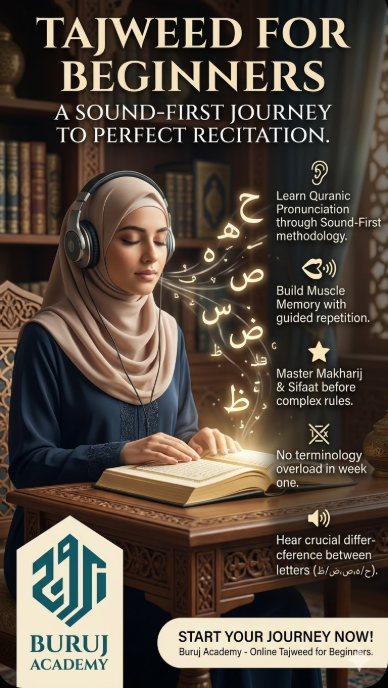
For anyone beginning this process, our Tajweed for Beginners course introduces the foundational rules systematically, starting with sound recognition before progressing to rule application.
Book Your FREE Trial Lesson to Begin Your Tajweed Journey
5. Reading Quran Improve Arabic Consistently and Progressively
Reading Quran in Arabic does meaningfully improve Arabic language ability over time, particularly Quranic vocabulary and classical Arabic structures. The Quran uses approximately 1,700 root words, and regular recitation builds recognition of these roots through repeated exposure.
| Stage of Arabic Quran Reading | Typical Vocabulary Benefit |
| Early beginner (0–3 months) | Recognition of common short surahs’ vocabulary |
| Intermediate (3–12 months) | Growing familiarity with Quranic root patterns |
| Consistent reader (1–2 years) | Intuitive recognition of frequent Quranic terms |
| Advanced (2+ years with study) | Active Quranic vocabulary with comprehension ability |
The progress is not automatic — it deepens significantly when combined with deliberate vocabulary study.
But even without formal Arabic study, students who read Quran daily in Arabic begin recognizing repeated words like rahma (mercy), ʿilm (knowledge), and tawbah (repentance) without being taught them formally.
For accelerated progress, our Quranic Arabic Classes pair Quran reading with structured classical Arabic instruction taught by Al-Azhar graduates specializing in Quranic linguistics.
Begin Understanding Quranic Arabic with a FREE Lesson
6. Arabic Recitation Produces the Spiritual States the Quran Itself Describes
The Quran describes its own effect on those who truly hear it — and those descriptions are tied to its Arabic form. Allah says:
اللَّهُ نَزَّلَ أَحْسَنَ الْحَدِيثِ كِتَابًا مُّتَشَابِهًا مَّثَانِيَ تَقْشَعِرُّ مِنْهُ جُلُودُ الَّذِينَ يَخْشَوْنَ رَبَّهُمْ
Allāhu nazzala aḥsana al-ḥadīthi kitāban mutashābihan mathāniya taqshaʿirru minhu julūdu alladhīna yakhshawna rabbahum
“Allah has sent down the best statement: a consistent Book wherein is reiteration. The skins shiver therefrom of those who fear their Lord.” (Az-Zumar 39:23)
The shivering of skin described here — the khushūʿ experienced during recitation — is something students consistently report as emerging through Arabic recitation in a way translation alone does not replicate.
The rhythmic patterns, elongations, and phonetic precision of Arabic carry an emotional weight that is inseparable from the language itself.
Read also: Can You Read from the Mushaf While Praying?
Discover the Buruj Academy Difference
Step into our virtual classrooms and see how our expert instructors make learning Quran and Arabic intuitive and clear. We focus on overcoming the specific hurdles non-native speakers face, building your confidence and connection with the Quran.
Excel in Your Quranic Studies
Join Buruj Academy and master the Quran with our structured, professional curriculum.
Book Your Free Trial7. Reading Quran in Arabic Connects You to an Unbroken Chain of Transmission
Every Arabic Quran recitation tradition traces back continuously to the Prophet Muhammad ﷺ through sanad — an unbroken chain of transmission. This is unique in world religious literature.
The Arabic words you recite today are phonetically identical to what was recited in the Prophet’s ﷺ time.
Translation has no such chain. Translators change, interpretations evolve, and new editions reflect updated scholarly understandings. The Arabic text has remained phonetically unchanged and orthographically stable across fourteen centuries.
This connection has a practical dimension too. When a student at Buruj Academy receives Ijazah — certification in Quran recitation — their chain of transmission connects through their teacher, back through generations, to the Prophet ﷺ himself. That chain only exists in Arabic.
If pursuing this yourself, our Quran Ijazah program guides students through the recitation standards required for authentic Ijazah certification.
Book your FREE trial lesson in your path to Ijazah

8. The Reward for Reading Quran in Arabic Multiplies Further for Those Who Struggle
One of the most overlooked and deeply encouraging aspects of Arabic Quran recitation is that difficulty does not diminish reward — it multiplies it. The Prophet ﷺ said:
“The one who is proficient in the recitation of the Quran will be with the honourable and obedient scribes (angels), and he who recites the Quran and finds it difficult to recite, doing his best to recite it in the best way possible, will have a double reward.” (Sahih Muslim 798)
This hadith is specifically about Arabic recitation. The person who struggles with Arabic letters, who stumbles over makharij (articulation points), who needs multiple attempts to produce the ح versus the هـ correctly — that person earns a double reward.
We share this narration with every new student who arrives at Buruj Academy frustrated by slow progress. It reframes struggle from failure into an act of worship that Allah honours with greater reward.
Read also: Benefits of Reading Surah As-Saffat
9. Arabic Quran Reading Builds Consistency That Deepens Entire Islamic Practice
The habit of reading Quran in Arabic daily creates a disciplined connection to worship that permeates all other Islamic practices. Scholars consistently describe the Quran as the axis of Islamic life — the text from which Fiqh is derived, Tafsir unfolds, and Hadith is contextualized.
Students who build strong Arabic Quran reading habits report that their Quran memorization becomes more stable, their understanding of khutbahs deepens, and their connection to duas increases — all because Arabic recitation creates familiarity with the Quran’s linguistic fabric.
For those ready to structure their Arabic Quran reading, our resource on how to start reading Quran daily provides a practical system for consistency.
And for those wanting to improve the quality of their reading alongside its regularity, our tips on getting better at reading Quran address the most common obstacles directly.
Should I Read Quran in Arabic or Translation?
Arabic recitation and translation reading serve different purposes — and the scholarly position is that they are complementary, not competing. Arabic is required for worship and carries divine reward for each letter. Translation is a tool for understanding, not a substitute for the original text.
| Purpose | Arabic Recitation | Translation Reading |
| Gaining reward (thawab) | ✅ Direct and multiplied | ❌ Not equivalent |
| Salah recitation | ✅ Required | ❌ Not valid |
| Understanding meaning | ✅ Best with Arabic study | ✅ Useful bridge |
| Preserving exact divine speech | ✅ Only Arabic preserves it | ❌ Translator’s interpretation |
| Deep comprehension | ✅ With Quranic Arabic study | ✅ Starting point |
The ideal approach — and the one we consistently recommend — is to prioritize Arabic recitation while using a reliable translation alongside it for reflection.
The manners of reading the Quran in Islamic scholarship consistently emphasize tadabbur (reflection), which becomes far deeper when you understand the Arabic you are reciting.
Read also: What Happens If You Fart While Reading the Quran?
Start Reading Quran in Arabic with Buruj Academy’s Expert Instructors
Reading Quran in Arabic is an act of worship, a connection to divine speech, and a skill every Muslim can develop with the right guidance. The benefits outlined above are available to you — regardless of where you are starting from.
Buruj Academy’s Quran Reading Course is taught by Al-Azhar University graduates and Ijazah-certified instructors with 12+ years of experience guiding non-Arabic speakers to confident Arabic recitation.
Our approach — sound before rules, consistency before speed — ensures you build correct habits from your very first lesson.
We offer fully personalized 1-on-1 online sessions with flexible scheduling, real-time feedback, and a progression system designed to take you from your first Arabic letters to fluent Quranic reading.
Book your free trial lesson today and begin reading Allah’s words as He revealed them.
Take the next step in your learning journey today by enrolling in one of our specialized programs:
- Online Quran Classes
- Online Quran Classes for Beginners
- Online Quran Classes for Adults
- Online Quran Classes for Ladies
- Online Quran Classes for Kids
- Quran Reading Course
- Quran Recitation Course
- Online Ijazah Course
- Online Qirat Course
Don’t wait to transform your relationship with the Holy Quran. Join our global community of students and book your free evaluation session now!
Excel in Your Quranic Studies
Join Buruj Academy and master the Quran with our structured, professional curriculum.
Book Your Free TrialConclusion
The Arabic Quran is not simply a religious preference — it is the preserved, literal speech of Allah, carrying rewards, spiritual depth, and linguistic precision that no translation can replicate. From the multiplied reward on every letter to the unbroken chain of transmission connecting today’s recitation to the Prophet ﷺ, reading in Arabic places you inside a living tradition that stretches across fourteen centuries.
Whether you are reading for the first time or rebuilding a lapsed habit, the path forward is the same: start with Arabic, stay consistent, and let difficulty become part of the worship rather than a reason to stop.
Frequently Asked Questions About Reading Quran in Arabic
Does reading the Quran in Arabic improve your Arabic language skills?
Reading Quran in Arabic does improve Arabic language ability over time, particularly Quranic vocabulary and classical root recognition. Regular readers naturally absorb frequently repeated terms across surahs. Combining recitation with structured Quranic Arabic study accelerates this significantly and builds active comprehension rather than passive familiarity alone.
Should I read Quran in Arabic or translation if I don’t understand Arabic?
Both serve different purposes and should be used together. Arabic recitation is required for Salah, carries multiplied reward for each letter, and preserves Allah’s exact words. Translation builds understanding. The ideal approach is to recite in Arabic while consulting a reliable translation for reflection, gradually learning the vocabulary of frequently recited verses.
What is the reward for reading Quran in Arabic?
According to an authenticated hadith in Tirmidhi (2910), each Arabic letter recited earns a reward multiplied by ten. Sahih Muslim adds that those who struggle with Arabic recitation receive a double reward. This reward is specifically attached to the Arabic letters — it does not apply to reading translations.
Can beginners with no Arabic background read Quran in Arabic?
Yes — and this is precisely what our instructors at Buruj Academy specialize in. Complete beginners without any Arabic background can learn to read Quran in Arabic through systematic instruction starting with letter recognition and sounds. Most dedicated adult beginners achieve basic Quran reading ability within three to six months of consistent lessons.
Is it sinful to read only the translation without Arabic?
Reading translation is not sinful — it is encouraged for understanding and reflection. However, translation alone cannot substitute for Arabic recitation in Salah and does not carry the same divine reward as reciting Allah’s literal words. Scholars universally encourage Muslims to learn Arabic recitation rather than relying solely on translated text.