 Tajweed

| Key Takeaways |
| Most students achieve functional Tajweed proficiency — accurate, rule-based recitation — within 6 to 12 months of consistent practice. |
| The four main learning stages are: foundational rules (1–3 months), applied recitation (3–6 months), fluency (6–12 months), and Ijazah-level mastery (2–5 years). |
| Daily practice of 20–30 minutes produces measurably faster progress than longer, less frequent sessions spread across the week. |
Most non-Arabic speaking adults reach a level of confident, rule-correct Quran recitation within 6 to 12 months when studying consistently with qualified guidance. The exact timeline shifts based on prior Quran reading ability, session frequency, and instruction quality — all of which we break down below.
Table of Contents:
How Long Does It Realistically Take to Learn Tajweed?
For most non-Arabic speaking adult beginners, learning Tajweed to a functional standard — meaning the ability to recite the Quran with correct application of core rules — takes between 6 and 12 months of consistent practice. This assumes daily or near-daily sessions of 20–30 minutes with qualified instruction.
| Goal | Typical Timeframe | Focus Area |
| Basic Tajweed awareness | 1–2 months | Common rules and listening skills |
| Correct Quran reading | 3–6 months | Makharij and practical application |
| Confident independent recitation | 6–12 months | Fluency and error reduction |
| Advanced Tajweed proficiency | 1–3 years | Precision and consistency |
| Ijazah preparation | Varies by student | Full recitation accuracy |
Students who already read Arabic fluently often reach this milestone in 3–6 months, while complete beginners who are still building their reading foundation typically need 12–18 months before Tajweed rules feel natural and automatic.
These are instructional estimates drawn from our teachers’ experience at Buruj Academy, not published research statistics.
| Learner Type | Prior Reading Level | Estimated Timeline to Functional Tajweed |
| Complete beginner | None | 12–18 months |
| Basic Arabic reader | Can read slowly | 9–12 months |
| Confident Arabic reader | Reads fluently | 3–6 months |
| Ijazah pursuit | Advanced recitation | 2–5 years |
The table above reflects general patterns across our student base. Individual results vary significantly depending on practice consistency and instruction quality.
At Buruj Academy, our Online Tajweed Classes are designed to move students through this progression systematically — starting with sound recognition before introducing written rules, which is the core of the Buruj Method.
Book Your FREE Trial Lesson to Begin Your Tajweed Journey
What Factors Affect How Long It Takes to Learn Tajweed?
Several variables determine whether your Tajweed study takes 6 months or two years. Understanding them helps you plan realistically rather than comparing your progress to someone with a completely different learning profile.
How Often Do You Practice?
Daily practice — even 20 minutes — consistently outperforms two-hour sessions twice a week. Tajweed is fundamentally a motor skill: the tongue, lips, and throat must be trained through repetition.
Infrequent sessions reset the muscle memory built in previous lessons. In our instructors’ experience, students who practice five to six days per week typically progress twice as fast as those practicing twice weekly.
Are You Learning with a Qualified Teacher?
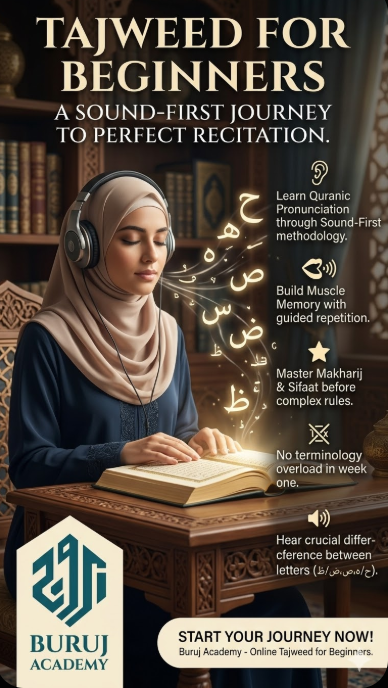
This is the single most important factor in your timeline. Self-study through videos and apps can introduce rules, but it cannot correct your specific errors in real time. Makharij mistakes — particularly distinguishing ح from هـ, or ص from س — become deeply ingrained within weeks if uncorrected.
A qualified Ijazah-certified instructor identifies and corrects these patterns before they solidify. If you are serious about reciting correctly, structured instruction is not optional — it is the most efficient path to accurate Tajweed.
Our Tajweed for Beginners course pairs each student with an Al-Azhar-trained instructor for personalized 1-on-1 sessions, ensuring errors are caught and corrected from the very first lesson.
Book Your FREE Trial Lesson to Begin Your Tajweed Journey
What Is Your Current Arabic Reading Level?
Tajweed cannot be applied to words you cannot yet read. Students who need to build reading fluency alongside Tajweed rules are working on two skills simultaneously.
If this describes you, beginning with the Noorani Qaida or a structured reading foundation course will actually shorten your total Tajweed timeline — not lengthen it.
Read also: Rules of Waqf and Ibtida in the Quran
What Does a Typical Tajweed Learning Timeline Look Like?
Most students experience recognizable stages as they develop their recitation skills. Understanding these milestones helps maintain realistic expectations.
| Stage | Main Focus | Common Outcome |
| Month 1 | Listening and basic rules | Increased awareness |
| Months 2–3 | Makharij correction | Improved letter accuracy |
| Months 3–6 | Rule application | More confident recitation |
| Months 6–12 | Fluency development | Fewer recurring mistakes |
| Year 1+ | Refinement | Advanced consistency |
In our sessions at Buruj Academy, one recurring pattern appears consistently. Adult learners often expect Ghunnah, Ikhfa, and Qalqalah to feel natural immediately after learning the rules.
In reality, most students need several weeks of guided repetition before these rules become automatic during live recitation. This observation is especially common among non-Arabic speakers studying Quran alongside work and family commitments.
Excel in Your Quranic Studies
Join Buruj Academy and master the Quran with our structured, professional curriculum.
Book Your Free TrialWhy Does Learning Makharij Usually Take the Longest?
Correct articulation points form the foundation of all Tajweed. Students who rush through makharij frequently struggle later, even when they understand the rules theoretically.
The Arabic letters emerge from specific articulation points throughout the throat, tongue, lips, and oral cavity. Learning to control these positions accurately requires muscle training, not merely intellectual understanding.
For example:
قُلْ هُوَ ٱللَّهُ أَحَدٌ
Qul huwa Allahu ahad
“Say, He is Allah, [who is] One.” (Quran 112:1)
This verse contains letters requiring distinct articulation characteristics, including ق and ح. Correct pronunciation depends on proper makhraj rather than memorized rules alone.
Students seeking deeper understanding should study Makharij Al Huruf The Complete Guide to Arabic Articulation Points.
Can You Learn Tajweed Without a Teacher?
Self-study can introduce Tajweed concepts, but accurate pronunciation correction usually requires qualified supervision. Tajweed is a science of sound, and sounds cannot always be evaluated reliably by the learner.
Books and videos may explain rules clearly, yet they cannot consistently detect subtle pronunciation mistakes.
A student might read an entire surah while unknowingly repeating the same articulation error dozens of times.
This is one reason traditional Quran transmission has always emphasized direct teacher-student learning. The Messenger of Allah ﷺ taught the Quran orally, and this method remains central to Tajweed instruction today.
Students who begin independently often accelerate their progress by later joining an Online Quran Recitation Course course with qualified instructors providing live correction.
Which Tajweed Rules Usually Take the Most Time to Master?
Some Tajweed concepts are generally learned quickly, while others require extensive repetition before they become natural.
| Easier Rules | More Challenging Rules |
| Basic Madd Asli | Precise Makharij |
| Simple Qalqalah | Tafkhim and Tarqiq |
| Basic Izhar | Advanced Ghunnah control |
| Rule identification | Real-time application |
| Rule memorization | Consistent implementation |
Many students can identify Ikhfa correctly on paper but struggle to execute it smoothly during flowing recitation.
How Long Does It Take to Reach Advanced Tajweed or Ijazah Level?
Advanced Tajweed proficiency — meaning fluent, beautiful recitation with correct application of all rules across the full Quran — typically requires one to two years of structured study beyond the beginner stage.
Ijazah certification in the Hafs ‘an ‘Asim riwayah, which represents the highest formal standard, generally requires a minimum of two to five years of consistent study under a certified scholar, followed by a rigorous recitation examination.
Ijazah is not a fixed course with a set endpoint — it is granted when the teacher certifies the student’s recitation meets the required standard across the entire Quran. Students who practice daily, revise regularly, and work with a qualified Ijazah-holding instructor consistently reach this milestone faster than those with irregular study habits.
Buruj Academy’s Online Ijazah Program prepares students for this certification under qualified scholars with authenticated sanad (chain of transmission), providing a structured path toward this significant achievement.
Book your FREE trial lesson in your path to Ijazah
Read also: Types of Madd in Tajweed with Examples
Discover the Buruj Academy Difference
Step into our virtual classrooms and see how our expert instructors make learning Quran and Arabic intuitive and clear. We focus on overcoming the specific hurdles non-native speakers face, building your confidence and connection with the Quran.
Start Your Tajweed Learning with Buruj Academy’s Expert Instructors
Reaching accurate, confident Tajweed recitation is achievable — the timeline depends almost entirely on the quality of your instruction and the consistency of your practice.
Buruj Academy offers Online Tajweed Classes taught by Al-Azhar University graduates and Ijazah-certified instructors with 12+ years of experience teaching non-Arabic speakers worldwide.
Every student receives a personalized 1-on-1 learning plan, flexible scheduling, and real-time pronunciation correction using the Buruj Method: sound before rules, consistency before speed, patience before performance.
Book your free trial lesson and begin your Tajweed study with qualified guidance from day one.
Join a supportive learning environment tailored to your pace and lifestyle. Start your journey toward excellence by enrolling in one of our specialized tracks:
- Online Tajweed Classes
- Tajweed Classes for Beginners
- Tajweed Classes for Adults
- Tajweed Classes for Sisters
- Tajweed Classes for Kids
- Advanced Tajweed Course
- Amli Tajweed Course (Practical Application)
Ready to transform your recitation? book your free assessment and start your path to Tajweed mastery today!
Excel in Your Quranic Studies
Join Buruj Academy and master the Quran with our structured, professional curriculum.
Book Your Free TrialConclusion
Tajweed is not a discipline that rewards rushing — it rewards showing up daily with focused intention. Whether you are starting from zero or correcting habits built over years, the path to accurate, beautiful Quran recitation is well-defined: foundational rules, applied practice, refined fluency, and — for those who pursue it — formal Ijazah certification.
The most important decision you will make is not how many hours to study, but with whom. Qualified instruction shortens every phase of the timeline, protects you from entrenched errors, and gives your recitation the foundation it deserves. May Allah make your Quran learning blessed and consistent.
Frequently Asked Questions About Learning Tajweed
Is Tajweed difficult to learn for non-Arabic speakers?
Tajweed presents specific challenges for non-Arabic speakers — particularly makharij articulation for letters that have no equivalent in English, such as ع, ح, and خ. With qualified instruction and daily practice, however, non-Arabic speaking adults consistently achieve accurate Tajweed recitation within 6–12 months. The difficulty is real but entirely manageable with structured guidance.
At what age is it best to start learning Tajweed?
Tajweed can be learned effectively at any age. Children between 6 and 12 tend to acquire correct pronunciation more naturally due to greater phonetic flexibility. Adults can absolutely reach high Tajweed proficiency — the process simply requires more deliberate attention to articulation. Buruj Academy offers tailored Tajweed classes for children and adults with age-appropriate methods for each group.
What is the difference between Tajweed and Tarteel?
Tajweed refers to the set of rules governing correct Quran recitation — proper articulation, elongation, and characteristics of letters. Tarteel describes the manner of reciting: slowly, clearly, and with measured rhythm, as instructed in Al-Muzzammil 73:4. Tajweed is the ruleset; Tarteel is the manner of application. Proper Tarteel requires correct Tajweed.
Can I learn Tajweed online effectively?
Yes — online Tajweed instruction is highly effective when conducted through live 1-on-1 sessions with a qualified teacher. Real-time audio correction replicates the core benefit of in-person instruction. Pre-recorded courses and apps alone are insufficient for accurate Tajweed development, as they cannot identify and correct your specific pronunciation errors in real time.
Related Articles
Tajweed






Leave a Reply