 Arabic
| Key Takeaways |
| Arabic has two pronoun types: detached (independent) pronouns that stand alone, and attached pronouns that suffix onto nouns, verbs, or prepositions. |
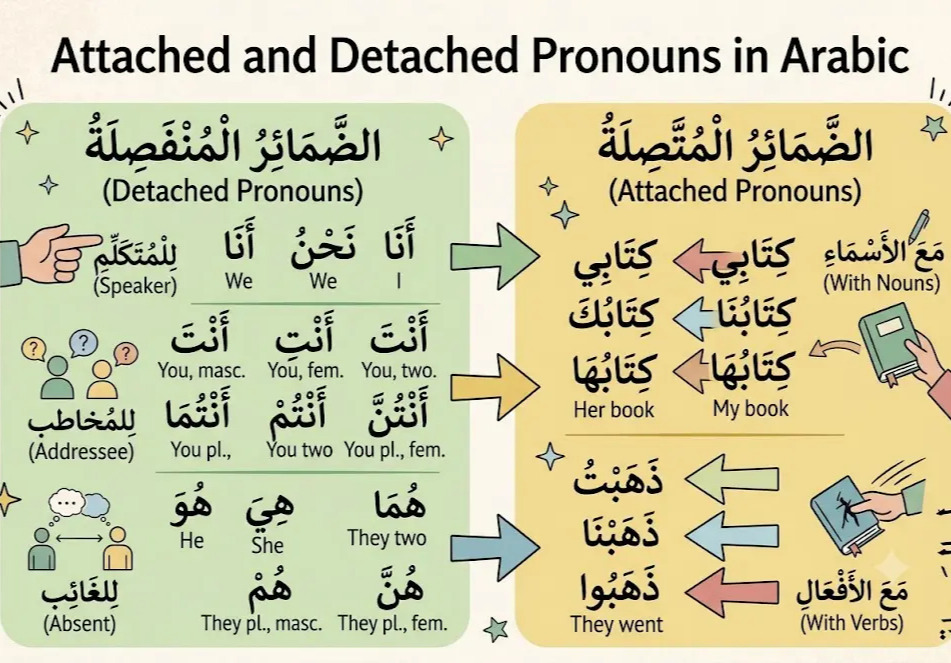
| Detached pronouns in Arabic cover 12 forms across singular, dual, and plural for first, second, and third person. |
| Attached pronouns in Arabic change in form depending on whether they follow a noun, a verb, or a preposition. |
| The same attached pronoun suffix can express possession (my book) or an object (he helped me) depending on context. |
Pronouns are the connective tissue of any language — and in Arabic, they work very differently from English. Arabic organizes its pronouns into two structurally distinct categories, each with its own placement rules, forms, and grammatical functions.
Attached and detached pronouns in Arabic are not just vocabulary items; they are grammatical tools that tell you who owns something, who performs an action, and who receives it. Once you grasp how these two systems operate — and how they interact with nouns, verbs, and prepositions — your Arabic sentences will become dramatically more natural and accurate.
Table of Contents:
What Are Pronouns in Arabic?
Arabic pronouns divide into two types because Arabic grammar distinguishes between a pronoun that stands independently as a full word and one that attaches to another word as a suffix. Detached pronouns (الضمائر المنفصلة — al-damā’ir al-munfaṣilah) function as standalone subjects. Attached pronouns (الضمائر المتصلة — al-damā’ir al-muttaṣilah) attach as suffixes to nouns, verbs, and prepositions.
This two-form system reflects a core feature of Arabic morphology: words carry grammatical meaning within their own structure. A suffix is not merely “added on” — it integrates into the word and changes its meaning precisely.
At Buruj Academy, our Arabic Language Experts with Al-Azhar University backgrounds find that students who understand why Arabic has two pronoun systems — not just what they are — progress through grammar far more confidently.
Our Arabic Grammar Course introduces pronouns within real sentence structures from the very first sessions, so learners encounter them in meaningful context rather than isolated tables.
If you are starting from the very beginning, it also helps to get your Arabic grammar for beginners foundation solid before tackling pronouns in depth.
Understand the Arabic Grammar with Buruj’s free trial lesson
What Are the Detached Pronouns in Arabic?
Detached pronouns in Arabic are independent words used as the subject of a sentence. They are never joined to another word and can stand alone.
Arabic has 12 detached pronouns covering first, second, and third person across singular, dual, and plural — and the second and third person forms also distinguish masculine and feminine.
| Person | Singular | Dual | Plural |
| 1st (I / We) | أنا (anā) — I | — | نحن (naḥnu) — We |
| 2nd Masc. (You) | أنتَ (anta) | أنتما (antumā) | أنتم (antum) |
| 2nd Fem. (You) | أنتِ (anti) | أنتما (antumā) | أنتنّ (antunna) |
| 3rd Masc. (He/They) | هو (huwa) | هما (humā) | هم (hum) |
| 3rd Fem. (She/They) | هي (hiya) | هما (humā) | هنّ (hunna) |
Notice that the dual form (antumā and humā) is shared between masculine and feminine — Arabic only differentiates gender in the dual for third-person in some contexts.
Read also:Understanding the Types of Nouns in Arabic
How ِArabic Detached Pronouns Work in Real Sentences
Detached pronouns appear most naturally as the subject of a nominal sentence (جملة اسمية — jumlah ismiyyah) or for emphasis before a verb.
| Arabic | Transliteration | English |
| أنا طالب | Anā ṭālib | I am a student (m.) |
| هي مُعلِّمة | Hiya mu’allimah | She is a teacher |
| نحن في البيت | Naḥnu fī al-bayt | We are in the house |
| أنتم أصدقائي | Antum aṣdiqā’ī | You (pl. m.) are my friends |
| هم يعملون هنا | Hum ya’malūna hunā | They (m.) work here |
In verbal sentences, Arabic verbs already encode the subject through conjugation, so detached pronouns are added only for emphasis or clarity. Saying أنا كتبتُ الرسالة (Anā katabtu al-risālah — “I wrote the letter”) emphasizes I specifically, not someone else.
Understanding Arabic sentence structure is essential here — nominal and verbal sentences each use detached pronouns differently.
What Are the Attached Pronouns in Arabic?
Attached pronouns in Arabic are suffixes added to the end of a noun, verb, or preposition to indicate possession, the object of a verb, or the object of a preposition.
They are never written as separate words. The same suffix can serve multiple grammatical functions depending on what it attaches to.
| Pronoun | Suffix Form | Meaning |
| I / my / me | ـي (-ī) or ـنِي (-nī) | first person singular |
| You (m.) / your / you | ـكَ (-ka) | second person masculine singular |
| You (f.) / your / you | ـكِ (-ki) | second person feminine singular |
| He / his / him | ـهُ (-hu) | third person masculine singular |
| She / her / her | ـهَا (-hā) | third person feminine singular |
| We / our / us | ـنَا (-nā) | first person plural |
| You (dual) | ـكُمَا (-kumā) | second person dual |
| You (m. pl.) / your | ـكُم (-kum) | second person masculine plural |
| You (f. pl.) / your | ـكُنَّ (-kunna) | second person feminine plural |
| They (m.) / their / them | ـهُم (-hum) | third person masculine plural |
| They (f.) / their / them | ـهُنَّ (-hunna) | third person feminine plural |
| They (dual) | ـهُمَا (-humā) | third person dual |
The suffix ـي (-ī) attaches after nouns (كتابي — kitābī — “my book”), while ـنِي (-nī) attaches after verbs (ساعدني — sā’adanī — “he helped me”).
This is one of the first distinctions we clarify in our sessions, because confusing the two is among the most frequent errors English speakers make.
How Do Attached Pronouns Work with Verbs in Arabic?
When an attached pronoun follows a verb, it functions as the direct object — the receiver of the action. The pronoun suffix attaches directly to the end of the conjugated verb, and the form used is typically the object form of the suffix.
| Arabic | Transliteration | English |
| سألَني | sa’alanī | He asked me |
| رأيتُكَ | ra’aytuka | I saw you (m.) |
| أحبَّها | aḥabbahā | He loved her |
| نصَحَكُم | naṣaḥakum | He advised you (pl. m.) |
| فهِمناهُ | fahimnāhu | We understood it |
| عَلَّمَنا | ‘allamanā | He taught us |
Notice that the verb carries its own subject through conjugation while the attached pronoun adds the object.
So رأيتُكَ means literally “I-saw-you” — the ـتُ suffix tells us the subject is “I,” and the ـكَ suffix tells us the object is “you.”
Attached Pronouns After Plural and Dual Verb Forms
Verb-ending vowels shift slightly when attaching some pronouns. The verb كتب (kataba — he wrote) becomes:
| Arabic | Transliteration | English |
| كتبَني | katabanī | He wrote to me / wrote for me |
| كتبتُهُ | katabtuhu | I wrote it |
| كتبناهُم | katabnāhum | We wrote them |
This connects closely to how Arabic tenses work — past, present, and future verb forms all accept attached pronoun suffixes, but the base verb form changes across tenses, so students need to recognize the suffix regardless of tense.
Read also: Arabic Personal Pronouns
How Do Attached Pronouns Express Possession with Nouns in Arabic?
When an attached pronoun follows a noun, it expresses possession — equivalent to English possessive pronouns (my, your, his, her, our, their). The noun always appears in the indefinite form before receiving the suffix, and the tanwin (nunation) is dropped.
| Noun | Arabic | Transliteration | English |
| كتاب (book) | كتابي | kitābī | my book |
| كتاب (book) | كتابُكَ | kitābuka | your (m.) book |
| بيت (house) | بيتُها | baytuhā | her house |
| أستاذ (teacher) | أستاذُنا | ustādhunā | our teacher |
| سيارة (car) | سيارتُهم | sayyāratuhum | their (m.) car |
One important phonological rule: when the third-person singular masculine suffix ـهُ (-hu) follows a kasrah (ِ) or ياء (yā’), it shifts to ـهِ (-hi). For example: بيتِهِ (baytihi — “his house” when following a kasrah context) versus بيتُهُ (baytuhu).
Arabic also has no word for “have” — instead, Arabic uses prepositions with attached pronouns to express possession:
- عنده كتاب — ‘indahu kitāb — “He has a book” (literally: “At-him a book”)
- معها قلم — ma’ahā qalam — “She has a pen” (literally: “With-her a pen”)
Understanding masculine and feminine nouns in Arabic matters here, because the noun’s gender affects how certain pronoun suffixes are written and pronounced.
Discover the Buruj Academy Difference
Step into our virtual classrooms and see how our expert instructors make learning Quran and Arabic intuitive and clear. We focus on overcoming the specific hurdles non-native speakers face, building your confidence and connection with the Quran.
Master the Arabic Language
Join our expert-led courses and build a strong foundation in Classical and Modern Arabic.
Get Your Free TrialHow Do Attached Pronouns Work with Prepositions in Arabic?
Attached pronouns in Arabic also suffix onto prepositions to form prepositional phrases equivalent to “to me,” “for him,” “with us,” and so on. This is one of the most frequent patterns in everyday Arabic speech.
| Preposition | Arabic + Pronoun | Transliteration | English |
| في (in) | فيهِ | fīhi | in it |
| على (on) | عليكَ | ‘alayka | on you (m.) |
| مع (with) | معنا | ma’anā | with us |
| لِـ (for/to) | لها | lahā | for her |
| من (from) | منهم | minhum | from them (m.) |
| إلى (to) | إليكِ | ilayki | to you (f.) |
| بـ (with/by) | بهِ | bihi | with it / by it |
The preposition لِـ (li- — for/to) combines with the first-person suffix to produce لي (lī) — “for me” or “to me.” Note that the preposition إلى (ilā) becomes إليـ before attaching a pronoun: إليهم (ilayhim — “to them”).
In our Arabic Classes for Beginners at Buruj Academy, prepositional phrases with attached pronouns trip up students most when the preposition itself changes spelling before the suffix.
We spend dedicated time on على (‘alā) in particular, which becomes علي- before pronoun attachment — a shift that surprises many intermediate learners.
Begin learning Arabic at Buruj with a FREE trial lesson

When Should You Use a Detached Pronoun Instead of an Attached Pronoun?
The choice between detached and attached pronouns in Arabic is not a stylistic preference — it is grammatically determined. Detached pronouns function as sentence subjects or for emphasis. Attached pronouns function as possessives, direct objects, or objects of prepositions. There is no overlap in grammatical function.
| Function | Use | Example |
| Subject of a nominal sentence | Detached | هو مُدرِّس — Huwa mudarris (He is a teacher) |
| Emphasis before a verb | Detached | أنا كتبتُ — Anā katabtu (I [specifically] wrote) |
| Possession after a noun | Attached | قلمُهُ — qalamahu (his pen) |
| Direct object after a verb | Attached | شاهدتُكَ — shāhaddtuka (I watched you) |
| Object of a preposition | Attached | عندنا — ‘indanā (we have / at us) |
A common error we see from students of Modern Standard Arabic for beginners is writing a detached pronoun where an attached suffix is required — for example, writing كتاب هو instead of كتابُهُ.
The first is grammatically wrong; Arabic does not allow a detached pronoun to express possession this way.
Practice Exercises for Arabic Pronouns
The tables and explanations above only become grammar tools when you apply them actively. Work through the following exercises — answers are provided so you can self-check immediately.
Exercise 1 — Identify the Pronoun Type
Classify each underlined pronoun as detached or attached and state its meaning:
| Sentence | Answer |
| هي طالبةٌ ممتازة | Detached — “She” (subject of nominal sentence) |
| ساعدنا الأستاذُ | Attached — “us” (direct object after verb) |
| أنتم تفهمون الدرس | Detached — “You (pl. m.)” (subject/emphasis) |
| هذا كتابي | Attached — “my” (possession after noun) |
| ذهبتُ إليهِ | Attached — “to him” (object of preposition) |
Exercise 2 — Fill in the Attached Pronoun
Add the correct attached pronoun suffix based on the English meaning in brackets:
- بيت___ كبير [his house] → بيتُهُ كبير
- رأيتُ___ أمس [I saw her yesterday] → رأيتُها أمس
- الكتاب عند___ [The book is with me] → الكتاب عندي
- أعطيتُ___ الهدية [I gave you (f.) the gift] → أعطيتُكِ الهدية
- سيارة___ جديدة [our car is new] → سيارتُنا جديدة
Exercise 3 — Translate into Arabic
Translate these sentences using the correct pronoun type:
- She is a doctor. → هي طبيبة
- He called me. → اتصل بي or اتصل–نِي
- Their house is big. → بيتُهُم كبير
- We are with you (m.). → نحن معكَ
- I wrote to her. → كتبتُ إليها
Regular practice with these patterns — even ten minutes daily — builds the automatic recognition that makes Arabic sentences feel natural rather than calculated.
Read also: Female Pronouns in Arabic
Learn Arabic Pronouns Confidently with Buruj Academy’s Expert Instructors
Arabic pronouns are one of those grammar pillars that, once mastered, make everything else click into place. Our Online Arabic Classes at Buruj Academy are designed to do exactly that — build grammar competence through real sentence practice, not abstract rule memorization.
Here is what makes Buruj Academy different:
- Al-Azhar University graduates with 12+ years teaching non-Arabic speakers
- The Buruj Method: Context-before-abstraction — you use pronouns in real sentences before memorizing paradigm tables
- Personalized 1-on-1 sessions tailored to your pace and learning style
- Flexible scheduling with 24/7 availability for students worldwide
- Real-time correction and individualized feedback every session
Book your free trial lesson today and experience the difference structured, expert-led Arabic instruction makes.
Begin your transformation today by choosing the path that fits your goals:
- Online Arabic Classes (General & Comprehensive)
- Arabic Course for Beginners
- Arabic Alphabet Learning Course
- Online Arabic Classes for Kids
- Arabic Classes for Adults
- Arabic Grammar Course (Nahw & Sarf)
- Intermediate Arabic Course (B1/B2)
- Arabic Speaking Course (Conversational Fluency)
- Arabic Reading Course (Literary Excellence)
- Learn Arabic Writing Course (Calligraphy & Composition)
Ready to speak with confidence? Join the global community at Buruj Academy and book your free placement interview today!
Master the Arabic Language
Join our expert-led courses and build a strong foundation in Classical and Modern Arabic.
Get Your Free TrialConclusion
Arabic pronouns are not a single system but two complementary ones — each with a clear grammatical role. Detached pronouns anchor subjects and add emphasis; attached pronouns carry possession, objects, and prepositional meaning as compact, integrated suffixes. The examples, tables, and exercises above give you a working foundation to recognize both in reading and deploy both in writing.
The next step is consistent practice in real sentences. Keep returning to the exercises, build new examples of your own, and pay attention to both pronoun types whenever you encounter Arabic text. Grammar becomes intuition through repetition — and that repetition is far more effective when it happens with qualified guidance.
Frequently Asked Questions About Attached and Detached Pronouns in Arabic
What is the difference between attached and detached pronouns in Arabic?
Detached pronouns in Arabic are standalone words that function as sentence subjects — such as huwa (he) or naḥnu (we). Attached pronouns are suffixes added to nouns, verbs, or prepositions to express possession, direct objects, or prepositional objects — such as -hu (his/him) or -nā (our/us). The two types never substitute for each other grammatically.
How many attached pronouns are there in Arabic?
Arabic has 12 attached pronoun suffixes, corresponding to the 12 pronouns of the language: first person singular and plural; second person singular masculine and feminine, dual, and plural masculine and feminine; and third person singular masculine and feminine, dual, and plural masculine and feminine.
Can the same attached pronoun suffix mean different things in Arabic?
Yes. The suffix ـهُ (-hu) means “his” when attached to a noun (kitābuhu — his book), “him” when attached to a verb (ra’aytuhu — I saw him), and “it/him” when attached to a preposition (‘alayhi — on it/him). The grammatical function depends entirely on what word the suffix attaches to.