 Arabic
| Key Takeaways |
| Arabic nouns are grammatically gendered — every noun is either masculine (مُذَكَّر / Mudhakkar) or feminine (مُؤَنَّث / Mu’annath), with no neutral category. |
| The most reliable feminine marker is the Taa’ Marbuutah (ة), appearing at the end of most feminine nouns like طَالِبَة (Taalibah — female student). |
| Some nouns are feminine by convention (Mu’annath Samaai / مُؤَنَّث سَمَاعِي) without any visible marker, including body parts and place names. |
| Gender agreement in Arabic affects adjectives, verbs, and pronouns — a mismatch signals a grammar error to any native speaker immediately. |
| Learning gender patterns through vocabulary in context — not memorization lists — is the most effective method for non-native speakers. |
Every Arabic learner reaches a moment when the language clicks differently. That moment usually arrives when they realize that Arabic grammar is not arbitrary — it is a deeply logical system where gender shapes every sentence.
Masculine and feminine nouns are not just vocabulary labels; they are the grammatical engine that drives agreement across the whole sentence.
In Arabic, every single noun carries a gender, and that gender determines how adjectives, verbs, and pronouns behave around it. Understanding masculine and feminine nouns in Arabic — their markers, their exceptions, and their patterns — gives you the structural key to reading, writing, and speaking Arabic with real accuracy.
Table of Contents:
What Are Masculine and Feminine Nouns in Arabic?
Masculine and feminine nouns in Arabic form a binary grammatical system where every noun belongs to one of two genders: masculine (Mudhakkar / مُذَكَّر) or feminine (Mu’annath / مُؤَنَّث). Unlike English, Arabic has no grammatically neutral gender — even objects, abstract ideas, and places carry a fixed gender that must be learned and applied consistently.
This is not simply a vocabulary matter. Gender in Arabic controls sentence-level agreement. The adjective describing a noun must match its gender.
The verb preceding or following a noun must reflect it. The pronoun replacing it must carry the same gender. One incorrect gender assignment creates a ripple of errors across the entire sentence.
How Do Gender Differ from Biological Sex in Arabic?
Grammatical gender and biological sex overlap in Arabic but are not identical. Words for male humans and male animals are typically masculine. Words for female humans and female animals are typically feminine.
But many inanimate nouns carry grammatical gender with no biological reasoning — شَمْس (shams — sun) is feminine, قَمَر (qamar — moon) is masculine.
These must be acquired through exposure and systematic study, which is precisely why we recommend building vocabulary in context through our Arabic Grammar course from day one rather than memorizing isolated word lists.
Understand the Arabic Grammar with Buruj’s free trial lesson

What Is the Taa’ Marbuutah (ة) and Why Does It Matter?
The Taa’ Marbuutah (ة) is the single most important feminine marker in Arabic. It is a modified form of the letter Taa’ (ت) written at the end of a word, pronounced as a short -ah sound in isolation and as -at when the word is connected to what follows it in an Idaafah construction (genitive phrase).
Recognizing this letter instantly flags a noun as feminine in the vast majority of cases. It is the first pattern we teach in Buruj Academy’s Arabic Grammar course, because it gives learners an immediate, reliable tool for gender identification before they have memorized individual words.
Masculine and Feminine Nouns Examples with Taa’ Marbuutah
| Masculine (مُذَكَّر) | Meaning | Feminine (مُؤَنَّث) | Meaning |
| طَالِب (Taalib) | Male student | طَالِبَة (Taalibah) | Female student |
| مُعَلِّم (Mu’allim) | Male teacher | مُعَلِّمَة (Mu’allimah) | Female teacher |
| مُسْلِم (Muslim) | Muslim man | مُسْلِمَة (Muslimah) | Muslim woman |
| كَبِير (Kabeer) | Big (m.) | كَبِيرَة (Kabeerah) | Big (f.) |
| جَمِيل (Jameel) | Beautiful (m.) | جَمِيلَة (Jameelah) | Beautiful (f.) |
Notice how the Taa’ Marbuutah converts both nouns and adjectives from masculine to feminine. This dual function makes it one of the most productive grammatical tools in the Arabic language.
How Do Children Learn Noun Gender in Arabic Most Effectively?
Children learning Arabic acquire gender naturally through listening and speaking before formal rules are introduced.
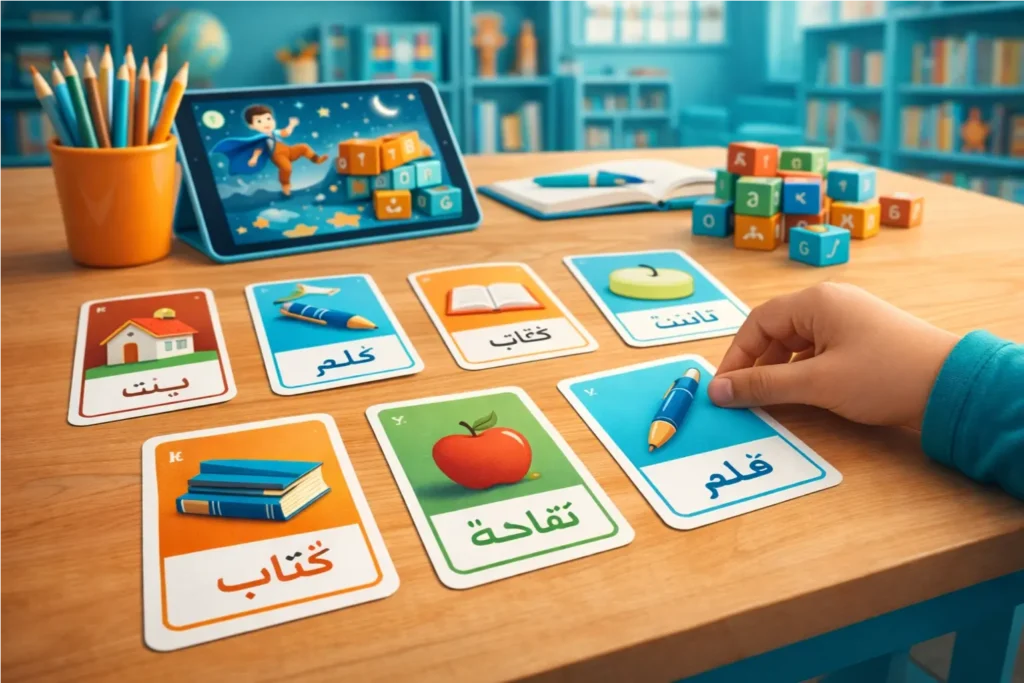
For structured learners, pairing nouns with images and using them repeatedly in simple sentences accelerates acquisition.
Our Arabic Classes for Kids follow exactly this immersive, pattern-first approach before introducing grammatical terminology.
Book a FREE Arabic trial for your Child

What Is Mu’annath Haqeeqi and Mu’annath Lafzhi?
Arabic grammarians (Nuhat / نُحَاة) divide feminine nouns into two main categories based on the relationship between form and meaning. Understanding this distinction prevents the confusion that arises when students encounter feminine nouns without visible markers.
1. Mu’annath Haqeeqi
Mu’annath Haqeeqi (مُؤَنَّث حَقِيقِي / Real Feminine) refers to nouns that are feminine because they denote biologically female beings. These words refer to female humans or female animals, and their femininity reflects biological reality.
2. Mu’annath Lafzhi
Mu’annath Lafzhi (مُؤَنَّث لَفْظِي / Formal Feminine) refers to nouns that carry feminine grammatical markers — typically the Taa’ Marbuutah — but may refer to male beings. A famous example is خَلِيفَة (Khaleefah — Caliph), which ends in Taa’ Marbuutah yet refers to a male leader and is treated as masculine grammatically.
| Type | Arabic Term | Example | Explanation |
| Real Feminine | مُؤَنَّث حَقِيقِي | أُمّ (Umm — mother) | Female referent, often no marker |
| Formal Feminine | مُؤَنَّث لَفْظِي | خَلِيفَة (Khaleefah) | Has ة marker, masculine referent |
| Figurative Feminine | مُؤَنَّث مَجَازِي | شَمْس (Shams — sun) | No marker, treated as feminine |
This table reflects the classical Arabic grammatical framework as established in traditional Nahw (نَحْو / grammar) scholarship.
What Is Mu’annath Samaai in Arabic?
Mu’annath Samaai (مُؤَنَّث سَمَاعِي — heard feminine) describes nouns that are feminine purely by convention and usage — not because of a visible marker or a female referent. The term Samaai (سَمَاعِي) means “heard” or “received through listening,” indicating these must be learned through exposure to authentic Arabic rather than derived through rules.
This category is where most non-native speakers make persistent errors, because they apply the Taa’ Marbuutah rule as though it were universal.
In our sessions at Buruj Academy, the most consistent challenge adult students face is encountering a word like يَد (yad — hand) and treating it as masculine, simply because it lacks a visible marker.
The word is feminine, and native speakers notice the error immediately when a student writes يَدٌ كَبِيرٌ instead of the correct يَدٌ كَبِيرَة.
Master the Arabic Language
Join our expert-led courses and build a strong foundation in Classical and Modern Arabic.
Get Your Free TrialCommon Categories of Mu’annath Samaai
Paired body parts are systematically feminine in Arabic, regardless of the speaker’s gender:
| Arabic | Transliteration | Meaning |
| يَد | Yad | Hand |
| عَيْن | ‘Ayn | Eye |
| رِجْل | Rijl | Leg/foot |
| أُذُن | Udhun | Ear |
| كَتِف | Katif | Shoulder |
Geographic names — cities, countries, and most place names — are typically treated as feminine in Arabic:
- مِصْر (Misr — Egypt) → feminine: مِصْرُ الْجَمِيلَة (Misr al-Jameelah — beautiful Egypt)
- مَكَّة (Makkah) → feminine (also has Taa’ Marbuutah)
- الْمَدِينَة (Al-Madeenah) → feminine (also has Taa’ Marbuutah)
Wind and natural forces are also conventionally feminine in classical Arabic: رِيح (reeh — wind), نَار (naar — fire).
Learning these categories is more efficient than memorizing individual words. For a systematic approach to vocabulary acquisition in context, our article on mastering Arabic vocabulary offers practical strategies that apply directly here.
How Does Gender Agreement Work in a Full Arabic Sentence?
Gender agreement (Mutaabaqah / مُطَابَقَة) is the practical application of everything discussed above. In Arabic, the noun’s gender must be mirrored by every element that grammatically relates to it — adjectives, demonstrative pronouns, verbs, and relative pronouns.
Missing this agreement is one of the most common errors we correct in our Online Arabic Classes.
Book your FREE Arabic trial online Arabic class at Buruj
1. Agreement with Adjectives (النَّعْت / An-Na’t)
The adjective in Arabic follows the noun and must match it in gender, number, and case. This is fundamentally different from English, where adjectives never change form.
Masculine examples:
الطَّالِبُ الْمُجْتَهِدُ
At-Taalib ul-Mujtahid
The hardworking male student
الْكِتَابُ الْكَبِيرُ
Al-Kitaab ul-Kabeer
The big book (كِتَاب / Kitaab — book — is masculine)
Feminine examples:
الطَّالِبَةُ الْمُجْتَهِدَةُ
At-Taalibah ul-Mujtahidah
The hardworking female student
الْمَدْرَسَةُ الْكَبِيرَةُ
Al-Madrasah ul-Kabeerah
The big school (مَدْرَسَة / Madrasah — school — is feminine)
2. Agreement with Verbs (الْفِعْل / Al-Fi’l)
When a verb precedes its subject (Fi’l qabl al-Faa’il / فِعْل قَبْلَ الْفَاعِل), it agrees with the subject in gender. This is the verbal agreement pattern students encounter immediately in basic Arabic reading.
ذَهَبَ الطَّالِبُ
Dhahaba at-Taalib
The male student went. (Verb: masculine singular)
ذَهَبَتِ الطَّالِبَةُ
Dhahabat at-Taalibah
The female student went. (Verb: feminine singular, marked by ت)
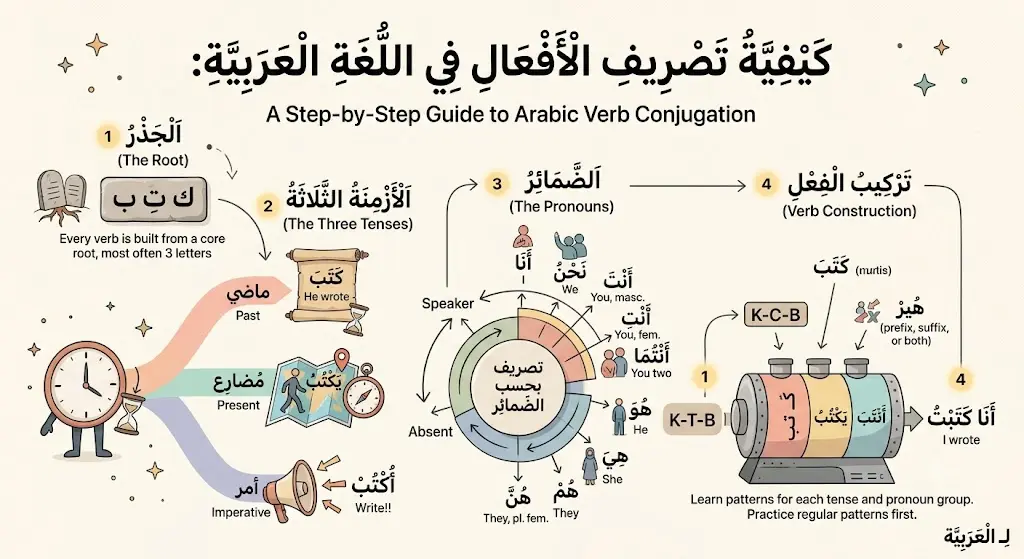
The addition of ت (Taa’) at the end of the past tense verb is the feminine agreement marker for third-person singular — a pattern consistent throughout classical and Modern Standard Arabic. Understanding this connects directly to broader Arabic sentence structure patterns worth studying alongside gender.
A Masculine and Feminine Nouns List Organized by Category
A structured list organized by semantic category helps learners internalize gender patterns rather than memorizing random pairs. Below is a practical reference list with full grammatical labeling:
| Category | Masculine (مُذَكَّر) | Feminine (مُؤَنَّث) | Notes |
| People | أَب (Ab — father) | أُمّ (Umm — mother) | Mu’annath Haqeeqi |
| People | أَخ (Akh — brother) | أُخْت (Ukht — sister) | Different root form |
| Students | طَالِب (Taalib) | طَالِبَة (Taalibah) | ة marker |
| Teachers | مُعَلِّم (Mu’allim) | مُعَلِّمَة (Mu’allimah) | ة marker |
| Body parts | رَأْس (Ra’s — head) | يَد (Yad — hand) | Yad: Mu’annath Samaai |
| Animals | أَسَد (Asad — lion) | لَبُؤَة (Labu’ah — lioness) | Different root |
| Places | مَسْجِد (Masjid — mosque) | مَدِينَة (Madeenah — city) | ة marker |
| Nature | قَمَر (Qamar — moon) | شَمْس (Shams — sun) | Both Mu’annath/Mudhakkar Samaai |
The pair أُخْت (Ukht — sister) for أَخ (Akh — brother) is particularly important. Here, the feminine is not formed by adding Taa’ Marbuutah to the masculine root — it is an entirely different word pattern. This category of broken feminine forms (Mu’annath bi Taghayyur as-Seegha / مُؤَنَّث بِتَغَيُّرِ الصِّيغَة) requires separate attention.
What Is the Difference Between Masculine and Feminine Nouns in Arabic Grammar Terms?
The difference between masculine and feminine nouns in Arabic operates on three levels that learners need to understand clearly: morphological (form), syntactic (sentence function), and semantic (meaning).
Morphologically, the difference is usually signaled by the Taa’ Marbuutah (ة) or, in some cases, by the Alif Maqsuura (ى) or Alif Mamdouda (اء) — as in حُبْلَى (Hubla — pregnant woman) and حَمْرَاء (Hamraa’ — red, feminine form).
Syntactically, the difference controls agreement rules throughout the sentence as demonstrated above.
Semantically, the difference sometimes reflects biological gender (father/mother) and sometimes reflects pure grammatical convention (sun/moon).
Understanding this three-level framework is exactly the approach taught by our Al-Azhar-trained instructors in Buruj Academy’s Arabic Grammar course, where grammar is never taught as abstract rules but as living patterns within meaningful sentences.
For adults beginning this process, our beginner’s guide to Modern Standard Arabic provides essential foundational context.
Discover the Buruj Academy Difference
Step into our virtual classrooms and see how our expert instructors make learning Quran and Arabic intuitive and clear. We focus on overcoming the specific hurdles non-native speakers face, building your confidence and connection with the Quran.
Master Arabic Grammar with Buruj Academy’s Expert Instructors
Masculine and feminine noun agreement is one of the foundational pillars of accurate Arabic, and it rewards students who learn it systematically from the beginning rather than patching gaps later.
At Buruj Academy, our Al-Azhar University graduates and Ijazah-certified instructors teach Arabic grammar through the Buruj Method — Context-before-abstraction — meaning every rule is learned inside real sentences, not in isolation.
Our Arabic Grammar course and Arabic for Beginners course offer personalized 1-on-1 sessions with flexible scheduling built for working adults and parents globally.
Book your free trial lesson and experience the difference structured, expert-led instruction makes from session one.
Begin your transformation today by choosing the path that fits your goals:
- Online Arabic Classes (General & Comprehensive)
- Arabic Course for Beginners
- Arabic Alphabet Learning Course
- Online Arabic Classes for Kids
- Arabic Classes for Adults
- Arabic Grammar Course (Nahw & Sarf)
- Intermediate Arabic Course (B1/B2)
- Arabic Speaking Course (Conversational Fluency)
- Arabic Reading Course (Literary Excellence)
- Learn Arabic Writing Course (Calligraphy & Composition)
Ready to speak with confidence? Join the global community at Buruj Academy and book your free placement interview today!
Master the Arabic Language
Join our expert-led courses and build a strong foundation in Classical and Modern Arabic.
Get Your Free TrialConclusion
Masculine and feminine nouns in Arabic are not a minor grammatical detail — they are the structural backbone of the entire language. Every adjective, verb, and pronoun in a sentence depends on knowing the gender of the noun it relates to.
The good news is that the system, once understood, is consistent: the Taa’ Marbuutah covers the majority of cases, and the exceptions follow learnable patterns.
The key is not memorizing lists in isolation but encountering gender patterns repeatedly within real sentences and authentic Arabic text — including the Quran itself. That exposure, guided by instructors who know where non-native speakers struggle most, builds the instinctive grammatical accuracy that defines real Arabic competence.
Frequently Asked Questions About Masculine and Feminine Nouns in Arabic
Does Every Arabic Noun Have a Fixed Gender That Never Changes?
Yes — every Arabic noun has a fixed grammatical gender that does not change. A masculine noun remains masculine in all sentence positions, and a feminine noun remains feminine regardless of context. The only time gender appears to shift is in derivation, when a new feminine form is created from a masculine root.
Are All Words Ending in Taa’ Marbuutah (ة) Automatically Feminine?
Almost always, yes — but with one important exception. Some words ending in Taa’ Marbuutah refer to male beings and are treated as grammatically masculine. The classical example is خَلِيفَة (Khaleefah — Caliph). These cases are rare and well-documented in classical Nahw scholarship; the default rule holds reliably for beginners.
What Is the Fastest Way for Adults to Learn Arabic Noun Genders?
Adults learn noun genders most effectively by studying words in gendered sentences — always with their adjective — rather than memorizing noun-gender lists. Seeing الشَّمْسُ الْحَارَّة (the hot sun) with the feminine adjective is more memorable than learning that shams is feminine in isolation. For more strategies, see our guide on how to learn Arabic grammar easily.