 Arabic

Learning Modern Standard Arabic (MSA) opens the door to one of the world’s most vibrant cultures and a language spoken by hundreds of millions. Whether you’re aiming for travel, religious study, career development, or cultural enrichment, this beginner’s guide to Modern Arabic is the essential form of Arabic used in media, education, literature, and official communications across the Arab world.
This beginner’s guide to modern Arabic provides a detailed roadmap for absolute beginners, emphasizing effective Arabic lessons for beginners and demystifying Arabic grammar for beginners to help establish a strong foundation.
Table of Contents:
Why Learn Modern Standard Arabic?
This is a beginner’s guide to modern Arabic shows the backbone of written and formal spoken Arabic used universally by educated speakers throughout the Arab world. Unlike regional dialects, which can differ greatly, MSA unites countries from Morocco to the Middle East, offering clear advantages:
- Universal Communication: MSA is essential for journalism, academia, business, and diplomacy within the Arab world.
- Cultural and Religious Access: It enables direct understanding of classical literature, the Quran, and contemporary publications.
- Stepping Stone to Dialects: Mastery of MSA makes it easier to pick up local Arabic dialects later.
Modern Arabic Lessons for Beginners: Getting Started
Finding the right Arabic lessons for beginners is crucial. Here’s how to structure your early learning:
1. Structured Courses
- Self-paced Platforms: Websites like Duolingo, Rosetta Stone, Udemy, and Arab Academy offer interactive courses tailor-made for beginners.
- In-person and Online Tutors: Personalized feedback from tutors—either locally or via online platforms like italki—accelerates learning.
- Language Centers: Institutions such as Kalimah Center specialize in MSA, often using modern teaching methods and authentic materials.
Tip: Most high-quality beginner lessons start with the Arabic alphabet, basic pronunciation, simple dialogues, and useful phrases.
2. Free Online Resources
- YouTube: Channels like Arabic Enthusiasts, Al-Lisan, and Learn Arabic with Maha offer engaging video series targeting total beginners.
- Open Educational Resources: Free e-books, university materials, and language exchange forums provide invaluable supplementary practice.
3. Immersive Group Learning
- Community Classes: Mosque or cultural center classes can offer a supportive group environment.
- Language Exchange: Partnering with native speakers for conversation exchanges builds confidence and practical speaking skills.
Discover the Buruj Academy Difference
Step into our virtual classrooms and see how our expert instructors make learning Quran and Arabic intuitive and clear. We focus on overcoming the specific hurdles non-native speakers face, building your confidence and connection with the Quran.
Beginner’s Guide to Modern Standard Arabic: The Fundamentals
A firm grasp of Arabic grammar for beginners is key for progress and understanding. While Arabic grammar can seem complex at first, these core concepts make it approachable:
1. Sentence Structure
- Nominal Sentences (جملة اسمية): Begin with a noun or pronoun, often expressing identity or description.
- Example: البيت كبير. (The house is big.)
- Verbal Sentences (جملة فعلية): Begin with a verb, emphasizing actions.
- Example: ذهب الطالب إلى المدرسة. (The student went to school.)
2. Pronouns and Verb Conjugations
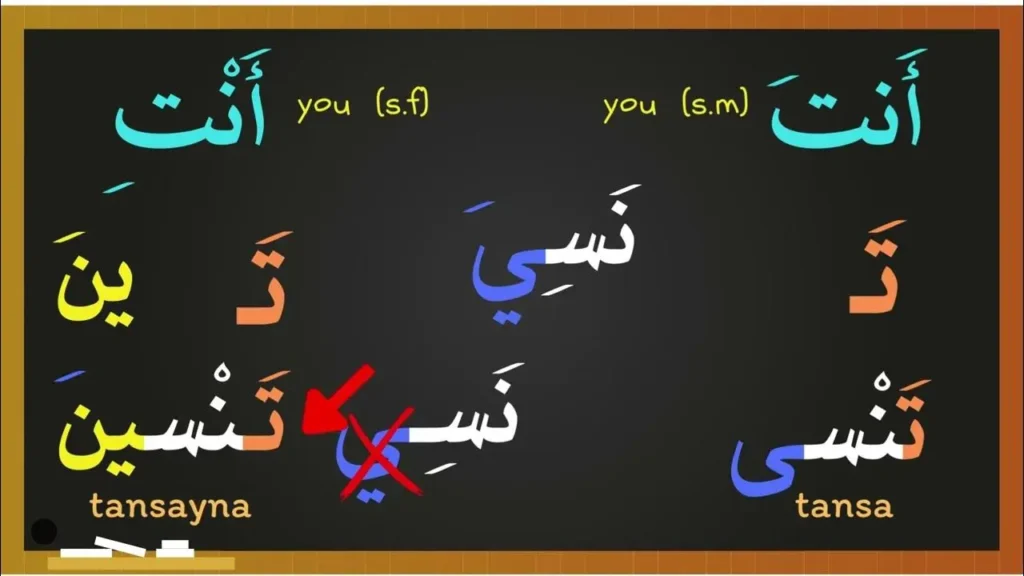
- Personal Pronouns: Practice “I” (أنا), “you” (أنت), “he” (هو), “she” (هي).
- Verb Tenses: Start with the present (يكتب – he writes), past (كتب – he wrote), and future (سيكتب – he will write).
3. Noun-Adjective Agreement
- Adjectives must match the noun’s gender, number, and definiteness.
- Example: سيارة جديدة (a new car – feminine); رجل طويل (a tall man – masculine).
4. Definite and Indefinite Nouns
- The definite article (ال, “al-”) is placed before nouns: كتاب (a book) → الكتاب (the book).
5. Basic Arabic Sentence Patterns
Memorize ten model sentences representing core patterns, then practice substituting different vocabulary while maintaining the grammatical structure.
| Pattern Type | Structure | Example | Translation |
|---|---|---|---|
| Nominal | Subject + Predicate | الطَّقْسُ جَمِيلٌ | The weather is beautiful |
| Verbal (Past) | Verb + Subject + Object | قَرَأَ الطَّالِبُ الكِتَابَ | The student read the book |
| Verbal (Present) | Verb + Subject + Object | يَقْرَأُ الطَّالِبُ الكِتَابَ | The student reads the book |
| Interrogative | Question Word + Sentence | أَيْنَ المَسْجِدُ؟ | Where is the mosque? |
This template approach builds productive language ability faster than learning isolated grammar rules separately from actual sentence construction.
Through Buruj Academy’s Arabic Grammar Course, students master sentence patterns systematically with English-speaker-specific explanations that address exact confusion points native speakers never encounter or understand.
Understand the Arabic Grammar with Buruj’s free trial lesson

Effective Strategies for Learning Modern Standard Arabic (MSA)
Learning Modern Standard Arabic requires a balanced approach that combines grammar, vocabulary building, and consistent real-world practice. The methods below will help learners develop a strong foundation while steadily improving fluency and confidence.
1. Mastering Grammar Step by Step
A solid understanding of Arabic grammar is essential, especially in the early stages. Begin with beginner-friendly grammar books and language-learning apps that introduce rules gradually and clearly. These resources help break down complex concepts such as sentence structure, verb conjugation, and gender agreement into manageable lessons.
To reinforce what you learn, actively apply new grammar rules by forming simple sentences. Writing and speaking short examples strengthens comprehension and helps move knowledge from theory into practical use. Supplement your study by watching grammar explanation videos and reviewing Modern Standard Arabic sentence examples to see how rules function in real contexts.
2. Expanding Vocabulary and Applying It Practically
Vocabulary growth is a key driver of fluency. Aim to build your word bank consistently while ensuring that new words are retained and actively used.
- Flashcards: Use physical flashcards or digital tools like Anki or Quizlet to introduce and review new words efficiently.
- Spaced Repetition: Schedule regular reviews so previously learned vocabulary stays fresh and accessible.
- Thematic Learning: Focus on vocabulary related to everyday topics such as family, food, travel, and greetings. Learning words in context makes them easier to remember and use naturally.
Practical Vocabulary Practice Ideas
- Write short daily journal entries in Arabic, even if they are only a few sentences.
- Create simple dialogues that incorporate newly learned words and grammar structures.
- Translate basic sentences from your native language into Arabic to strengthen comprehension and sentence formation skills.
3. Immersion Techniques: Integrating Arabic into Daily Life
Meaningful progress happens when Arabic becomes part of your everyday routine. Immersion does not require living in an Arabic-speaking country—it can be created intentionally.
Arabic Reading
Begin with children’s books, graded readers, and beginner-friendly textbooks such as Al Arabiyyah Bayna Yadayk. These materials introduce vocabulary and grammar in accessible contexts.
Arabic Listening
Listen to simplified news segments, Arabic-learning podcasts, and learner-focused radio programs to improve comprehension and pronunciation.
Arabic Speaking
Practice speaking aloud regularly, even when alone. Engage with language exchange platforms, join study groups, or participate in conversation clubs to build confidence and fluency.
| Arabic Sound | Articulation Point | English Approximation | Practice Word |
| ع | Deep throat constriction | None—unique to Arabic | عِلْم (knowledge) |
| ح | Upper throat, breathy | H in “hello” but throatier | حَبّ (love) |
| ق | Back of throat, stopped | K but much deeper | قَلْب (heart) |
| خ | Soft palate friction | Scottish “loch” | خَيْر (goodness) |
Record yourself reading simple Arabic words and compare with native speaker audio from reliable Quran recitation sources. The gap between your pronunciation and accurate models reveals specific sounds requiring focused correction rather than general practice.
Through Buruj Academy’s Arabic Classes for Adults, students receive real-time pronunciation correction during live sessions, eliminating fossilized errors before they become permanent speech patterns that later require months of remedial work.
Book your free Arabic trial lesson at Buruj

Arabic Writing
Progress from short sentences to longer paragraphs. Consistent writing sharpens grammar accuracy and reinforces vocabulary usage.
Succeeding with a Beginner’s Guide to Modern Standard Arabic
Today’s Arabic learners have access to a wide range of digital tools that can significantly accelerate progress when used strategically.
1. Language Learning Apps:
Platforms such as Duolingo, Memrise, and Mango Languages provide structured, beginner-friendly lessons that introduce essential vocabulary, pronunciation, and basic grammar. These apps are especially effective for daily practice, reinforcing concepts through repetition, quizzes, and spaced learning techniques.
2. Translation and Reference Tools:
Tools like Google Translate and Reverso Context are invaluable for understanding unfamiliar words and expressions. While Google Translate is useful for quick comprehension, Reverso Context excels at showing how words and phrases are used in real sentences, helping learners grasp meaning in context and avoid common mistakes.
3. Online Learning Communities:
Engaging with other learners can dramatically improve motivation and retention. Communities such as Reddit’s r/learn_arabic, dedicated Facebook groups, and Discord servers for Arabic learners provide spaces to ask questions, share resources, practice writing or speaking, and receive constructive feedback from peers and more advanced learners.
By combining these tools with consistent practice and clear learning goals, beginners can build a strong foundation in Modern Arabic and progress with greater confidence and efficiency.
Build Speaking Confidence Through Structured Daily Practice
Speaking remains most Arabic learners’ weakest skill because traditional courses prioritize reading and grammar over oral production. Developing conversational ability requires deliberate speaking practice from week one, not after achieving theoretical grammar mastery that many learners never reach.
Begin with self-directed speaking exercises describing your immediate environment in simple sentences. Look around your room and produce: “هَذَا كُرْسِيٌّ” (This is a chair), “الكُرْسِيُّ أَحْمَر” (The chair is red), “أَجْلِسُ عَلَى الكُرْسِيّ” (I sit on the chair). This internal monologue builds sentence formation speed without social pressure.
Record yourself daily speaking about predetermined topics—your family, your work, your hobbies, your faith journey. Listen to recordings identifying specific pronunciation errors and grammatical mistakes, then re-record correcting those problems. This self-monitoring dramatically accelerates improvement compared to unreviewed speaking practice.
Use language exchange apps connecting you with native Arabic speakers learning English. Structure exchanges with specific goals: spend 15 minutes discussing a predetermined topic in Arabic, then switch to English. This reciprocal arrangement provides authentic speaking practice with immediate correction from native speakers.
Through Buruj Academy’s Arabic Speaking Course, students practice structured conversation from day one with patient instructors experienced in coaxing hesitant adult learners into confident Arabic production through graduated speaking challenges.
Speak Arabic fluently with a free Buruj trial

Overcoming Common Challenges with Beginner’s Guide to Modern Standard Arabic
Every beginner faces hurdles on the path to fluency. Here’s a practical table of typical issues and solutions:
| Challenge | Solution |
| Arabic Alphabet | Practice tracing, listening, and writing for two weeks daily. |
| Grammar Complexity | Work through one rule at a time, using examples and exercises. |
| Vocabulary Retention | Group words thematically and review with spaced repetition. |
| Speaking Nerves | Practice with patient partners and record yourself for review. |
Building Vocabulary: A Foundational Step in the Beginner’s Guide to Modern Standard Arabic
Vocabulary acquisition is the cornerstone of learning any new language, and Arabic is no exception. A strong vocabulary allows learners to understand basic conversations, express simple ideas, and gradually build confidence. Beginners should focus first on high-frequency words—terms that appear regularly in everyday communication.
Key vocabulary categories to prioritize include:
- Greetings and polite expressions (hello, thank you, please, goodbye)
- Numbers and days of the week, which are essential for daily interactions
- Family, food, and clothing vocabulary, commonly used in real-life situations
- Essential verbs for daily actions, such as eat, go, write, read, and sleep
Learning words within meaningful contexts—sentences, short dialogues, or real-life scenarios—will make them easier to remember and use.
Practical Study Tips from The Beginner’s Guide to Modern Arabic
Starting Arabic may seem challenging at first due to its new script and sounds, but with the right strategies, progress becomes both manageable and rewarding.
Effective Study Strategies
- Set realistic goals: Instead of trying to master Arabic quickly, aim to learn 5–10 new words per day. Consistency is far more effective than cramming.
- Practice daily exposure: Even short daily study sessions help reinforce memory and build habits.
- Immerse yourself in the language: Watch Arabic TV shows or videos with subtitles, listen to Arabic podcasts or audio programs, and follow Arabic speakers on social media to familiarize yourself with natural usage and pronunciation.
Read Also: Learn Nahw and Sarf online
Practical Tips for Lifelong Language Learning
Arabic learning is a long-term journey. Staying organized and motivated is key to lasting success.
- Set achievable milestones: For example, “Learn five new words every day” or “Write one short paragraph each week.”
- Mix learning methods: Combine textbooks, apps, video lessons, and speaking practice to keep learning engaging and well-rounded.
- Self-assess regularly: Review what you’ve learned, identify strengths and gaps, and adjust your study plan accordingly.
- Stay motivated: Celebrate small achievements, join language-learning communities, and always remind yourself why you chose to learn Arabic.
With patience, consistency, and the right resources, mastering Modern Arabic becomes an attainable and rewarding goal.
Read Also: How to Improve Arabic Speaking Skills?
Master the Arabic Language
Develop reading, writing, speaking, and comprehension skills through interactive Arabic lessons for all levels.
Start Arabic ClassesRead Also: How to Learn Arabic Grammar Easily: A beginner Friendly Guide
Master Modern Arabic Effectively With Expert Guidance
Buruj Academy’s Online Arabic Classes use proven context-before-abstraction methodology teaching Arabic through meaningful content from day one rather than isolated drills.
Al-Azhar-trained instructors with 12+ years teaching non-Arabic speakers provide personalized learning plans adapted to adult learning styles and time constraints.
The Buruj Method emphasizes consistent daily practice over intensive sporadic sessions, with proven progression systems taking complete beginners to confident Arabic users within 12-18 months.
Find your perfect match among Buruj’s top Arabic courses:
- Arabic Classes for Adults
- Arabic Course for Beginners
- Alphabet course
- Arabic Grammar
- Reading Arabic fluently
- Speaking Arabic fluently
- Arabic writing
Conclusion
The Beginner’s Guide to Modern Arabic encourages you to make consistent, daily progress. Embrace a balanced approach: combine high-quality Arabic lessons for beginners with a foundational knowledge of Arabic grammar for beginners. Use modern technology, immerse yourself in Arabic media, and connect with others on the same journey. With dedication and the right resources, you’ll soon unlock the beauty and depth of Modern Standard Arabic—one word, one phrase, and one conversation at a time.
The root system provides exponential vocabulary expansion once learners recognize patterns connecting thousands of words through shared three-consonant cores. Graduated reading from children’s stories to Quranic tafsir to classical texts reinforces grammar naturally through meaningful content rather than isolated textbook exercises.






Leave a Reply