 Arabic
| Key Takeaways |
| The Arabic alphabet has 28 letters, each with up to four written forms depending on position in a word. |
| Pairing each Arabic letter with a familiar picture word dramatically accelerates recognition and memory in young learners. |
| Arabic letters are written right to left, and most letters connect to neighboring letters within a word. |
| Starting with isolated letter forms before connected forms prevents confusion and builds confidence in early readers. |
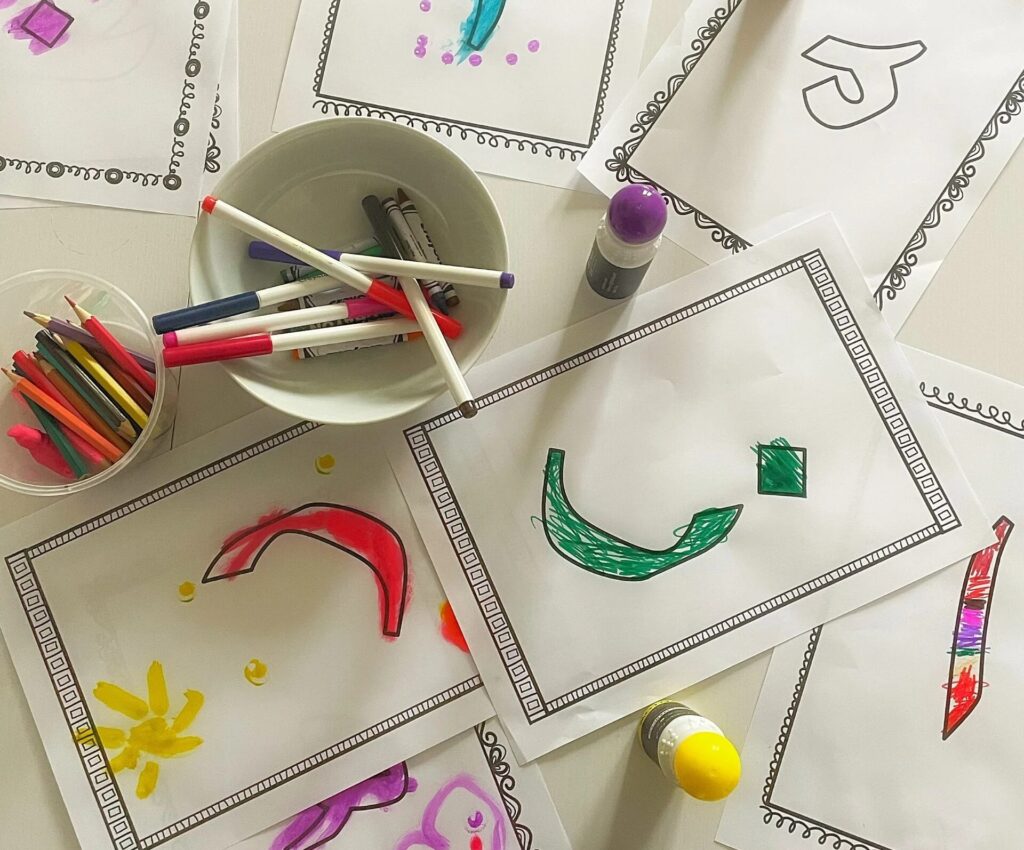
Children remember what they can see. That simple truth is why picture-based learning remains the most effective entry point for young Arabic learners — especially those growing up in English-speaking homes where Arabic letters look entirely unfamiliar at first glance.
The Arabic alphabet has 28 letters, written right to left, each carrying its own sound and shape. Pairing every letter with a recognizable picture word — something a child already knows — creates an instant memory anchor that textbook drills rarely match.
If you are looking for the full Arabic alphabet for kids laid out simply and visually, this guide covers every letter with its picture word, pronunciation, and form.
Table of Contents:
1. ا — Alif Looks Like a Standing Pole and Sounds Like “A” in “Apple”
Alif (ا) is the first letter of the Arabic alphabet, producing a long “aa” vowel sound when marked or a neutral glottal stop when bare. أَسَد (Asad) — Lion. The tall, straight shape of Alif resembles the lion standing proud and upright.
| Feature | Detail |
| Letter Name | Alif |
| Arabic Script | ا |
| Sound | Long “aa” / glottal stop |
| Picture Word | أَسَد — Lion |
| Connects? | Right side only |
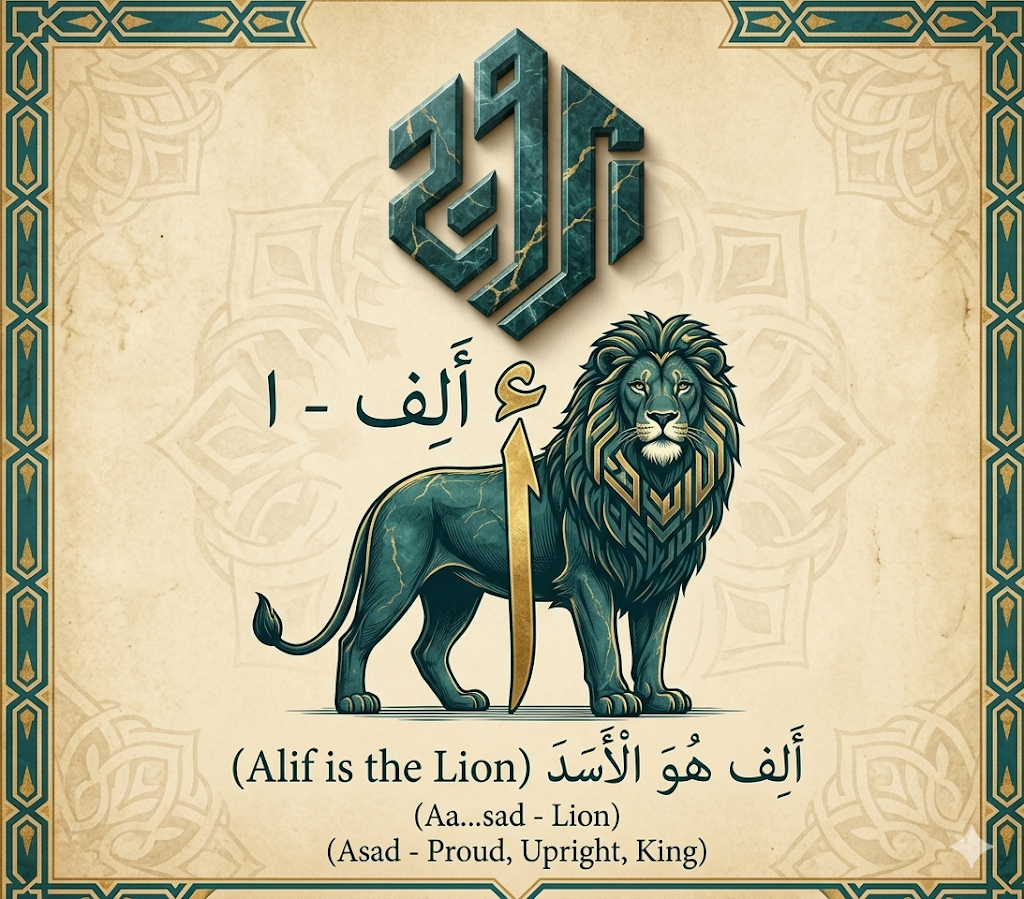
In our sessions at Buruj Academy, Alif is always the first letter we introduce — its simple, upright form gives young learners an immediate confidence boost right at the start.
At Buruj Academy, our Arabic Alphabet Learning course introduce letters alphabetically while explicitly pointing out shape-family patterns throughout.
Get your kid a free trial now in Buruj’s Best Alphabet course
2. ب — Ba Looks Like a Boat with One Dot Underneath and Sounds Like “B”
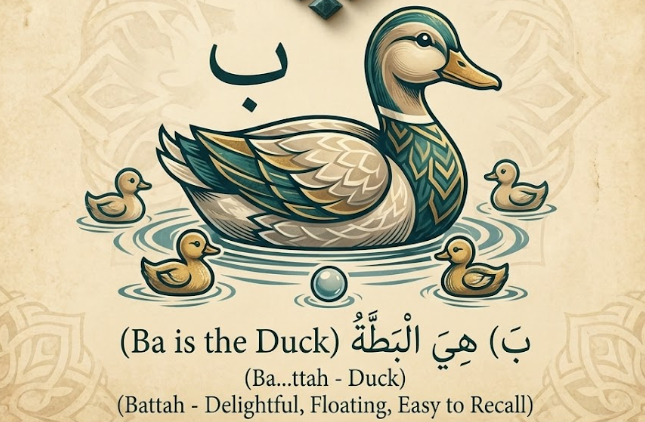
Ba (ب) produces the familiar “b” sound, identical to English. بَطَّة (Battah) — Duck. The shape of Ba — a wide, curved base with a single dot below — resembles a duck floating on water, which children find delightful and easy to recall.
| Form | Isolated | Initial | Medial | Final |
| Ba | ب | بـ | ـبـ | ـب |
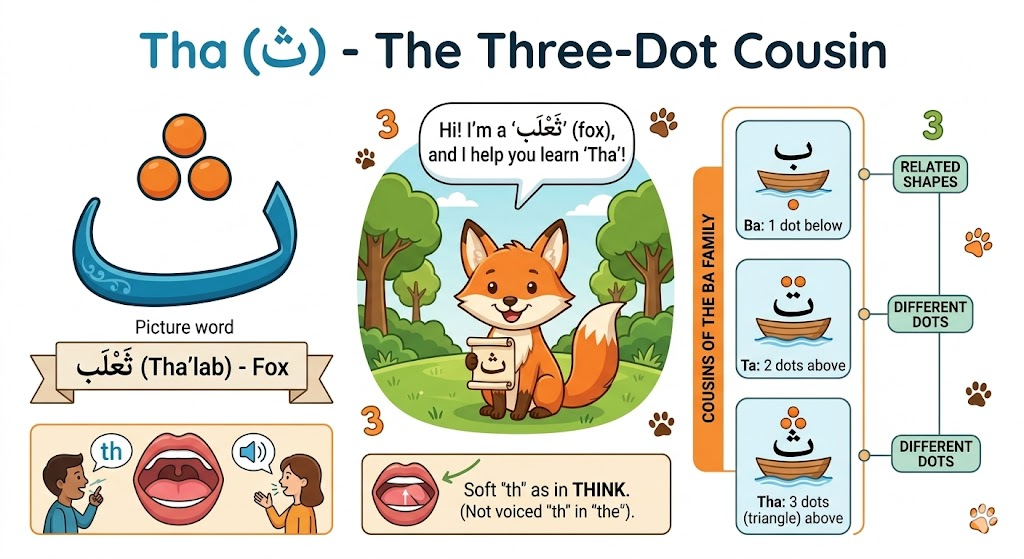
Ba is among the three letters (ب، ت، ث) that share the same base shape, differing only in dot count and placement — a key pattern we highlight early to help kids group similar letters together.
3. ت — Ta Looks Like a Boat with Two Dots on Top and Sounds Like “T”
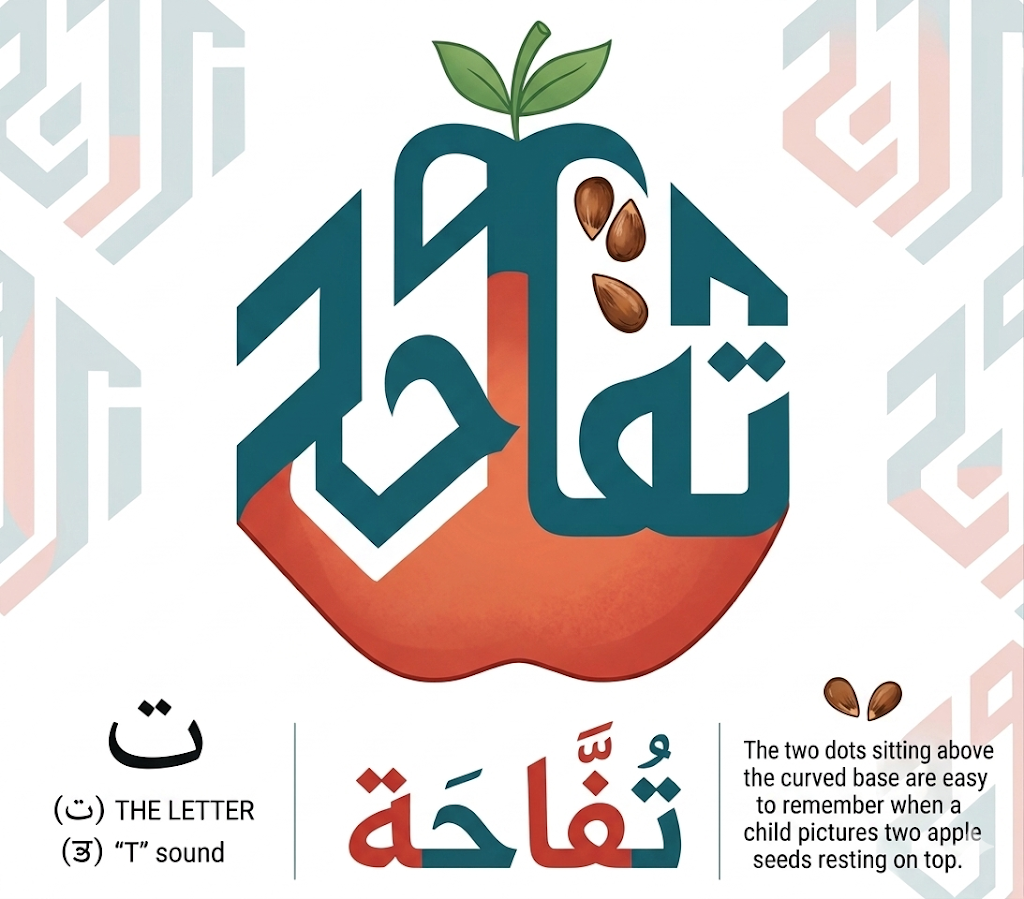
Ta (ت) produces a clear “t” sound. تُفَّاحَة (Tuffaha) — Apple. The two dots sitting above the curved base are easy to remember when a child pictures two apple seeds resting on top.
Ta shares its base shape with Ba and the next letter, Tha. Teaching these three together as a “family” is one of the most effective strategies we use in our Online Arabic Classes for Kids — children recognize the dot pattern difference within a single lesson.
Book a FREE Arabic trial for your Child

4. ث — Tha Looks Like a Boat with Three Dots on Top and Sounds Like “Th” in “Think”
Tha (ث) produces the soft “th” sound, as in the English word “think” — not the voiced “th” in “the.” ثَعْلَب (Tha’lab) — Fox. Three dots arranged in a triangle above the base curve make this letter the clear “three-dot cousin” of Ba and Ta.
English-speaking children sometimes want to say “s” or “t” for Tha. We always correct this gently from day one, because this sound becomes important for correct Quran recitation later in their learning path.
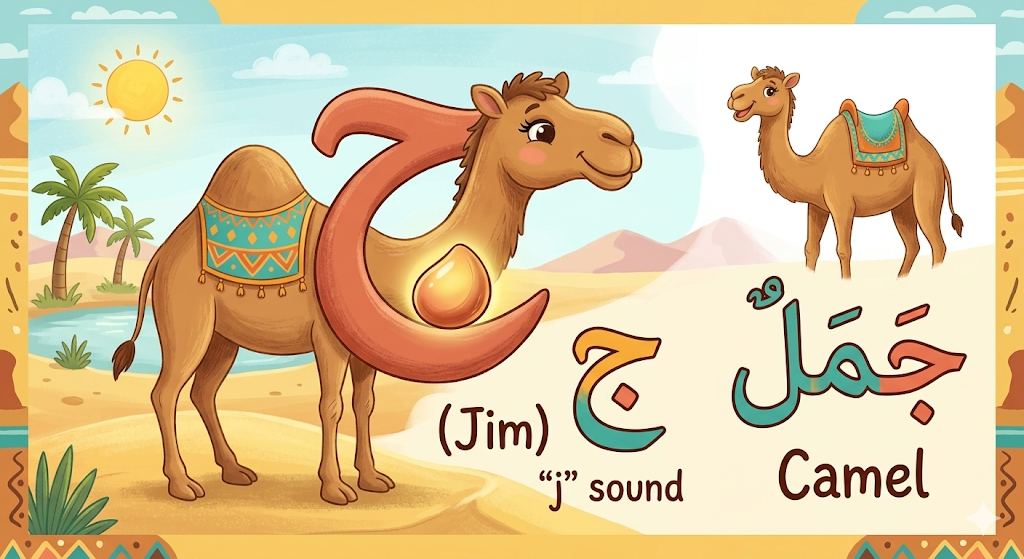
5. ج — Jim Looks Like a Hook with a Dot and Sounds Like “J” in “Jar”
Jim (ج) produces the “j” sound. جَمَل (Jamal) — Camel. The sweeping hook shape of Jim, with its dot nestled inside the curve, resembles a camel’s arched neck — a vivid image for young imaginations.
Jim belongs to a three-letter family with Ha (ح) and Kha (خ), all sharing the same base shape but differing in dot placement. Grouping them as the “hook family” helps children decode the dot-based differences quickly.
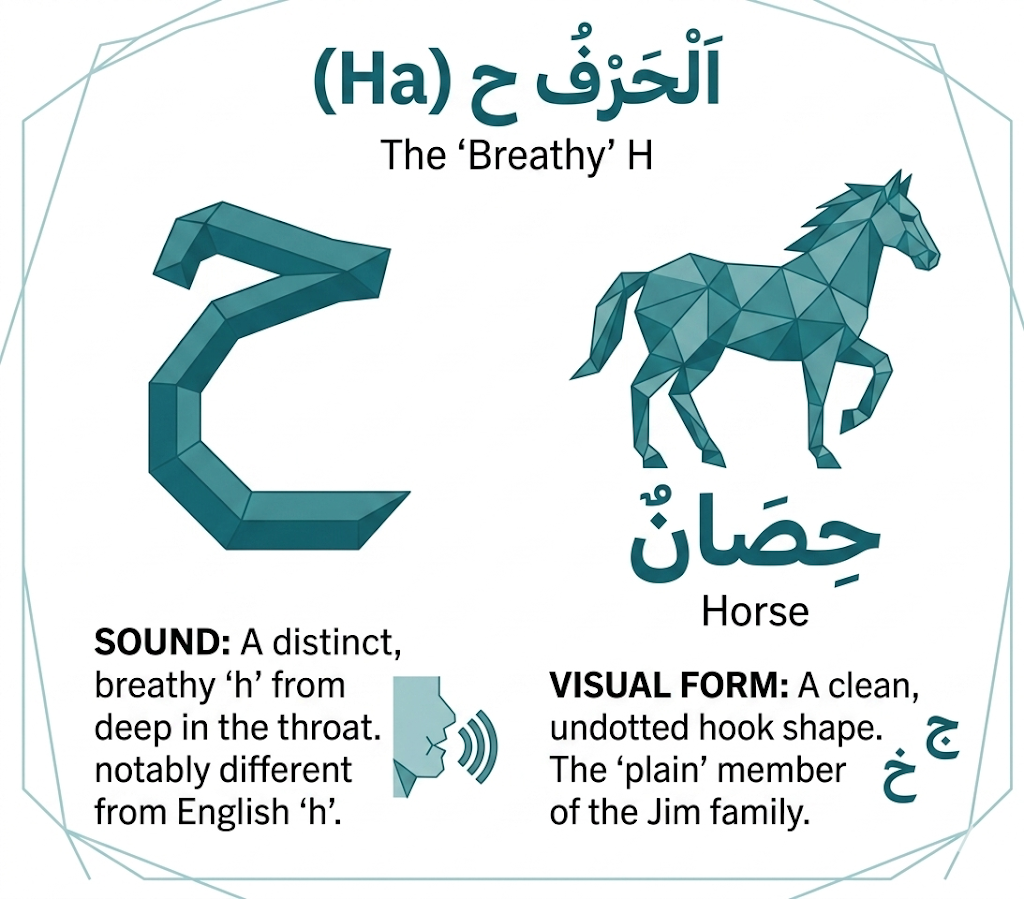
6. ح — Ha Looks Like a Hook with No Dot and Sounds Like a Breathy “H”
Ha (ح) produces a distinct, breathy “h” sound from the throat — notably different from the English “h.” حِصَان (Hisan) — Horse. The clean, undotted hook shape is the “plain” member of the Jim family.
This letter’s sound requires special attention for non-Arabic speakers. The pharyngeal articulation — produced by constricting the throat slightly — is one of the sounds we focus on carefully in our Arabic Alphabet Learning course.
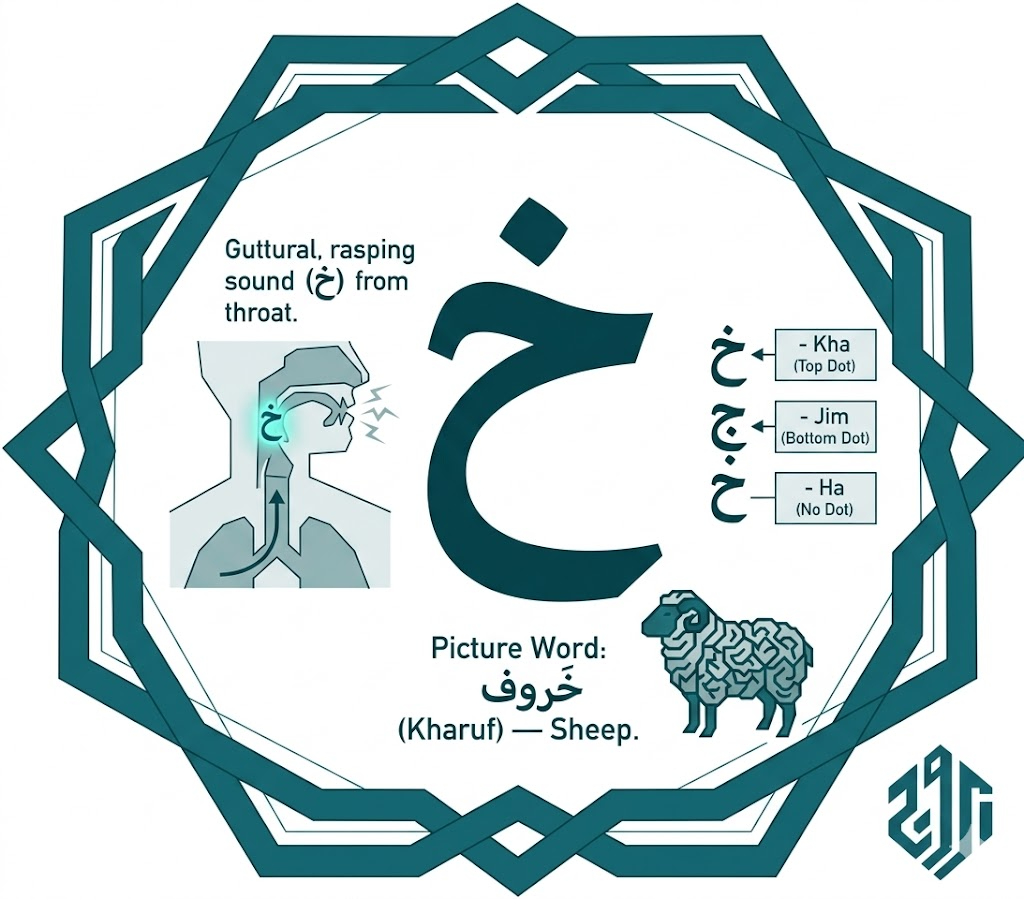
7. خ — Kha Looks Like a Hook with a Dot on Top and Sounds Like “Ch” in Scottish “Loch”
Kha (خ) produces a guttural, rasping sound from the back of the throat. خَرُوف (Kharuf) — Sheep. The single dot on top of the hook shape distinguishes it from Jim and Ha within this letter family.
| Letter | Dots | Sound |
| ج (Jim) | One dot inside/below | “J” |
| ح (Ha) | No dots | Breathy “H” |
| خ (Kha) | One dot above | Guttural “Kh” |
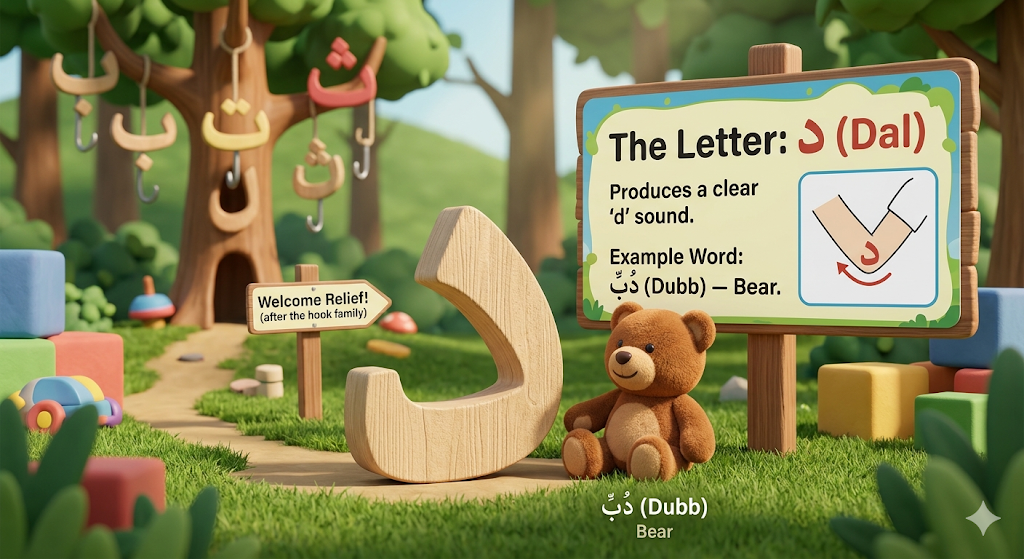
8. د — Dal Looks Like a Bent Arm and Sounds Like “D” in “Door”
Dal (د) produces a clear “d” sound. دُبّ (Dubb) — Bear. The short, angular shape of Dal — like a bent elbow — is one of the simplest letter forms children encounter, making it a welcome relief after the hook family.
Dal is one of the non-connecting letters: it only connects to the letter before it, never to the letter that follows. Understanding non-connecting letters early prevents a very common reading error among beginners.
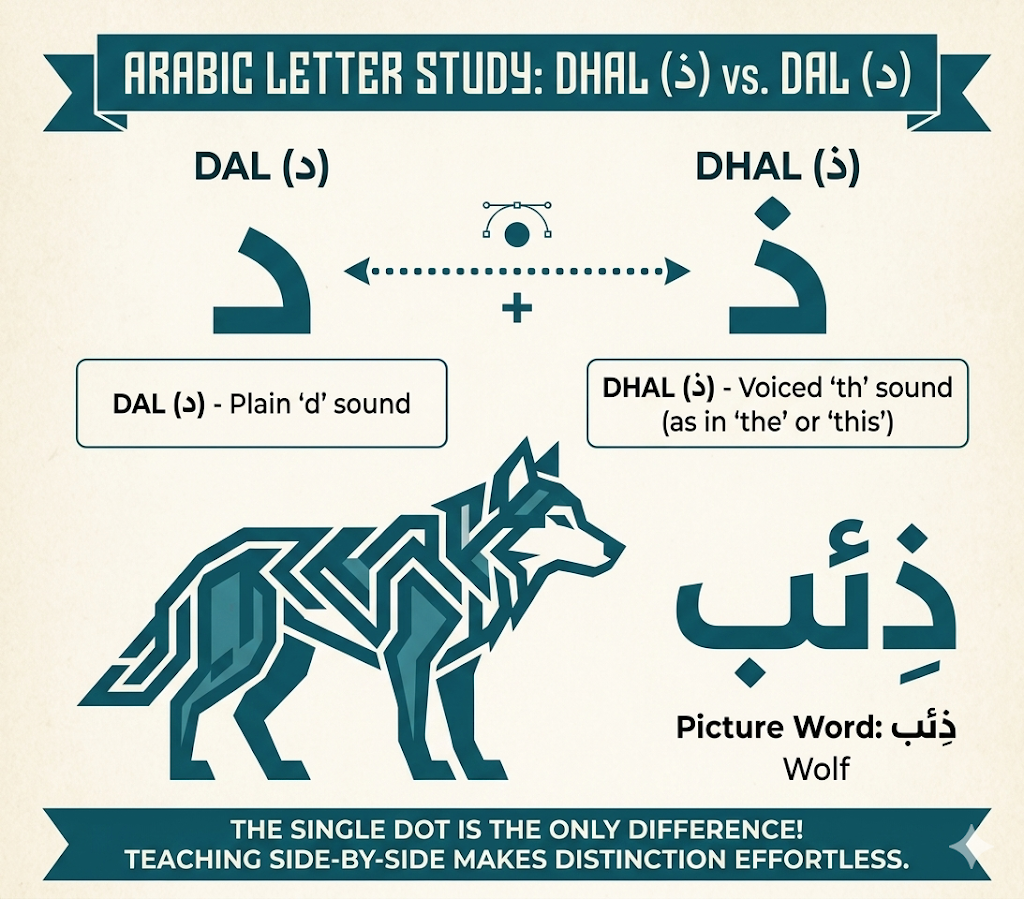
9. ذ — Dhal Looks Like Dal with a Dot and Sounds Like “Th” in “The”
Dhal (ذ) produces the voiced “th” sound, as in “the” or “this.” ذِئْب (Dhi’b) — Wolf. The single dot above the Dal base is the only visual difference — teaching them side by side makes this distinction effortless.
Children sometimes confuse the two “th” sounds in Arabic: Tha (ث) is unvoiced (“think”) while Dhal (ذ) is voiced (“the”). A simple hand-on-throat test — feeling the vibration — is the technique we use to make this distinction physical and memorable.
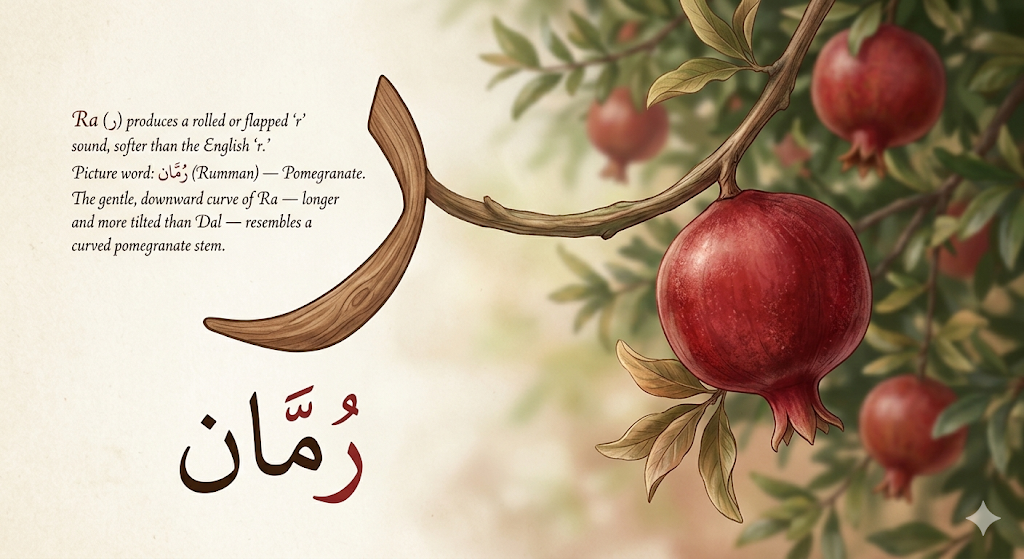
10. ر — Ra Looks Like a Tilted Hook and Sounds Like a Rolled “R”
Ra (ر) produces a rolled or flapped “r” sound, softer than the English “r.” رُمَّان (Rumman) — Pomegranate. The gentle, downward curve of Ra — longer and more tilted than Dal — resembles a curved pomegranate stem.
Ra is also a non-connecting letter and belongs to a pair with the next letter, Zay. Their base shape is identical — only the dot distinguishes them.
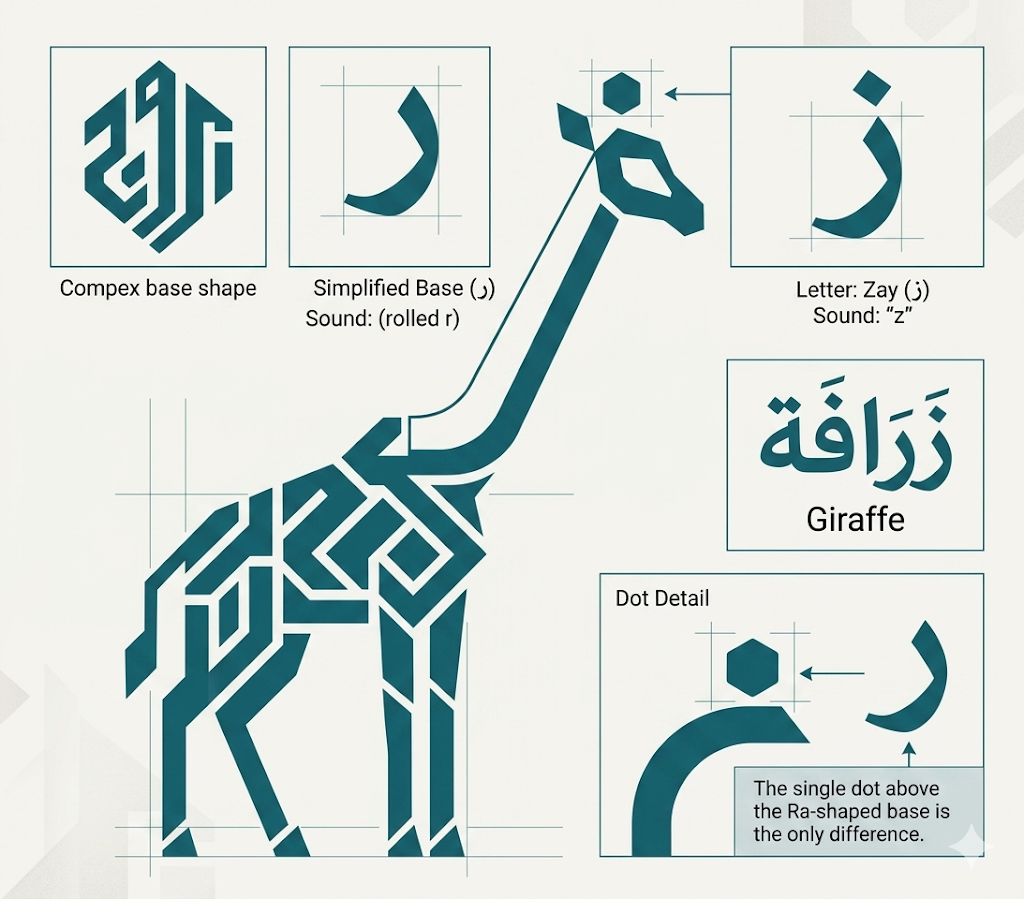
11. ز — Zay Looks Like Ra with a Dot and Sounds Like “Z” in “Zebra”
Zay (ز) produces the “z” sound. زَرَافَة (Zarafa) — Giraffe. The single dot above the Ra-shaped base is the only difference, making these two letters another natural teaching pair.
| Letter | Dot | Sound | Picture Word |
| ر (Ra) | None | Rolled “R” | رُمَّان — Pomegranate |
| ز (Zay) | One above | “Z” | زَرَافَة — Giraffe |
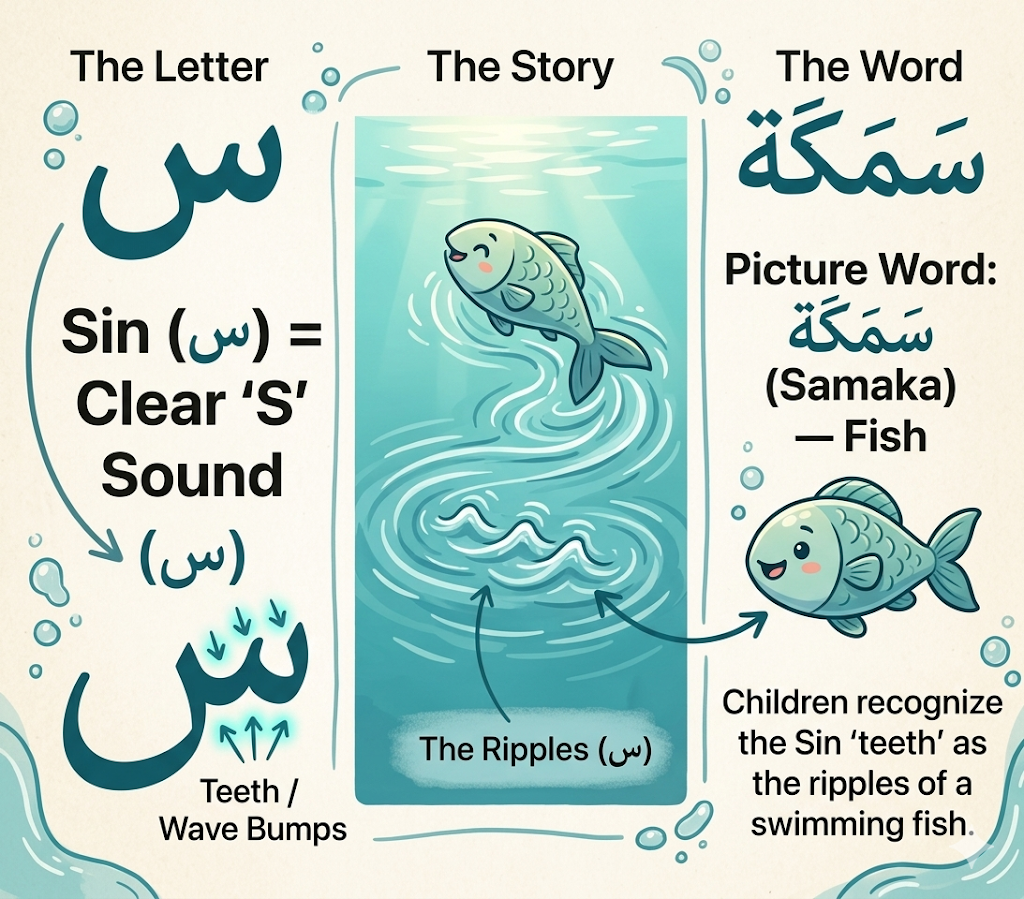
12. س — Sin Looks Like Three Waves and Sounds Like “S” in “Sun”
Sin (س) produces a clear “s” sound. Picture word: سَمَكَة (Samaka) — Fish. The three small “teeth” or wave-like bumps of Sin are immediately recognized by children when described as the ripples a fish makes swimming through water.
Sin pairs naturally with Shin in the next entry. Teaching them together as the “wave family” — one plain, one with dots — is a pattern that sticks quickly with young learners.
Read also: Best Arabic Worksheets for Kids
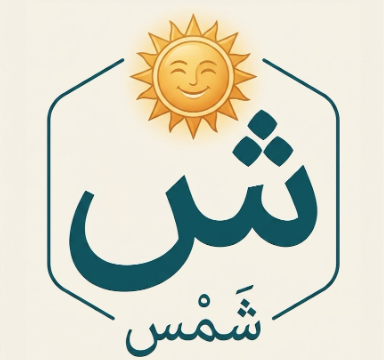
13. ش — Shin Looks Like Three Waves with Three Dots and Sounds Like “Sh” in “Shoe”
Shin (ش) produces the “sh” sound. Picture word: شَمْس (Shams) — Sun. The three dots above the familiar wave base make Shin visually distinctive and easy to remember once Sin is known.
Both Sin and Shin change shape significantly in their initial and medial forms (سـ / شـ), dropping the three teeth for a simple forward stroke. Showing children both forms early — isolated and connected — prevents confusion when they begin reading full words. For more on connected forms, our guide on how to learn to read Arabic for kids covers this clearly.
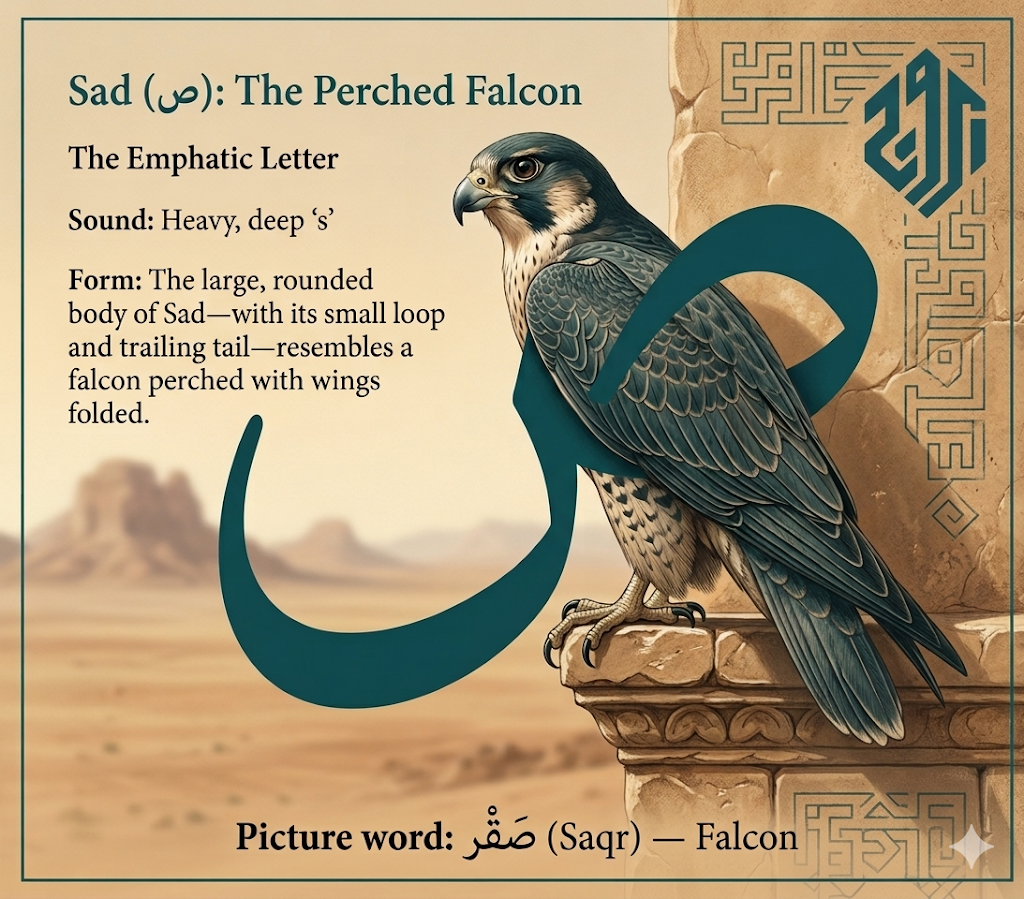
14. ص — Sad Looks Like a Rounded Loop with a Tail and Sounds Like an Emphatic “S”
Sad (ص) is an emphatic letter, produced with the tongue pressed against the upper palate, creating a heavier, deeper “s” sound. Picture word: صَقْر (Saqr) — Falcon. The large, rounded body of Sad — with its small loop and trailing tail — resembles a falcon perched with wings folded.
The emphatic letters (ص، ض، ط، ظ) are a genuinely new category of sound for English-speaking children. We introduce them as “heavy cousins” of familiar letters — same family, deeper sound.
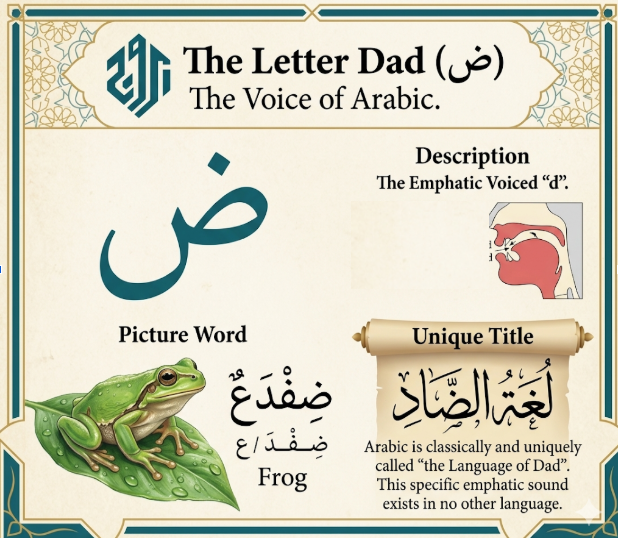
15. ض — Dad Looks Like Sad with a Dot and Sounds Like an Emphatic “D”
Dad (ض) is the emphatic “d” — produced with the same tongue position as Sad but voiced. Picture word: ضِفْدَع (Difda’) — Frog. Arabic is classically called “لُغَةُ الضَّاد” (the Language of Dad) because this unique letter exists in no other language.
Master the Arabic Language
Join our expert-led courses and build a strong foundation in Classical and Modern Arabic.
Get Your Free Trial| Emphatic Letter | Plain Counterpart | Sound Distinction |
| ص (Sad) | س (Sin) | Heavy “S” |
| ض (Dad) | د (Dal) | Heavy “D” |
| ط (Ta) | ت (Ta) | Heavy “T” |
| ظ (Dha) | ذ (Dhal) | Heavy “Dh” |
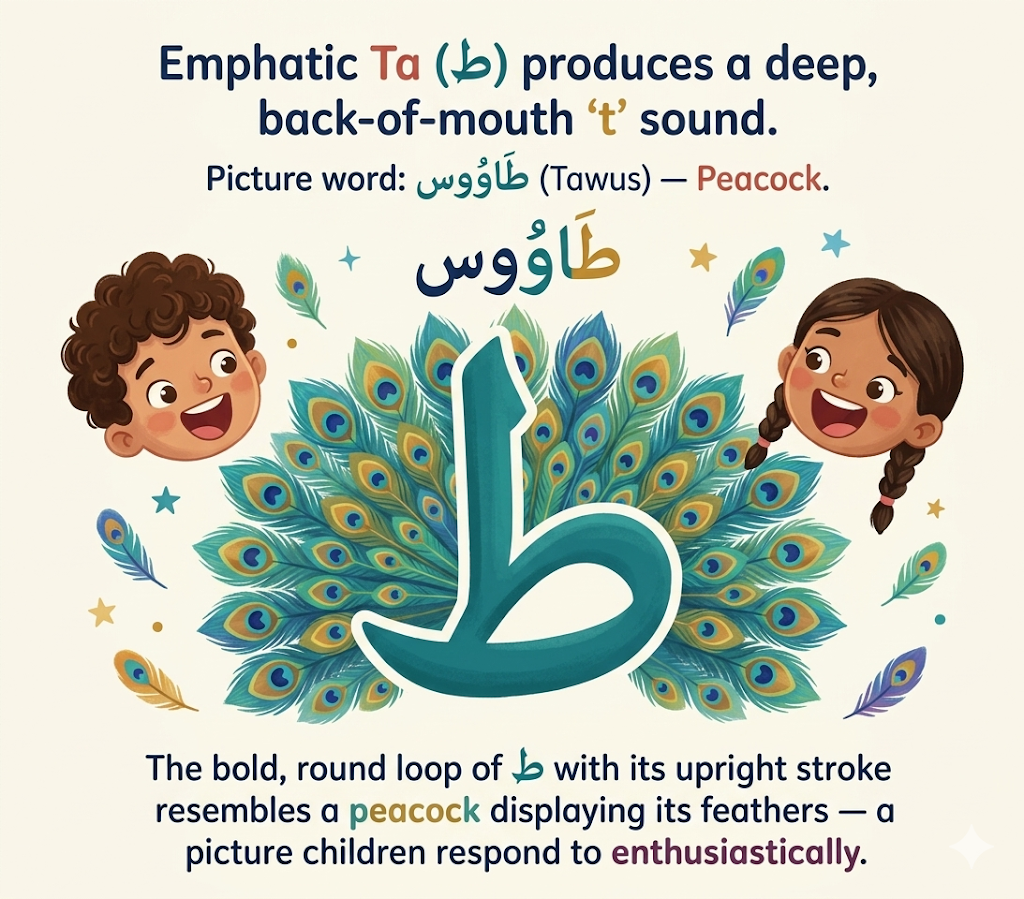
16. ط — Emphatic Ta Looks Like a Loop with a Vertical Stroke and Sounds Like a Heavy “T”
Emphatic Ta (ط) produces a deep, back-of-mouth “t” sound. طَاوُوس (Tawus) — Peacock. The bold, round loop of ط with its upright stroke resembles a peacock displaying its feathers — a picture children respond to enthusiastically.
This is distinct from the letter Ta (ت) encountered earlier. Using the peacock image alongside the plain Ta’s apple image keeps the two clearly separate in a child’s memory.
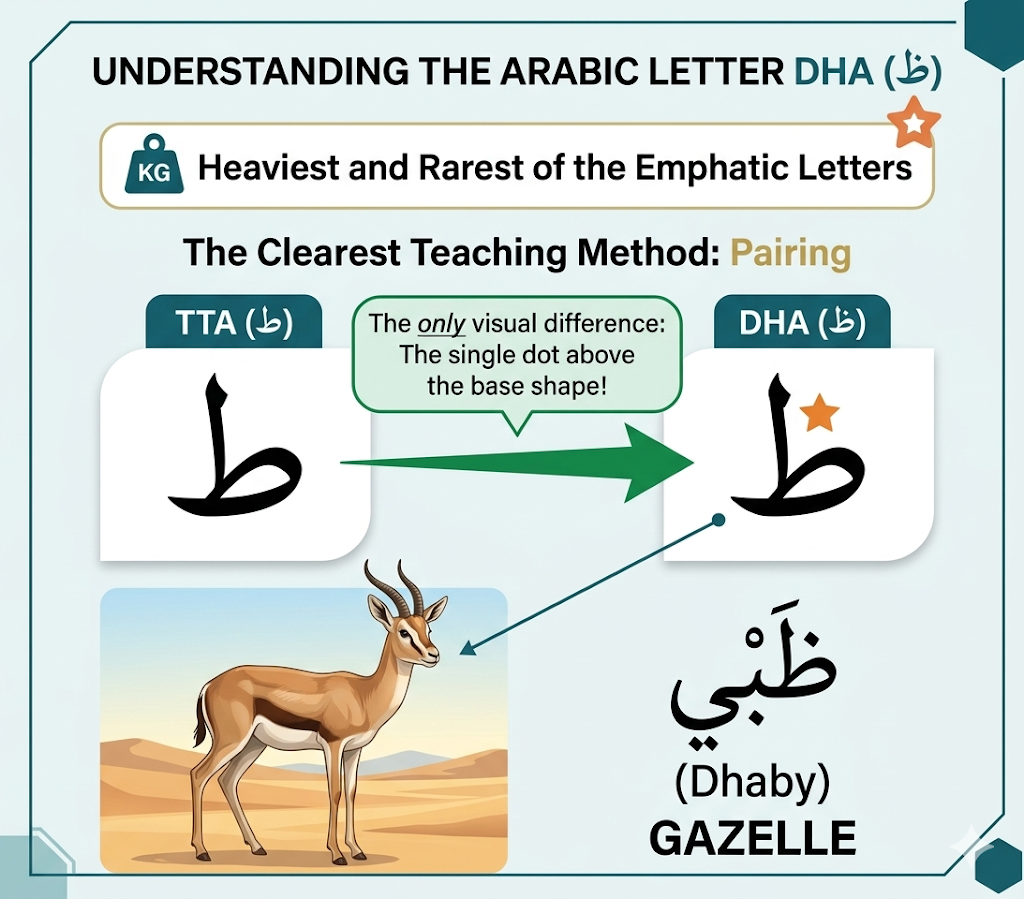
17. ظ — Emphatic Dha Looks Like Emphatic Ta with a Dot and Sounds Like a Heavy “Dh”
Emphatic Dha (ظ) is the heaviest and rarest of the emphatic letters. ظَبْي (Dhaby) — Gazelle. A single dot above the ط base is the only visual difference — pairing it directly with ط is the clearest way to teach it.
In our experience, ظ is the letter most frequently mispronounced — children often merge it with Dhal (ذ). The distinction is the heaviness: ظ resonates deeper in the mouth, pulling surrounding vowels into a fuller, rounder sound.
18. ع — ‘Ayn Looks Like a Knot and Sounds Like a Voiced Pharyngeal
‘Ayn (ع) has no English equivalent. It is produced by constricting the throat and voicing through the constriction — sometimes described as a “squeezed” vowel sound. Picture word: عِنَب (‘Inab) — Grapes. The knotted, twisting shape of ‘Ayn mirrors the tangled vines of a grape cluster.
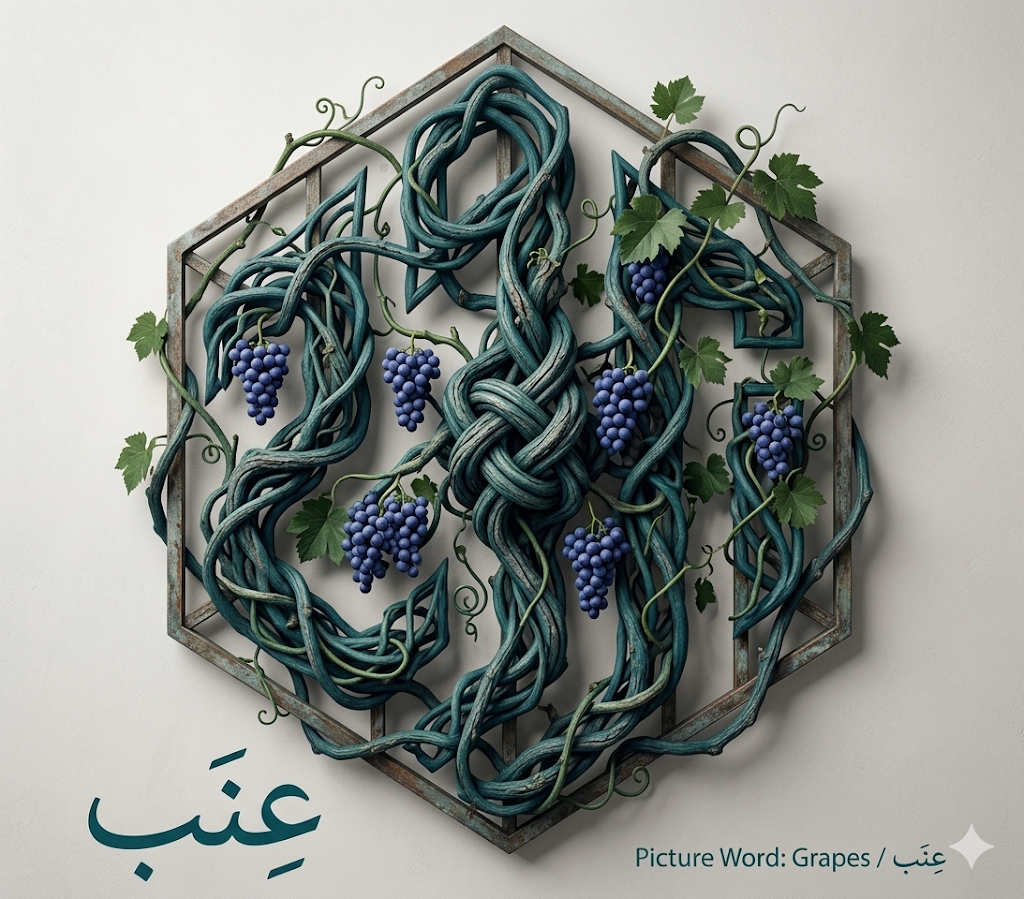
‘Ayn is one of the most challenging sounds for English-speaking children. We introduce it early and revisit it often, because correct pronunciation here is foundational for Quran recitation.
Families who want structured guidance can explore our Arabic for Beginners course for step-by-step phonetic support.
Begin learning Arabic at Buruj with a FREE trial lesson
19. غ — Ghayn Looks Like ‘Ayn with a Dot and Sounds Like a Gargled “Gh”
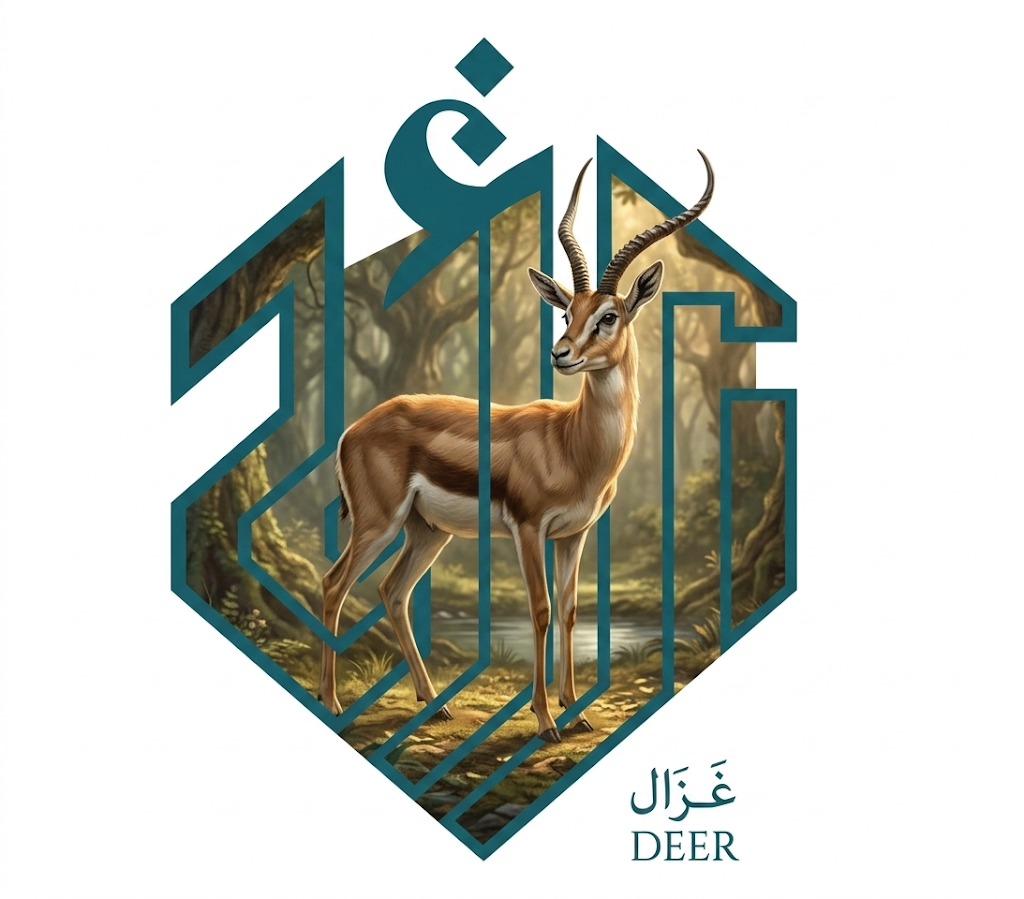
Ghayn (غ) is the unvoiced counterpart of ‘Ayn — a guttural, gargled sound similar to a Parisian French “r.” Picture word: غَزَال (Ghazal) — Deer. The single dot above the ‘Ayn base is the only visual change, though the sound is entirely distinct.
| Letter | Dot | Sound |
| ع (‘Ayn) | None | Voiced pharyngeal |
| غ (Ghayn) | One above | Guttural “Gh” |
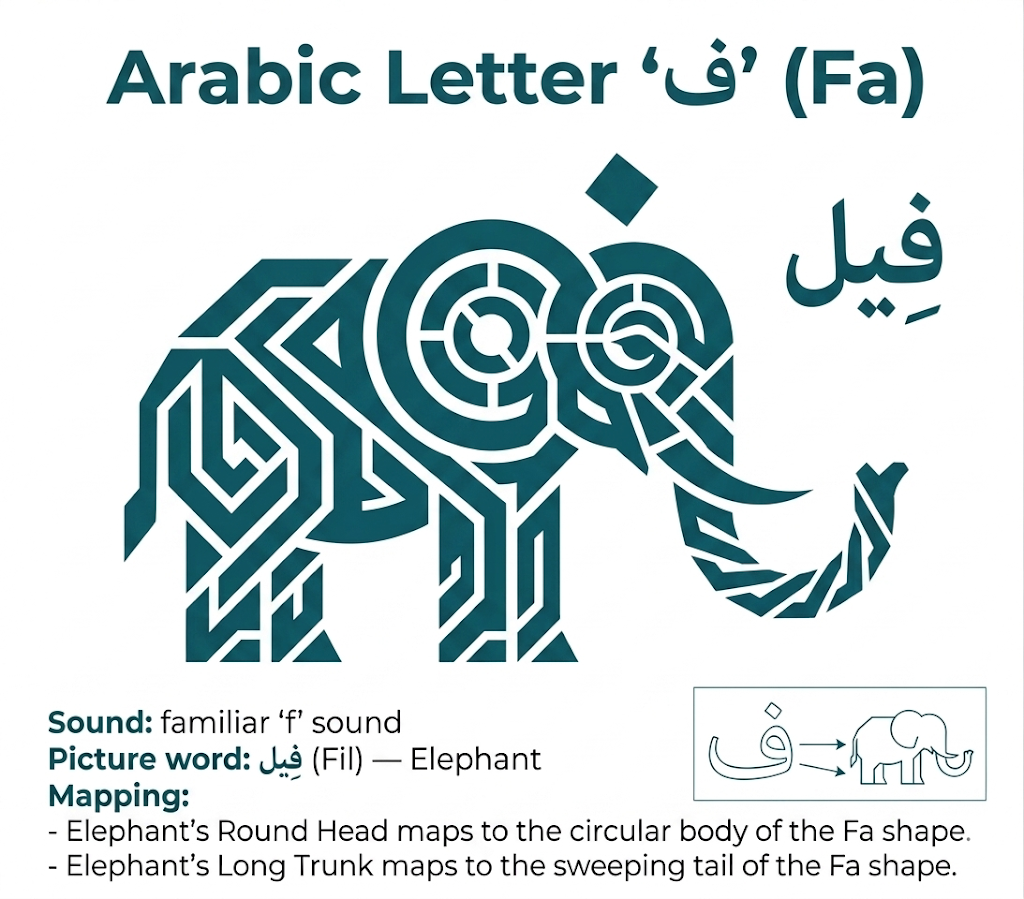
20. ف — Fa Looks Like a Circle with a Dot and a Tail and Sounds Like “F” in “Fish”
Fa (ف) produces the familiar “f” sound. فِيل (Fil) — Elephant. The round head and long trunk of the elephant map perfectly onto the circular body and sweeping tail of the Fa shape — one of the most loved letter-picture pairings we use with young students.
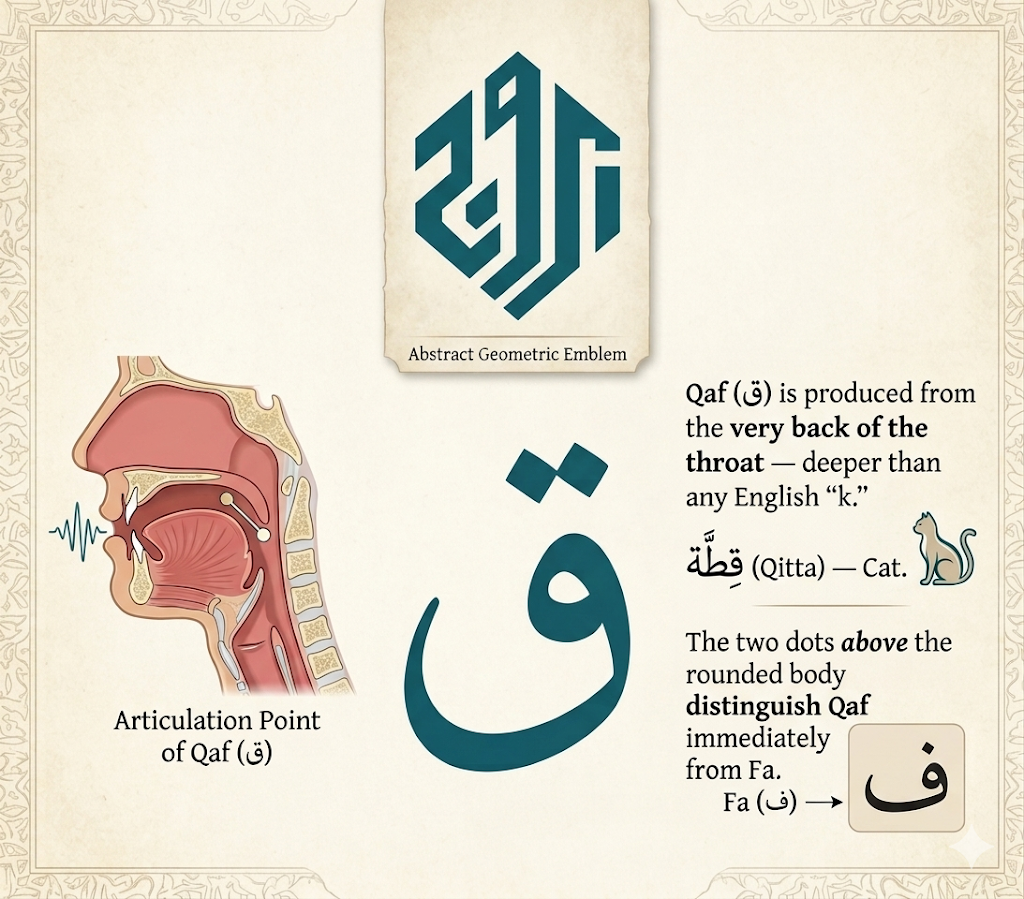
21. ق — Qaf Sounds Like a Deep “Q”
Qaf (ق) is produced from the very back of the throat — deeper than any English “k.” قِطَّة (Qitta) — Cat. The two dots hanging below the rounded body distinguish Qaf immediately from Fa.
Qaf is also one of the five Qalqalah letters in Tajweed (ق ط ب ج د), producing a small echo sound when it appears without a vowel. Laying the correct pronunciation foundation now pays dividends when children progress to Quran reading with proper Tajweed.
Book Your FREE Trial Lesson to Begin Your Tajweed Journey
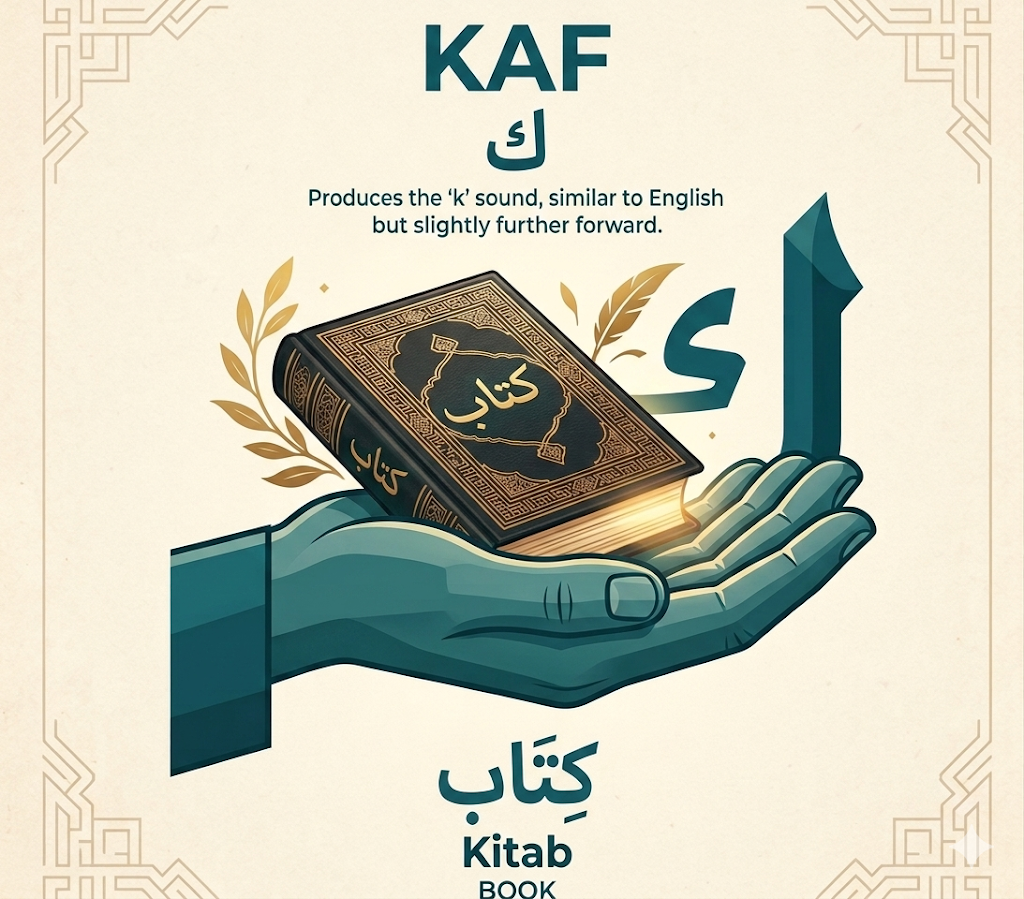
22. ك — Kaf Sounds Like “K” in “Kite”
Kaf (ك) produces the “k” sound, similar to English but slightly further forward in the mouth. Picture word: كِتَاب (Kitab) — Book. The open, angled shape of Kaf — like a palm held open to receive a book — makes the picture connection feel natural.
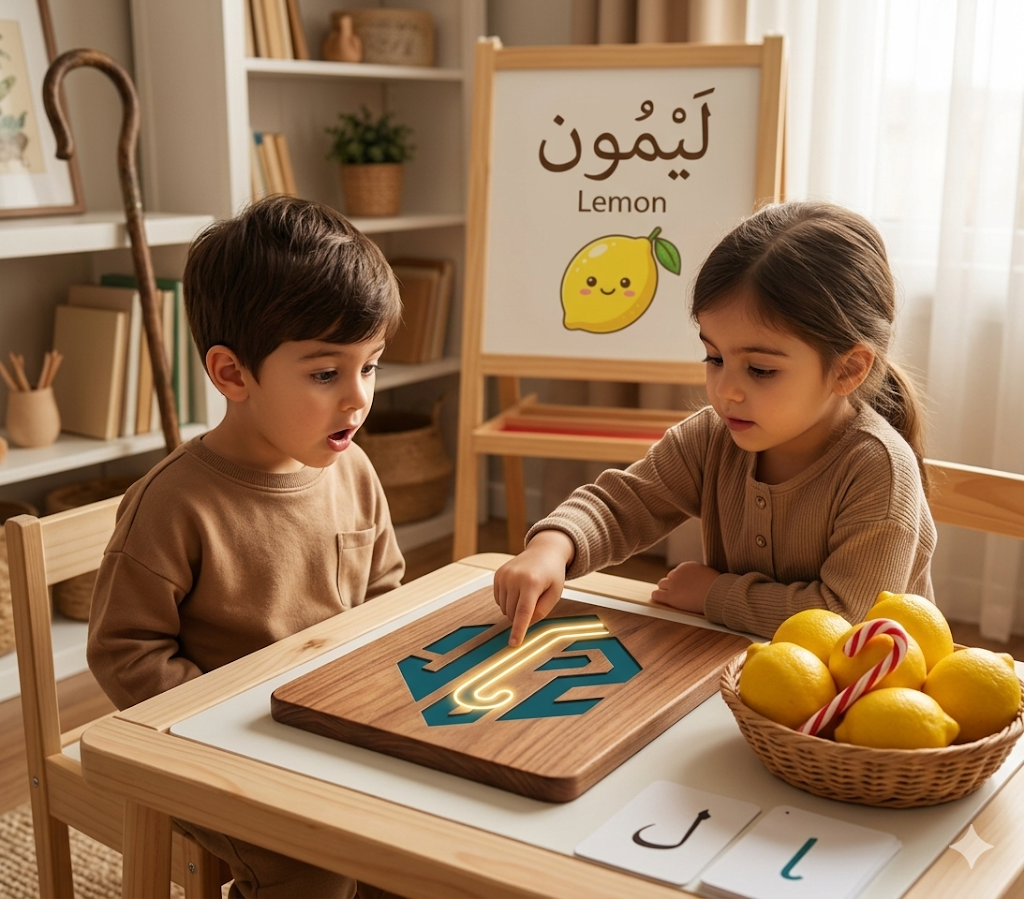
23. ل — Lam Looks Like a Shepherd’s Crook and Sounds Like “L” in “Lion”
Lam (ل) produces the “l” sound. Picture word: لَيْمُون (Laymun) — Lemon. The tall, curved stroke of Lam — swooping up then curling forward — is immediately recognized by children as a shepherd’s staff or a candy cane hook.
Lam has a famous special combination with Alif: the Lam-Alif ligature (لا), which appears constantly in Arabic writing and specifically in the word اللّٰه (Allah). Introducing this early gives children a meaningful, recognizable milestone.
For more on reading connected letters, our Arabic sentences for kids guide builds on this foundation.
Read also: Best Arabic Children’s Books with English Translation
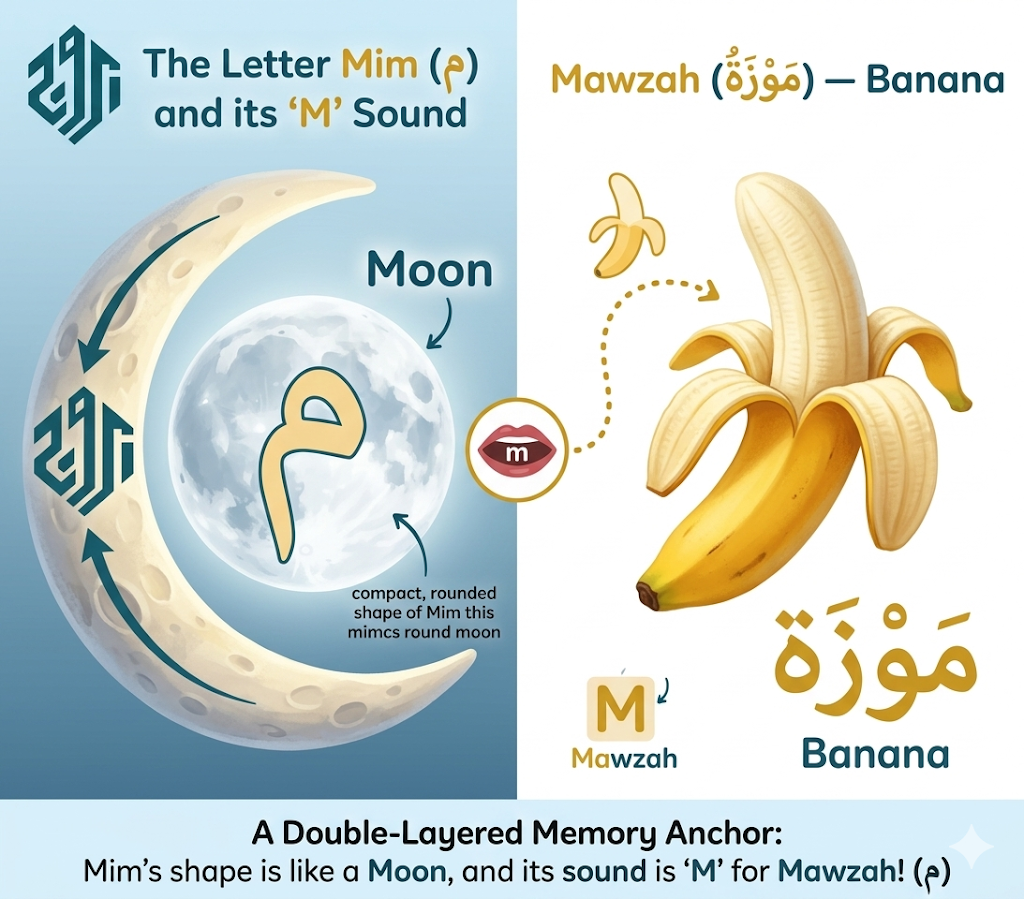
24. م — Mim Sounds Like “M” in “Moon”
Mim (م) produces the “m” sound. مَوْزَة (Mawzah) — Banana. The compact, rounded shape of Mim — like a round moon — combined with the “m” in “moon” creates a double-layered memory anchor children find highly effective.
25. ن — Nun Looks Like a Boat with One Dot Inside and Sounds Like “N” in “Nest”
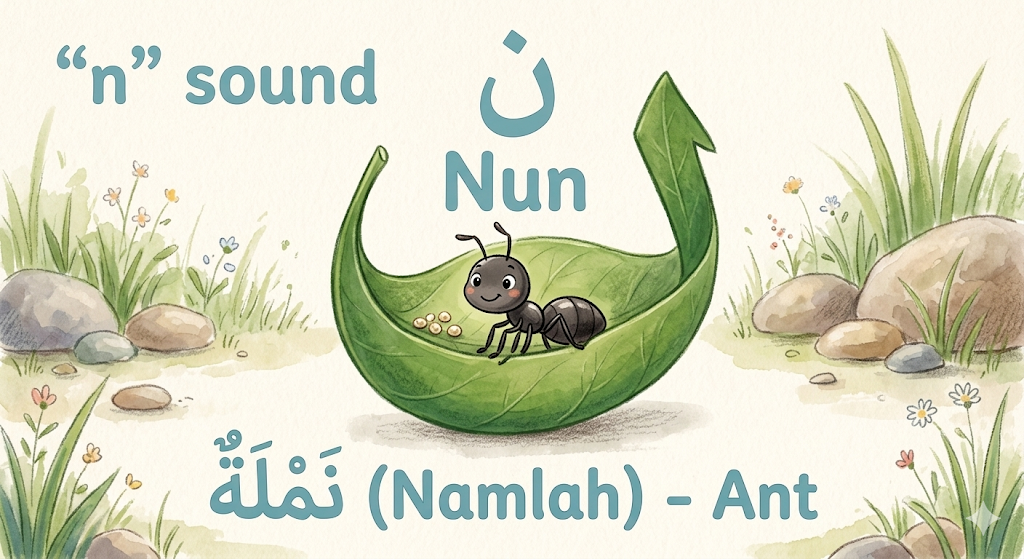
Nun (ن) produces the “n” sound. نَمْلَة (Namlah) — Ant. The small, curved basin of Nun with its single centered dot resembles a tiny ant sitting inside a leaf bowl — a playful image that children consistently remember.
Nun is also significant in Tajweed rules: Noon Sakinah (Nun without a vowel) governs four important rules — Idhhar, Idgham, Iqlab, and Ikhfa. Correct pronunciation of Nun from the start sets a strong recitation foundation for later study.
26. هـ — Ha Looks Like a Heart or Loops and Sounds Like “H” in “House”
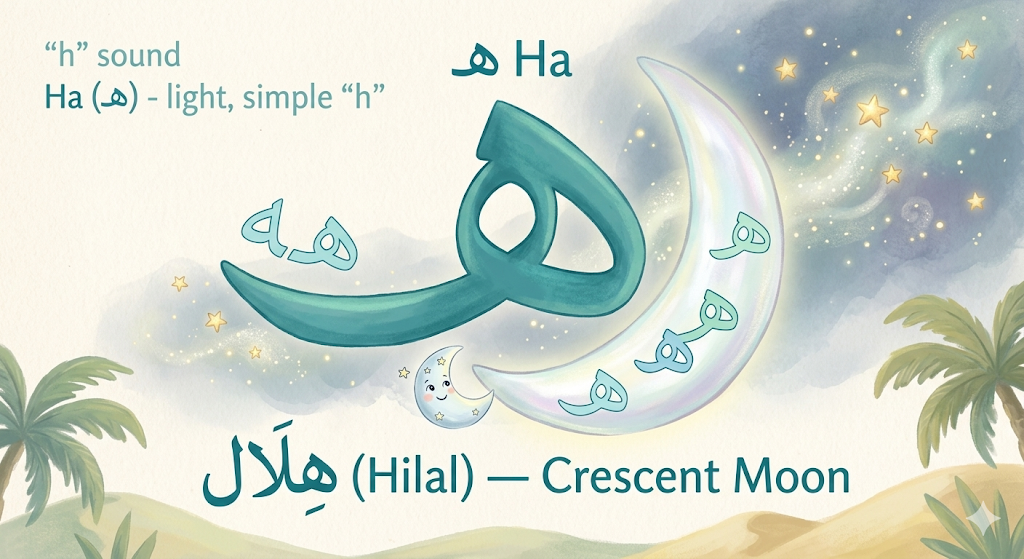
Ha (هـ) is the light, simple “h” — similar to English “h” in “house,” entirely different from the pharyngeal ح encountered earlier. هِلَال (Hilal) — Crescent Moon. The looping, open forms of Ha in its different positions resemble crescent curves.
| Position | Form | Example |
| Isolated | هـ | هِلَال |
| Initial | هـ | هَذَا |
| Medial | ـهـ | يَهْدِي |
| Final | ـه | وَجْهَه |
Ha’s multiple forms look quite different from each other — showing all four positions early prevents confusion during reading practice.
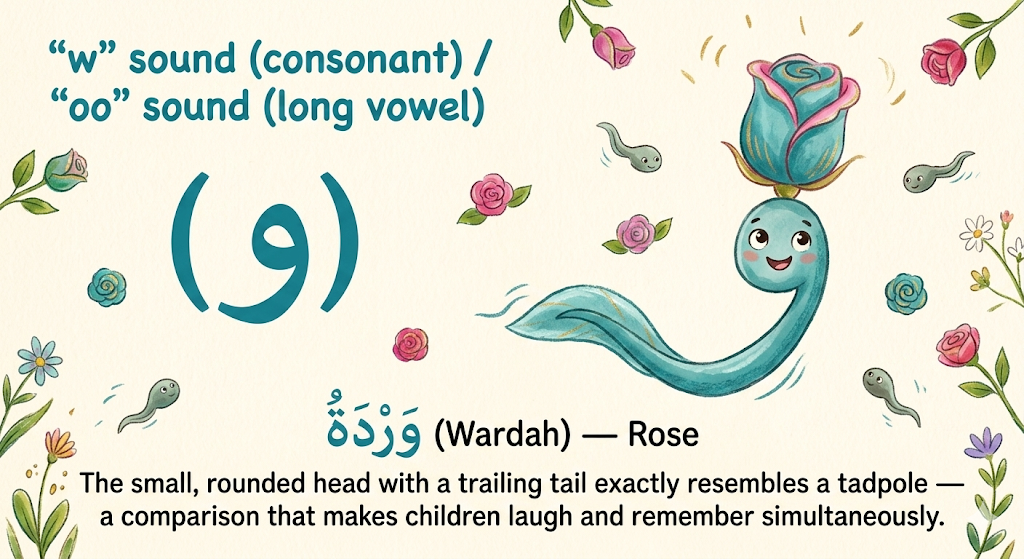
27. و — Waw Looks Like a Tadpole and Sounds Like “W” in “Water” or “oo” in “Moon”
Waw (و) serves as both a consonant (“w” sound) and a long vowel (“oo” sound). Picture word: وَرْدَة (Wardah) — Rose. The small, rounded head with a trailing tail exactly resembles a tadpole — a comparison that makes children laugh and remember simultaneously.
Waw is a non-connecting letter and shares this dual consonant-vowel role with Alif and Ya — the three long vowel letters in Arabic, which are essential for understanding Arabic vowels correctly.
28. ي — Ya Looks Like a Boat with Two Dots Below and Sounds Like “Y” in “Yellow” or “ee” in “Tree”
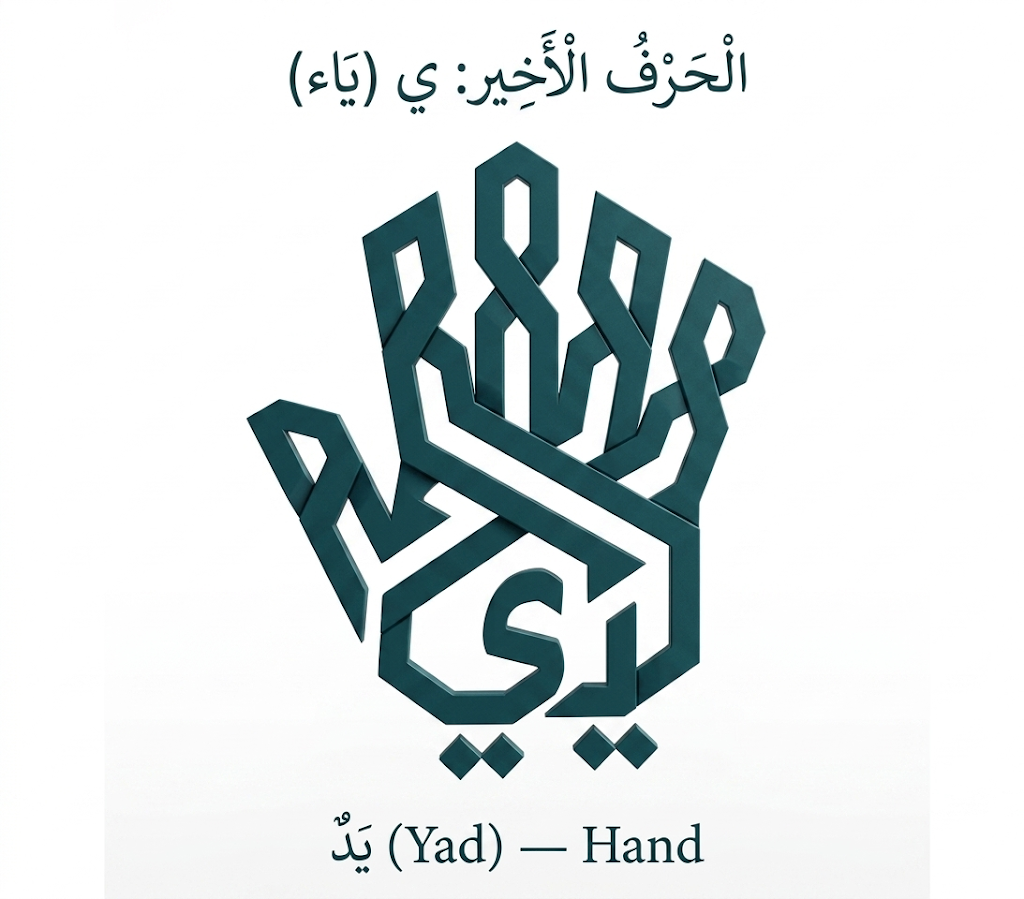
Ya (ي) is the final letter of the Arabic alphabet, serving as both a consonant (“y” sound) and the long vowel “ee.” Picture word: يَدٌ (Yad) — Hand. The two dots below the curved base distinguish Ya from its close visual cousin Nun (ن), which has one centered dot.
Completing the full alphabet is a proud milestone. In our experience at Buruj Academy, children who reach Ya for the first time — especially those who began feeling overwhelmed at the emphatic letters — experience a genuine surge of motivation that carries them confidently into reading full words.
Discover the Buruj Academy Difference
Step into our virtual classrooms and see how our expert instructors make learning Quran and Arabic intuitive and clear. We focus on overcoming the specific hurdles non-native speakers face, building your confidence and connection with the Quran.
Start Your Child’s Arabic Alphabet Learning with Buruj Academy’s Expert Kids Instructors
Every letter in this guide is a building block — but the real progress happens when a qualified teacher watches your child sound each one, corrects their pronunciation in real time, and adapts the pace to their specific needs.
Picture words open the door; consistent, structured instruction is what walks children through it.
Buruj Academy’s Online Arabic Classes for Kids are designed specifically for non-Arabic speaking children, taught by Al-Azhar University graduates with 12+ years of experience.
Enroll your child in one of our specialized, kid-friendly tracks today:
- Online Quran Classes for Kids
- Tajweed Classes for Kids
- Hifz Classes for Kids
- Online Arabic Classes for Kids
- Quranic Arabic Course for Kids
- Noorani Qaida Course for Kids
- Islamic Studies Classes for Kids
Ready to watch your child grow in knowledge and character? Join the Buruj Academy family and book a free trial session for your child today!
Our instructors use the Buruj Method — sound-before-rules, patience-before-performance — with age-appropriate visuals, games, and real-time feedback in personalized 1-on-1 sessions.
Book a free trial lesson and let your child meet their teacher today, Insha’Allah.
Master the Arabic Language
Join our expert-led courses and build a strong foundation in Classical and Modern Arabic.
Get Your Free TrialConclusion
The Arabic alphabet is not just 28 abstract shapes — for a child, it is 28 new friends, each with a sound, a story, and a picture to remember them by. Moving through Alif to Ya with the right visual anchors transforms an unfamiliar script into something a child can genuinely own.
Picture-based learning accelerates recognition, but structure and consistency are what build lasting readers. Whether your child is just meeting Alif for the first time or working through the emphatic letters, pairing daily practice with qualified instruction makes all the difference. The foundation you build now carries them all the way to confident Quran reading, Insha’Allah.
Frequently Asked Questions About the Arabic Alphabet with Pictures for Kids
At What Age Can Children Start Learning the Arabic Alphabet?
Children can begin recognizing Arabic letters as early as age 3–4 using picture-based methods, songs, and visual flashcards. Formal reading instruction — connecting letters and reading short words — is typically most effective from age 5 onward, when fine motor skills and attention spans support structured practice sessions of 10–15 minutes daily.
How Many Letters Are in the Arabic Alphabet?
The Arabic alphabet contains 28 letters. Each letter has up to four written forms — isolated, initial, medial, and final — depending on its position within a word. Six letters (Alif, Dal, Dhal, Ra, Zay, Waw) are non-connecting and only attach to the preceding letter.
How Long Does It Take a Child to Learn All 28 Arabic Letters?
Most children aged 5–8 recognize all 28 Arabic letters in their isolated forms within 3–8 weeks of structured daily practice. Reading letters in connected word forms typically takes an additional 4–6 weeks. Consistent short sessions of 10–15 minutes daily outperform longer, infrequent ones significantly.
What Is the Best Way to Help Kids Remember Arabic Letters at Home?
Pairing each letter with a picture word the child already knows in Arabic or English, using colorful flashcards, and revisiting three to five letters daily through games and songs produces the fastest results. Avoid drilling all 28 letters at once — grouping them into families by shared shape (like the Ba/Ta/Tha group) builds pattern recognition efficiently.
Should Children Learn Arabic Letters in Order or by Shape Similarity?
Both approaches have merit. Teaching in alphabetical order (Alif to Ya) provides a systematic framework and matches how children will encounter letters in books and curricula. Teaching by shape families — such as grouping Jim, Ha, and Kha together — accelerates visual discrimination. At Buruj Academy, our Arabic Alphabet Learning course combines both strategies, introducing letters alphabetically while explicitly pointing out shape-family patterns throughout.