 Arabic
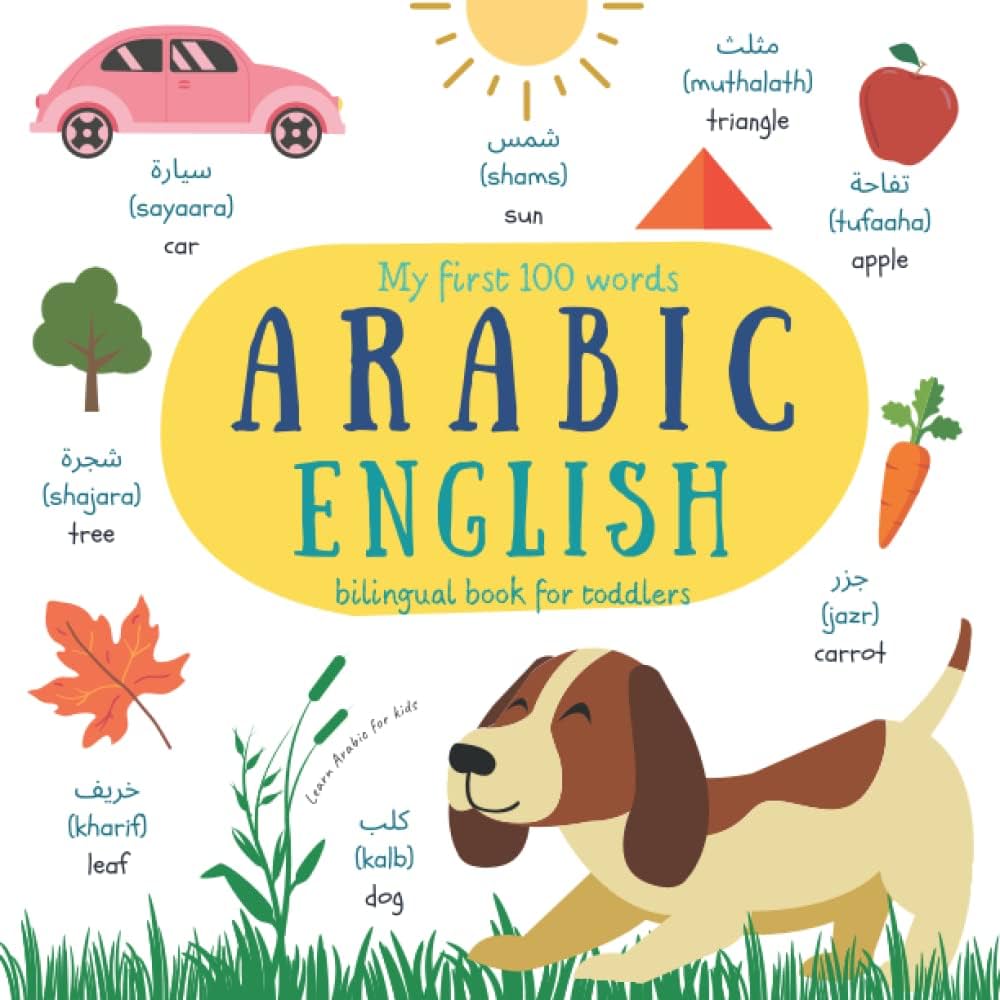
Finding the right Arabic children’s book with an English translation is one of the most common challenges parents raise with us at Buruj Academy. Families want something engaging, accurate, and genuinely useful — not just decorative shelf pieces that collect dust after the first read.
The best Arabic children’s books with English translation combine vivid illustrations, clear bilingual text, and age-appropriate Arabic script to make language learning feel natural rather than forced.
Whether your child is a complete beginner or growing up in a bilingual household, the ten books below offer something meaningful at every stage.
Table of Contents:
1. I Love My Mom by Shelley
I Love My Mom (English Arabic Bilingual Collection) by KidKiddos Books is among the most widely used Arabic-English bilingual picture books for children aged 3–9. The story follows little Jimmy the bunny as he and his brothers plan a birthday surprise for their mother — a universal theme that resonates across cultures.
Both Arabic and English text appear on every page in large, clear print, making it accessible for beginner Arabic readers and for English-speaking parents reading alongside their child.
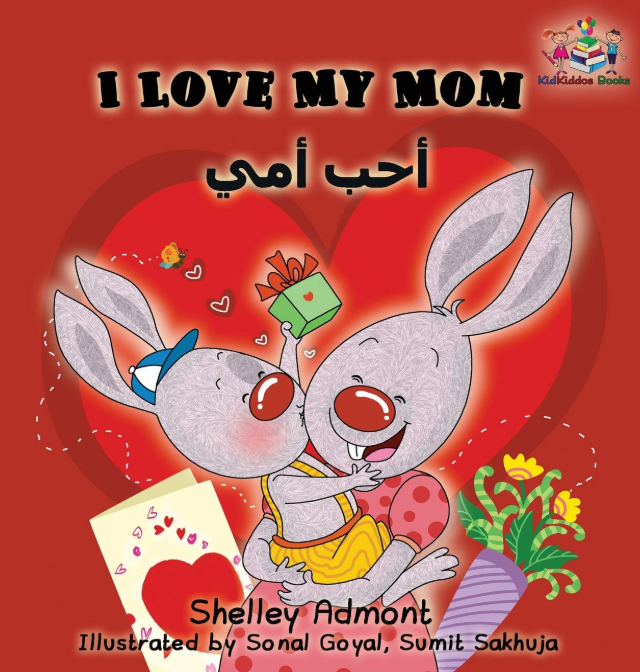
The Arabic script includes vowel markings (harakat), which is a detail we always highlight to parents: without harakat, young readers cannot reliably decode unfamiliar words.
In our experience working with children in Buruj Academy’s Online Arabic Classes for Kids, books with harakat-marked text reduce decoding frustration significantly for early readers. This series is a go-to recommendation we make to parents starting their children’s Arabic reading practice at home.
| Feature | Detail |
| Age Range | 3–9 years |
| Format | Paperback / Kindle |
| Arabic Script | Fully voweled (harakat included) |
| Series | English Arabic Bilingual Collection (KidKiddos) |
| Best For | Bedtime reading, beginner readers |
The KidKiddos series spans over 50 languages, and the Arabic editions are among the most highly reviewed for their translation quality and large-print formatting. The full series includes titles like I Love to Help, I Love to Eat Fruits and Vegetables, and Amanda’s Dream, giving families a progression of stories to work through over months.
Book a FREE Arabic trial for your Child
2. The Rainbow Fish English/Arabic Edition
The Rainbow Fish English/Arabic Bilingual Edition by Marcus Pfister is arguably the most globally recognized bilingual picture book adapted into Arabic. The story of the vain fish who learns that generosity brings true friendship has been translated into over 65 languages — and its Arabic-English edition is one of the most beautifully produced in the bilingual children’s book market.
This is particularly valuable for Muslim families because the theme of sharing and humility (tawadu’) aligns naturally with Islamic character values, making it a meaningful conversation starter alongside Islamic education.
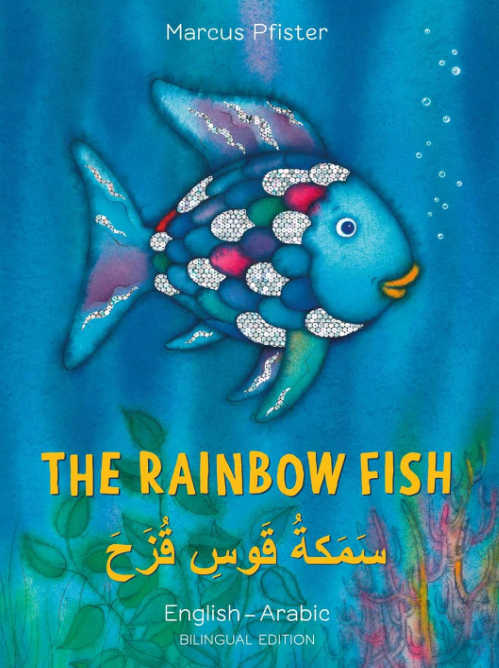
The Arabic translation is clean Modern Standard Arabic (MSA), suitable for children learning Fusha rather than a regional dialect.
Buruj Academy’s instructors often recommend this book for families whose children are enrolled in our Arabic for Beginners course as a supplementary home reading tool. Seeing familiar MSA vocabulary in a story context reinforces what children are learning in structured lessons.
The iridescent sparkle-scale illustrations make this book visually unforgettable for young children — a factor that matters enormously for sustaining a child’s interest in a second-language reading session.
Begin learning Arabic at Buruj with a FREE trial lesson
3. My First English-Arabic Learning Library
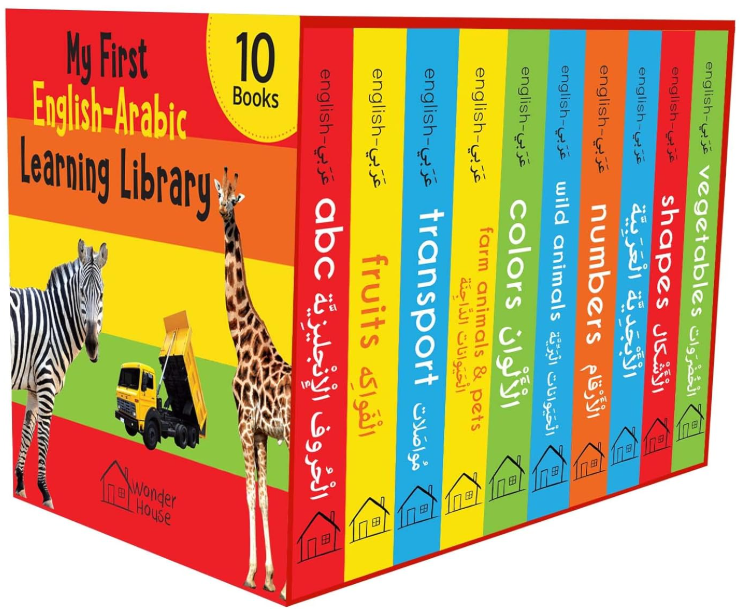
My First English-Arabic Learning Library by Wonder House Books is a 10-book board book boxset covering foundational topics: colors, numbers, shapes, animals, body parts, food, and more. Each book uses real photographs alongside Arabic and English labels — a format we specifically recommend for children under 4, where realistic images build word-to-concept connections faster than illustrations.
This boxset is ideal for heritage speakers — children growing up in Western households with Arabic-speaking family members — who need visual Arabic vocabulary anchoring before formal reading instruction begins.
It covers exactly the core noun vocabulary that children encounter in their first months of structured Arabic learning.
| Book in Set | Topic Covered |
| My First Colors | Colors + basic adjectives |
| My First Numbers | Numerals 1–20 |
| My First Animals | Common Arabic animal names |
| My First Body Parts | Human body vocabulary |
| My First Food | Food and fruit vocabulary |
One practical note for parents: board book format is important for children under 3. The thick, chewable pages survive the handling toddlers give to books — and durability matters when you want a book to remain in rotation for months. To deepen your child’s early Arabic vocabulary further, our guide on learning Arabic words for kids pairs well with this boxset.
4. Stepping Stones: A Refugee Family’s Journey
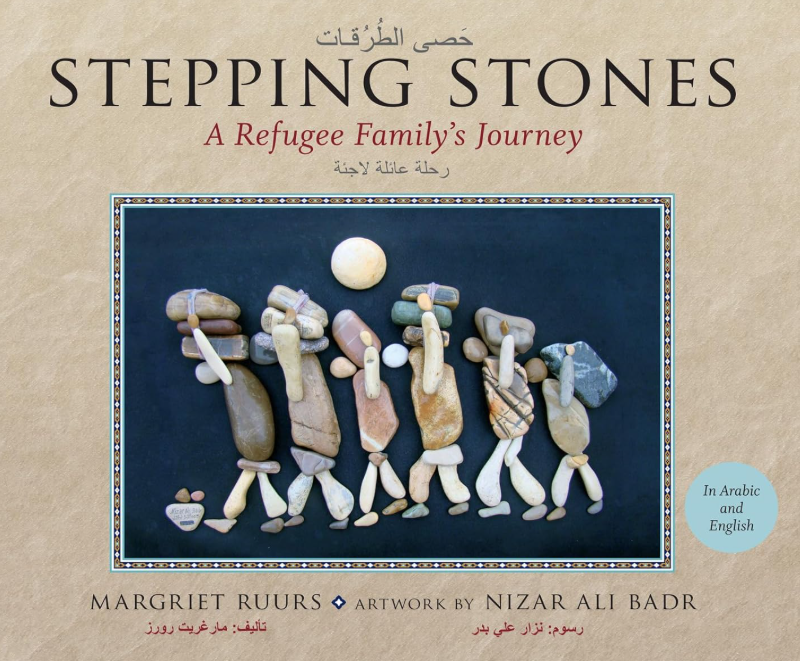
Stepping Stones: A Refugee Family’s Journey by Margriet Ruurs, illustrated with the stone artwork of Syrian artist Nizar Ali Badr, is unlike any other bilingual Arabic children’s book on this list. The entire book is illustrated through stunning stone collage art — pebbles and rocks arranged into figures that depict a Syrian family’s journey to safety in Europe.
The Arabic translation, rendered by Falah Raheem, appears alongside English text, making this a genuinely bilingual literary experience rather than a simple labeled vocabulary book.
The language is poetic yet accessible, suitable for children aged 4–8, and the themes of displacement, resilience, and family love carry deep Islamic resonance around themes of sabr (patience) and tawakkul (trust in Allah).
Stanford University’s Education Library includes this title in its curated Arabic-English bilingual children’s book collection, which is testament to its literary and educational standing. For parents seeking Arabic books for kids that also carry emotional and cultural depth, this is a standout title.
This book works especially well as a shared reading experience between parents and children aged 5 and above, generating natural Arabic-English conversation about story events.
5. I Love to Help (English Arabic Bilingual)
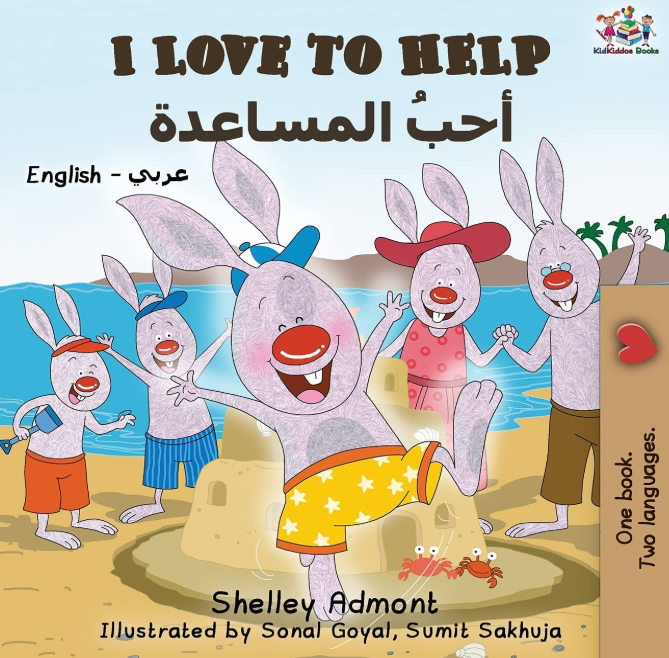
I Love to Help — also from Shelley Admont and KidKiddos Books — follows Jimmy the bunny at the beach, where he discovers how helping others makes everything better. The Arabic-English parallel text format presents each sentence simultaneously in both languages, allowing children to naturally absorb sentence-level patterns rather than just isolated words.
Master the Arabic Language
Join our expert-led courses and build a strong foundation in Classical and Modern Arabic.
Get Your Free TrialThis is pedagogically important. Single-word labeling books build vocabulary; sentence-level bilingual books begin exposing children to basic Arabic sentence structure — subject, verb, object — without any formal grammar instruction.
Our instructors at Buruj Academy call this “passive structural absorption,” and it forms a natural bridge toward the more structured Arabic sentences for kids that children encounter in formal Arabic study.
For older learners interested in learning the Arabic alphabet and progressing toward reading authentic Arabic text, this book serves as a meaningful bridge resource. Parents interested in deepening their own Arabic foundation alongside their children can explore Buruj Academy’s Arabic Reading course for structured adult reading instruction.
Read Arabic fluently with a free Buruj trial
Read also: Best Arabic Worksheets for Kids
6. My First Bilingual Book Series by Milet Publishing Offers Simple, Durable Vocabulary Books for Toddlers and Early Learners
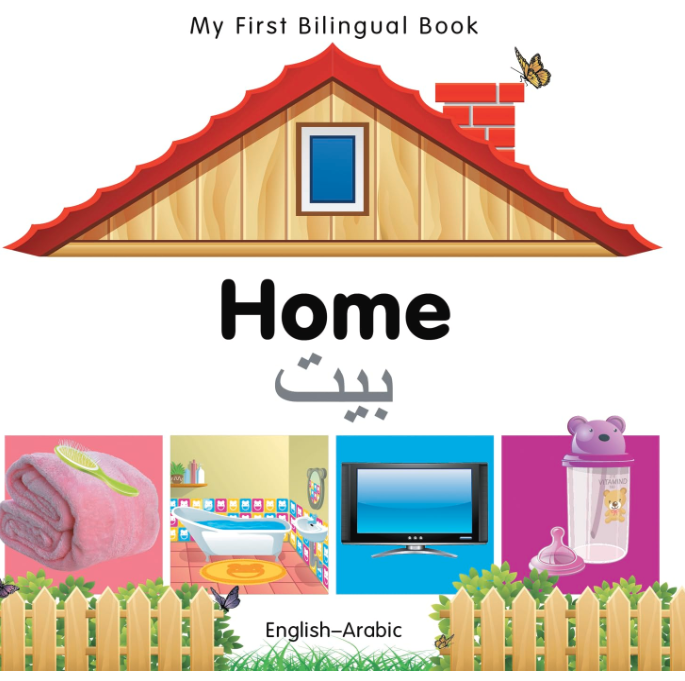
The My First Bilingual Book series by Milet Publishing — covering themes like Home, Colors, Animals, Food, and My Body — provides simple photographic board books where each spread shows a real-world image alongside the Arabic and English label.
Milet Publishing is one of the most established publishers in the bilingual children’s book space, and their Arabic-English editions are notable for the quality of their translation and the naturalness of their Arabic phrasing.
Unlike some bilingual books that feel mechanically translated, Milet’s Arabic reads fluently and uses standard vocabulary that aligns with what children encounter in formal Arabic learning.
| Series Title | Topic |
| My First Bilingual Book — Colors | Color vocabulary |
| My First Bilingual Book — Home | Household objects |
| My First Bilingual Book — Animals | Common animals |
| My First Bilingual Book — Food | Everyday food words |
These books are excellent starting points before introducing the more narrative bilingual titles listed here. Parents who are new to supporting Arabic literacy at home will find a practical overview of what the learning process looks like in our guide on how to learn Arabic for kids.
7. Stepping Into Arabic: My First Arabic Alphabets Picture Book with English Translations Builds Letter Recognition Through Illustrated Vocabulary
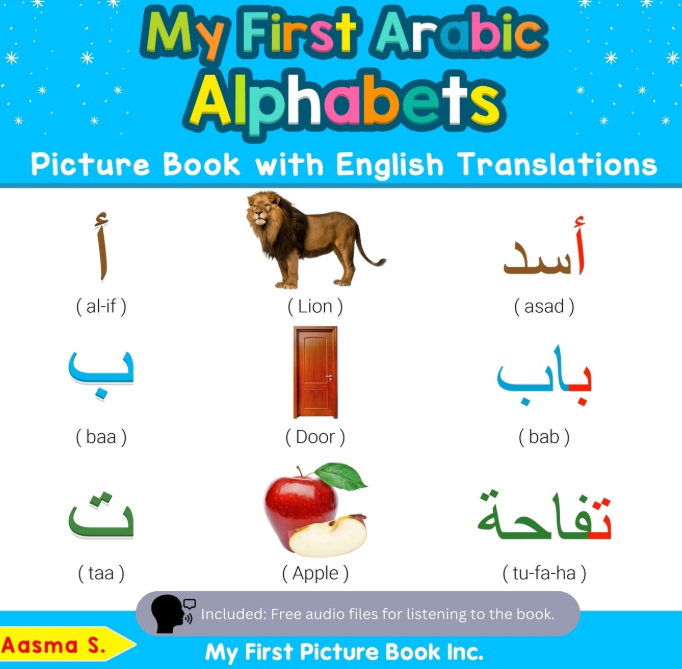
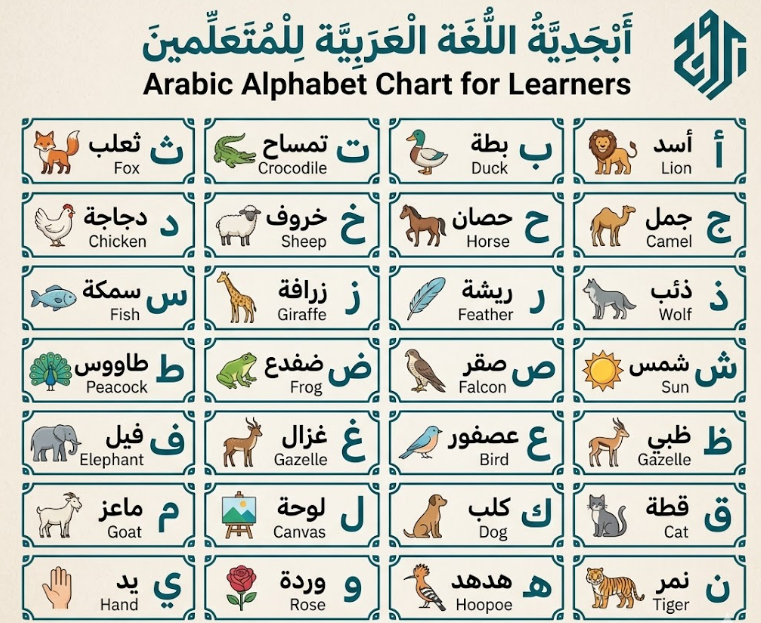
My First Arabic Alphabets Picture Book with English Translations by Aasma S. is part of a larger Teach & Learn Basic Arabic Words for Children series that covers alphabets, animals, food, colors, body parts, and more. The alphabet book specifically presents each Arabic letter alongside illustrated vocabulary words and English translations.
What makes this series particularly effective for non-Arabic speaking households is its dual-function design: parents who do not read Arabic can follow the English translations, while children absorb the Arabic script through repeated visual exposure.
For families learning Arabic together, our article on the easiest way to learn Arabic offers a practical framework that complements what this book introduces at home.
| Book in Series | Focus |
| Arabic Alphabets | Letter recognition, letter-word associations |
| Arabic Animals & Insects | Common animal vocabulary |
| Arabic Colors & Places | Color words, location vocabulary |
| Arabic Body Parts | Human body in Arabic |
| Arabic Fruits & Snacks | Food and nutrition vocabulary |
The series works best alongside structured Arabic alphabet instruction. For families ready to move from passive book exposure to guided letter learning, Buruj Academy’s Arabic Alphabet Learning course provides the systematic instruction that turns letter recognition into real reading ability.
Discover the Buruj Academy Difference
Step into our virtual classrooms and see how our expert instructors make learning Quran and Arabic intuitive and clear. We focus on overcoming the specific hurdles non-native speakers face, building your confidence and connection with the Quran.
Read also: Arabic Alphabet with Pictures for Kids
Start Your Child’s Arabic Reading With Buruj Academy’s Expert-Guided Kids’ Arabic Classes
Bilingual books are a wonderful start — but consistent, structured instruction is what builds lasting Arabic literacy in children.
At Buruj Academy, our Online Arabic Classes for Kids are designed by Al-Azhar University graduates with 12+ years of experience teaching non-native Arabic speakers worldwide.
Our instructors use the Buruj Method — Context-before-abstraction, Consistency-before-speed — to make Arabic genuinely enjoyable for young learners.
Every session is 1-on-1, personalized to your child’s age, level, and learning style, with flexible scheduling to fit busy family routines.
Enroll your child in one of our specialized, kid-friendly tracks today:
- Online Quran Classes for Kids
- Tajweed Classes for Kids
- Hifz Classes for Kids
- Online Arabic Classes for Kids
- Quranic Arabic Course for Kids
- Noorani Qaida Course for Kids
- Islamic Studies Classes for Kids
Ready to watch your child grow in knowledge and character? Join the Buruj Academy family and book a free trial session for your child today!
Buruj Academy’s teaching team includes Ijazah-certified instructors and Al-Azhar graduates who understand both Modern Standard Arabic and Quranic Arabic pedagogy for children. Book a free trial lesson today and let us show you how far your child can progress with the right guidance.
Master the Arabic Language
Join our expert-led courses and build a strong foundation in Classical and Modern Arabic.
Get Your Free TrialConclusion
Arabic children’s books with English translation are more than reading material — they are the beginning of a lifelong relationship with one of the world’s richest languages. The books on this list span everything from board books for toddlers to emotionally powerful picture books for older children, giving families a real toolkit for Arabic literacy at home.
The most important insight we share with every parent who asks us about bilingual books: no book, however well designed, replaces the presence of a live, patient, expert instructor. Books build exposure; teachers build ability. When both work together, children make truly remarkable progress.
Frequently Asked Questions About Arabic Children’s Books with English Translation
What Age Is Best to Start Reading Arabic-English Bilingual Books with Children?
Arabic-English bilingual books can begin as early as 10 months with simple board books featuring real photographs and single Arabic-English labels. Between ages 3–5, narrative picture books with full sentences become appropriate. By ages 6–8, children ready for structured Arabic instruction can transition to parallel-text story books that expose them to natural Arabic sentence patterns.
Do Bilingual Arabic Books Use Modern Standard Arabic or Dialects?
Most bilingual Arabic children’s books published for international audiences use Modern Standard Arabic (MSA / Fusha), which is also the language of the Quran and formal Arabic instruction. A small number, such as the Levantine Arabic edition of Am I Small?, use regional dialects. Always check the publisher’s description to confirm which Arabic variety is used before purchasing.
Can Non-Arabic Speaking Parents Use These Books Effectively?
Yes — the English translation on every page means non-Arabic speaking parents can read the story confidently while their child sees the Arabic script. Over time, parents absorb vocabulary alongside their children. For parents who want to deepen their own Arabic simultaneously, Buruj Academy’s Arabic for Beginners course offers structured adult Arabic instruction that complements home reading sessions.
How Do Bilingual Books Support Children Learning Arabic in Formal Classes?
Bilingual books reinforce vocabulary, sentence structure, and script familiarity encountered in formal Arabic lessons. Children who see familiar vocabulary in a story context retain it significantly better than those who only practice through exercises. Our instructors at Buruj Academy consistently recommend bilingual home reading as a supplement to — not a replacement for — structured class instruction.