 Arabic
| Key Takeaways |
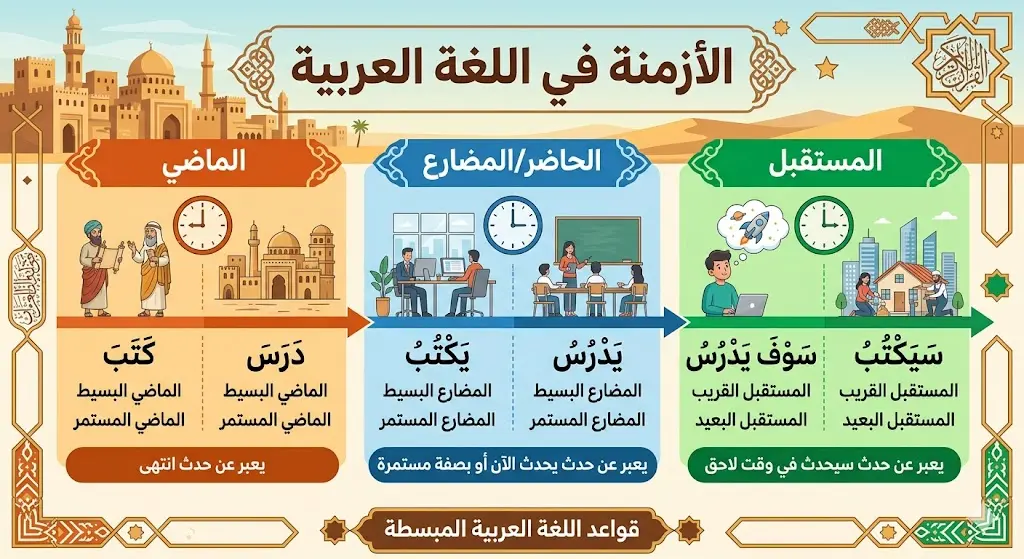
| Arabic has four verb tenses: the past tense (الماضي, al-māḍī), present tense (المضارع, al-muḍāriʿ), future tense (المستقبل, al-mustaqbal), and command form (الأمر, al-amr). |
| The Arabic past tense is the base verb form; all other tenses are built by adding prefixes or suffixes to this root. |
| Arabic verbs conjugate according to person, gender, and number — making subject pronouns grammatically optional in most sentences. |
| Negation rules differ by tense: لَمْ (lam) negates the present used as past, لَا (lā) negates the present, and لَا (lā) or لَا تَفْعَل negate commands. |
| Regular (sound/salim, سالم) verbs follow consistent conjugation patterns, making them the essential starting point for Arabic grammar mastery. |
Arabic verb tenses confuse English speakers because the system works on entirely different logic. Where English marks time primarily through word order and auxiliary verbs, Arabic encodes person, gender, and number directly into the verb itself through prefixes and suffixes.
Arabic has four core tenses: the past tense (الماضي, al-māḍī), the present tense (المضارع, al-muḍāriʿ), the future tense (المستقبل, al-mustaqbal — formed from the present), and the command form (الأمر, al-amr). Mastering these four forms on regular (سالم, sālim) verbs gives you the structural foundation every advanced construction builds upon.
Table of Contents:
What Is the Past Tense in Arabic?
The past tense in Arabic (الماضي, al-māḍī) expresses a completed action. The third-person masculine singular form — هو فَعَلَ (huwa faʿala, “he did”) — is the dictionary base form of every Arabic verb, and all conjugations are built from it by attaching suffixes.
This is why Arabic dictionaries list verbs in the past tense: it is the simplest, most root-transparent form. The root letters appear without the prefixes that the present tense adds, making the three-letter root (الجذر, al-jiðr) immediately visible.
For example, the root ك-ت-ب (k-t-b) meaning “write” appears in its clearest form as كَتَبَ (kataba, “he wrote”).
Conjugation Table: كَتَبَ (kataba) — “He Wrote” — Past Tense, Regular Verb
| Pronoun (Arabic) | Pronoun (English) | Verb Form | Transliteration | Meaning |
| هُوَ | He | كَتَبَ | kataba | He wrote |
| هِيَ | She | كَتَبَتْ | katabat | She wrote |
| أَنْتَ | You (m. sg.) | كَتَبْتَ | katabta | You wrote |
| أَنْتِ | You (f. sg.) | كَتَبْتِ | katabti | You wrote |
| أَنَا | I | كَتَبْتُ | katabtu | I wrote |
| هُمْ | They (m. pl.) | كَتَبُوا | katabū | They wrote |
| هُنَّ | They (f. pl.) | كَتَبْنَ | katabna | They wrote |
| نَحْنُ | We | كَتَبْنَا | katabnā | We wrote |
Notice that suffixes carry all the grammatical information. No auxiliary verb like “had” or “was” is needed — the suffix alone completes the meaning.
How to Negate the Past Tense in Arabic?
The past tense is negated using لَمْ (lam) followed by the present tense verb in its jussive form (المجزوم, al-majzūm). This is a common source of confusion for beginners.
| Positive | Negative | Meaning |
| كَتَبَ (kataba) | لَمْ يَكْتُبْ (lam yaktub) | He did not write |
| ذَهَبَتْ (ðahabat) | لَمْ تَذْهَبْ (lam taðhab) | She did not go |
| أَكَلْنَا (akalnā) | لَمْ نَأْكُلْ (lam naʾkul) | We did not eat |
At Buruj Academy, our Arabic Grammar Course instructors emphasize this point from the very first week — لَمْ (lam) is not a past-tense negator in form, but it functions as one in meaning. Getting this distinction right early prevents deeply-rooted errors later.
Understand the Arabic Grammar with Buruj’s free trial lesson

Arabic Past Tense Usage Examples
كَتَبَ الطَّالِبُ الدَّرْسَ
Kataba al-ṭālibu al-darsa.
The student wrote the lesson.
ذَهَبَتْ فَاطِمَةُ إِلَى الْمَدْرَسَةِ
Ðahabat Fāṭimatu ilā al-madrasa.
Fatima went to the school.
أَكَلْنَا الطَّعَامَ
Akalnā al-ṭaʿām.
We ate the food.
What Is the Present Tense in Arabic?
The present tense (المضارع, al-muḍāriʿ) in Arabic expresses ongoing, habitual, or general actions. Unlike the past tense which uses only suffixes, the present tense is formed by adding both prefixes and suffixes to the root — the prefix signals the person and the suffix refines gender and number.
The four present-tense prefixes are: أَ (a-) for first person singular, نَ (na-) for first person plural, يَ (ya-) for third person masculine, and تَ (ta-) for third person feminine and second person. Learning these four letters unlocks every present-tense conjugation in Arabic.
Conjugation Table: يَكْتُبُ (yaktabu) — “He Writes” — Present Tense, Regular Verb
| Pronoun (Arabic) | Pronoun (English) | Verb Form | Transliteration | Meaning |
| هُوَ | He | يَكْتُبُ | yaktabu | He writes |
| هِيَ | She | تَكْتُبُ | taktabu | She writes |
| أَنْتَ | You (m. sg.) | تَكْتُبُ | taktabu | You write |
| أَنْتِ | You (f. sg.) | تَكْتُبِينَ | taktubīna | You write |
| أَنَا | I | أَكْتُبُ | aktabu | I write |
| هُمْ | They (m. pl.) | يَكْتُبُونَ | yaktubūna | They write |
| هُنَّ | They (f. pl.) | يَكْتُبْنَ | yaktubna | They write |
| نَحْنُ | We | نَكْتُبُ | naktabu | We write |
One consistent challenge we see in our sessions is that students confuse هُوَ (he) and أَنْتَ (you, masculine) in the present tense — both use the prefix تَ.
The difference only becomes visible with a subject noun or pronoun. This is exactly the kind of subtle distinction a qualified teacher clarifies before it becomes a fossilized error.
How to Negate the Present Tense?
The present tense is negated with لَا (lā) placed directly before the verb.
| Positive | Negative | Meaning |
| يَكْتُبُ (yaktabu) | لَا يَكْتُبُ (lā yaktabu) | He does not write |
| تَدْرُسُ (tadrusu) | لَا تَدْرُسُ (lā tadrusu) | She does not study |
| نَذْهَبُ (naðhabu) | لَا نَذْهَبُ (lā naðhabu) | We do not go |
Present Tense Usage Examples
يَقْرَأُ مُحَمَّدٌ الْقُرْآنَ كُلَّ يَوْمٍ
Yaqraʾu Muḥammadun al-Qurʾāna kulla yawmin.
Muhammad reads the Quran every day.
تَدْرُسُ الطَّالِبَةُ اللُّغَةَ الْعَرَبِيَّةَ
Tadrusu al-ṭālibatu al-lugata al-ʿarabiyyata.
The female student studies the Arabic language.
This tense also appears extensively in the Quran, giving Quranic Arabic learners constant exposure to it. You can read more about building Arabic sentence structure to see how these verb forms slot into full sentences.
How Is the Future Tense Formed in Arabic?
The future tense in Arabic (المستقبل, al-mustaqbal) does not require an entirely new set of verb forms. It is formed simply by attaching the prefix سَـ (sa-) or the word سَوْفَ (sawfa) to the present tense verb. Both mean “will,” with سَوْفَ carrying slightly more emphasis or distance in time.
This is one of Arabic’s most learner-friendly features: once you know the present tense, you already know the future tense. No new conjugations, no irregular forms — just one prefix added to what you already learned.
Arabic Future Tense Formation: سَ + Present Tense Verb
| Present Form | Future Form (سَـ) | Transliteration | Meaning |
| يَكْتُبُ | سَيَكْتُبُ | sa-yaktabu | He will write |
| تَذْهَبُ | سَتَذْهَبُ | sa-taðhabu | She will go |
| نَدْرُسُ | سَنَدْرُسُ | sa-nadrusu | We will study |
| أَقْرَأُ | سَأَقْرَأُ | sa-aqraʾu | I will read |
سَوْفَ is used identically but written as a separate word:
سَوْفَ يَكْتُبُ (sawfa yaktabu) — “He will write” (with added emphasis).
Master the Arabic Language
Join our expert-led courses and build a strong foundation in Classical and Modern Arabic.
Get Your Free TrialHow to Negate the Arabic Future Tense
The future tense is negated using لَنْ (lan) followed by the present tense verb in its subjunctive/mansub form (المنصوب, al-manṣūb), where the final ـُ (ḍamma) drops or changes.
| Positive Future | Negative Future | Meaning |
| سَيَكْتُبُ (sa-yaktabu) | لَنْ يَكْتُبَ (lan yaktuba) | He will not write |
| سَتَذْهَبُ (sa-taðhabu) | لَنْ تَذْهَبَ (lan taðhaba) | She will not go |
| سَنَدْرُسُ (sa-nadrusu) | لَنْ نَدْرُسَ (lan nadrusu) | We will not study |
Future Tense Usage Examples
سَيَصِلُ الْأُسْتَاذُ غَدًا
Sa-yaṣilu al-ustāðu ghadan.
The teacher will arrive tomorrow.
لَنْ أَنْسَى هَذَا الدَّرْسَ
Lan ansā hāðā al-darsa.
I will not forget this lesson.
The Quran uses both سَ and سَوْفَ extensively. A beautiful example appears in Surah Ad-Duha:
وَلَسَوْفَ يُعْطِيكَ رَبُّكَ فَتَرْضَىٰ
Wa-la-sawfa yuʿṭīka rabbuka fa-tarḍā
“And your Lord is going to give you, and you will be satisfied.” (Ad-Duha 93:5)
لَسَوْفَ here is an emphatic future — the لَ (lam) before سَوْفَ adds strong certainty to the promise. This is a beautiful example of how the future prefix carries weight in Quranic expression.
Students in our Quranic Arabic Grammar Classes encounter this verse as a teaching moment — the future prefix alone communicates divine certainty without needing additional words.
Get Your Free Trial Quranic Arabic Grammar Lesson

What Is the Command Form in Arabic?
The command form in Arabic (الأمر, al-amr) is used to give direct instructions, requests, or orders. The command form in Arabic is derived from the present tense jussive (المجزوم, al-majzūm) form by dropping the second-person prefix تَ (ta-) and, when needed, adding a connecting hamza (همزة الوصل, hamzat al-waṣl) at the beginning.
This form addresses only you — singular masculine, singular feminine, and plural — since you cannot command yourself or a third party directly in standard Arabic grammar (النحو, al-naḥw).
How to Build the Command Form in Arabic?
Start with the present tense second-person masculine: تَكْتُبُ (taktabu)
- Remove the prefix تَ → كْتُبُ (ktabu)
- Remove the final vowel case ending → كْتُبْ (ktub)
- The word now starts with a sukūn (consonant cluster) — add اُ (u) → اُكْتُبْ (uktub)
Result: اُكْتُبْ (uktub) — “Write!” (to one male)
Conjugation Table: اُكْتُبْ (uktub) — “Write!” — Command Form
| Addressed To | Arabic Command | Transliteration | Meaning |
| You (m. sg.) | اُكْتُبْ | uktub | Write! |
| You (f. sg.) | اُكْتُبِي | uktubī | Write! |
| You (m. pl.) | اُكْتُبُوا | uktubū | Write! |
| You (f. pl.) | اُكْتُبْنَ | uktubna | Write! |
How to Negate the Command Form in Arabic?
Negating a command produces what Arabic grammar calls النهي (al-nahy), the prohibition. It uses لَا (lā) followed by the present tense jussive form (المجزوم).
| Command | Prohibition (Negative Command) | Meaning |
| اُكْتُبْ (uktub) | لَا تَكْتُبْ (lā taktub) | Do not write! |
| اِذْهَبْ (iðhab) | لَا تَذْهَبْ (lā taðhab) | Do not go! |
| اِقْرَأْ (iqraʾ) | لَا تَقْرَأْ (lā taqraʾ) | Do not read! |
The Quran uses the command form powerfully in some of its most recognized verses. In Surah Al-Isra, Allah commands:
وَقُل رَّبِّ زِدْنِي عِلْمًا
Wa-qul rabbi zidnī ʿilmā
“And say: My Lord, increase me in knowledge.” (Al-Isra 17:114)
قُلْ (qul) is the command form of قَالَ (qāla, “to say”) — one of the most frequently occurring commands in the Quran. زِدْنِي is a command form with an attached pronoun, making it a compound grammatical structure.
Arabic Command Form Usage Examples
اِقْرَأي الْكِتَابَ
Iqraʾi al-kitāba.
Read the book! (to a female)
لَا تَنْسَ وَاجِبَكَ
Lā tansa wājibaka
“Do not forget your homework!” (to a male)
اِذْهَبُوا إِلَى الْمَسْجِدِ
Iðhabū ilā al-masjid.
Go to the mosque!” (to a group of males)
In our Online Arabic Classes, the command form is one of the first practical forms students learn to use in real conversation — asking for things, giving household directions, understanding Islamic supplications — because it appears immediately in daily life.
Book your FREE Arabic trial online Arabic class at Buruj

What Are Regular (Sound/Salim, سالم) Verbs and Why Do They Matter?
Regular verbs in Arabic — called الفعل الصحيح السالم (al-fiʿl al-ṣaḥīḥ al-sālim, the sound/salim verb) — are verbs whose three root letters are all “healthy”: no weak letters (و or ي) and no doubled (geminate) letters.
Because none of the root letters change or drop during conjugation, their patterns remain entirely predictable.
This predictability is precisely why every serious Arabic curriculum begins with سالم verbs.
Once you master the conjugation patterns on a sound verb like كَتَبَ (kataba), you hold the template that governs all other verb types — including hollow verbs (الأجوف), defective verbs (الناقص), and assimilated verbs (المثال). Mastering the سالم model first is not optional groundwork — it is the only logical path.
Common Regular Verbs to Practice All Arabic Tenses
| Root | Past (ماضي) | Present (مضارع) | Future (مستقبل) | Command (أمر) | Meaning |
| ك-ت-ب | كَتَبَ | يَكْتُبُ | سَيَكْتُبُ | اُكْتُبْ | write |
| ذ-هـ-ب | ذَهَبَ | يَذْهَبُ | سَيَذْهَبُ | اِذْهَبْ | go |
| د-ر-س | دَرَسَ | يَدْرُسُ | سَيَدْرُسُ | اُدْرُسْ | study |
| ج-لـ-س | جَلَسَ | يَجْلِسُ | سَيَجْلِسُ | اِجْلِسْ | sit |
| خ-ر-ج | خَرَجَ | يَخْرُجُ | سَيَخْرُجُ | اُخْرُجْ | exit |
A note from our instructors: students who study the سالم verb in all four tenses with these five roots — before touching any other verb type — consistently outperform those who rush into vocabulary acquisition without this foundation.
The mastering of Arabic vocabulary becomes far more efficient once your verb conjugation instincts are trained on clean, predictable patterns.
Arabic Tenses Negation Summary
This table is one of the most-consulted references our students keep during their early months of study.
| Tense | Positive Example | Negation Particle | Negative Example | Meaning |
| Past (ماضي) | كَتَبَ | لَمْ + jussive | لَمْ يَكْتُبْ | He did not write |
| Present (مضارع) | يَكْتُبُ | لَا | لَا يَكْتُبُ | He does not write |
| Future (مستقبل) | سَيَكْتُبُ | لَنْ + subjunctive | لَنْ يَكْتُبَ | He will not write |
| Command (أمر) | اُكْتُبْ | لَا + jussive | لَا تَكْتُبْ | Do not write! |
Notice that لَا (lā) appears in three of the four tenses but triggers different grammatical effects each time. This is why understanding the form — not just memorizing the particle — is the only reliable approach.
Discover the Buruj Academy Difference
Step into our virtual classrooms and see how our expert instructors make learning Quran and Arabic intuitive and clear. We focus on overcoming the specific hurdles non-native speakers face, building your confidence and connection with the Quran.
Master Arabic Grammar with Buruj Academy’s Expert Instructors
Arabic tenses follow a deeply logical, internally consistent system — and that system rewards students who learn it with a qualified teacher who can catch errors before they solidify.
Buruj Academy’s Arabic Grammar Course is taught by Al-Azhar University graduates with 12+ years of experience teaching non-Arabic speakers.
Our instructors apply the Buruj Method — Context-before-Abstraction — meaning you practice real sentences from day one, not abstract paradigms in isolation.
Every session is personalized 1-on-1, with flexible 24/7 scheduling and real-time correction. Whether you are starting from zero or strengthening an existing foundation, book your free trial lesson today.
Begin your transformation today by choosing the path that fits your goals:
- Online Arabic Classes (General & Comprehensive)
- Arabic Course for Beginners
- Arabic Alphabet Learning Course
- Online Arabic Classes for Kids
- Arabic Classes for Adults
- Arabic Grammar Course (Nahw & Sarf)
- Intermediate Arabic Course (B1/B2)
- Arabic Speaking Course (Conversational Fluency)
- Arabic Reading Course (Literary Excellence)
- Learn Arabic Writing Course (Calligraphy & Composition)
Ready to speak with confidence? Join the global community at Buruj Academy and book your free placement interview today!
Master the Arabic Language
Join our expert-led courses and build a strong foundation in Classical and Modern Arabic.
Get Your Free TrialConclusion
Arabic tenses are not an obstacle — they are an elegantly structured system that, once understood, makes the language feel more logical than English, not less. The past tense (الماضي) gives you the root. The present tense (المضارع) builds on it with prefixes. The future (المستقبل) adds a single particle. The command (الأمر) derives naturally from the present. Each tense has a clear, consistent negation pattern that follows grammatical rules rather than exceptions.
Start with سالم verbs. Drill all four tenses on the same five roots until they feel automatic. Then negation, then expansion to other verb types — this is the sequence that works.
Insha’Allah, this foundation will open the Quran and Arabic communication to you in ways you have not yet imagined.
Frequently Asked Questions About Arabic Tenses
How Many Verb Tenses Does Arabic Have?
Arabic has four core verb forms: the past tense (الماضي, al-māḍī), the present tense (المضارع, al-muḍāriʿ), the future tense (المستقبل, al-mustaqbal), and the command form (الأمر, al-amr). The future is not an independent tense — it is the present tense with سَ or سَوْفَ prefixed. Classical Arabic also recognizes the jussive and subjunctive as moods of the present.
What Is the Difference Between سَ and سَوْفَ for the Arabic Future Tense?
Both سَ (sa-) and سَوْفَ (sawfa) indicate the future in Arabic. سَ is a prefix attached directly to the present verb and implies near or general future. سَوْفَ is a separate word placed before the verb and implies a more distant or emphatic future. In the Quran, سَوْفَ often carries a tone of absolute divine certainty about future events.
Why Does Arabic Negate the Past Tense with a Present Verb Form?
Arabic negates the past using لَمْ (lam) + the present jussive form because لَمْ itself grammatically “pulls back” the present into the past in meaning. This is a classical feature of Semitic grammar. The verb changes form (to jussive/majzūm) because لَمْ is a particle that governs the jussive mood — understanding mood governance (عوامل الجزم) is key to understanding Arabic negation fully.
Are Regular (Salim) Verbs Common in the Quran?
Yes. Many of the most frequently occurring Quranic verbs are sound (سالم) or near-sound verbs, making them the ideal starting point for students of Quranic Arabic. Verbs like كَتَبَ (wrote), ذَهَبَ (went), خَرَجَ (exited), and دَخَلَ (entered) appear in narratives throughout the Quran and follow regular conjugation patterns completely.
How Long Does It Take to Learn Arabic Verb Conjugation?
In our instructors’ experience, students who practice daily for 20–30 minutes typically achieve confident recognition and production of all four tenses on regular سالم verbs within 6–10 weeks. Production fluency — generating conjugated verbs in real sentences without pausing — generally takes 3–4 additional months of consistent structured practice with a qualified teacher providing real-time correction.