 Arabic
| Key Takeaways |
| Arabic has two future tense markers: سَـ (sa-) for near future and سَوْفَ (sawfa) for distant or emphatic future. |
| The future tense in Arabic is formed by adding سَـ or سَوْفَ to the present tense verb (المضارع / al-muḍāriʿ) without any stem change. |
| Negating the future tense uses لَنْ (lan) + the subjunctive (المنصوب / al-manṣūb), which changes the final vowel of the verb. |
| Arabic grammarians classify future meaning under the present tense verb, making the المضارع the foundation of all future expressions. |
When Arabic learners first encounter the future tense, they often expect a separate verb form — a dedicated structure like French’s futur simple or English’s “will + verb.” Arabic works differently, and that difference is actually good news for learners.
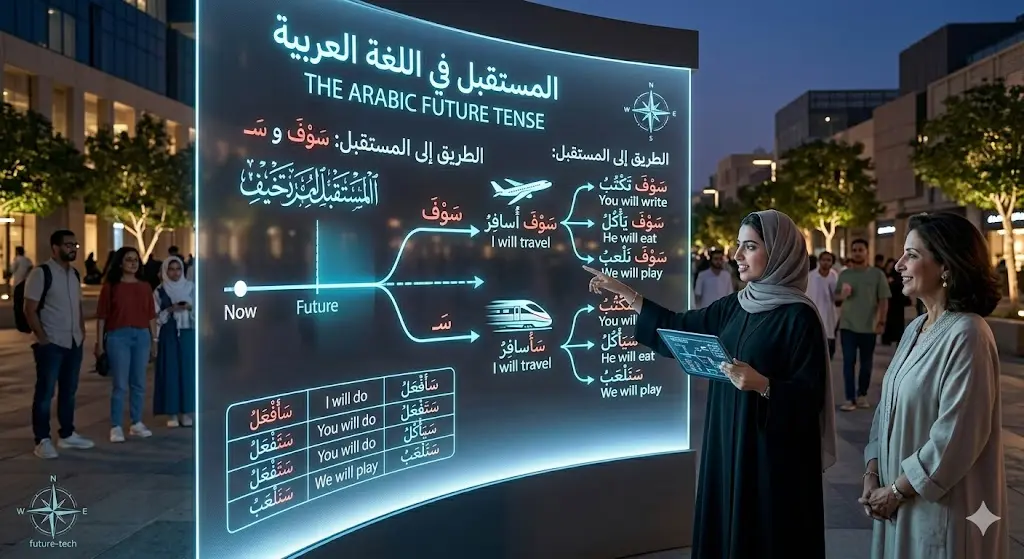
In Arabic grammar (النحو والصرف / an-naḥw waṣ-ṣarf), the future tense is not a standalone verb form. Instead, it is built by attaching a prefix — سَـ (sa-) or سَوْفَ (sawfa) — to the present tense verb (الفعل المضارع / al-fiʿl al-muḍāriʿ), transforming its temporal meaning while keeping its conjugation intact.
Table of Contents:
What Is the Future Tense in Arabic?
The Arabic future tense expresses an action or state that has not yet occurred. The Arabic future tense is formed exclusively from the present tense verb (الفعل المضارع / al-fiʿl al-muḍāriʿ) by prefixing either سَـ (sa-) or سَوْفَ (sawfa). No new verb stem is required — the conjugation pattern you already know for the present tense applies completely.
This makes the Arabic future tense one of the most learner-friendly structures in the entire grammar system.
Arabic grammar does not list the future tense as an independent verb tense (زمن / zaman) the way many European languages do.
Classical Arabic grammarians — and the traditional nahw tradition taught at institutions like Al-Azhar — describe Arabic verbs as having three primary forms: the past (الماضي / al-māḍī), the present/imperfect (المضارع / al-muḍāriʿ), and the command (الأمر / al-amr).
Future meaning is generated by modifying the present tense with particles, not by changing the verb’s base form.
Understanding this principle early saves enormous confusion. We see it consistently with students in our Arabic Grammar Course — the moment they realize the future tense requires zero new verb memorization, their confidence with Arabic verb conjugation increases dramatically.
Understand the Arabic Grammar with Buruj’s free trial lesson

What Are the Two Types of Future Tense in Arabic?
Arabic expresses future time through two distinct prefixes, each carrying a different shade of meaning. Choosing between them is not random — each signals a specific relationship between the speaker and the future action.
1. The Near or Simple Future: سَـ (Sa-)
سَـ (sa-) is a short prefix attached directly to the present tense verb. In traditional grammar, it is called حرف تسويف (ḥarf taswīf) or sometimes حرف استقبال (ḥarf istiqbāl) — a particle indicating nearness or immediacy in the future. It is the most frequently used future marker in both Modern Standard Arabic (MSA / الفصحى) and Quranic Arabic.
| Present Tense | With سَـ (Sa-) | Meaning |
| يَذْهَبُ (yadh-habu) | سَيَذْهَبُ (sa-yadh-habu) | He will go |
| تَكْتُبُ (taktubu) | سَتَكْتُبُ (sa-taktubu) | She will write |
| أَدْرُسُ (adrusu) | سَأَدْرُسُ (sa-adrusu) | I will study |
| نَفْهَمُ (nafh-amu) | سَنَفْهَمُ (sa-nafh-amu) | We will understand |
Notice that سَـ attaches directly to the verb with no space — it is a bound prefix (متصل / muttaṣil), not a separate word.
Read also: How to Use Negation in Arabic
2. The Distant or Emphatic Future: سَوْفَ (Sawfa)
سَوْفَ (sawfa) is a separate word placed before the present tense verb. Classical Arabic grammarians describe it as carrying a sense of greater distance, emphasis, or certainty about the future event.
| Present Tense | With سَوْفَ (Sawfa) | Meaning |
| يَعْلَمُ (yaʿlamu) | سَوْفَ يَعْلَمُ (sawfa yaʿlamu) | He will surely know |
| تَرَى (tarā) | سَوْفَ تَرَى (sawfa tarā) | You will see |
| نُنَبِّئُكَ (nunabbi’uka) | سَوْفَ نُنَبِّئُكَ | We will inform you |
| يُجْزَى (yujzā) | سَوْفَ يُجْزَى | He will be recompensed |
A powerful Quranic example using سَوْفَ:
وَلَسَوْفَ يُعْطِيكَ رَبُّكَ فَتَرْضَىٰ
Wa la-sawfa yuʿṭīka rabbuka fa-tarḍā
“And your Lord is going to give you, and you will be satisfied.” (Ad-Duha 93:5)
سَوْفَ here carries emphatic certainty — a divine promise. The لـ before سَوْفَ is the لام التوكيد / lām at-tawkīd, the emphatic lam, adding another layer of assurance.
What Is the Complete Conjugation of the Arabic Future Tense?
The future tense conjugation (التصريف / at-taṣrīf) follows the present tense conjugation exactly. The prefix سَـ or سَوْفَ is simply added to every conjugated form. Below is the full conjugation table of the future tense using the root كَتَبَ (k-t-b, “to write”) as the model verb.
Full Future Tense Conjugation Table — سَيَكْتُبُ (He will write)
| Pronoun | Arabic Pronoun | Present Tense | Future (سَـ) | Transliteration |
| He | هُوَ | يَكْتُبُ | سَيَكْتُبُ | sa-yaktubu |
| She | هِيَ | تَكْتُبُ | سَتَكْتُبُ | sa-taktubu |
| They (m.) | هُمْ | يَكْتُبُونَ | سَيَكْتُبُونَ | sa-yaktubūna |
| They (f.) | هُنَّ | يَكْتُبْنَ | سَيَكْتُبْنَ | sa-yaktubna |
| They (dual) | هُمَا | يَكْتُبَانِ | سَيَكْتُبَانِ | sa-yaktubāni |
| You (m. sg.) | أَنْتَ | تَكْتُبُ | سَتَكْتُبُ | sa-taktubu |
| You (f. sg.) | أَنْتِ | تَكْتُبِينَ | سَتَكْتُبِينَ | sa-taktubīna |
| You (m. pl.) | أَنْتُمْ | تَكْتُبُونَ | سَتَكْتُبُونَ | sa-taktubūna |
| You (f. pl.) | أَنْتُنَّ | تَكْتُبْنَ | سَتَكْتُبْنَ | sa-taktubna |
| You (dual) | أَنْتُمَا | تَكْتُبَانِ | سَتَكْتُبَانِ | sa-taktubāni |
| I | أَنَا | أَكْتُبُ | سَأَكْتُبُ | sa-aktubu |
| We | نَحْنُ | نَكْتُبُ | سَنَكْتُبُ | sa-naktubu |
To use سَوْفَ instead, simply replace سَـ with the separate word سَوْفَ before each form: سَوْفَ يَكْتُبُ، سَوْفَ تَكْتُبُ، and so on. The verb forms themselves do not change at all.
If you are still building confidence with verb conjugation fundamentals, our Arabic classes for beginners begin with present tense mastery before introducing tense modifications — because the المضارع is the engine of all Arabic verb grammar.
Begin learning Arabic at Buruj with a FREE trial lesson

How Do You Negate the Future Tense in Arabic?
Negating the future tense (النفي / an-nafī) requires a specific particle: لَنْ (lan). This is one of the most important grammar distinctions in Arabic, and students in our Online Arabic Classes consistently find it surprising at first.
لَنْ is a naṣb particle (حرف نصب / ḥarf naṣb) — meaning it places the verb that follows it in the subjunctive mood (المنصوب / al-manṣūb / manṣūb). This changes the final vowel of the verb:
- Verbs ending in ـُ (ḍamma) → change to ـَ (fatḥa)
- Verbs with ـُونَ → drop the نون → become ـُوا
- Verbs with ـِينَ → drop the نون → become ـِي
Negation Table: لَنْ + المنصوب
| Positive Future | Negative Future | Transliteration | Meaning |
| سَيَذْهَبُ | لَنْ يَذْهَبَ | lan yadh-haba | He will not go |
| سَتَكْتُبُ | لَنْ تَكْتُبَ | lan taktuba | She will not write |
| سَأَدْرُسُ | لَنْ أَدْرُسَ | lan adrus | I will not study |
| سَيَكْتُبُونَ | لَنْ يَكْتُبُوا | lan yaktubū | They (m.) will not write |
| سَتَكْتُبِينَ | لَنْ تَكْتُبِي | lan taktubī | You (f.) will not write |
A Quranic example of لَنْ in use:
لَنْ تَنَالُوا الْبِرَّ حَتَّىٰ تُنفِقُوا مِمَّا تُحِبُّونَ
Lan tanālū al-birra ḥattā tunfiqū mimmā tuḥibbūn
“Never will you attain the good until you spend from that which you love.” (Ali ‘Imran 3:92)
لَنْ تَنَالُوا — the verb نَالَ in the plural masculine subjunctive: the final نون of تَنَالُونَ is dropped because of the naṣb effect of لَنْ.
One important caution: لَا (lā) + present tense negates the present, not the future. And لَمْ (lam) + jussive negates the past.
Using the wrong negation particle is one of the most frequent errors we encounter, even among intermediate students. The future is negated specifically and only by لَنْ.
Master the Arabic Language
Join our expert-led courses and build a strong foundation in Classical and Modern Arabic.
Get Your Free TrialWhat Are the Main Usages of the Arabic Future Tense?
The future tense in Arabic serves several distinct communicative functions beyond simple statements about what will happen. Understanding these usages brings the grammar alive in real speech and Quranic comprehension.
1. Expressing Simple Future Events
This is the most direct usage — describing an action that will take place after the moment of speaking.
سَيَصِلُ الطَّالِبُ غَدًا
sa-yaṣilu aṭ-ṭālibu ghadan
The student will arrive tomorrow.
سَنَبْدَأُ الدَّرْسَ بَعْدَ قَلِيلٍ
sa-nabdaʾu ad-darsa baʿda qalīl
We will begin the lesson shortly.
2. Expressing Promises and Commitments
سَوْفَ in particular carries the force of a firm commitment or solemn promise, which is why it appears in Quranic promises from Allah.
سَوْفَ أُكْمِلُ الْوَاجِبَ
sawfa ukmilu al-wājib
I will certainly complete the assignment.
3. Expressing Warnings and Threats
The future tense — especially with سَوْفَ — is used in warning contexts, both in everyday speech and in Quranic passages addressing consequences.
كَلَّا سَوْفَ تَعْلَمُونَ
Kallā sawfa taʿlamūn
“No! You are going to know.” (At-Takathur 102:3)
This is the future tense as a warning — سَوْفَ تَعْلَمُونَ uses the full plural masculine form because no naṣb particle follows. The verb remains مرفوع / marfūʿ.
How Does the Arabic Future Tense Compare to Past and Present Tenses?
Understanding where the future tense sits within the full Arabic verb system clarifies how the language functions as a whole. Here is a complete comparison of all three primary verb forms, with the same root ذَهَبَ (dhahaba — to go):
Arabic Tense Comparison Chart
| Feature | الماضي (Past) | المضارع (Present) | المستقبل (Future) |
| Term | Al-māḍī | Al-muḍāriʿ | Al-mustaqbal |
| Example (he) | ذَهَبَ (dhahaba) | يَذْهَبُ (yadh-habu) | سَيَذْهَبُ (sa-yadh-habu) |
| Default ending | Fatḥa (ـَ) | Ḍamma (ـُ) | Ḍamma (ـُ) — unchanged |
| Prefix marker | None | يـ / تـ / أـ / نـ | سَـ or سَوْفَ + present prefix |
| Negation particle | مَا / لَمْ | لَا | لَنْ |
| Mood changes? | No | Yes (مرفوع، منصوب، مجزوم) | Negation triggers منصوب via لَنْ |
This table reveals a key structural truth: the future is not a third conjugation system. It is the present tense in a new temporal context. This is why learning Arabic grammar always prioritizes المضارع mastery — it unlocks both present and future expression simultaneously.
For a broader foundation in how Arabic sentences are organized around verbs, nouns, and particles, our guide on Arabic sentence structure provides an excellent structural overview before diving into tense manipulation.
Practical Examples of the Arabic Future Tense in Everyday Sentences
Examples (الأمثلة / al-amthila) are where grammar becomes real. Below are practical future tense sentences across contexts, following the instruction style we use in our Online Arabic Classes sessions — showing the Arabic term, transliteration, and meaning together.
Book your FREE Arabic trial online Arabic class at Buruj

Daily Life Examples of The Arabic Future Tense
| Arabic Sentence | Transliteration | English Meaning |
| سَأَذْهَبُ إِلَى الْمَسْجِدِ | sa-adh-habu ilā al-masjid | I will go to the mosque |
| سَيَقْرَأُ الْقُرْآنَ بَعْدَ الصَّلَاةِ | sa-yaqraʾu al-qurʾāna baʿda aṣ-ṣalāh | He will read the Quran after prayer |
| سَنَتَعَلَّمُ الْعَرَبِيَّةَ مَعًا | sa-nataʿallamu al-ʿarabiyyata maʿan | We will learn Arabic together |
| سَوْفَ تَفْهَمُ الدَّرْسَ | sawfa tafh-amu ad-darsa | You will (certainly) understand the lesson |
| لَنْ أَنْسَى هَذَا الْيَوْمَ | lan ansā hādhā al-yawm | I will never forget this day |
Building on Vocabulary While Practicing Grammar
Notice that each sentence above uses accessible vocabulary — words that connect to Islamic daily life, study, and worship. This is the context-before-abstraction approach central to how we teach at Buruj Academy: grammar always arrives inside meaningful, culturally connected sentences, never as isolated drills.
For students building vocabulary alongside grammar, our article on mastering Arabic vocabulary pairs well with this tense study — because the more vocabulary you hold, the more richly you can apply each new grammar structure.
Discover the Buruj Academy Difference
Step into our virtual classrooms and see how our expert instructors make learning Quran and Arabic intuitive and clear. We focus on overcoming the specific hurdles non-native speakers face, building your confidence and connection with the Quran.
Master Arabic Grammar with Buruj Academy’s Expert-Led Classes
The Arabic future tense — once understood — takes minutes to learn because it rests entirely on the present tense foundation. But that foundation needs to be built correctly from the start.
At Buruj Academy, our Arabic Grammar Course is taught by Al-Azhar University graduates with 12+ years of experience teaching non-Arabic speakers globally.
We use the Buruj Method — context-before-abstraction — meaning every rule arrives inside real, meaningful Arabic before any abstract explanation.
Our 1-on-1 sessions are flexible, personalized, and built for busy adults and motivated beginners alike.
Book your free trial lesson today and start building the Arabic grammar foundation that makes every tense, every sentence, and every Quranic verse more accessible.
Begin your transformation today by choosing the path that fits your goals:
- Online Arabic Classes (General & Comprehensive)
- Arabic Course for Beginners
- Arabic Alphabet Learning Course
- Online Arabic Classes for Kids
- Arabic Classes for Adults
- Arabic Grammar Course (Nahw & Sarf)
- Intermediate Arabic Course (B1/B2)
- Arabic Speaking Course (Conversational Fluency)
- Arabic Reading Course (Literary Excellence)
- Learn Arabic Writing Course (Calligraphy & Composition)
Ready to speak with confidence? Join the global community at Buruj Academy and book your free placement interview today!
Master the Arabic Language
Join our expert-led courses and build a strong foundation in Classical and Modern Arabic.
Get Your Free TrialConclusion
The Arabic future tense is one of those grammar topics that rewards learners quickly. Two particles — سَـ and سَوْفَ — carry the entire system, attaching to the present tense verb that you are already learning.
Negation through لَنْ adds one focused rule about the subjunctive mood. And the usage patterns — from everyday promises to Quranic warnings — give this grammar immediate real-world relevance.
What makes this structure so valuable is what it reveals about Arabic as a whole: the language is deeply systematic. Master the المضارع thoroughly, and you effectively hold the key to present, future, and much of the subjunctive in a single conjugation paradigm.
That is the kind of structural insight our instructors bring to every session at Buruj Academy — not just rules, but the logic underneath them.
Frequently Asked Questions About the Arabic Future Tense
What Is the Difference Between سَـ (Sa-) and سَوْفَ (Sawfa) in Arabic?
Both سَـ (sa-) and سَوْفَ (sawfa) form the future tense in Arabic by prefixing the present tense verb. سَـ implies nearness or immediacy, while سَوْفَ carries a sense of greater distance, emphasis, or certainty.
How Do You Negate the Future Tense in Arabic?
The future tense in Arabic is negated using لَنْ (lan) followed by the present tense verb in the subjunctive mood (المنصوب / al-manṣūb). This causes the verb’s final ḍamma to change to fatḥa, and plural/feminine forms drop their نون. For example: سَيَذْهَبُ (he will go) becomes لَنْ يَذْهَبَ (he will not go). Never use لَا or لَمْ to negate the future — these particles serve different tenses.
Does Arabic Have a Separate Verb Form for the Future Tense?
No. Arabic grammar (النحو / an-naḥw) does not assign the future a separate verb conjugation. Classical Arabic identifies three verb forms: past (ماضي), present/imperfect (مضارع), and command (أمر). Future meaning is expressed by adding سَـ or سَوْفَ to the present tense verb, leaving all conjugation endings unchanged. This makes the future one of the easiest structures for learners who have already studied the المضارع.
Is the Future Tense Used in Quranic Arabic?
Yes, the future tense appears throughout the Quran. Understanding how سَـ and سَوْفَ function is essential for Quranic comprehension. Our Quranic Arabic Classes specifically address how grammatical tense functions in Quranic context, helping students understand what they recite and read.
What Happens to Verb Endings in the Future Tense Negative (لَنْ)?
When لَنْ precedes a present tense verb, it triggers the subjunctive mood (المنصوب). Practically: verbs ending in ـُ change to ـَ (e.g., يَكْتُبَ); masculine plural forms drop their نون ( يَكْتُبُوا); feminine forms also drop their نون where applicable (تَكْتُبِي). The stem of the verb itself never changes — only the final endings are affected by the naṣb (نصب) grammatical state.