 Arabic
| Key Takeaways |
| Arabic has four core demonstrative pronouns: هَذَا (this, masculine), هَذِهِ (this, feminine), ذَلِكَ (that, masculine), and تِلْكَ (that, feminine). |
| Arabic demonstratives must agree in gender with the noun they point to — there is no gender-neutral “this” or “that.” |
| Arabic also has dual demonstrative forms (هَذَانِ / هَاتَانِ) and plural forms (هَؤُلَاءِ / أُولَئِكَ) not found in English. |
| Demonstratives in Arabic function as the subject of a nominal sentence, making the word that follows them act as a predicate without a verb. |
Pointing at things and saying “this” or “that” is one of the first communication tools any language learner reaches for.
In Arabic, this function is handled by a small but highly structured category of words called demonstrative pronouns in Arabic — and they behave quite differently from their English equivalents.
Unlike English, Arabic demonstratives carry grammatical gender, change for dual and plural nouns, and create complete sentences without a verb.
Table of Contents:
What Does Demonstrative Pronouns Mean in Arabic Grammar?
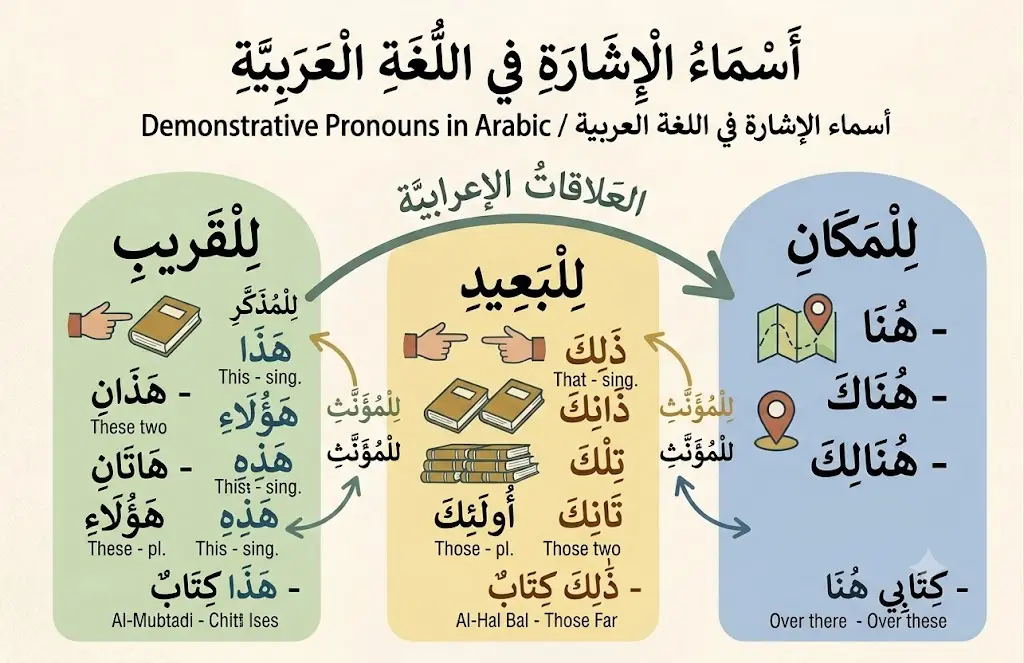
Demonstrative pronouns are words that point to people, objects, or places — the Arabic equivalent of “this,” “that,” “these,” and “those” in English. In Arabic grammar, they are called أَسْمَاءُ الإِشَارَةِ (asmā’ al-ishāra), which translates literally as “names of pointing.”
Every demonstrative in Arabic carries specific information about three things: distance (near or far), gender (masculine or feminine), and number (singular, dual, or plural).
This makes Arabic demonstratives more grammatically rich than their English counterparts. When an English speaker says “this book,” the word “this” gives no information about the gender of “book.”
In Arabic, the demonstrative must match the gender of the noun — so you cannot simply pick one form and apply it everywhere.
In our sessions at Buruj Academy, we notice that students from English-speaking backgrounds often try to use هَذَا (hādhā) as a universal “this” for everything. That single habit — ignoring gender agreement — is the most common demonstrative error we correct in the first month of study.
In our Arabic Grammar Course at Buruj Academy, demonstrative pronouns are one of the earliest grammar points we teach — because once students master them, they can start constructing real, meaningful Arabic sentences almost immediately.
Understand the Arabic Grammar with Buruj’s free trial lesson
What Are the Four Core Demonstrative Pronouns in Arabic?
The four core demonstrative pronouns in Arabic that every beginner must master are: هَذَا, هَذِهِ, ذَلِكَ, and تِلْكَ. These four forms handle all singular demonstrative pointing across both genders and both distances in Modern Standard Arabic.
| Pronoun | Arabic | Transliteration | Gender | Distance |
| This (masc.) | هَذَا | hādhā | Masculine | Near |
| This (fem.) | هَذِهِ | hādhihi | Feminine | Near |
| That (masc.) | ذَلِكَ | dhālika | Masculine | Far |
| That (fem.) | تِلْكَ | tilka | Feminine | Far |
These four forms serve as the foundation for everything else in the demonstrative system. Master these, and the dual and plural forms become logical extensions rather than new vocabulary to memorize.
If you are still building your core Arabic vocabulary alongside grammar, our guide on mastering Arabic vocabulary will help you attach real words to these demonstrative structures quickly.
How Do You Use هَذَا and هَذِهِ for Near Demonstratives?
هَذَا (hādhā) and هَذِهِ (hādhihi) both mean “this” — used for objects or people that are nearby. The choice between them depends entirely on the grammatical gender of the noun being pointed at, not its physical properties.
هَذَا — Used with Masculine Nouns
Use هَذَا with any masculine singular noun. Masculine nouns in Arabic are typically those that do not end in the feminine marker ة (tā’ marbūṭa).
| Arabic Sentence | Transliteration | English Meaning |
| هَذَا كِتَابٌ | hādhā kitābun | This is a book. |
| هَذَا بَابٌ كَبِيرٌ | hādhā bābun kabīrun | This is a big door. |
| هَذَا وَلَدٌ ذَكِيٌّ | hādhā waladun dhakiyyun | This is a smart boy. |
| هَذَا قَلَمٌ أَحْمَرُ | hādhā qalamun aḥmaru | This is a red pen. |
هَذِهِ — Used with Feminine Nouns
Use هَذِهِ with any feminine singular noun — including most nouns ending in ة.
| Arabic Sentence | Transliteration | English Meaning |
| هَذِهِ مَدْرَسَةٌ | hādhihi madrasatun | This is a school. |
| هَذِهِ سَيَّارَةٌ جَدِيدَةٌ | hādhihi sayyāratun jadīdatun | This is a new car. |
| هَذِهِ فَتَاةٌ مُجْتَهِدَةٌ | hādhihi fatātun mujtahidatun | This is a hardworking girl. |
| هَذِهِ حَقِيبَةٌ ثَقِيلَةٌ | hādhihi ḥaqībatun thaqīlatun | This is a heavy bag. |
Notice that in every example above, no verb appears between the demonstrative and the following noun.
This is a fundamental feature of Arabic nominal sentences — the demonstrative pronoun functions as the subject, and the noun that follows is the predicate.
This grammar principle is explained in greater depth in our article on Arabic sentence structure and in our Arabic Classes for Beginners.
Begin learning Arabic at Buruj with a FREE trial lesson

How Do You Use ذَلِكَ and تِلْكَ for Far Demonstratives?
ذَلِكَ (dhālika) and تِلْكَ (tilka) both mean “that” — used for objects or people at a distance. Like the near demonstratives, the choice depends strictly on grammatical gender.
ذَلِكَ — Used with Masculine Nouns at a Distance
| Arabic Sentence | Transliteration | English Meaning |
| ذَلِكَ بَيْتٌ قَدِيمٌ | dhālika baytun qadīmun | That is an old house. |
| ذَلِكَ رَجُلٌ طَيِّبٌ | dhālika rajulun ṭayyibun | That is a kind man. |
| ذَلِكَ مَسْجِدٌ كَبِيرٌ | dhālika masjidun kabīrun | That is a large mosque. |
تِلْكَ — Used with Feminine Nouns at a Distance
| Arabic Sentence | Transliteration | English Meaning |
| تِلْكَ شَجَرَةٌ طَوِيلَةٌ | tilka shajaratun ṭawīlatun | That is a tall tree. |
| تِلْكَ مَدِينَةٌ جَمِيلَةٌ | tilka madīnatun jamīlatun | That is a beautiful city. |
| تِلْكَ امْرَأَةٌ فَاضِلَةٌ | tilka imra’atun fāḍilatun | That is a virtuous woman. |
One practical note: in spoken Modern Standard Arabic, the distinction between “near” and “far” is used functionally, much like English uses “this” versus “that.”
You can also use ذَلِكَ / تِلْكَ when referring back to something already mentioned in conversation, even if it is not physically distant.
What Are the Dual and Plural Forms of Arabic Demonstrative Pronouns?
Arabic demonstrative pronouns extend beyond the four singular forms to include distinct dual and plural patterns. These forms follow the same gender-agreement logic as the singular forms.
Read also:Understanding Verbal Nouns in Arabic
Dual Demonstrative Pronouns in Arabic هَذَانِ – هَاتَانِ
The dual is used when pointing to exactly two items. The forms change depending on grammatical case (nominative vs. accusative/genitive).
| Form | Arabic | Transliteration | Meaning |
| These two (masc.) — subject | هَذَانِ | hādhāni | These two (masc.) |
| These two (fem.) — subject | هَاتَانِ | hātāni | These two (fem.) |
| Those two (masc.) — subject | ذَانِكَ | dhānika | Those two (masc.) |
| Those two (fem.) — subject | تَانِكَ | tānika | Those two (fem.) |
Example sentences with dual demonstrative pronouns in Arabic هَذَانِ – هَاتَانِ:
هَذَانِ كِتَابَانِ مُفِيدَانِ
Hādhāni kitābāni mufīdāni
These are two useful books.
هَاتَانِ طَالِبَتَانِ مُجْتَهِدَتَانِ
Hātāni ṭālibatāni mujtahidatāni
These are two hardworking female students.
Understanding dual noun forms will help you work with dual demonstratives more naturally. Our article on dual nouns in Arabic covers that system in full detail.
Read also: Definite Pronouns in Arabic
Discover the Buruj Academy Difference
Step into our virtual classrooms and see how our expert instructors make learning Quran and Arabic intuitive and clear. We focus on overcoming the specific hurdles non-native speakers face, building your confidence and connection with the Quran.
Master the Arabic Language
Join our expert-led courses and build a strong foundation in Classical and Modern Arabic.
Get Your Free TrialPlural Demonstrative Pronouns هَؤُلَاءِ – أُولَئِكَ
For three or more people, Arabic uses a distinct set of plural demonstratives. Importantly, Arabic uses the rational plural (for people) differently from the inanimate plural (for objects).
| Form | Arabic | Transliteration | Meaning |
| These (people) | هَؤُلَاءِ | hā’ulā’i | These (plural, for rational beings) |
| Those (people) | أُولَئِكَ | ulā’ika | Those (plural, for rational beings) |
For inanimate objects in the plural, Arabic treats them as feminine singular — so you use هَذِهِ and تِلْكَ rather than the plural forms.
Example sentences wth plural demonstrative pronouns هَؤُلَاءِ – أُولَئِكَ:
هَؤُلَاءِ طُلَّابٌ مُجْتَهِدُونَ
Hā’ulā’i ṭullābun mujtahidūna
These are hardworking students.
أُولَئِكَ مُعَلِّمُونَ خَبِيرُونَ
Ulā’ika mu’allimūna khabīrūna
Those are experienced teachers.
هَذِهِ كُتُبٌ كَثِيرَةٌ
Hādhihi kutubun kathīratun
These are many books.
Inanimate plural treated as feminine singular.
The Agreement Rules of Demonstrative Pronouns in Arabic Grammar
The governing rule for all Arabic demonstratives is gender agreement: the demonstrative must match the grammatical gender of the noun it points to, not the biological sex of a person or the physical nature of an object.
Three agreement rules that every student must internalize:
Rule 1 — Follow grammatical gender, not biological gender
The word شَمْس (shams — sun) is grammatically feminine, so you say هَذِهِ الشَّمْسُ (hādhihi al-shamsu — this sun), even though the sun is not biologically female.
Rule 2 — The definite article ال follows the demonstrative, not precedes it
When the noun is definite, the structure is: Demonstrative + Definite Noun.
| Indefinite | Definite |
| هَذَا كِتَابٌ (This is a book.) | هَذَا الكِتَابُ (This book.) |
| هَذِهِ سَيَّارَةٌ (This is a car.) | هَذِهِ السَّيَّارَةُ (This car.) |
| ذَلِكَ بَيْتٌ (That is a house.) | ذَلِكَ البَيْتُ (That house.) |
Rule 3 — Inanimate plurals take feminine singular demonstratives
This is the rule that surprises most English-speaking students most. Arabic grammarians explain that inanimate plural nouns are treated as collective entities with feminine agreement. So “these books” is هَذِهِ الكُتُبُ — using the singular feminine هَذِهِ, not a plural demonstrative.
Mastering gender agreement will serve you across all of Arabic grammar, not just demonstratives. Our article on masculine and feminine nouns in Arabic gives you the full noun-gender system as a foundation.
Demonstrative Pronouns in Arabic and English
Comparing Arabic and English demonstratives side by side helps learners anticipate exactly where mistakes tend to happen. The structural differences are significant.
| Feature | English | Arabic |
| Gender distinction | None (“this” works for all genders) | Mandatory — هَذَا vs. هَذِهِ |
| Dual form | None (“these two” uses “these”) | Yes — هَذَانِ / هَاتَانِ |
| Plural for people vs. objects | None (same “these/those” for all) | Different — هَؤُلَاءِ vs. هَذِهِ for objects |
| Verb required in equational sentence | Yes (“This is a book” uses “is”) | No verb needed — هَذَا كِتَابٌ is complete |
| Definite article placement | Before noun (“this book”) | After demonstrative (هَذَا الكِتَابُ) |
The absence of a linking verb in Arabic nominal sentences is one of the structural advantages Arabic offers — it actually makes sentences shorter and more direct once you internalize the pattern.
Understanding this structure connects directly to Arabic tenses and how Arabic handles different sentence types across time frames.
Practice Exercises for Demonstrative Pronouns in Arabic
The best way to cement demonstrative pronouns is through varied, context-rich practice. Below are three exercise types we use with students in our Arabic Online Classes
Book your FREE Arabic trial online Arabic class at Buruj

Exercise 1 — Fill in the Correct Demonstrative
Choose the correct form (هَذَا / هَذِهِ / ذَلِكَ / تِلْكَ) for each sentence:
- _____ مَدْرَسَةٌ كَبِيرَةٌ. (This is a big school.)
- _____ قَلَمٌ أَزْرَقُ. (This is a blue pen.)
- _____ جَبَلٌ عَالٍ. (That is a high mountain.)
- _____ غُرْفَةٌ نَظِيفَةٌ. (That is a clean room.)
Answers:
1 — هَذِهِ | 2 — هَذَا | 3 — ذَلِكَ | 4 — تِلْكَ
Exercise 2 — Translate into Arabic
- This is a new student (male).
- That is a beautiful garden.
- These are hardworking teachers (people).
- This is the red car. (definite)
Answers:
- هَذَا طَالِبٌ جَدِيدٌ
- تِلْكَ حَدِيقَةٌ جَمِيلَةٌ
- هَؤُلَاءِ مُعَلِّمُونَ مُجْتَهِدُونَ
- هَذِهِ السَّيَّارَةُ الحَمْرَاءُ
Exercise 3 — Demonstrative Quizzes: Spot the Error
Each sentence below contains one error. Identify and correct it:
- هَذَا مَدْرَسَةٌ كَبِيرَةٌ.
- تِلْكَ كِتَابٌ قَدِيمٌ.
- هَؤُلَاءِ كُتُبٌ كَثِيرَةٌ.
Corrections:
- Should be هَذِهِ — مَدْرَسَةٌ is feminine.
- Should be ذَلِكَ — كِتَابٌ is masculine.
- Should be هَذِهِ — inanimate plurals take feminine singular demonstratives.
Regular practice with these types of demonstrative quizzes accelerates the gender-agreement intuition that every Arabic learner needs.
If you are building a broader grammar foundation, our beginner-friendly Arabic grammar guide maps the full learning path for you.
Read also: Arabic Relative Pronouns
Start Learning Arabic with Buruj Academy’s Expert Instructors
Demonstrative pronouns are one of the most immediately useful grammar structures in Arabic — and with the right guided instruction, students typically achieve confident command of all four core forms within a few lessons.
At Buruj Academy, our Arabic Grammar Course builds exactly this kind of structured, step-by-step fluency.
Our Al-Azhar University graduates with 12+ years of experience teaching non-Arabic speakers guide every student through gender agreement, sentence construction, and practical application using the Buruj Method — Context-before-abstraction, meaning real words and real sentences before abstract rules.
All sessions are personalized 1-on-1 with flexible scheduling to fit any lifestyle.
Book your free trial lesson and start building real Arabic grammar confidence today.
Begin your transformation today by choosing the path that fits your goals:
- Online Arabic Classes (General & Comprehensive)
- Arabic Course for Beginners
- Arabic Alphabet Learning Course
- Online Arabic Classes for Kids
- Arabic Classes for Adults
- Arabic Grammar Course (Nahw & Sarf)
- Intermediate Arabic Course (B1/B2)
- Arabic Speaking Course (Conversational Fluency)
- Arabic Reading Course (Literary Excellence)
- Learn Arabic Writing Course (Calligraphy & Composition)
Ready to speak with confidence? Join the global community at Buruj Academy and book your free placement interview today!
Master the Arabic Language
Join our expert-led courses and build a strong foundation in Classical and Modern Arabic.
Get Your Free TrialConclusion
Demonstrative pronouns in Arabic are compact, rule-governed, and immediately practical. The four core forms — هَذَا, هَذِهِ, ذَلِكَ, and تِلْكَ — unlock the ability to build real Arabic sentences from the very first weeks of learning, without relying on a verb. The gender-agreement system, the dual forms, and the inanimate plural rule all follow clear internal logic once you see them together.
Consistent practice with varied examples — especially the exercises above — trains that grammatical intuition faster than any amount of passive reading. Invest the time in these four forms now, and every other part of Arabic grammar will feel more accessible as a result.
Frequently Asked Questions About Demonstrative Pronouns in Arabic
What Does “Demonstrative Pronouns” Mean in Arabic?
Demonstrative pronouns in Arabic — called أَسْمَاءُ الإِشَارَةِ (asmā’ al-ishāra) — are words that point to specific people, objects, or places. They are the Arabic equivalents of “this,” “that,” “these,” and “those” in English, but they carry gender and number information that English demonstratives do not.
What Are the Four Demonstrative Pronouns in Arabic?
The four core demonstrative pronouns in Arabic are هَذَا (this, masculine), هَذِهِ (this, feminine), ذَلِكَ (that, masculine), and تِلْكَ (that, feminine). These four singular forms cover all basic demonstrative pointing in Modern Standard Arabic and are the starting point for every learner.
Do Arabic Demonstrative Pronouns Have to Match the Noun in Gender?
Yes — gender agreement is mandatory in Arabic. If the noun is masculine, you must use هَذَا or ذَلِكَ. If the noun is feminine, you must use هَذِهِ or تِلْكَ. The grammatical gender of the noun determines the form, not the biological nature of what is being described. Mismatching gender is one of the most common errors we see in beginner learners.