 Arabic
| Key Takeaways |
| Arabic has three short vowels — Fathah (َ), Kasrah (ِ), and Dhammah (ُ) — that determine how consonants are pronounced. |
| Short vowels appear as small diacritical marks above or below Arabic letters and are essential for correct reading and meaning. |
| Changing one short vowel on a word completely alters its grammatical role — subject, object, or possessive — in a sentence. |
When Arabic learners first encounter written text, they often notice small marks hovering above and below the letters — marks that seem optional, even decorative. They are anything but optional. Those marks are short vowels, and without understanding them, reading Arabic correctly is simply not possible.
Short vowels in Arabic are three diacritical symbols — Fathah, Kasrah, and Dhammah — that indicate the vowel sound attached to each consonant.
Mastering them is the single most important early step in reading Arabic accurately, whether your goal is Modern Standard Arabic, everyday conversation, or understanding classical texts.
Table of Contents:
What Are Short Vowels in Arabic and Why Do They Matter?
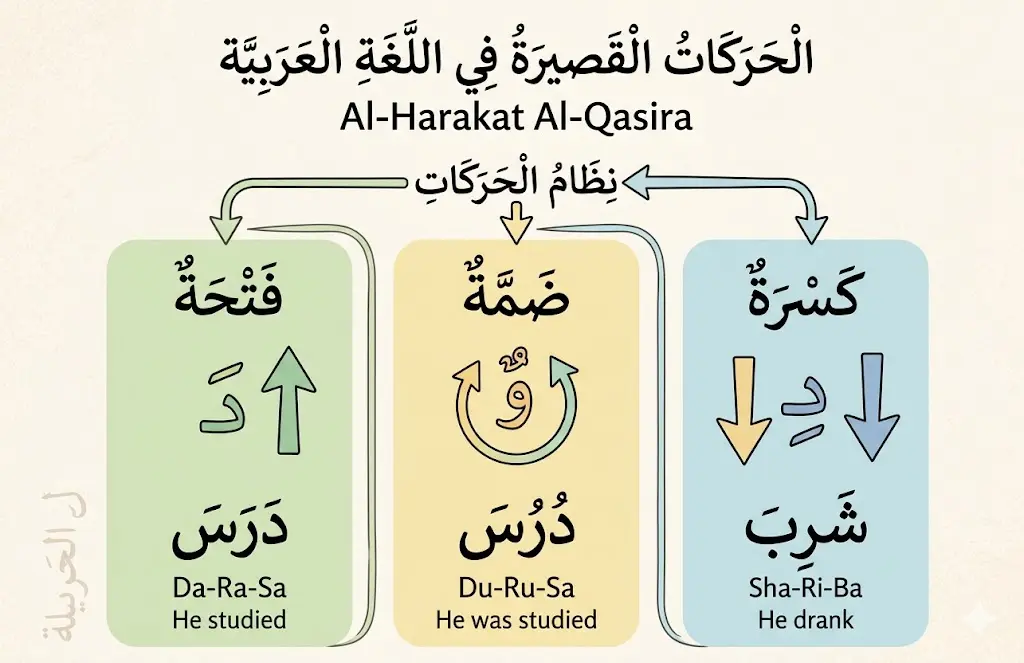
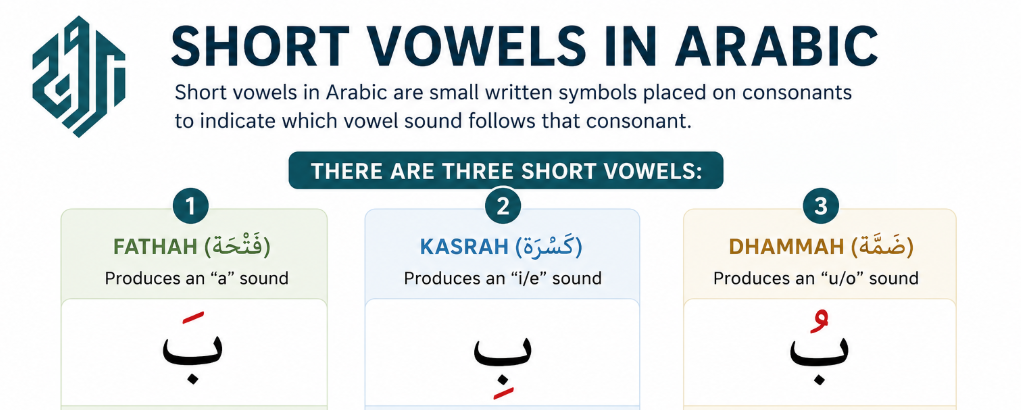
Short vowels in Arabic are small written symbols placed on consonants to indicate which vowel sound follows that consonant. There are three short vowels: Fathah (فَتْحَة), producing an “a” sound; Kasrah (كَسْرَة), producing an “i/e” sound; and Dhammah (ضَمَّة), producing a “u/o” sound. Together, they determine pronunciation and grammatical meaning in every Arabic sentence.
Arabic is a consonant-based language. This means the written skeleton of most words consists only of consonants.
Short vowels breathe life into those consonants, telling the reader exactly how to pronounce each letter and — critically — what role the word plays in a sentence.
At Buruj Academy, our instructors observe the same pattern repeatedly: students who skip short vowels early on develop guessing habits that take months to correct.
Our Arabic for Beginners course builds vowel recognition from the very first lesson, because a strong phonetic foundation makes everything else — grammar, vocabulary, reading — dramatically easier to acquire.
Begin learning Arabic at Buruj with a FREE trial lesson

The Three Short Vowels in Arabic with Meaning and Symbol
Each short vowel has a name, a symbol, a sound, and a grammatical implication. Here is the complete reference:
| Vowel Name | Arabic Name | Symbol | Placement | Sound | Example Letter |
| Fathah | فَتْحَة | ( َ ) | Above the letter | “a” as in “cat” | بَ = ba |
| Kasrah | كَسْرَة | ( ِ ) | Below the letter | “i” as in “bit” | بِ = bi |
| Dhammah | ضَمَّة | ( ُ ) | Above the letter | “u” as in “put” | بُ = bu |
The Fathah is the most frequently occurring short vowel in Arabic. It appears in the majority of verb conjugations, making it the first one students encounter and the one they need most urgently.
The Kasrah most commonly signals possession (the genitive case) and appears on objects governed by prepositions.
The Dhammah typically marks the grammatical subject (the nominative case) of a sentence.
1. Fathah (فَتْحَة): The Most Common Short Vowel in Arabic with Examples
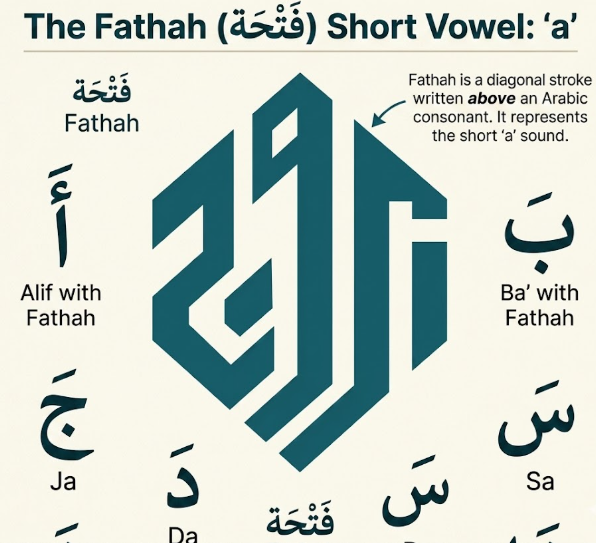
Fathah is a small diagonal stroke written above a consonant, representing the short “a” vowel sound. It is the default vowel of Arabic verbs in their base form and appears extensively across all word types.
How Fathah Sounds in Isolated Arabic Letters
| Arabic Letter | With Fathah | Pronunciation |
| ب | بَ | ba |
| كَ | كَ | ka |
| دَ | دَ | da |
| سَ | سَ | sa |
| مَ | مَ | ma |
The sound is a short, open “a” — never elongated unless followed by an Alif (ا), which creates the long vowel “aa.”
Fathah in Real Arabic Words with Meaning
| Arabic Word | Transliteration | Meaning |
| كَتَبَ | kataba | He wrote |
| ذَهَبَ | dhahaba | He went |
| فَتَحَ | fataha | He opened |
| جَلَسَ | jalasa | He sat |
| أَكَلَ | akala | He ate |
Notice that past-tense Arabic verbs in their simplest (third-person masculine singular) form consist almost entirely of Fathah vowels. This makes the past tense the natural starting point for learning Arabic grammar, and it is where our instructors consistently begin.
Read also:Understanding Long Vowels in Arabic
Practice Exercise: Fathah Recognition
Read these consonant skeletons, then add Fathah to every letter and pronounce each word aloud:
- ك – ت – ب → كَتَبَ (kataba — he wrote)
- د – ر – س → دَرَسَ (darasa — he studied)
2. Kasrah (كَسْرَة) in Arabic
Kasrah is a small diagonal stroke placed below a consonant, representing a short “i” or “e” sound. It is the only short vowel written below the letter, making it visually distinctive once students train their eye to look downward.
Kasrah in Isolated Arabic Letters
| Arabic Letter | With Kasrah | Pronunciation |
| بِ | بِ | bi |
| كِ | كِ | ki |
| فِ | فِ | fi |
| لِ | لِ | li |
| مِ | مِ | mi |
Kasrah in Real Arabic Words with Meaning
| Arabic Word | Transliteration | Meaning |
| بِيَد | bi-yad | by hand / with a hand |
| فِي البَيْت | fil-bayt | in the house |
| كِتَاب | kitāb | book |
| مِفْتَاح | miftāh | key |
| بِنْت | bint | girl / daughter |
The preposition فِي (fi — “in/at”) is one of the most essential Arabic words and is built entirely on Kasrah.
Every time a noun follows a preposition in Arabic, it takes the Kasrah (genitive/possessive ending) on its final letter.
This is a grammatical signal, not just a pronunciation choice — which is why we emphasize from early in our Arabic Alphabet course that short vowels and grammar are inseparable.
Get a free trial now in Buruj’s Alphabet course
Kasrah and the Genitive Case
When a noun is owned or governed by a preposition, its final consonant takes Kasrah:
| Example | Transliteration | Meaning |
| كِتَابُ الطَّالِبِ | kitābu-t-tālibi | The student’s book |
| فِي البَيْتِ | fil-bayti | In the house |
| عَلَى الطَّاوِلَةِ | ‘alā-t-tāwilati | On the table |
The final Kasrah in each example is not decorative. It is a grammatical marker telling a reader: this word is in a dependent relationship with what precedes it.
3. Dhammah (ضَمَّة) in Arabic
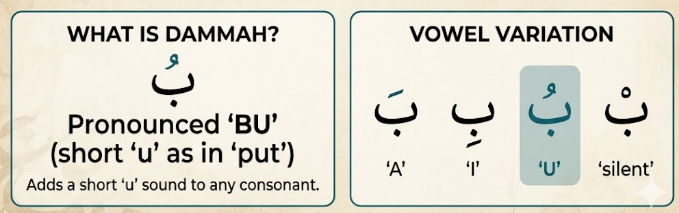
Dhammah is a small loop or comma-like shape written above a consonant, producing a short “u” sound. It most prominently marks the grammatical subject (nominative case) of an Arabic sentence, making it a vital reading signal even for beginners.
Dhammah in Isolated Arabic Letters
| Arabic Letter | With Dhammah | Pronunciation |
| بُ | بُ | bu |
| كُ | كُ | ku |
| رُ | رُ | ru |
| سُ | سُ | su |
| نُ | نُ | nu |
Dhammah in Real Arabic Words with Meaning
| Arabic Word | Transliteration | Meaning |
| مُعَلِّم | mu’allim | teacher |
| مُسَافِر | musāfir | traveler |
| كُتُب | kutub | books |
| مُدِير | mudīr | director/manager |
| نُور | nūr | light |
Many Arabic nouns derived from verb roots use Dhammah as part of their internal vowel pattern.
The word مُعَلِّم (teacher) comes from the root ع-ل-م (knowledge), and the Dhammah on the first letter is part of a recognized pattern (مُفَعِّل) that means “doer of an intensive action.” Recognizing these vowel patterns unlocks vocabulary acquisition at speed.
For a broader look at how Arabic vocabulary works systematically, our guide on mastering Arabic vocabulary explores exactly this.
Read also: Syllable Letters in Arabic
Discover the Buruj Academy Difference
Step into our virtual classrooms and see how our expert instructors make learning Quran and Arabic intuitive and clear. We focus on overcoming the specific hurdles non-native speakers face, building your confidence and connection with the Quran.
Master the Arabic Language
Join our expert-led courses and build a strong foundation in Classical and Modern Arabic.
Get Your Free TrialDhammah and the Nominative Case
| Example | Transliteration | Meaning |
| الطَّالِبُ يَدْرُسُ | al-tālibu yadrusu | The student studies |
| المُعَلِّمُ يَشْرَحُ | al-mu’allimu yashraḥu | The teacher explains |
| الوَلَدُ يَلْعَبُ | al-waladu yal’abu | The boy plays |
In each sentence, the final Dhammah on the subject noun is a grammatical signal. Remove it or replace it, and the sentence either changes meaning or becomes grammatically ambiguous.
This is precisely why reading Arabic with correct vowels is essential before attempting unvowelized texts.
How Do Short Vowels Change the Meaning of Arabic Words Completely?
One of the most striking features of Arabic — and one that consistently surprises our students at Buruj Academy — is how dramatically a single vowel change alters the meaning or grammatical role of a word. This is not an edge case; it is the norm.
The Same Consonants, Three Different Meanings
The root letters ك – ت – ب (k-t-b) relate to writing. Watch what vowels do:
| Arabic | Transliteration | Meaning |
| كَتَبَ | kataba | He wrote (verb, past tense) |
| كِتَاب | kitāb | Book (noun) |
| كُتِبَ | kutiba | It was written (passive voice) |
| كُتُب | kutub | Books (plural) |
The consonants never change. The vowels carry the entire semantic and grammatical load.
The three short vowels — Dhammah, Fathah, Kasrah — function as live grammatical indicators on the final letter of every fully declined noun. This system is called I’rāb (الإعراب), and understanding it is central to Arabic grammar.
Our Arabic Grammar course dedicates early lessons to I’rāb precisely because students who grasp it early stop making random guessing errors and start reading with precision.
Understand the Arabic Grammar with Buruj’s free trial lesson
What Is Tanwin and How Does It Relate to Short Vowels?
Tanwin (تَنْوِين) is the doubling of a short vowel on the final letter of an indefinite noun, producing an “n” sound at the end of the word. It is not a fourth vowel — it is an extension of the three existing short vowels applied to indefinite nouns.
| Tanwin Type | Symbol | Sound | Example | Meaning |
| Tanwin Fath | ( ً ) | “-an” | كِتَاباً | a book (object) |
| Tanwin Kasr | ( ٍ ) | “-in” | كِتَابٍ | a book (possessive) |
| Tanwin Damm | ( ٌ ) | “-un” | كِتَابٌ | a book (subject) |
Tanwin only appears on indefinite nouns (nouns without “the” — ال). Once the definite article is added, Tanwin disappears:
- كِتَابٌ (kitābun) — a book
- الكِتَابُ (al-kitābu) — the book
This distinction is one of the most reliable clues for identifying definiteness in Arabic text. Students who learn short vowels alongside Tanwin from the beginning avoid one of the most common reading errors we see in our sessions.
Short Vowels in Arabic with Examples
Here is a master practice table covering all three short vowels across ten common Arabic letters:
| Letter | With Fathah | With Kasrah | With Dhammah | With Sukoon |
| ب | بَ (ba) | بِ (bi) | بُ (bu) | بْ (b) |
| كَ | كَ (ka) | كِ (ki) | كُ (ku) | كْ (k) |
| دَ | دَ (da) | دِ (di) | دُ (du) | دْ (d) |
| فَ | فَ (fa) | فِ (fi) | فُ (fu) | فْ (f) |
| مَ | مَ (ma) | مِ (mi) | مُ (mu) | مْ (m) |
| سَ | سَ (sa) | سِ (si) | سُ (su) | سْ (s) |
| نَ | نَ (na) | نِ (ni) | نُ (nu) | نْ (n) |
| رَ | رَ (ra) | رِ (ri) | رُ (ru) | رْ (r) |
| لَ | لَ (la) | لِ (li) | لُ (lu) | لْ (l) |
| هَ | هَ (ha) | هِ (hi) | هُ (hu) | هْ (h) |
Read each row aloud three times, moving across the vowels without pausing between repetitions. This trains your ear to hear the vowel distinctions clearly before connecting them to full words.
Practical Exercises to Master Short Vowels in Arabic
Exercise 1: Vowel Identification
Read the following words and identify which short vowel each underlined letter carries:
- كَتَبَ — What vowel is on كَ? On تَ? On بَ?
- مُعَلِّمٌ — What vowel is on مُ? What does the final ٌ tell you about this noun?
- فِي البَيْتِ — What vowel is on فِ? Why does بَيْتِ end in Kasrah?
(Answers: 1. All three carry Fathah. 2. Dhammah; Tanwin Damm indicating it is an indefinite subject. 3. Kasrah; because it follows the preposition فِي and is therefore in the genitive case.)
Exercise 2: Vowel Insertion
Add the correct short vowels to these consonant skeletons based on the given meaning:
| Consonant Skeleton | Target Meaning | Answer |
| د – ر – س | He studied (past) | دَرَسَ |
| ك – ت – ب | Books (plural) | كُتُب |
| م – د – ر – س – ة | School (nominative) | مَدْرَسَةٌ |
| ط – ل – ب | Student (subject) | طَالِبٌ |
Exercise 3: Grammatical Vowel Reading
Read these three sentences and state the grammatical function of the bolded word in each:
- الطَّالِبُ يَقْرَأُ الكِتَابَ. (The student reads the book.)
- قَرَأَ المُعَلِّمُ الكِتَابَ. (The teacher read the book.)
- صَفَحَاتُ الكِتَابِ جَمِيلَةٌ. (The pages of the book are beautiful.)
The same word الكِتَاب appears in all three sentences — subject (Dhammah), object (Fathah), and possessive (Kasrah). This is I’rāb in action.
Getting comfortable with Arabic tenses and sentence structure alongside short vowels accelerates reading accuracy significantly.
At Buruj Academy, our Online Arabic Classes teach short vowels not as a phonetics drill but as a live reading and grammar system from the very beginning, because the two are inseparable.
Book your FREE Arabic trial online Arabic class at Buruj

How Do Short Vowels Connect to Arabic Sentence Structure?
Short vowels are not isolated phonetic tools — they are embedded in Arabic sentence grammar at the deepest level. Arabic sentence structure relies on vowel endings (I’rāb) to signal relationships between words, which means word order is more flexible in Arabic than in English. The vowel does the work that word order does in English.
Compare these two Arabic sentences:
- أَكَلَ الوَلَدُ التُّفَّاحَةَ — The boy ate the apple. (verb — subject — object)
- أَكَلَ التُّفَّاحَةَ الوَلَدُ — The boy ate the apple. (same meaning, different word order)
Both sentences are grammatically correct and mean the same thing because the short vowels on the final letters of الوَلَدُ (Dhammah = subject) and التُّفَّاحَةَ (Fathah = object) make the relationships unambiguous regardless of position.
For a more detailed look at how this works in practice, our Arabic sentence structure guide walks through these patterns step by step.
Read also: Arabic Conjunctions
Learn Arabic Short Vowels Effectively with Buruj Academy’s Expert Instructors
Short vowels are the foundation of accurate Arabic reading, correct grammar, and confident speaking. Without them, reading is guesswork; with them, Arabic becomes readable, logical, and deeply satisfying.
Buruj Academy’s Online Arabic Classes are taught by Al-Azhar University graduates with 12+ years of experience teaching non-Arabic speakers.
Our Arabic for Beginners course builds short vowel mastery in the first lessons using the Buruj Method — context-before-abstraction — so students understand why vowels matter, not just what they are.
We offer personalized 1-on-1 sessions with flexible scheduling, real-time pronunciation correction, and learning plans tailored to your level and goals.
Book your free trial lesson today and experience the difference structured, expert instruction makes from day one.
Begin your transformation today by choosing the path that fits your goals:
- Online Arabic Classes (General & Comprehensive)
- Arabic Course for Beginners
- Arabic Alphabet Learning Course
- Online Arabic Classes for Kids
- Arabic Classes for Adults
- Arabic Grammar Course (Nahw & Sarf)
- Intermediate Arabic Course (B1/B2)
- Arabic Speaking Course (Conversational Fluency)
- Arabic Reading Course (Literary Excellence)
- Learn Arabic Writing Course (Calligraphy & Composition)
Ready to speak with confidence? Join the global community at Buruj Academy and book your free placement interview today!
Master the Arabic Language
Join our expert-led courses and build a strong foundation in Classical and Modern Arabic.
Get Your Free TrialConclusion
Short vowels in Arabic are far more than pronunciation aids — they are the grammatical heartbeat of the language. Fathah, Kasrah, and Dhammah determine meaning, signal grammatical relationships, and distinguish subjects from objects from possessives, all through three small marks above and below the letters.
Students who invest in vowel mastery early find that Arabic grammar becomes far more logical, vocabulary retention improves, and reading unvowelized texts — the ultimate goal — becomes achievable rather than daunting. The consonant skeleton of Arabic is what you see; the short vowels are what make it speak. Master both, and Arabic opens up in ways that surprise even our most advanced students.
Frequently Asked Questions About Short Vowels in Arabic
What are the three short vowels in Arabic?
The three short vowels in Arabic are Fathah (َ), producing a short “a” sound; Kasrah (ِ), producing a short “i/e” sound; and Dhammah (ُ), producing a short “u” sound. Each is a small diacritical mark written above or below a consonant to indicate the vowel following that consonant in pronunciation.
Why are short vowels not written in most Arabic texts?
Most Arabic texts written for native speakers omit short vowels because proficient readers use grammatical knowledge and context to supply them mentally. Short vowels are written in learning materials, children’s books, the Quran, and classical poetry to aid accuracy. Learners should master vowelized texts thoroughly before attempting unvowelized reading.
Do short vowels change the meaning of Arabic words?
Yes — short vowels in Arabic can completely change a word’s meaning or grammatical role. The consonants ك-ت-ب with Fathah throughout give كَتَبَ (he wrote); with different internal vowels they produce كِتَاب (book) or كُتُب (books). Case-ending vowels also signal whether a noun is a subject, object, or possessive in a sentence.
What is the difference between short vowels and long vowels in Arabic?
Short vowels (Fathah, Kasrah, Dhammah) produce brief vowel sounds and are written as diacritical marks on consonants. Long vowels are formed when a short vowel is followed by a corresponding letter — Alif (ا) after Fathah gives “aa,” Yaa (ي) after Kasrah gives “ii,” and Waaw (و) after Dhammah gives “uu.” Long vowels are always written in the consonant skeleton, while short vowels often are not.