 Arabic
| Key Takeaways |
| Arabic conjunctions fall into two main categories: coordinating and subordinating, each serving distinct grammatical roles. |
| The conjunction وَ (and) is the most frequently used Arabic conjunction, connecting nouns, verbs, and full sentences without altering grammatical case. |
| Subordinating conjunctions like لِأَنَّ (because), إِذَا (if/when), and بَيْنَمَا (while) introduce dependent clauses and are essential for complex sentence building. |
| Arabic conjunctions directly affect the grammatical case (إعراب) of the words they connect — understanding this prevents the most common errors non-native speakers make. |
Arabic conjunctions connect words, phrases, and clauses with precision that English simply does not require.
Whether you are linking two nouns with وَ, expressing contrast with لَكِنْ, or building a conditional sentence with إِذَا, every Arabic conjunction carries specific grammatical weight — and knowing that weight is what separates halting Arabic from fluent, confident expression.
Table of Contents:
What Are Arabic Conjunctions?
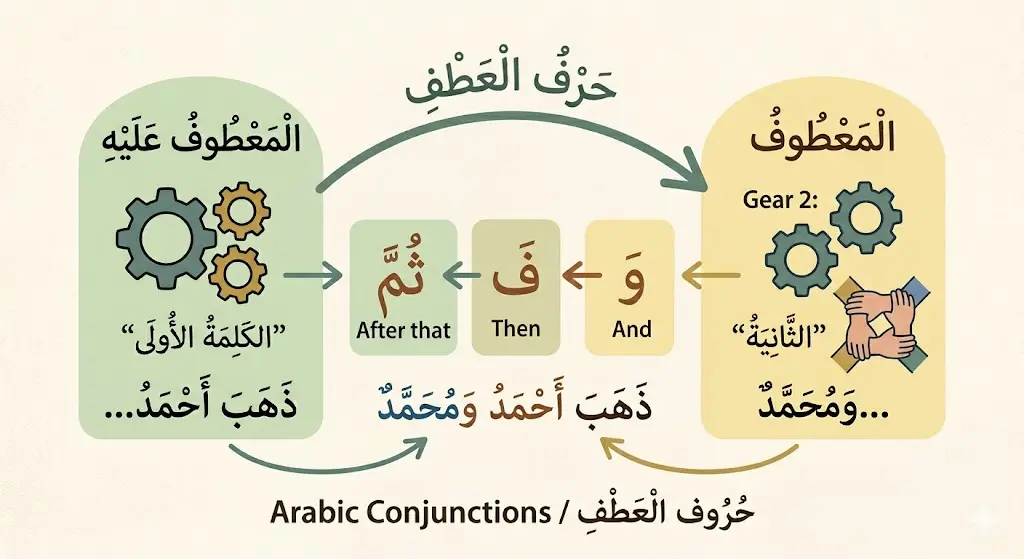
Arabic conjunctions are particles that link words, phrases, or clauses within a sentence. They divide into two primary categories: coordinating conjunctions (حُرُوف الْعَطْف), which connect grammatically equal elements, and subordinating conjunctions (أدوات الرَّبْط), which introduce dependent clauses. Together, they are the structural glue of Arabic sentences at every level of complexity.
What makes Arabic conjunctions different from their English equivalents is grammatical agreement. In English, “and” simply connects — it carries no case information.
In Arabic, وَ (and) requires the second element to match the grammatical case of the first.
This is why students who memorize Arabic conjunctions in a list but study them without live sentence practice still struggle to use them correctly.
At Buruj Academy, this is one of the first structural hurdles we address in our Online Arabic Grammar Course.
We have consistently found that students who understand conjunctions as grammar triggers — not just vocabulary items — advance through sentence construction far more confidently than those who treat them as simple translation equivalents.
Understand the Arabic Grammar with Buruj’s free trial lesson
The Complete Arabic Conjunctions List
Coordinating conjunctions in Arabic connect two elements of equal grammatical rank. The connected element (الْمَعْطُوف) must carry the same grammatical case as the first element (الْمَعْطُوف عَلَيْه). This case-matching rule is the defining feature of حروف العطف.
The nine classical coordinating conjunctions recognized by Arabic grammarians are:
| Conjunction | Arabic | Meaning | Key Function |
| Waw | وَ | And | Simple connection, no sequence implied |
| Fa | فَ | And then / So | Immediate sequence or consequence |
| Thumma | ثُمَّ | And then (later) | Sequence with delay |
| Aw | أَوْ | Or | Alternative or doubt |
| Am | أَمْ | Or (in questions) | Choice between two options |
| Bal | بَلْ | Rather / But rather | Correction or transition |
| Lakin | لَكِنْ | But | Contrast after negation |
| La | لَا | Not (but) | Excluding the second element |
| Hatta | حَتَّى | Even / Until | Inclusion of an extreme case |
Each of these conjunctions does more than translate a meaning — it signals a grammatical and semantic relationship.
Arabic Conjunctions with Examples
Understanding the difference between فَ (immediate consequence) and ثُمَّ (delayed sequence), for example, is not just stylistic; it changes the meaning of what you are saying entirely.
How Does وَ (Waw) Work in Arabic Sentences?
The conjunction وَ is the most common Arabic conjunction and the first one every learner encounters. It connects nouns, verbs, adjectives, and full sentences. Importantly, وَ carries no implication of sequence — it simply groups elements together.
Examples of the Conjunction وَ (Waw):
ذَهَبَ أَحْمَدُ وَمَرْيَمُ إِلَى الْمَدْرَسَةِ
Dhahaba Ahmadu wa-Maryamu ila al-madrasa.
Ahmad and Maryam went to school.
Both nouns carry the same nominative case — مَرْفُوع — because they are both subjects.
أُحِبُّ الْقَهْوَةَ وَالشَّايَ
Uhibbu al-qahwata wa-al-shaya.
I love coffee and tea.
Both nouns carry accusative case — مَنْصُوب — because they are both objects of the verb.
How Does فَ (Fa) Express Immediate Sequence?
The conjunction فَ indicates that the second action follows the first immediately or is a direct consequence of it. This is fundamentally different from وَ, which implies no time relationship at all.
Examples of the Conjunction فَ (Fa):
دَرَسَ فَنَجَحَ
Darasa fa-najaḥa.
He studied and then (immediately) passed.
The success is a direct, immediate result of the studying.
دَخَلَ فَجَلَسَ
Dakhala fa-jalasa.
He entered and then sat down.
Sitting follows entering directly — no gap in time.
What Is the Difference Between فَ and ثُمَّ in Arabic?
This is one of the most common questions in our Online Arabic Classes, and it deserves a clear answer. Both conjunctions indicate sequence, but ثُمَّ carries an explicit implication of delay or a gap between the two actions.
Book your FREE Arabic trial online Arabic class at Buruj

| Feature | فَ (Fa) | ثُمَّ (Thumma) |
| Sequence | Immediate | Delayed |
| Consequence | Often implied | Not implied |
| Example | دَخَلَ فَجَلَسَ (entered then sat) | ذَهَبَ ثُمَّ عَادَ (went, then later returned) |
| English feel | “and right away” | “and afterwards” |
Example of the Conjunction ثُمَّ (Thumma):
سَافَرَ ثُمَّ عَادَ بَعْدَ شَهْرٍ
Safara thumma ‘ada ba’da shahrin.
He traveled, and then returned after a month.
How Does لَكِنْ (Lakin) Express Contrast in Arabic?
The conjunction لَكِنْ introduces a contrast and most naturally appears after a negative statement. It is the Arabic equivalent of “but” in a specific corrective sense — the second clause offers something contrary to or unexpected from the first.
Examples of the Conjunction لَكِنْ (Lakin):
لَمْ أَذْهَبْ إِلَى الْحَفْلَةِ لَكِنَّ أَخِي ذَهَبَ
Lam adhhab ila al-ḥaflati lakin akhi dhahaba.
I did not go to the party, but my brother did.
الْجَوُّ بَارِدٌ لَكِنَّهُ جَمِيلٌ
Al-jawwu baridun lakinnahū jamīlun.
The weather is cold, but it is beautiful.
Read also: Plural in Arabic
Discover the Buruj Academy Difference
Step into our virtual classrooms and see how our expert instructors make learning Quran and Arabic intuitive and clear. We focus on overcoming the specific hurdles non-native speakers face, building your confidence and connection with the Quran.
Master the Arabic Language
Join our expert-led courses and build a strong foundation in Classical and Modern Arabic.
Get Your Free TrialHarf e Ataf in Arabic: The Grammar of Connected Elements
The term harf e ataf (حَرْف الْعَطْف) refers specifically to conjunctions that create an attf construction — a grammatical connection (عَطْف) between two elements where the second mirrors the case of the first. This is not just a semantic link; it is a structural grammatical operation.
The rule is: الْمَعْطُوف يَتْبَعُ الْمَعْطُوفَ عَلَيْهِ فِي الْإِعْرَابِ — the connected element follows the element it is connected to in grammatical case.
Case-matching examples:
| Sentence | Case | Explanation |
| جَاءَ عَلِيٌّ وَمُحَمَّدٌ | مَرْفُوع (Nominative) | Both are subjects of جَاءَ |
| رَأَيْتُ عَلِيًّا وَمُحَمَّدًا | مَنْصُوب (Accusative) | Both are objects of رَأَيْتُ |
| مَرَرْتُ بِعَلِيٍّ وَمُحَمَّدٍ | مَجْرُور (Genitive) | Both follow the preposition بِـ |
This case-matching is what linguists mean when they say harf e ataf is a tabi’ (تَابِع) operator — it brings the second element into grammatical compliance with the first.
Understanding this principle is foundational for anyone studying Arabic grammar seriously. Our guide on Arabic sentence structure covers how these connections function within full nominal and verbal sentences.
Subordinating Conjunctions in Arabic
Subordinating conjunctions in Arabic (أدوات الرَّبْط أَوِ الْوَصْل) introduce dependent clauses — a subordinate idea that cannot stand alone grammatically. These are essential for expressing reasons, conditions, time relationships, and purpose.
Unlike coordinating conjunctions, subordinating conjunctions do not require case agreement between two elements. Instead, they introduce a full clause that depends on the main sentence for its meaning.
| Conjunction | Arabic | Meaning | Type of Clause |
| Li-anna | لِأَنَّ | Because | Reason |
| Idha | إِذَا | If / When | Condition / Time |
| Inna | إِنَّ / إِذَا كَانَ | If (hypothetical) | Condition |
| Baynama | بَيْنَمَا | While / Whereas | Time |
| Hatta | حَتَّى | So that / Until | Purpose / Result |
| Kay / Li-kay | كَيْ / لِكَيْ | In order to | Purpose |
| Lamma | لَمَّا | When (past) | Time |
| Ba’da an | بَعْدَ أَنْ | After | Time |
| Qabla an | قَبْلَ أَنْ | Before | Time |
| Arghama anna | رَغْمَ أَنَّ | Although / Despite | Concession |
How Do You Use لِأَنَّ (Because) in Arabic?
The conjunction لِأَنَّ introduces a reason clause. It is followed by a noun in the accusative case (مَنْصُوب), and then a predicate. This differs from لِأَنْ, which introduces a verbal clause.
Examples of لِأَنَّ (Because):
لَمْ يَأْكُلْ لِأَنَّهُ مَرِيضٌ
Lam ya’kul li-annahu marīḍun.
He did not eat because he is sick.
فَرِحَتْ لِأَنَّهَا نَجَحَتْ فِي الِامْتِحَانِ
Fariḥat li-annahā najaḥat fī al-imtiḥān.
She was happy because she passed the exam.
How Does إِذَا Work as a Conditional and Time Conjunction?
The conjunction إِذَا is one of the most versatile in Arabic. It functions both as a conditional (“if”) in future-leaning contexts and as a temporal conjunction (“when”) referring to expected or recurring events. It typically introduces a condition followed by a result clause.
Examples:
إِذَا دَرَسْتَ نَجَحْتَ
Idhā darastu najaḥta.
If you study, you will succeed.
إِذَا جَاءَ الرَّبِيعُ تَتَفَتَّحُ الْأَزْهَارُ
Idhā jā’a al-rabī’u tatafattaghu al-azhāru.
When spring comes, the flowers bloom.
The verb after إِذَا is typically in the past tense (الْمَاضِي) even when referring to future events — a structural pattern that consistently surprises English speakers. We have seen this trip up even our intermediate students at Buruj Academy until we frame it explicitly as a rule of Arabic conditional structure. You can explore more about Arabic verb behavior in our guide on Arabic tenses.
Arabic Conjunctions in English vs. Arabic: Key Structural Differences
Non-native speakers naturally translate English conjunction patterns into Arabic — and this is where many persistent errors originate. The table below maps the most important structural contrasts between Arabic and English conjunction behavior.
| Feature | English | Arabic |
| Case agreement | Not required | Required for حروف العطف |
| “And” for all purposes | One word: “and” | وَ (neutral), فَ (immediate), ثُمَّ (delayed) |
| “Or” differentiation | One word: “or” | أَوْ (alternative), أَمْ (in questions) |
| Conditional structure | “If you study, you’ll pass” | Verb after إِذَا often in past tense |
| “But” distinction | One word: “but” | لَكِنْ (after negation), بَلْ (correction/transition) |
The distinction between أَوْ and أَمْ is particularly worth noting. أَوْ appears in statements and open-ended questions with no clear answer expected. أَمْ appears in questions offering exactly two options where one must be chosen.
- هَلْ تُرِيدُ شَايًا أَوْ قَهْوَةً؟ — Do you want tea or coffee? (open, أَوْ)
- أَتُرِيدُ الشَّايَ أَمِ الْقَهْوَةَ؟ — Do you want tea or coffee? (choose one, أَمْ)
Read also: Syllable Letters in Arabic
Arabic Conjunctions Exercises: Practice What You Have Learned
Putting these conjunctions into practice is the fastest path to retention. The exercises below progress from recognition to production.
Exercise 1 — Fill in the Blank (Choose the Correct Conjunction)
Choose from: وَ / فَ / ثُمَّ / لَكِنَّ / لِأَنَّ / إِذَا
- سَمِعَ الْجَرَسَ __________ خَرَجَ مِنَ الْغُرْفَةِ فَوْرًا.
- هُوَ مَشْغُولٌ __________ سَيُسَاعِدُكَ.
- اشْتَرَيْتُ كِتَابًا __________ قَلَمًا.
- __________ جِئْتَ مُبَكِّرًا وَجَدْتَ مَكَانًا.
- تَغَيَّبَ __________ كَانَ مَرِيضًا.
- أَكَلَ __________ نَامَ بَعْدَ سَاعَةٍ.
Answers:
1. فَ 2. لَكِنَّهُ 3. وَ 4. إِذَا 5. لِأَنَّهُ 6. ثُمَّ
Exercise 2 — Translation Practice (Arabic → English)
Translate these sentences and identify the conjunction used and its type:
- إِذَا أَسْرَعْتَ سَتَلْحَقُ بِالْقِطَارِ.
- لَمْ يَنَمْ لَيْلَةَ الِامْتِحَانِ لِأَنَّهُ كَانَ خَائِفًا.
- قَرَأَ الرِّسَالَةَ ثُمَّ رَدَّ عَلَيْهَا بَعْدَ يَوْمَيْنِ.
Answers:
- If you hurry, you will catch the train. (إِذَا — subordinating conditional)
- He did not sleep the night of the exam because he was afraid. (لِأَنَّ — subordinating reason)
- He read the letter, then replied to it after two days. (ثُمَّ — coordinating, delayed sequence)
Exercise 3 — Case Agreement (Identify the Correct Form)
Rewrite the second element with the correct grammatical case marker:
- جَاءَ الْمُدَرِّسُ وَ ـ (الطَّالِب) ـ .
- رَأَيْتُ الْمُدِيرَ وَ ـ (الْمُعَلِّم) ـ .
- مَرَرْتُ بِالْمَسْجِدِ وَ ـ (الْمَدْرَسَة) ـ .
Answers:
- الطَّالِبُ (nominative — subject)
- الْمُعَلِّمَ (accusative — object)
- الْمَدْرَسَةِ (genitive — after preposition)
In our experience teaching Arabic grammar for beginners, Exercise 3 is where learners most clearly see whether they have truly internalized harf e ataf or simply memorized the vocabulary. Case agreement is the real test.
Start Mastering Arabic Conjunctions with Buruj Academy’s Expert Instructors
Arabic conjunctions are not a minor vocabulary item — they are the framework that makes complex, authentic Arabic communication possible. Knowing them deeply means knowing the grammatical logic behind each connection.
At Buruj Academy, our Online Arabic Classes are taught by Al-Azhar University graduates with 12+ years of experience teaching non-native speakers.
We use the Buruj Method — context-before-abstraction — meaning you learn conjunctions inside real sentences from day one, not as isolated vocabulary lists.
Our Arabic Grammar Course builds conjunction mastery systematically, from coordinating particles through complex subordinating structures, with real-time correction from Ijazah-certified instructors.
Book your free trial lesson today and experience personalized, flexible 1-on-1 instruction that fits your schedule and learning pace.
Begin your transformation today by choosing the path that fits your goals:
- Online Arabic Classes (General & Comprehensive)
- Arabic Course for Beginners
- Arabic Alphabet Learning Course
- Online Arabic Classes for Kids
- Arabic Classes for Adults
- Arabic Grammar Course (Nahw & Sarf)
- Intermediate Arabic Course (B1/B2)
- Arabic Speaking Course (Conversational Fluency)
- Arabic Reading Course (Literary Excellence)
- Learn Arabic Writing Course (Calligraphy & Composition)
Ready to speak with confidence? Join the global community at Buruj Academy and book your free placement interview today!
Master the Arabic Language
Join our expert-led courses and build a strong foundation in Classical and Modern Arabic.
Get Your Free TrialConclusion
Arabic conjunctions are the structural joints of the language — small in form, large in grammatical consequence. The difference between وَ, فَ, and ثُمَّ is not just stylistic; it shapes meaning and tense relationships within a sentence. The case-agreement requirement of حروف العطف separates genuine grammatical fluency from surface-level comprehension.
Building this knowledge takes more than reading a list. It takes pattern recognition through varied examples, active practice with grammatical case, and the kind of real-time feedback that only guided instruction provides. Insha’Allah, this guide has given you both the framework and the practice foundation to move forward with confidence.
Frequently Asked Questions About Arabic Conjunctions
What Is Harf e Ataf in Arabic?
Harf e ataf (حَرْف الْعَطْف) is an Arabic coordinating conjunction that connects two elements while requiring the second to match the grammatical case of the first. The nine classical harf e ataf particles include وَ، فَ، ثُمَّ، أَوْ، أَمْ، بَلْ، لَكِنْ، لَا، and حَتَّى. Case agreement is the defining grammatical feature.
How Many Conjunctions Are There in Arabic?
Classical Arabic grammar identifies nine core coordinating conjunctions (حُرُوف الْعَطْف). Subordinating conjunctions are considerably more numerous — covering conditions, time, reason, purpose, contrast, and concession. Together, both categories constitute a rich system far more grammatically precise than the English conjunction system.
Why Do Arabic Learners Struggle Most with Conjunctions?
The core difficulty is that Arabic conjunctions carry grammatical obligations — not just semantic meaning. English speakers naturally focus on meaning (“and” = وَ) but overlook case agreement, sequence implications, and clause-type requirements. In our sessions at Buruj Academy, the biggest breakthroughs come when students stop translating and start analyzing the Arabic logic behind each connection. Our how to learn Arabic for beginners guide is a helpful starting point for understanding this shift in approach.