 Arabic
| Key Takeaways |
| Arabic has three plural types: sound masculine plural, sound feminine plural, and broken plural — each with distinct formation rules. |
| The sound masculine plural adds ون (nominative) or ين (accusative/genitive) to the singular masculine noun. |
| The sound feminine plural is formed by replacing the singular’s تاء مربوطة with ات, applicable to most feminine nouns. |
| Broken plurals change the internal vowel structure of the singular word and must be memorized individually — no single rule governs them. |
| Most Arabic nouns have only one correct plural form; using the wrong type is a grammatical error, not a style choice. |
Forming plurals in Arabic is one of the first grammar points where English-speaking learners realize that Arabic truly operates by its own internal logic. In English, you add “-s” or “-es” and you are done. Arabic offers you three entirely separate systems, each applying to different noun categories.
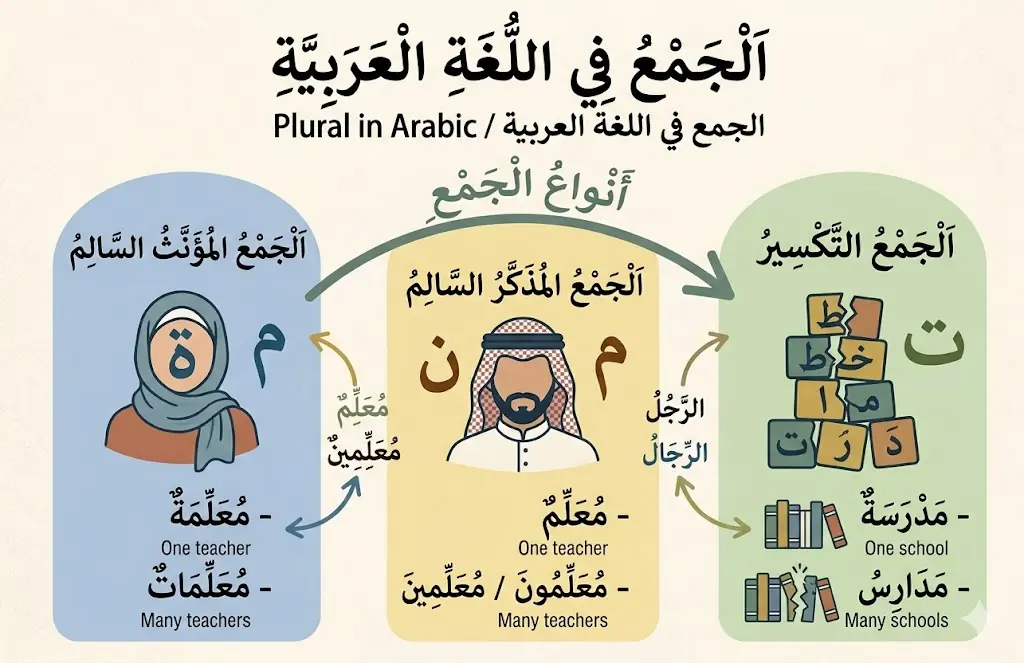
The three types of plural in Arabic are the sound masculine plural (جمع المذكر السالم), the sound feminine plural (جمع المؤنث السالم), and the broken plural (جمع التكسير). Knowing which system applies to which word — and how to form each one — is what separates a learner who guesses from one who reads and speaks with accuracy.
Table of Contents:
What Does “Plural” Mean in Arabic Grammar?
Plural in Arabic words refers to any noun or adjective referring to three or more entities. Arabic grammar recognizes three states of number: singular (مفرد), dual (مثنى), and plural (جمع). The dual is a separate category — it covers exactly two of something and uses its own suffix system, which we cover in our guide on dual nouns in Arabic.
The plural system activates only from three upward. This distinction matters practically: saying “two students” and “three students” uses grammatically different structures in Arabic, and confusing them produces clear errors.
Before working through plural types, make sure you are comfortable with masculine and feminine nouns in Arabic, since the sound plurals are built directly on gender categories.
What Are the 3 Types of Plural in Arabic?
The three types of plural in Arabic are: the sound masculine plural, the sound feminine plural, and the broken plural. Sound plurals (السالم) preserve the singular word’s letters intact and simply attach a suffix. Broken plurals (التكسير) restructure the word itself — vowels shift, letters may be added or removed, and the singular form becomes nearly unrecognizable.
| Plural Type | Arabic Name | Formation Method | Applies To |
| Sound Masculine Plural | جمع المذكر السالم | Add ون / ين suffix | Rational masculine nouns |
| Sound Feminine Plural | جمع المؤنث السالم | Replace ة with ات | Feminine nouns + some masculine |
| Broken Plural | جمع التكسير | Internal restructuring | Most Arabic nouns |
The broken plural is by far the most common category in Arabic. In our instructors’ experience at Buruj Academy, students who try to apply sound plural rules to broken plural nouns produce errors in nearly every paragraph they write — because the majority of everyday Arabic vocabulary uses broken plural forms.
How Does the Sound Masculine Plural Work in Arabic?
The sound masculine plural (جمع المذكر السالم) applies to masculine nouns referring to rational beings — almost always people — by attaching a two-form suffix. In the nominative case, add ون. In the accusative and genitive cases, add ين. The word’s original letters remain untouched.
| Singular | Meaning | Nominative Plural | Accusative/Genitive Plural |
| مُعَلِّم | teacher (m.) | مُعَلِّمُون | مُعَلِّمِين |
| مُسْلِم | Muslim (m.) | مُسْلِمُون | مُسْلِمِين |
| مُهَنْدِس | engineer | مُهَنْدِسُون | مُهَنْدِسِين |
Which Nouns Take the Sound Masculine Plural?
The sound masculine plural is restricted to a specific category. It applies to: masculine proper names of people, masculine adjectives describing people, and certain active participles (اسم الفاعل) and passive participles (اسم المفعول) in their masculine forms. It does not apply to objects, animals, or abstract nouns — even masculine ones.
For example, the word كِتَاب (book) is grammatically masculine, but its plural is كُتُب — a broken plural, not كِتَابُون.
This is one of the most common errors we see in beginner Arabic grammar classes: students correctly identify a noun as masculine and then incorrectly attach the sound masculine plural suffix.
Understand the Arabic Grammar with Buruj’s free trial lesson
How Is the Sound Feminine Plural Formed in Arabic?
The sound feminine plural (جمع المؤنث السالم) is formed by removing the تاء مربوطة (ة) from the end of a feminine singular noun and replacing it with ات. If the noun does not end in ة, the ات suffix is added directly. The word’s internal structure, like the sound masculine plural, remains intact.
| Singular | Meaning | Plural | Meaning |
| مُعَلِّمَة | teacher (f.) | مُعَلِّمَات | teachers (f.) |
| سَيَّارَة | car | سَيَّارَات | cars |
| طَالِبَة | student (f.) | طَالِبَات | students (f.) |
What Is a Broken Plural in Arabic?
The broken plural (جمع التكسير) changes the internal vowel structure of the singular word — sometimes dramatically. There is no single suffix to memorize.
The pattern a noun follows is usually predictable once you learn the noun’s root and vowel structure — but it requires learning.
| Singular Pattern | Example Singular | Example Plural | Meaning |
| فَعْل | كَلْب | كِلَاب | dogs |
| فَاعِل | كَاتِب | كُتَّاب | writers |
| فَعِيل | صَدِيق | أَصْدِقَاء | friends |
| فَعَل | جَبَل | جِبَال | mountains |
| فِعَال | كِتَاب | كُتُب | books |
Read also: Nominal Sentence in Arabic
Discover the Buruj Academy Difference
Step into our virtual classrooms and see how our expert instructors make learning Quran and Arabic intuitive and clear. We focus on overcoming the specific hurdles non-native speakers face, building your confidence and connection with the Quran.
Master the Arabic Language
Join our expert-led courses and build a strong foundation in Classical and Modern Arabic.
Get Your Free TrialThe Most Common Broken Plural Patterns You Will Encounter
The pattern أَفْعَال is one of the highest-frequency broken plural patterns in Arabic. It applies to many common three-letter nouns:
- سَبَب → أَسْبَاب (reason → reasons)
- وَلَد → أَوْلَاد (boy → boys)
- بَاب → أَبْوَاب (door → doors)
- حَال → أَحْوَال (condition → conditions)
The pattern فُعُول is similarly common:
- قَلْب → قُلُوب (heart → hearts)
- بَيْت → بُيُوت (house → houses)
In our Arabic classes at Buruj Academy, we teach broken plurals using a root-pattern recognition method rather than asking students to memorize individual word pairs in isolation.
Once you internalize five or six high-frequency patterns, you begin predicting plurals correctly — and more importantly, recognizing them immediately when you read. Our Arabic Grammar Course covers all major broken plural patterns with systematic drills.
Understand the Arabic Grammar with Buruj’s free trial lesson

Singular and Plural in Arabic
Understanding how singular and plural relate in Arabic requires training your eye to spot internal vowel changes — not just suffix changes.
The table below gives you direct singular-to-plural comparisons across all three plural types so you can see the contrast clearly.
| Singular | Plural | Plural Type | Meaning |
| مُدَرِّس | مُدَرِّسُون / مُدَرِّسِين | Sound Masculine | teacher/s (m.) |
| مُدَرِّسَة | مُدَرِّسَات | Sound Feminine | teacher/s (f.) |
| مَدِينَة | مُدُن | Broken | city/cities |
| طَرِيق | طُرُق | Broken | road/roads |
| وَلَد | أَوْلَاد | Broken | boy/boys |
| بِنْت | بَنَات | Sound Feminine* | girl/girls |
| مُسْلِمَة | مُسْلِمَات | Sound Feminine | Muslim woman/women |
| مُسْلِم | مُسْلِمُون | Sound Masculine | Muslim man/men |
*Note: بَنَات follows the sound feminine plural pattern even though بِنْت does not end in ة — this is one of a small group of irregular-seeming forms that are in fact rule-following once you understand the full feminine category.
For further grounding in how Arabic nouns function, our guide on how to learn Arabic grammar easily is a practical starting point.
Practice Exercises: Plural in Arabic Words
Active practice is how plural patterns move from knowledge to instinct. Work through these exercises without looking at the answers first.
Exercise 1 — Identify the Plural Type
Classify each plural as sound masculine (SM), sound feminine (SF), or broken (B):
| Word | Plural | Type |
| طَالِب | طُلَّاب | ? |
| مُعَلِّمَة | مُعَلِّمَات | ? |
| مُهَنْدِس | مُهَنْدِسُون | ? |
| كِتَاب | كُتُب | ? |
| سَيَّارَة | سَيَّارَات | ? |
Answers: B / SF / SM / B / SF
Exercise 2 — Form the Plural
Given the singular, produce the plural. Singular type is indicated.
- مُسَافِر (traveller, m.) → sound masculine plural: ________
- جَامِعَة (university) → sound feminine plural: ________
- بَيْت (house) → broken plural (pattern: فُعُول): ________
- سَبَب (reason) → broken plural (pattern: أَفْعَال): ________
Answers: مُسَافِرُون / مُسَافِرِين — جَامِعَات — بُيُوت — أَسْبَاب
Exercise 3 — Translate and Pluralize
Translate into Arabic, then write the correct plural:
- One student (m.) → two students (dual) → three or more students (plural)
- One teacher (f.) → plural
Answers: طَالِب → طَالِبَان / طَالِبَيْن → طُلَّاب (broken) or طَالِبُون (sound masculine, less common) — مُعَلِّمَة → مُعَلِّمَات
For more structured vocabulary building alongside plural patterns, see our guide on mastering Arabic vocabulary.
Read also: Cases in Arabic Grammar
Master Arabic Plurals with Buruj Academy’s Expert Instructors
Arabic plurals — especially broken plurals — require systematic instruction, not guesswork. Buruj Academy’s Arabic Grammar Course covers all three plural types with pattern-based drilling, instant feedback, and progression from foundational rules to fluent application.
Our instructors are Al-Azhar University graduates with 12+ years of experience teaching non-Arabic speakers worldwide.
Every session is personalized 1-on-1 with flexible scheduling across all time zones.
We apply the Buruj Method — context-before-abstraction — so you encounter plurals in real sentences before drilling abstract patterns.
Book your free trial lesson and start building grammatical accuracy from your very first session.
Begin your transformation today by choosing the path that fits your goals:
- Online Arabic Classes (General & Comprehensive)
- Arabic Course for Beginners
- Arabic Alphabet Learning Course
- Online Arabic Classes for Kids
- Arabic Classes for Adults
- Arabic Grammar Course (Nahw & Sarf)
- Intermediate Arabic Course (B1/B2)
- Arabic Speaking Course (Conversational Fluency)
- Arabic Reading Course (Literary Excellence)
- Learn Arabic Writing Course (Calligraphy & Composition)
Ready to speak with confidence? Join the global community at Buruj Academy and book your free placement interview today!
Master the Arabic Language
Join our expert-led courses and build a strong foundation in Classical and Modern Arabic.
Get Your Free TrialConclusion
Arabic plural forms are not arbitrary — they follow systems that become predictable the more you work with them. The sound masculine and sound feminine plurals are the most learnable entry points: attach a suffix, preserve the root, and match the gender. Broken plurals demand more patience, but learning the ten highest-frequency patterns covers the vast majority of words you will encounter in everyday Modern Standard Arabic.
The investment in getting plurals right pays across every skill — reading comprehension, writing accuracy, and spoken fluency all depend on it. With consistent practice using the exercises and pattern tables above, Insha’Allah, plural recognition will become second nature.
Frequently Asked Questions About Plural in Arabic
What Is the Difference Between Sound and Broken Plural in Arabic?
Sound plurals (السالم) preserve the singular word’s letters and simply add a suffix — ون/ين for masculine or ات for feminine. Broken plurals (التكسير) restructure the word’s internal vowels entirely. Sound plurals apply to a specific category of nouns; broken plurals cover the majority of Arabic vocabulary and must be learned word by word or pattern by pattern.
Is the Plural in Arabic the Same for Quranic Arabic and Modern Standard Arabic?
The plural systems are the same — both Quranic Arabic and Modern Standard Arabic use the identical three-type framework. The difference lies in frequency: classical Quranic Arabic uses certain broken plural patterns that appear less often in contemporary MSA, and vice versa. For learners focused on how to learn Arabic for beginners, starting with MSA plural patterns covers the overwhelming majority of both registers.
Can Adjectives Also Take Plural Forms in Arabic?
Yes. Arabic adjectives agree with their nouns in gender, number, and case — which means adjectives also have plural forms. Rational masculine plural nouns take masculine plural adjectives (usually sound masculine). For non-rational nouns — objects and animals — Arabic treats the noun as grammatically feminine singular for the purpose of adjective agreement, regardless of the noun’s actual plural form. This rule, known as the non-rational plural rule, is one of the most important grammar points for intermediate learners.
Related Articles
Arabic