 Arabic
| Key Takeaways |
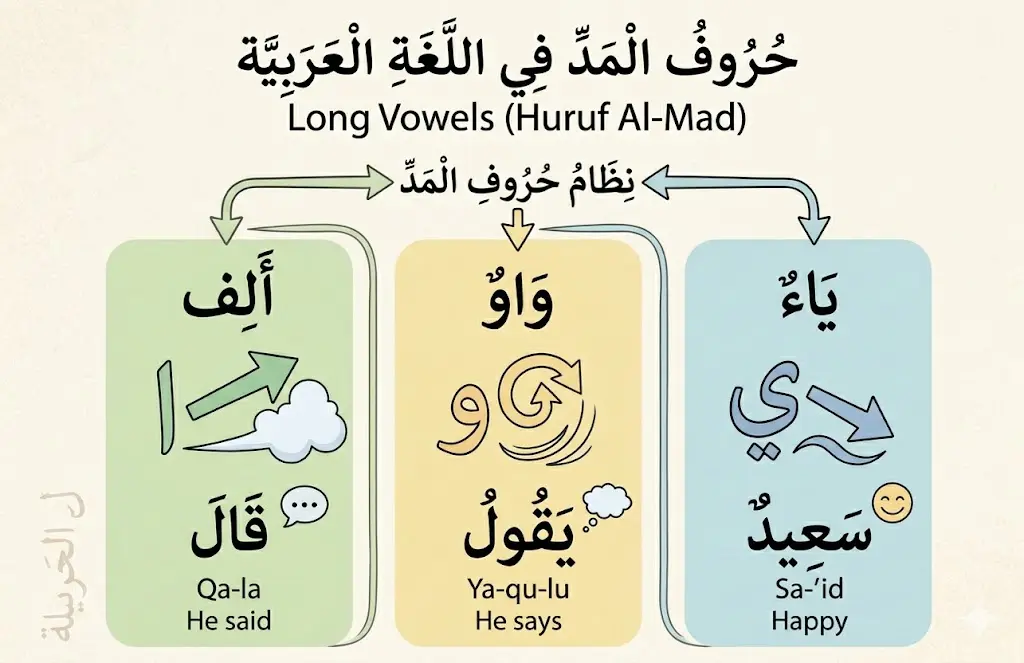
| Arabic has three long vowels — Alif (آ), Waw (وْ), and Ya (يْ) — each doubling the duration of their short counterpart. |
| Long vowels in Arabic change word meaning entirely; كَتَبَ (kataba, he wrote) vs. كَاتِب (kātib, writer) differ only in vowel length. |
| Long vowels are written with letters (Alif, Waw, Ya) while short vowels use small diacritical marks called harakat above or below consonants. |
Vowel length is one of the misunderstood features of Arabic for English speakers — and one of the most consequential. Unlike English, where vowel spelling varies unpredictably, Arabic marks vowel duration with precision, and that duration carries real grammatical and semantic weight.
Arabic uses exactly two vowel categories: short vowels, represented by small diacritical marks, and long vowels, represented by dedicated letters.
Learning to distinguish, pronounce, and write long vowels in Arabic words is foundational to reading, writing, and speaking Arabic correctly.
Table of Contents:
What Are Long Vowels in Arabic?
Long vowels in Arabic are sustained vowel sounds held for approximately twice the duration of their short equivalents. Arabic has three long vowels: the long “aa” sound written with Alif (ا), the long “uu” sound written with Waw (و), and the long “ii” sound written with Ya (ي). Each long vowel is a full letter within the word — not a marker added above or below.
This distinction matters beyond pronunciation. In Arabic, vowel length is phonemic — meaning it changes the meaning of words. Consider these pairs:
| Short Vowel Word | Meaning | Long Vowel Word | Meaning |
| كَتَبَ (kataba) | He wrote | كَاتِب (kātib) | A writer |
| مَلَكَ (malaka) | He owned | مَالِك (mālik) | Owner / King |
| قَتَلَ (qatala) | He killed | قَاتِل (qātil) | Killer |
| سَمِعَ (sami’a) | He heard | سَمِيع (samī’) | All-Hearing |
In our speaking Arabic classes at Buruj Academy, this is often the moment students have a genuine breakthrough — they realize that Arabic vowel length is grammatically functional, not just a pronunciation preference.
Book your free trial to start speaking Arabic fluently

The Three Long Vowels in Arabic: Alif, Waw, and Ya
Long vowels are the structural backbone of Arabic word patterns. Understanding each one individually builds the recognition speed you need for reading fluency.
How the Long Alif (ا) Works in Arabic Words
The long Alif produces an open “aa” sound, similar to the “a” in “father” held slightly longer. It always follows a consonant carrying a short fatha (َ) diacritic. You will find it in nouns, verb forms, and particles across all levels of Arabic.
| Arabic Word | Transliteration | Meaning |
| كِتَاب | kitāb | book |
| بَاب | bāb | door |
| قَال | qāla | he said |
| مَاء | mā’ | water |
| سَلَام | salām | peace |
| فَارِس | fāris | horseman / knight |
Notice that Alif never carries its own vowel diacritic in this function — it elongates the preceding fatha vowel sound.
How the Long Waw (و) Works in Arabic Words
The long Waw produces an “uu” sound, similar to “oo” in “moon.” It follows a consonant carrying a short damma (ُ) diacritic. This vowel appears frequently in verb forms, plurals, and verbal nouns.
| Arabic Word | Transliteration | Meaning |
| نُور | nūr | light |
| كَنُوز | kunūz | treasures |
| يَقُول | yaqūl | he says |
| مُوسَى | mūsā | Moses |
| سُوق | sūq | marketplace |
| عُلُوم | ‘ulūm | sciences |
How the Long Ya (ي) Works in Arabic Words
The long Ya produces an “ii” sound, similar to “ee” in “see.” It follows a consonant carrying a short kasra (ِ) diacritic. This vowel is especially common in adjective patterns and broken plurals.
Read also: How Short Vowels Work in Arabic
| Arabic Word | Transliteration | Meaning |
| كَبِير | kabīr | big / great |
| صَغِير | saghīr | small |
| جَمِيل | jamīl | beautiful |
| طَوِيل | tawīl | tall / long |
| قَرِيب | qarīb | near / close |
| بَعِيد | ba’īd | far |
Short and Long Vowels in Arabic
Understanding the difference between short and long vowels in Arabic requires both visual and auditory training. Short vowels are written as harakat — small marks placed above or below a consonant letter. Long vowels are written as full letters embedded within the word.
| Feature | Short Vowels | Long Vowels |
| Arabic term | Harakat (حَرَكَات) | Huruf al-Madd (حُرُوف الْمَدّ) |
| Written form | Diacritical marks (tiny symbols) | Full letters: ا / و / ي |
| Duration | One beat (one count) | Two beats (two counts) |
| Fatha (َ) → | Short “a” as in “cat” | Long “aa” — written with Alif (ا) |
| Damma (ُ) → | Short “u” as in “put” | Long “uu” — written with Waw (و) |
| Kasra (ِ) → | Short “i” as in “bit” | Long “ii” — written with Ya (ي) |
| Visible in text? | Often omitted in modern Arabic | Always written (permanent letters) |
This table captures something our instructors at Buruj Academy emphasize repeatedly: long vowels are permanent parts of the word — they are there whether the text is fully voweled or not.
Short vowels are often omitted in newspapers, novels, and everyday written Arabic. Long vowels never disappear.
This is exactly why students who learn only short vowels struggle with unvoweled Arabic text. Long vowels are your navigational anchors when reading without harakat.
If you are building from the foundation, our Arabic for Beginners course addresses this distinction from lesson one, ensuring students develop accurate reading habits before moving to unvoweled texts.
Begin learning Arabic at Buruj with a FREE trial lesson

How Do Long Vowels Change Arabic Word Meaning?
The meaning-changing power of Arabic long vowels is best learned through pattern recognition. Arabic word structure is built on three-letter roots, and vowel patterns — including vowel length — determine what grammatical role a word plays.
The Fā’il Pattern: Long Alif Creates Doer Nouns
The pattern فَاعِل (fā’il) uses a long Alif after the first root letter to indicate “the one who does” — called an ism al-fā’il (اسم الفاعل).
| Root | Simple Verb | Meaning | Fā’il Noun | Meaning |
| ك-ت-ب | كَتَبَ (kataba) | he wrote | كَاتِب (kātib) | writer |
| ق-ر-أ | قَرَأَ (qara’a) | he read | قَارِئ (qāri’) | reader |
| ع-م-ل | عَمِلَ (‘amila) | he worked | عَامِل (‘āmil) | worker |
| د-خَل | دَخَلَ (dakhala) | he entered | دَاخِل (dākhil) | one entering |
This single long vowel — the Alif after the first root letter — transforms a past-tense verb into an active doer noun. Once you recognize this pattern, you can decode hundreds of Arabic nouns you have never encountered before.
The Fa’īl Pattern: Long Ya Creates Adjectives
The pattern فَعِيل (fa’īl) uses a long Ya after the second root letter to create common adjectives.
| Root | Adjective | Meaning |
| ك-ب-ر | كَبِير (kabīr) | big |
| ص-غ-ر | صَغِير (saghīr) | small |
| ج-م-ل | جَمِيل (jamīl) | beautiful |
| ق-ر-ب | قَرِيب (qarīb) | near |
| ح-ز-ن | حَزِين (hazīn) | sad |
Recognizing this fa’īl pattern means that when you encounter an unfamiliar adjective in Arabic, you can often identify it immediately by the long Ya sitting after the second consonant.
For more on how Arabic word patterns interact with grammar, our guide on Arabic grammar for beginners provides a practical foundation.
How to Pronounce Long Vowels in Arabic Correctly
Correct pronunciation of Arabic long vowels depends on two factors: vowel quality (the mouth shape) and vowel quantity (the held duration). Most English speakers instinctively get the quality approximately right but severely underestimate the duration.
Read also:Arabic Words with Double Vowels Explained
The Count-and-Hold Method for Arabic Vowel Duration
In our experience, the most effective technique for non-native speakers is the count-and-hold method: when you encounter a long vowel, mentally count to two while sustaining the sound. Short vowel = one count. Long vowel = two counts.
Practice this progression aloud:
- بَب → بَاب (bab → bāb): door — feel the Alif hold
- قُل → يقُول (qul → yqūl): say — feel the Waw stretch
- مِم → مِيم (mim → mīm) — feel the Ya lengthen
This is not a subtle distinction. In natural Arabic speech, a long vowel is perceptibly longer. Native speakers and trained instructors can hear the difference immediately.
Read also: Dammah in Arabic
Discover the Buruj Academy Difference
Step into our virtual classrooms and see how our expert instructors make learning Quran and Arabic intuitive and clear. We focus on overcoming the specific hurdles non-native speakers face, building your confidence and connection with the Quran.
Master the Arabic Language
Join our expert-led courses and build a strong foundation in Classical and Modern Arabic.
Get Your Free TrialCommon Pronunciation Mistakes English Speakers Make with Long Vowels in Arabic
In our sessions at Buruj Academy, the most consistent error adult beginners make with long vowels is treating them like stressed English vowels rather than truly lengthened sounds. English uses vowel quality and stress to signal importance — Arabic uses measurable duration.
Mistake 1: Saying كِتَاب (kitāb) as “KI-tab” — shortening the long Alif at the end.
Correction: Extend the “aa” noticeably — “ki-TAAB” where the final syllable genuinely lasts longer.
Mistake 2: Pronouncing نُور (nūr) as “nor” — collapsing the long Waw.
Correction: The “oo” in nūr must be a full, sustained “oo” sound — closer to “nooor.”
Mistake 3: Reading يَقُول (yaqūl) without sustaining the Waw inside the word.
Correction: The Waw elongates the syllable — “ya-QUUUL.”
For guidance on building accurate Arabic pronunciation habits, our Arabic pronunciation online resource covers these patterns in practical detail.
Practice Exercises for Long Vowels in Arabic Words
Active practice converts recognition into reading and speaking fluency. Work through these exercises systematically.
Exercise 1: Identify the Long Vowel
Read each word below and identify which long vowel it contains (Alif, Waw, or Ya) and what the long vowel sounds like.
| Arabic Word | Transliteration | Long Vowel Present |
| مَدِينَة | madīna | Ya — long “ii” |
| كِتَاب | kitāb | Alif — long “aa” |
| نُور | nūr | Waw — long “uu” |
| رَسُول | rasūl | Waw — long “uu” |
| عَظِيم | ‘azīm | Ya — long “ii” |
| سَلَام | salām | Alif — long “aa” |
Exercise 2: Short vs. Long — Spot the Difference
Compare each pair and identify what changes:
| Pair A | Pair B | What Changed |
| مَلَكَ (malaka) — he owned | مَلَك (malak) — angel | Short vowels shift |
| سَمِعَ (sami’a) — he heard | سَمِيع (samī’) — All-Hearing | Long Ya added |
| عَلِمَ (‘alima) — he knew | عَالِم (‘ālim) — scholar | Long Alif added |
| كَرُمَ (karuma) — he was generous | كَرِيم (karīm) — generous one | Long Ya shifts pattern |
Exercise 3: Fill-in-the-Long-Vowel
Each sentence below has a blank. Choose the correct long vowel letter to complete the word:
- الكِت__ب على المَكتَب. (The book is on the desk.) → ا → كِتَاب
- هو مُعَلِّم كَب__ر. (He is a big/great teacher.) → ي → كَبِير
- رَأيتُ ن__راً في السَّماء. (I saw a light in the sky.) → و → نُوراً
- هذا البَاب طَو__ل. (This door is tall.) → ي → طَوِيل
- السَّلَ__م عَلَيكُم. (Peace be upon you.) → ا → السَّلَام
Long Vowels in Arabic Verb Forms: Patterns Every Student Needs
Long vowels appear with regularity in Arabic verb conjugations — and recognizing them speeds up reading dramatically. Our Arabic tenses guide covers the full conjugation system, but here is how long vowels function within verb patterns specifically.
Long Vowels in the Present Tense (المضارع)
The present tense uses long Waw in certain verb patterns to indicate sustained or habitual action:
| Verb Form | Transliteration | Meaning |
| يَقُول | yaqūl | he says |
| يَكُون | yakūn | he is / he becomes |
| يَسُوق | yasūq | he drives |
| يَعُود | ya’ūd | he returns |
These are hollow verbs (أفعال جوفاء) — verbs whose middle root letter is a Waw or Ya, which surfaces as a long vowel in certain conjugations. For more on how these behave grammatically, our resource on irregular verbs in Arabic explains the patterns in full.
Long Vowels in the Active Participle (اسم الفاعل)
As shown earlier, the فَاعِل pattern consistently uses a long Alif. This pattern is productive across all Arabic verb roots and is one of the most important long-vowel patterns to memorize:
| Root | Active Participle | Meaning |
| ع-ل-م | عَالِم (‘ālim) | scholar / knower |
| ح-ك-م | حَاكِم (hākim) | ruler |
| ر-ح-م | رَاحِم (rāhim) | merciful one |
| ص-ب-ر | صَابِر (sābir) | patient one |
Buruj Academy‘s Online Arabic Classes build pattern recognition into every lesson — training students to see these vowel structures as meaningful signals, not random decoration.
Book your FREE Arabic trial online Arabic class at Buruj

Long Vowels in Arabic Nouns
Arabic noun patterns (أوزان) encode meaning through vowel structure. Long vowels are central to several of the most common patterns you will encounter in Modern Standard Arabic (MSA) and classical texts.
The Maf’ūl Pattern: Long Waw for Passive Objects
The pattern مَفْعُول (maf’ūl) — using long Waw — indicates “something that has been done to”:
| Arabic | Transliteration | Meaning |
| مَكْتُوب | maktūb | written (letter, document) |
| مَرْفُوع | marfū’ | raised / elevated |
| مَوْلُود | mawlūd | newborn |
| مَحْبُوب | mahbūb | beloved |
| مَشْهُور | mashhūr | famous |
The Fu’ūl Pattern: Broken Plurals with Long Waw
Arabic broken plurals (جَمْع التكسير) frequently use long vowels. The fu’ūl pattern is among the most common:
| Singular | Meaning | Plural (Fu’ūl) | Meaning |
| قَلْب | heart | قُلُوب (qulūb) | hearts |
| بَيْت | house | بُيُوت (buyūt) | houses |
| عَيْن | eye | عُيُون (‘uyūn) | eyes |
Understanding broken plural patterns transforms Arabic vocabulary acquisition. Once you recognize that قُلُوب contains a long Waw between the second and third root letters, you can identify this as a fu’ūl plural immediately — and predict similar forms in new words.
Our resource on mastering Arabic vocabulary explores pattern-based vocabulary learning in depth.
Read also: Arabic Conjunctions
Learn Arabic Long Vowels Effectively with Buruj Academy’s Expert Instructors
Arabic long vowels are not a minor technical detail — they are the mechanism through which Arabic builds meaning, signals grammar, and organizes its word patterns. Getting them right requires both accurate pronunciation training and systematic pattern recognition.
At Buruj Academy, our Online Arabic Classes course is taught by Al-Azhar University graduates with 12+ years of experience teaching non-native speakers. Our approach — context before abstraction, sound before rule — means students hear and feel long vowels correctly before analyzing them grammatically.
We offer personalized 1-on-1 sessions with flexible 24/7 scheduling, real-time pronunciation correction, and customized learning plans built around your current level.
Whether you are a complete beginner or an intermediate student building reading fluency, our instructors meet you exactly where you are.
Book your free trial lesson and experience the difference structured instruction makes.
Begin your transformation today by choosing the path that fits your goals:
- Online Arabic Classes (General & Comprehensive)
- Arabic Course for Beginners
- Arabic Alphabet Learning Course
- Online Arabic Classes for Kids
- Arabic Classes for Adults
- Arabic Grammar Course (Nahw & Sarf)
- Intermediate Arabic Course (B1/B2)
- Arabic Speaking Course (Conversational Fluency)
- Arabic Reading Course (Literary Excellence)
- Learn Arabic Writing Course (Calligraphy & Composition)
Ready to speak with confidence? Join the global community at Buruj Academy and book your free placement interview today!
Master the Arabic Language
Join our expert-led courses and build a strong foundation in Classical and Modern Arabic.
Get Your Free TrialConclusion
Long vowels in Arabic are not decorative — they are structurally essential. The three long vowels, Alif, Waw, and Ya, carry distinct sounds, mark grammatical patterns, and distinguish word meanings that short vowels alone cannot convey. Recognizing them visually, pronouncing them with proper duration, and reading them within real word patterns are the three skills that move a student from labored decoding to confident Arabic reading.
The good news is that Arabic vowel patterns are consistent. Once you know that a long Alif after the first root letter signals a doer noun, or that a long Ya between root letters creates a fa’īl adjective, you gain interpretive tools that apply across thousands of words. That pattern-level understanding is what separates students who memorize individual words from students who genuinely read Arabic.
Frequently Asked Questions About Long Vowels in Arabic Words
What Are the Three Long Vowels in Arabic?
The three long vowels in Arabic are the long “aa” sound written with Alif (ا), the long “uu” sound written with Waw (و), and the long “ii” sound written with Ya (ي). Each long vowel is a full consonant letter functioning as a vowel carrier, and each pairs with its corresponding short vowel diacritic — fatha, damma, and kasra respectively.
How Are Short and Long Vowels in Arabic Different in Writing?
Short vowels in Arabic are written as small diacritical marks (harakat) placed above or below consonant letters — fatha (َ), damma (ُ), and kasra (ِ). Long vowels are written as full letters — Alif, Waw, or Ya — embedded permanently within the word. Short vowels are often omitted in everyday Arabic text; long vowels are always present.
Do Long Vowels in Arabic Change Word Meaning?
Yes — Arabic long vowels are phonemic, meaning they directly change word meaning. For example, كَتَبَ (kataba) means “he wrote,” while كَاتِب (kātib) means “a writer.” The long Alif in kātib is not optional — removing it produces a completely different word. This meaning-distinguishing function makes accurate pronunciation of vowel length essential.