 Arabic
| Key Takeaways |
| Arabic is written and read from right to left, a direction shared by Hebrew, Persian, Urdu, and several other Semitic and Indo-Iranian languages. |
| The right-to-left direction of Arabic originates from ancient Semitic writing systems, particularly Phoenician and Aramaic, dating back over 3,000 years. |
| Arabic numerals, despite originating in the Arab world, are written left to right in modern Arabic text, creating a bidirectional writing system. |
| Learning to write Arabic from right to left requires deliberate physical retraining, typically taking 2–4 weeks of daily practice to feel natural for beginners. |
| Arabic is not the only right-to-left language — Hebrew, Farsi, Urdu, Pashto, and Kurdish also follow the same directional convention. |
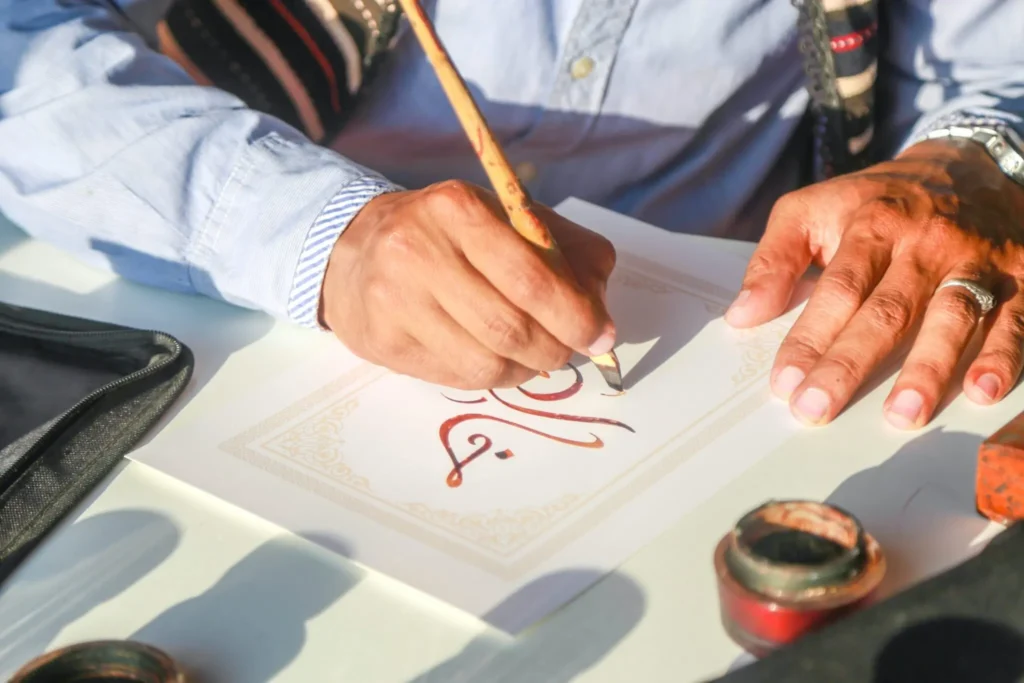
Every English speaker who begins learning Arabic faces the same moment of confusion: the page opens from what feels like the “back,” words begin where sentences seem to end, and the hand must learn to move in a direction it has never practiced. This disorientation is real, and we see it in every beginner who joins our classes.
Arabic is written and read from right to left — a direction rooted in ancient Semitic linguistic tradition stretching back more than three millennia.
Far from being arbitrary, this directional system is consistent, logical, and shared by a family of languages that includes Hebrew, Farsi, and Urdu. Understanding why Arabic works this way is the first step toward reading it with confidence.
Table of Contents:
Is Arabic the Only Language Written from Right to Left?
No, Arabic is not the only language written from right to left. Several major living languages share this directional convention, all tracing their scripts back to ancient Semitic writing traditions.
The most widely spoken right-to-left languages today include Arabic, Hebrew, Persian (Farsi), Urdu, Pashto, Kurdish (Sorani), and Sindhi. Together, these languages are spoken by over 700 million people worldwide.
| Language | Script | Primary Region |
| Arabic | Arabic script | Middle East, North Africa |
| Hebrew | Hebrew script | Israel, Jewish diaspora |
| Persian (Farsi) | Modified Arabic script | Iran, Afghanistan |
| Urdu | Nastaliq (Arabic-based) | Pakistan, India |
| Pashto | Modified Arabic script | Afghanistan, Pakistan |
| Kurdish (Sorani) | Modified Arabic script | Iraq, Iran |
What these languages share is a common ancestor: the ancient Phoenician and Aramaic writing systems of the ancient Near East.
This shared origin explains why their directional conventions align so closely, even when their grammatical structures differ significantly.
Why Is Arabic Writing from Right to Left?
Arabic is written right to left because it descends directly from ancient Semitic scripts that established right-to-left directionality as their standard over 3,000 years ago. This direction became structurally embedded in Arabic script long before the language reached its classical form.
The Phoenician alphabet, developed around 1050 BCE, was one of the earliest writing systems to move away from pictographic representation toward a true phonetic alphabet.
Most scholars agree that Phoenician was written right to left, and this convention passed directly through Aramaic into the early Arabic alphabet.
By the time Arabic script was formally standardized — culminating in the dot system (nuqat) and vowel marks (tashkeel) developed during the early Islamic period — the right-to-left direction was already an ancient, unquestioned convention.
Did Scribal Practice Reinforce the Right-to-Left Direction?
Some historians note a practical dimension: scribes writing on stone or clay with the right hand found right-to-left movement prevented smudging fresh ink or gouged marks.
While this theory is debated among linguists, what is certain is that the directional convention predates the Arabic language itself and was inherited, not invented.
For students of Quranic Arabic, this history carries meaning. The same right-to-left script that carries the words of the Quran connects to one of humanity’s oldest continuous writing traditions.
When our students in the Arabic Writing Course first open a Quran and begin following the text from right to left, they are joining a reading practice with roots stretching back to the ancient world.
Book your free trial to start writing Arabic
Is Arabic Read Right to Left Across All Text Types?
Arabic text is read right to left in all standard prose, poetry, Quranic text, and formal writing. This applies uniformly across Modern Standard Arabic (MSA), Classical Arabic, Quranic Arabic, and all regional dialects when written. The directional rule has no exceptions in standard Arabic orthography.
However, one specific category creates an important exception: numerals.
Are Arabic Numbers Written Right to Left?
Modern Arabic numerals — the digits used in everyday Arab-world writing (٠١٢٣٤٥٦٧٨٩) — are written and read from left to right within an otherwise right-to-left sentence.
This creates what linguists call bidirectional text, where the sentence flows right to left but any embedded number sequence runs left to right.
A sentence like “The student memorized ٣٠ Juz'” flows from right to left until reaching the numeral, which then reads left to right before the sentence continues rightward.
This bidirectionality is handled automatically by modern Arabic word processors and publishing software.
For handwriting students, it requires deliberate attention: write the surrounding sentence right to left, then insert number sequences left to right within that flow.
| Text Type | Direction |
| Arabic prose and poetry | Right to left |
| Quranic text | Right to left |
| Standard punctuation | Right to left |
| Numerals (Hindu-Arabic digits) | Left to right (within RTL text) |
| URLs and Latin script within Arabic text | Left to right |
Understanding bidirectionality early prevents significant confusion. In our experience teaching Arabic for beginners, students who learn this distinction in the first week avoid weeks of frustration when they encounter numbers in reading exercises.
How to Learn Writing Arabic from Right to Left
Learning to write Arabic from right to left requires retraining three things simultaneously: hand movement direction, letter connection rules, and the physical starting position on the page. Most adult beginners — even those who are highly educated in other languages — take between two and four weeks of daily 15–20 minute practice sessions before right-to-left movement feels natural.
Here is the structured approach we use at Buruj Academy in our Arabic Writing Course:
Step 1: Establish the Correct Starting Position
Begin every writing session by placing the pen at the right margin of the page — not the left. For right-handed writers, this means the hand starts near the body’s midline and moves away from the body as it writes.
This is the opposite of what English writing trains. Physically placing a reference mark at the right margin for the first two weeks builds muscle memory faster than conscious instruction alone.
Step 2: Learn Arabic Letters in Their Isolated Form First
Before attempting connected script, practice each of the 28 Arabic letters in isolation. The goal at this stage is letter formation accuracy — the correct starting stroke, direction, and proportional size — without the added complexity of connection rules.
Our native Arabic instructors have observed that students who rush into connected script before mastering isolated forms develop inconsistent letter shapes that are difficult to correct later.
Read also: Negation in Arabic
Discover the Buruj Academy Difference
Step into our virtual classrooms and see how our expert instructors make learning Quran and Arabic intuitive and clear. We focus on overcoming the specific hurdles non-native speakers face, building your confidence and connection with the Quran.
Master the Arabic Language
Join our expert-led courses and build a strong foundation in Classical and Modern Arabic.
Get Your Free TrialStep 3: Practice Arabic Letter Connections Systematically
Arabic letters connect to neighboring letters on their right side (the side from which text flows). Most letters have up to four forms: isolated, initial, medial, and final. Practicing transitions between forms — not individual letters in isolation — is what produces readable connected script.
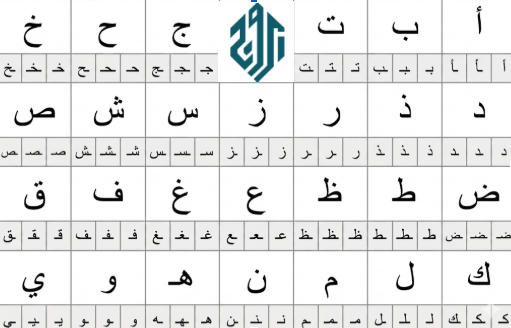
| Letter Form | Position in Word | Description |
| Isolated | Stands alone | Full form of the letter |
| Initial | Beginning of word | Connects to left only |
| Medial | Middle of word | Connects to both sides |
| Final | End of word | Connects to right only |
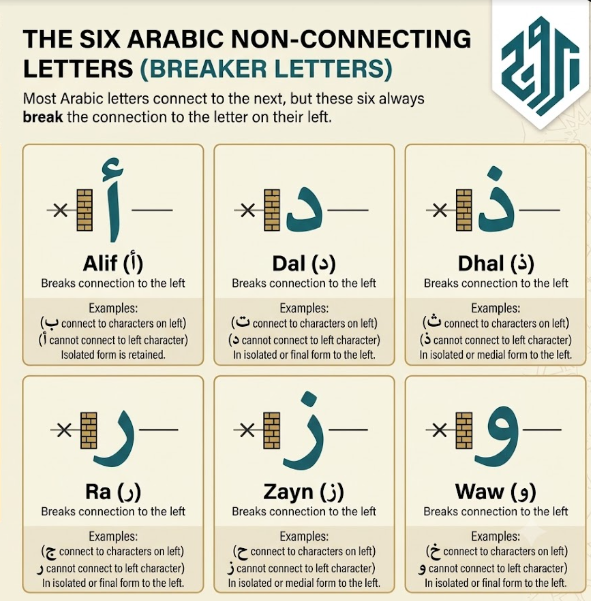
Six letters (و، ز، ر، ذ، د، ا) are non-connecting: they connect to the letter on their right but do not connect to the letter on their left, creating a natural break in the word. Recognizing these early prevents students from attempting impossible connections.
Step 4: Use Lined Paper with Right-Side Baseline Practice
Standard lined paper can be used with the lines running horizontally, but most Arabic calligraphy instructors recommend practicing with the baseline — the line along which most letter bodies rest — treated as a guide for letter height consistency.
Arabic letters sit on, hang below, or rise above this baseline in specific ways. Consistent baseline adherence is one of the most effective early habits for producing clean, readable handwriting.
For parents looking to support their children with this process, our Arabic Alphabet Learning Course provides structured, age-appropriate handwriting progression that addresses the right-to-left transition through visual and tactile methods designed for young learners.
Get a free trial now in Buruj’s Alphabet course

What Makes Arabic Script Unique Beyond Its Direction?
Arabic script has several structural features that distinguish it from right-to-left scripts like Hebrew and make it particularly distinctive for new learners.
1. Arabic is a cursive script by default
Unlike English, where print and cursive are separate styles, Arabic letters in standard prose always connect. There is no “print Arabic” for beginners to start with before moving to cursive. This means students must learn connected writing from day one.
2. Short vowels are typically omitted in standard text
The three short vowel marks (fatha, kasra, damma) — which appear as small symbols above or below letters — are included in Quranic text and beginner textbooks but are absent from most newspapers, books, and everyday Arabic writing.
Proficient readers infer vowel sounds from grammatical context and word recognition. This is one of the features that makes Arabic grammar study so valuable for developing reading fluency.
3. Arabic has no capital letters
The distinction between sentence-opening letters and mid-sentence letters that English readers use as visual anchors does not exist in Arabic. All letters maintain the same size relationship regardless of their position in a sentence.
At Buruj Academy, our Arabic for beginners course addresses each of these features systematically, ensuring students build accurate mental models of the script rather than importing assumptions from their native writing systems.
Begin learning Arabic at Buruj with a FREE trial lesson

Read also: Arabic Prepositions
Start Writing Arabic Confidently with Buruj Academy
Understanding the right-to-left direction of Arabic is one thing — building genuine writing and reading fluency requires structured, expert-guided practice.
At Buruj Academy, our Arabic Writing Course and Online Arabic Classes are taught by Al-Azhar University graduates and instructors with 12+ years of experience teaching non-native speakers.
Every student receives a personalized learning plan through 1-on-1 online sessions with flexible scheduling.
Book your free trial lesson today at Buruj Academy and take your first step with an expert teacher beside you.
Begin your transformation today by choosing the path that fits your goals:
- Online Arabic Classes (General & Comprehensive)
- Arabic Course for Beginners
- Arabic Alphabet Learning Course
- Online Arabic Classes for Kids
- Arabic Classes for Adults
- Arabic Grammar Course (Nahw & Sarf)
- Intermediate Arabic Course (B1/B2)
- Arabic Speaking Course (Conversational Fluency)
- Arabic Reading Course (Literary Excellence)
- Learn Arabic Writing Course (Calligraphy & Composition)
Ready to speak with confidence? Join the global community at Buruj Academy and book your free placement interview today!
Master the Arabic Language
Join our expert-led courses and build a strong foundation in Classical and Modern Arabic.
Get Your Free TrialConclusion
Arabic’s right-to-left direction is not a quirk or an obstacle — it is a feature of one of the world’s most ancient and systematic writing traditions. Shared by Hebrew, Persian, Urdu, and several other languages, this directional convention connects Arabic to a Semitic scribal legacy over three thousand years old.
For learners approaching Arabic for the first time, the key is systematic retraining: establish the correct starting position, master letter forms before connection, and practice consistently.
Frequently Asked Questions About Arabic Writing Direction
Is Arabic the Only Language Written from Right to Left?
Arabic is not the only right-to-left language. Hebrew, Persian (Farsi), Urdu, Pashto, and Kurdish (Sorani) all follow the same right-to-left directional convention. These languages share ancient Semitic or Aramaic script ancestry. Together, right-to-left languages are spoken by over 700 million people across the Middle East, South Asia, and North Africa.
Why Is Arabic Written from Right to Left and English from Left to Right?
Arabic descends from ancient Semitic scripts which established right-to-left direction over 3,000 years ago. English, by contrast, descends from Latin and Greek, which moved to left-to-right direction. The two traditions developed independently, with each directional convention becoming deeply embedded in its respective script family over centuries.
Are Arabic Numbers Written Right to Left?
Standard Arabic numerals (the digits ٠١٢٣٤٥٦٧٨٩ used in Arab countries) are read left to right when they appear within an Arabic text. This creates bidirectional text where the surrounding prose flows right to left but number sequences run left to right. Modern word processors handle this automatically; handwriters must learn to manage the directional shift manually.