 Arabic
| Key Takeaways |
| Arabic uses six primary negation particles: لا، لم، لن، ما، لات، and لَيْسَ, each with distinct grammatical rules. |
| لَيْسَ (laysa) is a verb-like particle that negates nominal sentences and requires its predicate in the accusative case. |
| لا negates present-tense verbs in the indicative mood, while لَمْ negates past actions using the jussive (مجزوم) form. |
| لَنْ expresses strong future negation and requires the subjunctive (منصوب) form of the verb after it. |
Arabic negation is a grammatically rich system where the particle you choose directly affects the verb form that follows it — and choosing the wrong one changes the meaning entirely.
Arabic has six core negation particles, each governing a specific tense, sentence type, or level of emphasis. Once you understand which particle serves which function — and how it reshapes the verb — negation in Arabic becomes one of the most logical and rewarding areas of the language to master.
Table of Contents:
What Is Negation in Arabic Grammar?
Negation in Arabic grammar is the system of particles used to express that an action did not happen, is not happening, will not happen, or that a state of being does not exist. Unlike English, where “not” works across virtually all contexts, Arabic assigns a dedicated particle to each negation scenario.
Students in our Online Arabic Grammar Course consistently tell us that confusing لا with لَمْ — or misapplying لَيْسَ — is among the most frequent early grammar mistakes they arrive with. Correcting those habits early prevents persistent errors in both speaking and writing.
Getting negation right also signals grammatical competence to native speakers. The verb form you use after each particle is not optional — it is a non-negotiable grammatical agreement.
Understand the Arabic Grammar with Buruj’s free trial lesson

What Are the Core Arabic Negation Particles?
Arabic uses six primary negation particles: لا، لم، لن، ما، لات، and لَيْسَ, each with distinct grammatical rules. The table below maps each particle to its function before we examine each one in depth.
| Particle | Transliteration | Negates | Verb Form Required |
| لا | Lā | Present / Future / Commands | Indicative (مرفوع) or Jussive (مجزوم) |
| لَمْ | Lam | Past (recently completed) | Jussive (مجزوم) |
| لَنْ | Lan | Future (emphatic) | Subjunctive (منصوب) |
| مَا | Mā | Past / Nominal sentences | Indicative or no change |
| لَيْسَ | Laysa | Nominal sentences (present) | Accusative predicate (منصوب) |
| لَاتَ | Lāta | Specific time expressions | Nominative or Accusative |
Each particle has a personality. Let us walk through them one by one with real, varied examples.
How to Use لا (Lā) to Negate Present-Tense Verbs in Arabic?
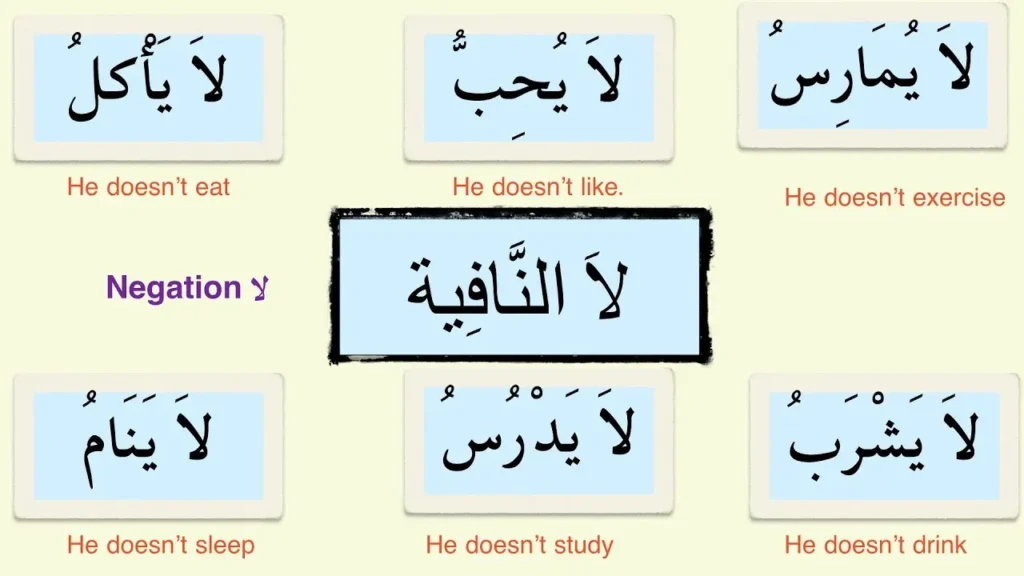
لا is the most frequently used negation particle in Arabic, and it covers the widest range of contexts. When placed before a present-tense verb (المضارع), it negates an ongoing or habitual action without changing the verb’s mood — the verb stays in the indicative (مرفوع) form.
Examples with لا + present tense (indicative):
| Arabic Sentence | Transliteration | English Meaning |
| لا أفهمُ هذا الدرسَ | Lā afhamul-darsa | I do not understand this lesson |
| لا يذهبُ إلى المدرسةِ | Lā yadhhabu ilal-madrasa | He does not go to school |
| لا نتكلمُ الفرنسيةَ | Lā natakallumul-fransiyya | We do not speak French |
| لا تُحبُّ القهوةَ | Lā tuhibbul-qahwa | She does not like coffee |
| لا يعملانِ في المكتبِ | Lā yaʿmalanī fil-maktab | They (dual) do not work in the office |
Notice that the verb ending remains مرفوع — no change to the verb’s mood here.
How Does لا Negate Commands (Prohibitive Negation)?
When لا is used with the present-tense verb in the jussive mood (مجزوم), it becomes a prohibition — the equivalent of “do not” in English. This is called لا الناهية (lā al-nāhiya).
| Arabic Sentence | Transliteration | English Meaning |
| لا تكذِبْ | Lā takdhib | Do not lie |
| لا تتأخرْ عن الصلاةِ | Lā tata’akhkhar ʿanis-ṣalāh | Do not be late for prayer |
| لا تنسَ واجبَك | Lā tansa wājibak | Do not forget your duty |
| لا تتركوا العملَ ناقصًا | Lā tatrakū al-ʿamala nāqiṣan | Do not leave the work incomplete |
The jussive drops the final short vowel or ن in certain verb forms — this is the grammatical marker that confirms prohibition.
How Does لَمْ (Lam) Negate the Past Tense in Arabic?
لَمْ is Arabic’s dedicated particle for negating a past action. It pulls the present-tense verb form into a past meaning and requires the jussive mood (مجزوم). This combination — لَمْ + present jussive — is equivalent to the simple past negation in English.
Many learners find this counterintuitive at first: why use a present-tense verb to express the past? The answer lies in Arabic’s aspectual logic — لَمْ signals that an action was not realized, and the jussive form marks grammatical dependency on the particle.
| Arabic Sentence | Transliteration | English Meaning |
| لم أذهبْ إلى السوقِ | Lam adh-hab ila-sūq | I did not go to the market |
| لم يفهمْ الطالبُ الشرحَ | Lam yafhamit-ṭālibu-sh-sharḥ | The student did not understand the explanation |
| لم تنمْ جيدًا الليلةَ الماضيةَ | Lam tanam jayyidan al-laylat-al-māḍiya | She did not sleep well last night |
| لم نُكملْ المشروعَ بعدُ | Lam nukminil-mashrūʿ baʿd | We did not complete the project yet |
| لم يتصلوا بنا | Lam yattaṣilū bina | They did not call us |
We consistently see in our Arabic grammar classes that students confuse مَا and لَمْ for past negation.
The key distinction: لَمْ is more common in Modern Standard Arabic (MSA) and uses a jussive verb, while مَا (discussed below) can accompany the actual past-tense verb form.
How Does لَنْ (Lan) Express Future Negation in Arabic?
لَنْ is used to negate future actions and carries a tone of strong assertion or definitiveness. It requires the subjunctive mood (منصوب) of the present-tense verb. Think of لَنْ as the Arabic equivalent of “will not” or “shall not” — with emphasis.
| Arabic Sentence | Transliteration | English Meaning |
| لن أنسى هذا اليومَ أبدًا | Lan ansa hādhal-yawma abadan | I will never forget this day |
| لن يفوزَ الفريقُ في المباراةِ | Lan yafūzal-farīqu fil-mubārāh | The team will not win the match |
| لن تجدَ عملًا بدونَ خبرةٍ | Lan tajida ʿamalan bidūni khibra | You will not find a job without experience |
| لن نتركَ هذه المدينةَ | Lan natruka hādhihil-madīna | We will not leave this city |
| لن يقبلوا العرضَ | Lan yaqbalū al-ʿarḍ | They will not accept the offer |
The subjunctive marker is visible on the verb ending — the ة in يجد becomes يجدَ with a fatḥa, and نون المضارعة drops in certain forms.
If you want to explore how Arabic tenses connect, our detailed guide on Arabic tenses explains the full verb system in accessible terms.
What Is لَيْسَ (Laysa) in Arabic and How Is It Used?
لَيْسَ (laysa) negates nominal sentences — sentences that do not contain a main verb and instead describe a state of being. It functions similarly to a verb, conjugating across all persons, numbers, and genders, and it places its predicate (الخبر) in the accusative case (منصوب).
لَيْسَ is one of Arabic’s sister verbs (أخوات كان), and understanding it requires knowing how nominal sentence structure works. For a strong foundation, our guide on Arabic sentence structure is a natural companion to this section.
Full Conjugation of لَيْسَ
| Form | Arabic | Transliteration | Meaning |
| He is not | لَيْسَ | Laysa | — |
| She is not | لَيْسَتْ | Laysat | — |
| You (m.) are not | لَسْتَ | Lasta | — |
| You (f.) are not | لَسْتِ | Lasti | — |
| I am not | لَسْتُ | Lastu | — |
| They (m.) are not | لَيْسُوا | Laysū | — |
| They (f.) are not | لَسْنَ | Lasna | — |
| We are not | لَسْنَا | Lasnā | — |
Examples of ليس in full sentences:
| Arabic Sentence | Transliteration | English Meaning |
| لَيْسَ الطقسُ باردًا اليومَ | Laysal-ṭaqsu bāridan al-yawm | The weather is not cold today |
| لَسْتُ طالبًا في هذه الجامعةِ | Lastu ṭāliban fī hādhihil-jāmiʿa | I am not a student at this university |
| لَيْسَتِ السيارةُ جديدةً | Laysatis-sayyārata jadīdatan | The car is not new |
| لَسْنَا متأخرينَ | Lasnā muta’akhkhirīn | We are not late |
| لَيْسُوا مسؤولينَ عن هذا | Laysū mas’ūlīna ʿan hādhā | They are not responsible for this |
Note how the predicate (باردًا، طالبًا، جديدةً) carries the accusative fatḥa — this is the grammatical signature of لَيْسَ sentences.
Discover the Buruj Academy Difference
Step into our virtual classrooms and see how our expert instructors make learning Quran and Arabic intuitive and clear. We focus on overcoming the specific hurdles non-native speakers face, building your confidence and connection with the Quran.
Master the Arabic Language
Join our expert-led courses and build a strong foundation in Classical and Modern Arabic.
Get Your Free TrialHow Does مَا (Mā) Work as a Negation Particle in Arabic?
مَا is one of the oldest negation particles in Arabic and is widely used in both MSA and spoken dialects. It negates past-tense verbs (leaving the verb in its normal past form) and can also negate nominal sentences in formal Arabic, functioning similarly to لَيْسَ.
مَا negating the past tense:
| Arabic Sentence | Transliteration | English Meaning |
| ما ذهبتُ إلى الحفلةِ | Mā dhahabtu ilal-ḥafla | I did not go to the party |
| ما فهمَ أحدٌ السؤالَ | Mā fahima aḥadun-su’āl | No one understood the question |
| ما نجحَ الطلابُ في الامتحانِ | Mā najaḥat-ṭullābu fil-imtiḥān | The students did not pass the exam |
| ما تكلمنا معه منذُ شهرٍ | Mā takallamna maʿahu mundhu shahr | We have not spoken to him for a month |
مَا negating a nominal sentence (formal Arabic):
| Arabic Sentence | Transliteration | English Meaning |
| ما هذا الأمرُ بسيطًا | Mā hādhal-amru basīṭan | This matter is not simple |
| ما الحياةُ راحةً دائمةً | Mā al-ḥayātu rāḥatan dā’ima | Life is not constant ease |
In this formal usage, مَا behaves like لَيْسَ and places the predicate in the accusative — this construction appears in classical literature and formal texts.
What Is the Difference Between لَمْ and مَا in Negating the Past?
The distinction between لَمْ and مَا for past negation is one of the most common points of confusion for learners of Arabic grammar. Both negate past actions, but they operate differently.
| Feature | لَمْ (Lam) | مَا (Mā) |
| Verb form used | Present-tense jussive (مجزوم) | Past-tense verb (unchanged) |
| Register | MSA, formal, written | MSA and colloquial |
| Nuance | Action was not realized | Action simply did not occur |
| Example | لم يأكلْ | ما أكلَ |
| English equivalent | He did not eat (lit. “he ate-not-realized”) | He did not eat |
In our Arabic online classes at Buruj Academy, Arabic learners who understand this distinction earlier progress through Arabic past tense exercises significantly faster — because they stop guessing which form to use and start applying the grammatical rule correctly.
Book your FREE Arabic trial online Arabic class at Buruj

How to Say “Not” in Arabic with Nominal Sentences Involving لَاتَ (Lāta)?
لَاتَ is a specialized negation particle used almost exclusively with time-related nouns in formal and classical Arabic. It is far less common than the other particles but appears in poetry, and the Quran.
لَاتَ negates one member of a pair — typically either the subject or the predicate is omitted, with one member in the nominative and the implied other in the accusative.
Example from the Quran:
لَاتَ حينَ مناصٍ
Lāta ḥīna manāṣ
“It was not a time for escape.” (Quran 38:3)
This particle appears in classical prose and literary Arabic. For modern learners, understanding لَاتَ at a recognition level is sufficient unless you are pursuing advanced literary studies.
Negation in Arabic Examples
Seeing all particles in parallel sentences helps cement their differences. Below, we negate the same core concept — “to study” (يدرسُ) — across different tenses and contexts.
| Negation Type | Arabic | Transliteration | English Meaning |
| Present (indicative) | لا يدرسُ الآنَ | Lā yadrusu al-ān | He does not study now |
| Prohibition | لا تدرسْ في الظلامِ | Lā tadrus fiz-ẓalām | Do not study in the dark |
| Past (جزم) | لم يدرسْ للامتحانِ | Lam yadrus lil-imtiḥān | He did not study for the exam |
| Past (ماضٍ) | ما درسَ الدرسَ | Mā darasa-d-darsa | He did not study the lesson |
| Future | لن يدرسَ غدًا | Lan yadrus ghadan | He will not study tomorrow |
| Nominal (laysa) | لَيْسَ طالبًا | Laysa ṭāliban | He is not a student |
This table is one we use regularly in Buruj Academy’s Online Arabic Grammar Course during the negation unit — because seeing all forms in one view removes the guesswork completely.
Understand the Arabic Grammar with Buruj’s free trial lesson

Master Arabic Grammar with Buruj Academy’s Expert-Led Classes
Negation in Arabic is a system — and systems respond well to structured, expert instruction. Buruj Academy’s Online Arabic Grammar Course builds this system correctly from the ground up, with live 1-on-1 sessions guided by Al-Azhar University graduates with 12+ years of experience teaching non-native speakers.
Our instructors use the Buruj Method — Context-before-abstraction — meaning you encounter each negation particle in real sentences before rules are formally named. This builds intuition before analysis.
- Ijazah-certified and Al-Azhar-trained native Arabic instructors
- Personalized learning plans tailored to your pace and goals
- Flexible 24/7 scheduling for global learners
- Real-time correction and structured progression from beginner to advanced
Book your free trial lesson and start building grammatical accuracy with expert guidance from day one.
Begin your transformation today by choosing the path that fits your goals:
- Online Arabic Classes (General & Comprehensive)
- Arabic Course for Beginners
- Arabic Alphabet Learning Course
- Online Arabic Classes for Kids
- Arabic Classes for Adults
- Arabic Grammar Course (Nahw & Sarf)
- Intermediate Arabic Course (B1/B2)
- Arabic Speaking Course (Conversational Fluency)
- Arabic Reading Course (Literary Excellence)
- Learn Arabic Writing Course (Calligraphy & Composition)
Ready to speak with confidence? Join the global community at Buruj Academy and book your free placement interview today!
Master the Arabic Language
Join our expert-led courses and build a strong foundation in Classical and Modern Arabic.
Get Your Free TrialConclusion
Arabic negation is one of the clearest examples of how grammatically precise Arabic truly is. Each particle — لا، لَمْ، لَنْ، مَا، لَيْسَ، and لَاتَ — carries a distinct function, and the verb form it governs is not negotiable. That precision, once internalized, makes Arabic both more learnable and more expressive than learners initially expect.
The path forward is repetition with understanding. Apply each particle in real sentences, pay attention to the verb mood that follows, and return to this framework whenever the system feels overwhelming.
With consistent practice and qualified instruction, negation in Arabic becomes second nature — and a genuine marker of grammatical competence.
Frequently Asked Questions About Negation in Arabic
What Is the Most Common Way to Say “Not” in Arabic?
The most commonly used negation particles in Modern Standard Arabic are لا and لَيْسَ. لا negates verbs in present, future, and prohibitive contexts. لَيْسَ negates nominal sentences describing a state of being. For past negation, لَمْ is the standard MSA choice, while مَا is widely used in both formal and colloquial contexts.
What Is the Difference Between لَمْ and لَا in Arabic Negation?
لَمْ negates a completed past action and requires the jussive (مجزوم) verb form — for example, لَمْ يكتبْ means “he did not write.” لَا negates present or habitual actions, using the indicative (مرفوع) form — لَا يكتبُ means “he does not write.” They target different tenses and cannot be swapped without changing the sentence’s temporal meaning.
How Do You Use لَيْسَ (Laysa) Correctly in an Arabic Sentence?
لَيْسَ functions like a verb and negates nominal sentences. It conjugates for all persons, genders, and numbers, and places its predicate in the accusative (منصوب) case. Example: لَيْسَ الجوُّ حارًّا — “The weather is not hot.” The predicate حارًّا takes the accusative fatḥa because of لَيْسَ’s grammatical effect.
What Are the Types of Negation in Arabic?
Arabic negation falls into four main types: present-tense negation (لَا + indicative verb), past-tense negation (لَمْ + jussive or مَا + past verb), future negation (لَنْ + subjunctive verb), and nominal sentence negation (لَيْسَ + accusative predicate). Prohibitive negation — “do not” — uses لَا with the jussive mood specifically. Each type has its own particle and verb agreement rules.