 Arabic
| Key Takeaways |
| Arabic nouns (الاسم / Al-Ism) are divided into three core grammatical categories: definite, indefinite, and proper nouns. |
| Arabic distinguishes masculine (مذكر / Mudhakkar) and feminine (مؤنث / Mu’annath) nouns, affecting agreement with verbs and adjectives throughout the sentence. |
| Number in Arabic nouns covers three forms — singular (مفرد / Mufrad), dual (مثنى / Muthanna), and plural (جمع / Jam’) — each with distinct grammatical endings. |
| Derived nouns (Ism Musytaqq / اسم مشتق) like verbal nouns and active participles are essential tools for reading Quranic Arabic with real understanding. |
Arabic noun grammar overwhelms most beginners — not because it’s impossibly difficult, but because English grammar offers no equivalent to the Arabic system of gender, number, and grammatical case all encoded within a single word.
Once you understand how the categories work together, reading Arabic sentences begins to feel like solving a satisfying puzzle rather than decoding a foreign code.
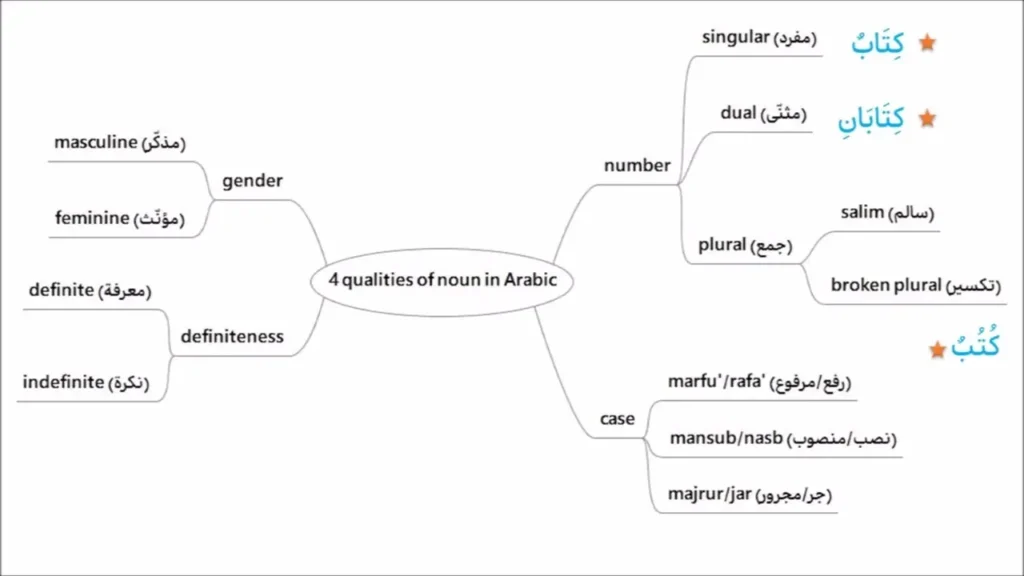
Arabic nouns (Al-Ism / الاسم) fall into several intersecting grammatical categories: definiteness, gender, number, derivation, and grammatical case (I’rab / الإعراب). Understanding these types — each with its Arabic grammatical term, its pronunciation, and its real-world examples — is the single most effective foundation for learning Arabic grammar at any level.
Table of Contents:
What Is a Noun in Arabic Grammar (Al-Ism / الاسم)?
A noun in Arabic (Al-Ism / الاسم — pronounced Al-Ism) is any word that refers to a person, place, thing, concept, or quality and can carry a grammatical case marker (I’rab).
This distinguishes nouns from verbs (Al-Fi’l / الفعل) and particles (Al-Harf / الحرف) — the other two members of Arabic’s three-part word classification system.
Every sentence in Arabic is built upon nouns, making this the single most foundational category in Arabic grammar.
Unlike English, Arabic encodes enormous grammatical information inside the noun itself — its ending vowels (Harakat) tell you whether it’s the subject, object, or possessor in a sentence. This is the system of I’rab (الإعراب), and it applies directly to nouns.
In our Arabic Grammar course at Buruj Academy, we teach the types of Arabic nouns from the very first week using real Quranic vocabulary — so students aren’t learning abstract labels but building genuine reading comprehension from the start.
Understand the Arabic Grammar with Buruj’s free trial lesson

What Are the Types of Nouns in Arabic Grammar?
The types of nouns in Arabic grammar are organized across five intersecting systems: definiteness, gender, number, origin (primitive vs. derived), and grammatical case.
These five systems are not separate lists — every Arabic noun simultaneously belongs to one category in each system. Understanding all five is what allows you to read and analyze Arabic sentences with precision.
The table below shows how these systems relate to each other:
| System | Arabic Term (Transliteration) | Categories |
| Definiteness | التعريف والتنكير (At-Ta’rif wal-Tankir) | Definite / Indefinite / Proper |
| Gender | الجنس (Al-Jins) | Masculine / Feminine |
| Number | العدد (Al-‘Adad) | Singular / Dual / Plural |
| Origin | الأصالة (Al-Asala) | Primitive / Derived |
| Grammatical Case | الإعراب (Al-I’rab) | Nominative / Accusative / Genitive |
Each system demands its own focused study. We address them one by one below — with Arabic terminology, transliteration, and multiple examples throughout.
1. Definite and Indefinite Nouns in Arabic (At-Ta’rif wal-Tankir / التعريف والتنكير)
Definiteness is the first noun distinction every Arabic learner must master, because it directly controls how every noun appears in written and spoken Arabic. A definite noun (الاسم المعرفة / Al-Ism Al-Ma’rifa) refers to something specific and known, while an indefinite noun (الاسم النكرة / Al-Ism An-Nakira) refers to something unspecified.
How Do Indefinite Nouns Work in Arabic (An-Nakira / النكرة)?
An indefinite noun carries Tanwin (التنوين) — the doubled vowel marker written as ـً ـٍ ـٌ at the end of the word — and means “a” or “an” in English. Arabic has no indefinite article; Tanwin itself performs that function.
| Arabic | Transliteration | Meaning |
| كِتَابٌ | Kitābun | a book |
| بَيْتٌ | Baytun | a house |
| طَالِبٌ | Ṭālibun | a student |
| مَدِينَةٌ | Madīnatun | a city |
How Do Definite Nouns Work in Arabic (Al-Ma’rifa / المعرفة)?
A noun becomes definite by adding the prefix الـ (Al-) — the definite article — to the beginning of the word. The Tanwin disappears, and the noun now means “the.”
| Indefinite | Definite | Meaning |
| كِتَابٌ (Kitābun) | الكِتَابُ (Al-Kitābu) | the book |
| بَيْتٌ (Baytun) | البَيْتُ (Al-Baytu) | the house |
| طَالِبٌ (Ṭālibun) | الطَّالِبُ (Aṭ-Ṭālibu) | the student |
Notice that Aṭ-Ṭālibu uses Aṭ- instead of Al- — because ط is a sun letter (Harf Shamsi / حرف شمسي), which causes the lam of the definite article to assimilate. For a detailed breakdown of this rule, see our guide on moon and sun letters in Arabic.
Proper Nouns in Arabic (Al-‘Alam / العَلَم)
Proper nouns — names of people, places, and things — form a third category of definiteness. They are inherently definite without requiring Al- or Tanwin.
Examples: مُحَمَّدٌ (Muḥammadun) — Muhammad | مَكَّةُ (Makkata) — Mecca | القُرْآنُ (Al-Qur’ānu) — the Quran
Note: Proper nouns may appear with or without Tanwin depending on their grammatical weight (Ism Ghayr Munsarif — nouns that don’t accept full Tanwin — is an advanced topic we cover in our structured program).
Read also:How Plurals Work in Arabic
2. Masculine and Feminine Nouns in Arabic (Al-Mudhakkar wal-Mu’annath / المذكر والمؤنث)
Arabic divides all nouns into two grammatical genders: masculine (Mudhakkar / مذكر) and feminine (Mu’annath / مؤنث). This isn’t just about biological sex — objects, concepts, and places are assigned grammatical gender, just as in French or Spanish.
Gender controls adjective agreement, verb agreement, and pronoun usage throughout the sentence.
A. Masculine Nouns in Arabic (Mudhakkar / مذكر)
Masculine nouns carry no special ending marker. Most words without the feminine marker are masculine by default.
Examples: قَلَمٌ (Qalamun) — a pen | بَابٌ (Bābun) — a door | رَجُلٌ (Rajulun) — a man | كِتَابٌ (Kitābun) — a book
B. Feminine Nouns in Arabic (Mu’annath / مؤنث)
Feminine nouns are typically marked by one of three signs:
1. Taa Marbuta (ة) — the most common feminine marker, appearing as a rounded ta at the end of the word.
| Arabic | Transliteration | Meaning |
| مَدْرَسَةٌ | Madrasatun | a school |
| طَالِبَةٌ | Ṭālibatun | a female student |
| سَيَّارَةٌ | Sayyāratun | a car |
2. Alif Maqsura (ى) or Alif Mamduda (اء) — a lengthened alif ending also marks femininity.
Examples: ذِكْرَى (Dhikrā) — a memory | صَحْرَاءُ (Ṣaḥrā’u) — a desert
3. Naturally Feminine Nouns — some words are feminine by convention despite having no visible marker. These must be memorized.
Examples: شَمْسٌ (Shamsun) — sun (feminine) | أَرْضٌ (Arḍun) — earth (feminine) | نَارٌ (Nārun) — fire (feminine)
In our online Arabic classes at Buruj Academy, we notice that students who struggle most with gender agreement are those who try to guess based on meaning rather than learning the markers.
Once they memorize the Taa Marbuta pattern and the short list of conventionally feminine nouns, agreement errors drop dramatically within a few weeks.
Book your FREE Arabic trial online Arabic class at Buruj

3. Singular, Dual, and Plural Nouns in Arabic (Al-Mufrad, Al-Muthanna, Al-Jam’ / المفرد والمثنى والجمع)
Arabic has three grammatical numbers, not two. This is where many English speakers encounter a genuinely new concept: the dual form (Al-Muthanna / المثنى), which has no English equivalent and must be explicitly formed and used whenever referring to exactly two of something.
A. Singular Nouns in Arabic (Al-Mufrad / المفرد)
The singular is the base form of any noun. It refers to one person, place, or thing.
Examples: كِتَابٌ (Kitābun) — one book | طَالِبٌ (Ṭālibun) — one student
B. Dual Nouns in Arabic (Al-Muthanna / المثنى)
The dual is formed by adding ـَانِ (-āni) in the nominative case or ـَيْنِ (-ayni) in the accusative and genitive cases to the singular noun.
| Singular | Dual (Nominative) | Meaning |
| كِتَابٌ | كِتَابَانِ (Kitābāni) | two books |
| طَالِبٌ | طَالِبَانِ (Ṭālibāni) | two students |
| بَيْتٌ | بَيْتَانِ (Baytāni) | two houses |
For feminine nouns ending in Taa Marbuta, the ta is restored before adding the dual suffix: مَدْرَسَةٌ – مَدْرَسَتَانِ (Madrasatāni) — two schools.
Master the Arabic Language
Join our expert-led courses and build a strong foundation in Classical and Modern Arabic.
Get Your Free TrialC. Plural Nouns in Arabic (Al-Jam’ / الجمع)
Arabic has two plural types, and understanding both is essential for reading Quranic Arabic fluently.
Sound Masculine Plural (Jam’ Al-Mudhakkar As-Salim / جمع المذكر السالم): Formed by adding ـُونَ (-ūna) in nominative or ـِينَ (-īna) in accusative/genitive.
مُسْلِمٌ (Muslimun) → مُسْلِمُونَ (Muslimūna) — Muslims
Sound Feminine Plural (Jam’ Al-Mu’annath As-Salim / جمع المؤنث السالم): Formed by replacing the Taa Marbuta with ـَاتٌ (-ātun).
مُسْلِمَةٌ (Muslimatun) → مُسْلِمَاتٌ (Muslimātun) — Muslim women
Broken Plural (Jam’ At-Taksir / جمع التكسير): Common — and most demanding — plural type. The internal vowel structure of the word itself changes, with no predictable rule. These must be learned individually.
| Singular | Broken Plural | Meaning |
| كِتَابٌ (Kitābun) | كُتُبٌ (Kutubun) | books |
| بَيْتٌ (Baytun) | بُيُوتٌ (Buyūtun) | houses |
| رَجُلٌ (Rajulun) | رِجَالٌ (Rijālun) | men |
| وَلَدٌ (Waladun) | أَوْلَادٌ (Awlādun) | children |
The broken plural is why we strongly recommend learners study nouns in context rather than in isolation. For strategies on building Arabic vocabulary effectively, see our article on mastering Arabic vocabulary.
If you’re ready to go deeper, our guide on how to learn Arabic grammar easily is the natural next step — or explore our Online Arabic Classes for Beginners to begin building your grammar foundation with an expert instructor by your side.
Begin learning Arabic at Buruj with a FREE trial lesson

4. Primitive and Derived Nouns in Arabic (Al-Ism Al-Jamid wal-Ism Al-Mushtaqq / الاسم الجامد والاسم المشتق)
This distinction is particularly significant for Quranic Arabic comprehension. Arabic nouns either stand independently (Jamid — primitive) or are derived from a root verb (Mushtaqq — derived).
The Arabic root system means that one three-letter root can generate dozens of related words across noun and verb categories.
A. Primitive Nouns in Arabic (Al-Ism Al-Jamid / الاسم الجامد)
These nouns do not derive from a verb root. They exist as standalone words and typically refer to physical objects or concrete concepts.
Examples: أَسَدٌ (Asadun) — lion | مَاءٌ (Mā’un) — water | شَجَرَةٌ (Shajaratun) — tree
B. Derived Nouns in Arabic (Al-Ism Al-Mushtaqq / الاسم المشتق)
Derived nouns are generated from verb roots and carry relational meaning. The most important types for Quran comprehension are:
Verbal Noun (Al-Masdar / المصدر — Al-Masdar): The noun form of a verb, equivalent to the English gerund (“-ing” form). Every Arabic verb has a Masdar.
كَتَبَ (Kataba — to write) – كِتَابَةٌ (Kitābatun) — writing
عَلِمَ (‘Alima — to know) – عِلْمٌ (‘Ilmun) — knowledge
Active Participle (Ism Al-Fa’il / اسم الفاعل — Ism Al-Fā’il): Names the doer of the action.
كَتَبَ – كَاتِبٌ (Kātibun) — a writer
عَلِمَ – عَالِمٌ (‘Ālimun) — a scholar
Passive Participle (Ism Al-Maf’ul / اسم المفعول — Ism Al-Maf’ūl): Names the one who receives the action.
كَتَبَ – مَكْتُوبٌ (Maktūbun) — something written
عَلِمَ – مَعْلُومٌ (Ma’lūmun) — something known
A Quranic Example of Derived Nouns in Action:
عَالِمُ الْغَيْبِ وَالشَّهَادَةِ
‘Ālimu l-ghaybi wa-sh-shahādah
“Knower of the unseen and the witnessed.” (Al-An’am 6:73)
Here عَالِمُ (‘Ālimu) is an active participle (Ism Al-Fa’il) derived from عَلِمَ (‘Alima — to know), functioning as a noun in a possessive construction (Idafa / الإضافة).
5. Grammatical Case in Arabic Nouns (Al-I’rab / الإعراب)
Arabic nouns change their final vowel ending based on their grammatical role in the sentence. This system — called Al-I’rab (الإعراب) — is what makes Arabic a highly inflected language. There are three cases: nominative, accusative, and genitive.
| Case | Arabic Term | Transliteration | Marker | Role |
| Nominative | المرفوع | Al-Marfū’ | Damma (ـُ) | Subject of the sentence |
| Accusative | المنصوب | Al-Manṣūb | Fatha (ـَ) | Object, or after inna particles |
| Genitive | المجرور | Al-Majrūr | Kasra (ـِ) | After prepositions, or in Idafa |
Example of Grammatical Case in Arabic Nouns With the Word كِتَاب (Kitāb — Book):
- الكِتَابُ مُفِيدٌ (Al-Kitābu mufīdun) — The book is useful. [Nominative — subject]
- قَرَأْتُ الكِتَابَ (Qara’tu l-kitāba) — I read the book. [Accusative — object]
- هَذَا غِلَافُ الكِتَابِ (Hādhā ghilāfu l-kitābi) — This is the book’s cover. [Genitive — in Idafa]
Understanding I’rab is essential for reading Arabic sentence structure correctly, especially in Quranic prose where case endings carry precise legal and theological meaning.
Discover the Buruj Academy Difference
Step into our virtual classrooms and see how our expert instructors make learning Quran and Arabic intuitive and clear. We focus on overcoming the specific hurdles non-native speakers face, building your confidence and connection with the Quran.
Build Your Arabic Noun Mastery with Buruj Academy’s Expert Instructors
Arabic grammar makes permanent sense once you understand its internal logic — and nouns are the gateway.
Buruj Academy’s Arabic Grammar course teaches every noun type systematically, using Quranic vocabulary and real sentence examples from day one, guided by Al-Azhar University graduates with 12+ years of experience teaching non-Arabic speakers.
Here is what sets our program apart:
- Ijazah-certified instructors and Al-Azhar University graduates
- The Buruj Method: context-before-abstraction — you learn grammar through meaning, not memorization of labels
- Personalized 1-on-1 online sessions with flexible 24/7 scheduling
- Real-time correction of grammatical errors during reading practice
- Clear progression from beginner noun recognition to advanced I’rab analysis
Book your free trial lesson and experience Arabic grammar taught the way it was meant to be learned.
Begin your transformation today by choosing the path that fits your goals:
- Online Arabic Classes (General & Comprehensive)
- Arabic Course for Beginners
- Arabic Alphabet Learning Course
- Online Arabic Classes for Kids
- Arabic Classes for Adults
- Arabic Grammar Course (Nahw & Sarf)
- Intermediate Arabic Course (B1/B2)
- Arabic Speaking Course (Conversational Fluency)
- Arabic Reading Course (Literary Excellence)
- Learn Arabic Writing Course (Calligraphy & Composition)
Ready to speak with confidence? Join the global community at Buruj Academy and book your free placement interview today!
Master the Arabic Language
Join our expert-led courses and build a strong foundation in Classical and Modern Arabic.
Get Your Free TrialConclusion
Arabic nouns are not a single category — they are a system of intersecting classifications that, together, give Arabic its extraordinary precision and expressive depth. From the definiteness markers of Ma’rifa and Nakira, through the gender system of Mudhakkar and Mu’annath, to the case endings of I’rab and the root-derived vocabulary of Masdar and Ism Al-Fa’il — every layer builds on the one before it.
The most effective approach is always the same: learn each type with its Arabic grammatical term, its transliteration, and multiple real examples — then meet it repeatedly in Quranic and Modern Standard Arabic text. That repetition in context is what moves these concepts from your notes into your intuition.
Frequently Asked Questions About Types of Nouns in Arabic
What Are the Main Types of Nouns in Arabic?
The main types of Arabic nouns are classified across five systems: definiteness (Ma’rifa and Nakira), gender (Mudhakkar and Mu’annath), number (Mufrad, Muthanna, Jam’), origin (Jamid and Mushtaqq), and grammatical case (I’rab). Every Arabic noun simultaneously belongs to one category in each system, which is what makes Arabic grammar precise and internally consistent.
What Is the Difference Between Taa Marbutaand Feminine Gender in Arabic?
Taa Marbuta (ة) is the most common marker of feminine gender in Arabic nouns, but not all feminine nouns carry it. Some nouns — like شَمْسٌ (sun) and أَرْضٌ (earth) — are grammatically feminine by convention without any visible marker. Learners must memorize these naturally feminine nouns, as they don’t follow a predictable rule.
What Is the Broken Plural in Arabic and Why Is It Difficult?
The broken plural (Jam’ At-Taksir / جمع التكسير) changes the internal vowel structure of the singular noun to form the plural, rather than adding a suffix. Because there is no single predictable pattern, each broken plural must be learned individually. For example, كِتَابٌ becomes كُتُبٌ and بَيْتٌ becomes بُيُوتٌ — the internal pattern shifts unpredictably.
What Is Al-Masdarand How Is It Used in Arabic?
Al-Masdar (المصدر) is the verbal noun in Arabic — the noun derived from a verb root that expresses the action itself. For example, كَتَبَ (to write) produces the Masdar كِتَابَةٌ (writing), and عَلِمَ (to know) produces عِلْمٌ (knowledge). Masdar forms are extremely frequent in both Quranic Arabic and Modern Standard Arabic.
How Does Grammatical Case (I’rab) Affect Arabic Nouns?
I’rab changes the final short vowel of a noun to show its grammatical role. A nominative noun (subject) ends in Damma (ـُ), an accusative noun (object) ends in Fatha (ـَ), and a genitive noun (after prepositions or in possession structures) ends in Kasra (ـِ). These endings are what allow Arabic sentences to be understood even when word order varies.