 Arabic
| Key Takeaways |
| Intermediate Arabic (B1–B2) means handling everyday conversations, reading unvowelized texts, and writing structured paragraphs independently. |
| Most motivated learners reach B1 in 12–18 months of consistent daily study averaging 45–60 minutes per session. |
| Intermediate Arabic grammar focuses on verb patterns (أوزان), dual forms, broken plurals, and the full i’rab case system in context. |
| B2 Arabic requires active vocabulary of approximately 4,000–5,000 words and confident use of complex subordinate clauses. |
Most learners reach a plateau after their first year of Arabic study — they know the alphabet, handle basic greetings, and follow slow conversations, but genuine communication still feels out of reach. That gap between beginner and confident user is exactly what intermediate Arabic training closes.
At the intermediate level, Arabic stops being a code you decode and starts becoming a language you actually think in. This guide walks you through what intermediate Arabic means in practice, how long it realistically takes, and exactly what grammar, vocabulary, and writing skills to build — so you can move forward with a clear, structured plan.
Table of Contents:
What Is Intermediate Level Arabic?
Intermediate Arabic sits between basic alphabet literacy and professional fluency, covering the B1 and B2 bands of the Common European Framework of Reference (CEFR).
At this level, a learner can hold sustained conversations on familiar topics, read unvowelized Modern Standard Arabic (MSA) texts with reasonable accuracy, and produce connected written paragraphs without relying on a teacher for every sentence.
In our experience at Buruj Academy, students who cross into intermediate territory share one defining shift: they stop translating word-by-word and begin processing phrases as units of meaning.
That cognitive transition — from decoding to understanding — is the true marker of intermediate competence, and it typically arrives between months 10 and 18 of consistent study.
What Can an Intermediate Arabic Learner Actually Do?
| Skill | B1 (Lower Intermediate) | B2 (Upper Intermediate) |
| Listening | Follows standard-speed MSA broadcasts with effort | Understands most news Arabic and formal lectures |
| Reading | Reads vowelized texts fluently; partially unvowelized | Reads unvowelized newspapers and formal prose |
| Speaking | Describes experiences and gives basic opinions | Argues a position and handles unexpected questions |
| Writing | Writes simple connected paragraphs | Produces structured essays with cohesive argument |
| Vocabulary | ~1,500–2,500 active words | ~4,000–5,000 active words |
Buruj Academy’s Arabic for Intermediate course is built specifically for learners at this stage, delivering structured B1–B2 progression through grammar, vocabulary, speaking, and writing.
Book your FREE Arabic for intermediate trial online class at Buruj
How Long Does It Take to Learn Intermediate Arabic?
Reaching intermediate Arabic (B1) from a true beginner baseline takes most non-native speakers 12 to 18 months, assuming 45–60 minutes of focused daily study. Advancing from B1 to B2 adds another 8–14 months at the same pace.
These are realistic instructor estimates, not guarantees — learner consistency, native language background, and instruction quality all shift the timeline significantly.
For context, Arabic is classified by the U.S. Foreign Service Institute (FSI) as a Category IV language — their hardest classification — estimating approximately 2,200 class hours for professional working proficiency. That figure aligns with reaching a solid B2-to-C1 level.
Factors That Speed Up Your Progress to Arabic Intermediate Level
Several variables consistently separate students who reach intermediate Arabic in 12 months from those who take 24:
1. Daily consistency outperforms session length
Forty-five minutes every day produces faster internalization than three-hour weekend sessions. Arabic morphology needs repeated, spaced exposure to stick.
2. Structured grammar instruction
Students who work through Arabic grammar systematically — understanding root systems and verb patterns rather than memorizing isolated words — reach intermediate reading ability significantly faster.
3. Immersive listening exposure
Pairing grammar study with daily Arabic audio input (podcasts, news, lectures) accelerates pattern recognition in ways that grammar drills alone cannot replicate.
4. Guided instruction
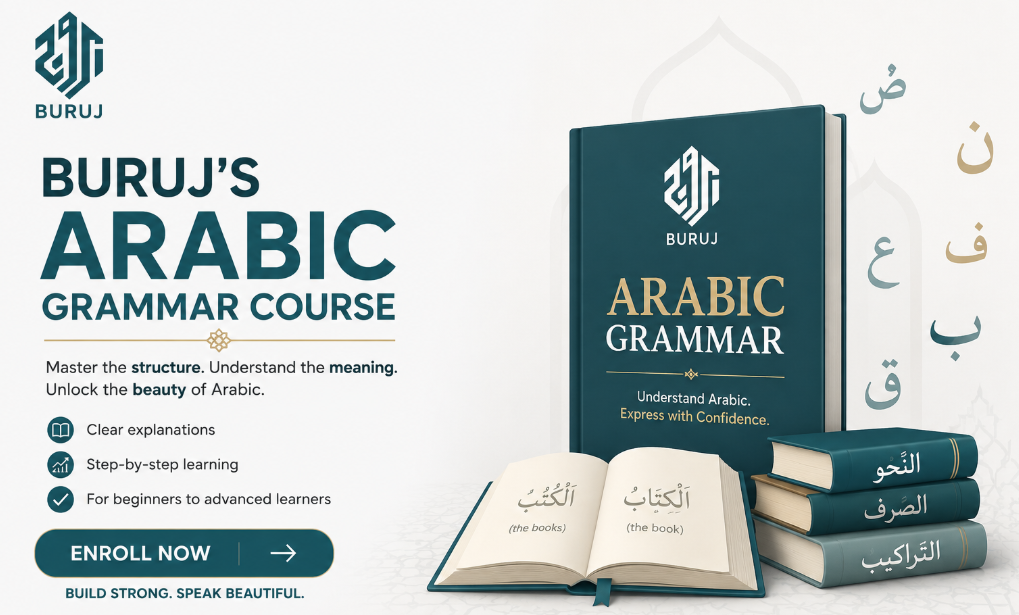
Self-study reaches limits quickly at the intermediate level. Through Buruj Academy’s Arabic Grammar Course, students receive structured progression through B1 and B2 grammar with real-time correction from Al-Azhar-trained instructors — a critical advantage when self-study stalls.
Understand the Arabic Grammar with Buruj’s free trial lesson
What Does Intermediate Arabic Grammar Cover?
Intermediate Arabic grammar is where the language’s structural logic becomes fully visible — and where most self-taught learners hit their most persistent obstacles.
At this level, learners move beyond basic sentence patterns into the productive mechanisms that generate the full range of Arabic expression.
The three grammar systems that define intermediate-level competence are:
1. Verb Patterns (الأوزان — Al-Awzaan)
Arabic verbs follow ten primary patterns (awzaan), each carrying predictable meaning modifications. A learner who understands these patterns can deduce the meaning of thousands of unfamiliar words from their root alone.
For example, recognizing that وزن فَعَّلَ typically indicates intensive or causative action allows a student to correctly infer كَسَّرَ (to smash repeatedly) from كَسَرَ (to break) without dictionary lookup.
We regularly observe that students who internalize even the five most common awzaan double their reading speed within six to eight weeks.
For a strong foundation in Arabic verb tenses before tackling patterns, revisiting tense formation — especially past tense and present tense conjugation — accelerates awzaan acquisition significantly.
2. The I’rab Case System in Context
Intermediate learners must move from recognizing case endings (الإعراب) theoretically to applying them automatically in reading and writing.
This means identifying the فاعل (subject) and مفعول به (direct object) by their grammatical markers — ضمة, فتحة, كسرة — across complex sentences without consciously stopping to analyze each word.
3. Broken Plurals and Dual Forms
Arabic’s dual noun structure and its extensive system of broken plurals (جموع التكسير) are grammatical territories with no parallel in English, making them disproportionately difficult for Western learners.
Intermediate mastery requires knowing the most common broken plural patterns — مَفَاعِيل, فُعَلَاء, أَفْعَال — and building a working vocabulary of high-frequency dual forms.
How to Learn Intermediate Arabic Words and Phrases Effectively?
Building intermediate Arabic vocabulary is not about memorizing long word lists — it’s about acquiring vocabulary within grammatical and thematic contexts so that words stay retained and become usable in production.
At B1–B2, a learner needs 1,500–5,000 active words depending on their target band.
| Vocabulary Strategy | Why It Works at Intermediate Level |
| Root-based learning (جذر) | One root yields 8–15 related words, multiplying acquisition speed |
| Sentence-level flashcards | Words stored in syntactic context are recalled faster in real speech |
| Thematic clustering | Grouping vocabulary by topic (travel, politics, health) builds field-specific fluency |
| Spaced repetition systems (SRS) | Algorithmically timed review prevents forgetting without overloading daily sessions |
| Reading authentic texts | Encountering words in context reinforces meaning and collocations simultaneously |
For intermediate phrases specifically, learners should prioritize connective discourse markers — transition words like بالرغم من (despite), في حين أن (whereas), and على الرغم من (notwithstanding) — that allow them to construct arguments in speaking and writing rather than producing only simple statements.
Pair vocabulary study with focused work on Arabic pronunciation to ensure newly acquired words are stored with correct phonetic representations. Mispronounced vocabulary is vocabulary that fails in real conversations.
Read also: What Are the Basics of Arabic?
Discover the Buruj Academy Difference
Step into our virtual classrooms and see how our expert instructors make learning Quran and Arabic intuitive and clear. We focus on overcoming the specific hurdles non-native speakers face, building your confidence and connection with the Quran.
Master the Arabic Language
Join our expert-led courses and build a strong foundation in Classical and Modern Arabic.
Get Your Free Trial1. Learn Intermediate Arabic Words
| Arabic Word | Transliteration | Meaning | Root |
| يَعْتَقِدُ | ya’taqidu | He believes | ع-ق-د |
| يَسْتَطِيعُ | yastatī’u | He is able to | ط-و-ع |
| يَتَضَمَّنُ | yataḍammanu | It includes | ض-م-ن |
| مُجْتَمَع | mujtama’ | Society | ج-م-ع |
| يُؤَثِّرُ | yu’aththiru | It affects | أ-ث-ر |
| نَتِيجَة | natīja | Result / outcome | ن-ت-ج |
| يَتَحَدَّثُ | yataḥaddathu | He speaks | ح-د-ث |
| مَسْؤُولِيَّة | mas’ūliyya | Responsibility | س-أ-ل |
| يَتَطَلَّبُ | yataṭallabu | It requires | ط-ل-ب |
| ظَرْف | ẓarf | Circumstance | ظ-ر-ف |
| يَنْتَشِرُ | yantashiru | It spreads | ن-ش-ر |
| قَرَار | qarār | Decision | ق-ر-ر |
| يُسَاهِمُ | yusāhimu | He contributes | س-ه-م |
| مَصْدَر | maṣdar | Source / verbal noun | ص-د-ر |
| يَتَغَيَّرُ | yataghayyaru | It changes | غ-ي-ر |
Read also: Arabic Video Tutorials to Learn Arabic
2. Learn Intermediate Arabic Phrases
| Arabic Phrase | Transliteration | Meaning | Use Context |
| بِالرَّغْمِ مِنْ ذَلِكَ | bi-r-raghmi min dhālika | Despite that | Contrast / argument |
| فِي حِينِ أَنَّ | fī ḥīni anna | Whereas / while | Comparison |
| مِنَ الْجَدِيرِ بِالذِّكْرِ | min al-jadīri bi-dh-dhikr | It is worth mentioning | Formal introduction |
| عَلَى الرَّغْمِ مِنْ | ‘alā r-raghmi min | In spite of | Concession |
| وَفْقًا لِـ | wafqan li- | According to | Attribution |
| يَتَّضِحُ مِنْ ذَلِكَ أَنَّ | yattaḍiḥu min dhālika anna | It is clear from this that | Drawing conclusions |
| مِنْ نَاحِيَةٍ أُخْرَى | min nāḥiyatin ukhrā | On the other hand | Counter-argument |
| لَا بُدَّ مِنْ | lā budda min | It is necessary to | Obligation |
| فِيمَا يَتَعَلَّقُ بِـ | fīmā yata’allaqu bi- | With regard to | Topic shift |
| أَدَّى إِلَى | addā ilā | Led to / resulted in | Cause and effect |
| تَجْدُرُ الإِشَارَةُ إِلَى | tajduru l-ishāratu ilā | It should be noted that | Formal emphasis |
| بِنَاءً عَلَى | binā’an ‘alā | Based on | Reasoning |
| عَلَى وَجْهِ التَّحْدِيدِ | ‘alā wajhi t-taḥdīd | Specifically / precisely | Exactness |
| فِي ضَوْءِ مَا سَبَقَ | fī ḍaw’i mā sabaqa | In light of the above | Conclusion / summary |
Learn Intermediate Arabic Writing
Intermediate Arabic writing is where many learners fall furthest behind their speaking and reading skills — because writing demands active, accurate production of a system they can passively recognize in reading. At the B1 level, a learner should produce coherent five-to-eight sentence paragraphs on familiar topics.
At B2, they should handle multi-paragraph structured essays with an argument and supporting evidence.
Two tools transform intermediate writing development faster than any others:
Arabic dictation practice trains the ear-to-hand connection that intermediate writers need to move quickly without stopping to recall letter forms. Our instructors strongly recommend dictation as the highest-leverage Arabic writing exercise at this level — it simultaneously reinforces vocabulary, spelling, and sentence structure.
Structured paragraph models give learners a template for Arabic prose organization: topic sentence (جملة رئيسية) → supporting details (تفاصيل داعمة) → concluding connector (خاتمة). English-speaking learners often impose English paragraph logic onto Arabic prose, producing technically correct sentences in a structurally foreign arrangement.
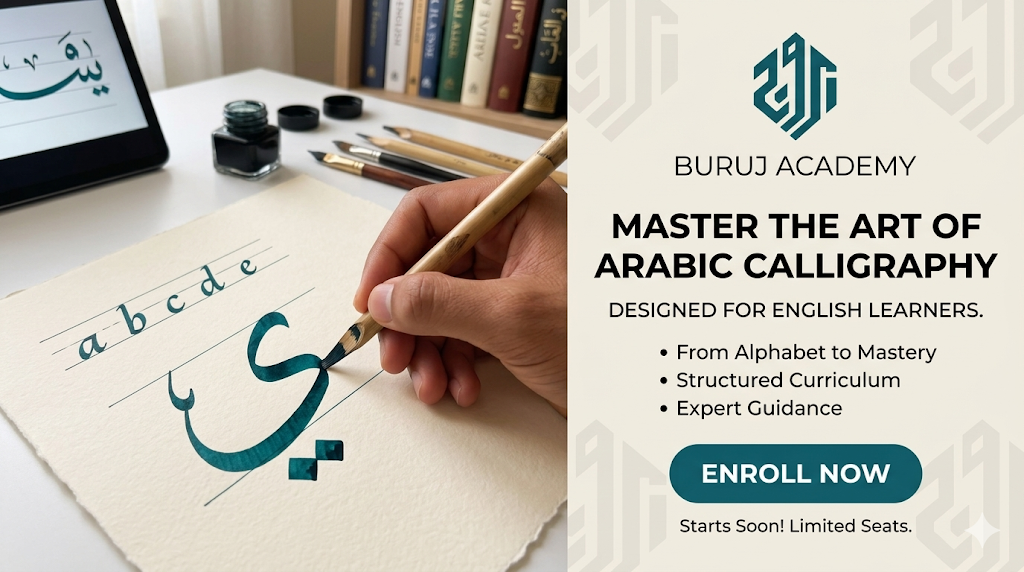
Buruj Academy’s Learn Arabic Writing Course provides systematic writing instruction from sentence-level accuracy through full paragraph and essay production, with written feedback from Al-Azhar-credentialed instructors who identify recurring error patterns before they become fixed habits.
Book your free trial to start writing Arabic
What Is a B2 Level in Arabic?
B2 Arabic represents upper-intermediate proficiency — the level at which a learner can function independently in most standard Arabic contexts without constant support. At B2, a speaker handles formal discussions, reads unvowelized newspaper articles on unfamiliar topics, and writes structured arguments with appropriate cohesive devices.
The defining characteristic of B2 that separates it from B1 is cognitive autonomy: the learner no longer needs to plan sentences consciously before speaking.
Responses come with natural latency, not with the visible effort of real-time translation. Active vocabulary at this point typically ranges from 4,000 to 5,000 words, and passive vocabulary may reach 8,000–10,000 words.
In practical terms, B2 Arabic learners can:
- Follow Al Jazeera news segments without subtitles on familiar topics
- Read formal government documents and academic abstracts
- Write a persuasive opinion piece of 300–400 words in MSA
- Handle unexpected conversational turns without reverting to simpler structures
B2 is also the entry threshold for most Arabic university programs and professional Arabic roles in international organizations.
How Long Does It Take to Learn Arabic to C2?
C2 Arabic — full mastery, equivalent to an educated native speaker — requires approximately 2,200–2,800 hours of structured study from a complete beginner baseline. At 60 minutes daily, that translates to roughly six to eight years of consistent effort. At 90 minutes daily with immersive supplementation, highly motivated learners have reached C1–C2 in four to five years.
This is not a discouraging figure — it is an accurate one. Arabic’s morphological complexity, its vast classical vocabulary layer, and the gap between MSA and spoken dialects mean that C2 represents genuine mastery of a richly layered linguistic system.
| Stage | CEFR Level | Approximate Hours | Daily Study (60 min/day) |
| Beginner | A1–A2 | 150–300 hours | 5–10 months |
| Intermediate | B1–B2 | 300–900 hours | 10 months–2.5 years |
| Advanced | C1 | 900–1,600 hours | 2.5–4.5 years |
| Mastery | C2 | 1,600–2,800 hours | 4.5–8 years |
These estimates assume MSA-focused study. Dialect acquisition runs as a parallel track and does not substitute for formal MSA literacy at advanced levels.
Read also: Arabic Language Levels
Take Your Arabic from Intermediate to Fluent with Buruj Academy
Reaching intermediate Arabic is a real achievement — and the right instruction makes all the difference in how quickly and accurately you get there.
Buruj Academy’s Arabic for Intermediate course is built specifically for learners at this stage, delivering structured B1–B2 progression through grammar, vocabulary, speaking, and writing.
Our teaching team includes Al-Azhar University graduates and instructors with 12+ years of experience teaching non-native speakers globally.
Every session is 1-on-1, scheduled flexibly around your life, and guided by the Buruj Method — context-before-abstraction, consistency-before-speed.
Book your free trial lesson today and get a personalized assessment of exactly where you stand and what to tackle next.
Begin your transformation today by choosing the path that fits your goals:
- Online Arabic Classes (General & Comprehensive)
- Arabic Course for Beginners
- Arabic Alphabet Learning Course
- Online Arabic Classes for Kids
- Arabic Classes for Adults
- Arabic Grammar Course (Nahw & Sarf)
- Intermediate Arabic Course (B1/B2)
- Arabic Speaking Course (Conversational Fluency)
- Arabic Reading Course (Literary Excellence)
- Learn Arabic Writing Course (Calligraphy & Composition)
Ready to speak with confidence? Join the global community at Buruj Academy and book your free placement interview today!
Master the Arabic Language
Join our expert-led courses and build a strong foundation in Classical and Modern Arabic.
Get Your Free TrialConclusion
Intermediate Arabic is not a vague milestone — it is a defined, reachable skill set with grammar patterns, vocabulary targets, and writing benchmarks that learners can systematically pursue. The clearest path through B1 and B2 combines structured grammar study, root-based vocabulary acquisition, regular writing practice, and consistent listening exposure. With the right plan and qualified instruction, the plateau most learners fear at the beginner stage becomes a genuine turning point toward real fluency.
Frequently Asked Questions About Learning Intermediate Arabic
What Is Intermediate Level Arabic?
Intermediate Arabic covers the B1 and B2 bands of the CEFR framework. At this level, learners can hold sustained conversations on familiar topics, read partially or fully unvowelized MSA texts, and write structured paragraphs independently. The defining marker is processing language as meaningful units rather than decoding word by word — a transition that typically arrives between 10 and 18 months of consistent study.
How Long Does It Take to Learn Intermediate Arabic?
Most motivated learners reach B1 intermediate Arabic in 12–18 months of 45–60 minutes of daily structured study. Advancing from B1 to B2 adds another 8–14 months at similar pace. These estimates assume consistent, guided instruction — irregular self-study typically doubles the timeline due to accumulating errors and gaps in systematic grammar progression.
What Arabic Grammar Do I Need at the Intermediate Level?
Intermediate Arabic grammar centers on three systems: the ten verb patterns (أوزان) that govern MSA word formation, the full i’rab case system applied in reading and writing production, and the broken plural patterns that dominate Arabic noun pluralization. Mastery of these three areas allows learners to read authentic texts, produce natural sentences, and analyze unfamiliar vocabulary from its root structure.
What Is a B2 Level in Arabic?
B2 Arabic means upper-intermediate independence — reading unvowelized newspapers, following standard-speed news broadcasts, writing persuasive 300–400 word essays, and managing unexpected conversational turns without reverting to simple structures. Active vocabulary at B2 ranges from 4,000 to 5,000 words, and learners demonstrate this level by functioning in formal Arabic contexts without teacher support.
How Long Does It Take to Learn Arabic to C2?
Reaching C2 Arabic mastery from a beginner baseline requires approximately 2,200–2,800 hours of structured study — roughly six to eight years at one hour daily, or four to five years at 90 minutes daily with immersive supplementation. C2 represents the proficiency of an educated native speaker, encompassing classical vocabulary, formal register control, and full comprehension across all text types.
Related Articles
Arabic