 Arabic

Writing in Modern Standard Arabic (MSA) is a skill that opens doors to academic, professional, and personal success. However, many learners and even native speakers struggle with correct dictation and spelling rules. If you want to improve your Arabic writing and master the art of accurate dictation, we will guide you through this article, and you can check out Buruj Academy’s Arabic courses today!. We’ll explore the importance of dictation and practical strategies for improvement and provide Arabic dictation exercises to help you practice and perfect your skills.
Table of Contents:
Why Improve Arabic Writing with Dictation?
Dictation is more than just a classroom exercise. It’s a foundational skill for anyone who wants to write clearly, correctly, and confidently in Arabic.
Dictation is a tool for all ages. Whether you are a student, adult learner, or parent helping a child, Arabic dictation exercises are flexible and adaptable. They work for both native Arabic speakers looking to polish their writing and non-native learners aiming for literacy or fluency.
These are examples that show why it is important to improve Arabic writing with dictation:
- Accuracy: Arabic has many words that sound similar but are spelled differently. Dictation helps you distinguish between them.
- Grammar Reinforcement: Writing from dictation reinforces grammatical rules and sentence structures.
- Vocabulary Expansion: Regular dictation introduces new words and phrases, expanding your Arabic vocabulary.
- Confidence: Mastering dictation builds confidence in your writing, whether for exams, work, or creative expression.
Buruj Academy’s proven dictation methodology transforms passive script recognition into active writing fluency through structured auditory training. Our Online Arabic Classes use graduated dictation sequences that train your ear to distinguish subtle phonetic differences while simultaneously building orthographic muscle memory for confident, accurate Arabic writing.
Book your FREE Arabic trial online Arabic class at Buruj

Common Challenges in Improve Arabic Writing with Dictation
Before diving into improvement strategies, it’s helpful to understand the common difficulties learners face:
- Confusing Similar Letters: Letters like (س) and (ص), (ذ) and (ز), or (ض) and (ظ) can be tricky.
- Hamza Rules: The placement of the hamza (ء) is one of the most challenging aspects of Arabic spelling.
- Taa Marbouta and Taa Maftouha: Knowing when to use (ة) versus (ت) at the end of words.
- Alif Maqsura and Ya: Distinguishing between (ى) and (ي) at the end of words.
- Silent Letters: Some words contain silent letters that are not pronounced but must be written.
Essential Dictation Rules in Modern Standard Arabic
To improve Arabic writing, it’s important to master the basic rules of dictation. Here are some of the most important:
1. The Hamza (ء) Rules
- Hamza at the Beginning: Always written as (أ) or (إ), depending on the vowel.
- Hamza in the Middle or End: Its placement depends on the surrounding vowels. For example, (سَأَلَ), (مساء), (ماء).
Hamza presents multiple challenges because it appears with different “seats” depending on surrounding vowels: أ إ ؤ ئ ء. Dictation forces attention to the specific phonetic environment that determines correct hamza spelling.
Practice word sets demonstrating hamza rules: أَكَلَ (he ate, hamza on alif), سُئِلَ (he was asked, hamza on ya), مَسْؤُول (responsible, hamza on waw), شَيْء (thing, hamza alone). Repeated exposure through dictation internalizes these patterns more effectively than memorizing abstract rules.
Buruj Academy’s Arabic Grammar Course integrates systematic hamza and ta marbuta dictation throughout instruction, ensuring these challenging features become automatic rather than perpetual sources of error.
Understand the Arabic Grammar with Buruj’s free trial lesson

2. The Alif Maqsura (ى) vs. Ya (ي)
- Alif Maqsura (ى): Appears at the end of some nouns and verbs, pronounced like “a,” e.g., (فتى), (سعى).
- Ya (ي): Used in the middle or end of words, pronounced “ee,” e.g., (يومي), (جدي).
3. Taa Marbouta (ة) vs. Taa Maftouha (ت)
- Taa Marbouta (ة): Used at the end of feminine nouns, e.g., (مدرسة), (سيارة).
- Taa Maftouha (ت): Used for verbs, adjectives, and some nouns, e.g., (كتبت), (بنت).
Ta marbuta sounds identical to regular ta (ت) in pausal form but requires different written representation. Dictation practice using feminine nouns and adjectives trains recognition of grammatical gender cues that signal ta marbuta usage.
Practice distinguishing مَدْرَسَة (school) from مَدْرَسَت (nonexistent form). Listen for the grammatical context: feminine singular nouns typically take ta marbuta, while masculine nouns and sound feminine plurals take regular ta.
4. The Definite Article (ال)
- Sun Letters and Moon Letters: When (ال) is attached to sun letters, the “l” sound is assimilated, e.g., (الشمس), but written the same as with moon letters, e.g., (القمر).
5. Spelling of Plurals
- Sound Masculine Plural: Add (ون) or (ين) to the end, e.g., (معلمون), (معلمين).
- Sound Feminine Plural: Add (ات), e.g., (معلمات).
Discover the Buruj Academy Difference
Step into our virtual classrooms and see how our expert instructors make learning Quran and Arabic intuitive and clear. We focus on overcoming the specific hurdles non-native speakers face, building your confidence and connection with the Quran.
Strategies to Improve Arabic Writing with Dictation
Improving your Arabic writing is a journey that requires patience and consistent practice. Here are proven strategies:
1. Read Regularly
The more you read in Arabic, the more familiar you become with correct spelling, grammar, and style. Read newspapers, books, and reputable websites in Modern Standard Arabic.
2. Write Daily
Set aside time each day to write a short paragraph or diary entry in Arabic. Focus on accuracy, not just speed.
3. Practice Dictation Exercises
Regular dictation exercises are one of the most effective ways to improve spelling and writing skills. Listen to a passage, then write it down, paying close attention to spelling and punctuation.
4. Review and Correct Mistakes
After each dictation or writing exercise, review your work. Identify mistakes and learn the correct forms. Keeping a “mistake journal” can help you track recurring errors.
5. Use Technology
There are many online tools and apps for Arabic writing practice. Use spell checkers, grammar checkers, and language learning platforms to get instant feedback.
6. Start With Single Letter Dictation To Build Foundation
Begin dictation practice by isolating individual Arabic letters in their various positional forms. Your instructor or audio source pronounces a letter while you identify and write its correct shape based purely on sound recognition.
This foundational stage addresses the reality that many Arabic letters sound similar to English speakers. Distinguishing ح from ه or ص from س requires trained auditory discrimination that only targeted listening practice develops.
Practice letters in groups organized by articulation point rather than alphabetical order. Group the throat letters ح ع خ غ together. Practice the emphatic letters ص ض ط ظ as a set. This phonetic grouping trains your ear to distinguish subtle articulation differences.
Write each dictated letter in all four positional forms: isolated, initial, medial, and final. This ensures you’re building complete orthographic knowledge, not just recognizing one shape per sound.
| Letter Group | Example Letters | Articulation Focus |
| Throat letters | ح ع خ غ | Back-of-throat distinctions |
| Emphatic letters | ص ض ط ظ | Heavy vs. light pairs |
| Dental pairs | ت ث د ذ | Tongue position accuracy |
Track accuracy rates for each letter group. When you achieve consistent 90% accuracy with single letters, advance to syllable dictation.
7. Progress To Syllable-Level Dictation For Pattern Recognition
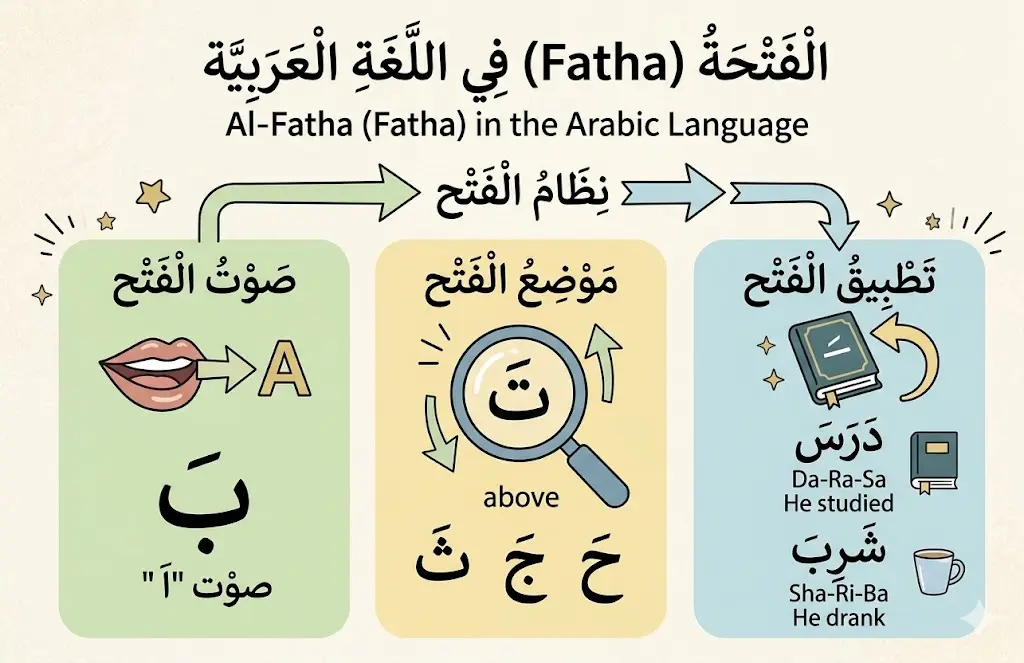
Syllable dictation introduces the critical skill of hearing and representing vowel sounds correctly. Arabic’s three short vowels (fatha, kasra, damma) and three long vowels (alif, ya, waw) create distinct syllable patterns that English speakers often mishear initially.
Your instructor dictates simple consonant-vowel syllables: بَ (ba), تِ (ti), دُ (du). You must hear both the consonant and the vowel, then write the correct consonant with its appropriate vowel mark.
This stage reveals the common error of neglecting vowel marks entirely. Many beginners focus solely on consonants, producing skeletal scripts that native readers find ambiguous. Dictation forces complete representation because you’re working from sound alone without visual reference.
Practice closed syllables next: بَب (bab), تِت (tit), دُد (dud). Then progress to syllables with long vowels: با (baa), تي (tee), دو (doo). This progression builds systematic recognition of Arabic’s fundamental syllable structures.
Through Buruj Academy’s Learn Arabic Writing Course, students master syllable-level dictation using authentic Arabic syllable patterns rather than artificial practice words, ensuring transferred skills apply directly to real vocabulary writing.
Master Arabic writing with a free Buruj trial

8. Practice Word-Level Dictation With Familiar Vocabulary
Word dictation combines the skills developed through letter and syllable practice while adding the challenge of word boundaries and connected script. Begin with highly familiar two-letter and three-letter words you’ve already learned to read.
Your instructor dictates simple nouns like بيت (house), كتاب (book), قلم (pen). You must segment the spoken word into its component sounds, recall each letter’s appropriate positional form, and execute proper letter connectivity.
This stage highlights the importance of knowing vocabulary aurally before attempting to write it. Dictating unfamiliar words creates guesswork rather than genuine orthographic development. Always practice dictation with words you’ve heard multiple times and can pronounce correctly yourself.
Vary practice between isolated words and words embedded in short phrases. Hearing أَكَلَ alone differs from hearing أَكَلَ الوَلَدُ. Contextual dictation trains your ear to parse continuous speech into discrete words—essential for real-world writing applications.
| Word Length | Example Vocabulary | Script Challenges Addressed |
| 2 letters | في، ما، لا | Minimal connectivity practice |
| 3 letters | بيت، ولد، يوم | Basic connectivity patterns |
| 4-5 letters | كتاب، مدرسة، طالب | Complex connectivity, hamza placement |
Create personal dictation word lists organized by orthographic feature: words with hamza, words with ta marbuta, words with sun letter assimilation. This targeted practice accelerates mastery of Arabic spelling conventions.
9. Combine Dictation With Immediate Feedback For Acceleration
Dictation effectiveness multiplies when paired with immediate, specific feedback. Writing without knowing whether you’ve succeeded creates ambiguous learning that may reinforce errors rather than correct them.
After completing each dictation exercise, immediately check against the correct version. Don’t wait until session end to review accumulated work. Immediate feedback creates stronger error correction learning.
When checking dictation, mark errors but also analyze them. Why did you write ت instead of ة? Did you mishear the vowel or forget the grammatical rule? Understanding error sources enables targeted correction.
Create correction routines that address specific mistake types. If you consistently confuse similar letters, practice isolation drills for those pairs. If vowel marks are frequently omitted, practice vowel-only dictation where you write just the diacritical marks.
Self-correction develops metacognitive skills essential for independent learning. Before checking against the answer key, reread your dictated text carefully. Can you identify likely errors yourself? This self-monitoring ability transfers to free composition.
Read Also: Beginner’s Guide to Modern Standard Arabic
Key Dictation Rules for Improvment
- Set Clear Goals: Decide what you want to achieve each week (e.g., master hamza rules, improve speed).
- Be Patient: Improvement takes time, so celebrate small victories.
- Seek Feedback: Ask teachers or native speakers to review your writing.
- Stay Motivated: Reward yourself for progress and keep your learning enjoyable.
Read Also: Learn Nahw and Sarf online
Improve Arabic Writing with Dictation: Why It Matters
Dictation is a powerful and time-tested method to enhance your proficiency in Modern Standard Arabic writing.
It involves listening carefully to spoken Arabic and accurately transcribing it, which helps learners internalize correct spelling, grammar, and punctuation. This focused practice sharpens your ability to distinguish between similar-sounding letters and words—a common challenge in Arabic—while reinforcing essential language rules. As a result, dictation plays a crucial role in improving Arabic writing by building accuracy and fluency over time.
Beyond accuracy, dictation exercises also improve your listening comprehension and vocabulary. By regularly engaging with spoken Arabic, learners become more attuned to pronunciation nuances and sentence structures, which directly translates into better writing skills. This dual benefit makes dictation an efficient tool for language learners who want to strengthen multiple skills simultaneously. Moreover, dictation encourages active engagement with the language, which leads to greater retention of new words and grammatical patterns.
Another important reason dictation matters is that it fosters confidence and reduces common writing errors. Research shows that students who practice Arabic dictation consistently make fewer spelling and grammar mistakes, leading to clearer and more polished writing. This confidence boost motivates learners to write more frequently and with less hesitation, accelerating their overall language development.
Read Also: Mastering Arabic Vocabs
Master the Arabic Language
Develop reading, writing, speaking, and comprehension skills through interactive Arabic lessons for all levels.
Start Arabic ClassesRead Also: How to Learn Arabic Grammar Easily: A beginner Friendly Guide
Master Arabic Writing Through Systematic Dictation With Buruj Academy’s Expert Guidance
Dictation transforms Arabic writing from tentative, error-prone effort into confident, accurate expression. This powerful technique develops the auditory discrimination, orthographic knowledge, and motor fluency that characterize advanced Arabic literacy.
Buruj Academy’s Learn Arabic Writing Course implements graduated dictation sequences proven effective with thousands of adult learners.
Our Al-Azhar-trained instructors with 12+ years experience provide personalized dictation practice calibrated precisely to your current level and specific error patterns.
Each one-on-one session includes targeted dictation exercises, immediate expert feedback, and customized correction drills addressing your individual challenges.
Find your perfect match among Buruj’s top Arabic courses:
- Arabic Classes for Adults
- Arabic Course for Beginners
- Alphabet course
- Arabic Grammar
- Reading Arabic fluently
- Speaking Arabic fluently
- Arabic writing

Final Thoughts: Dictation brings Real writing results
Improving Arabic writing isn’t only about memorizing grammar rules. it’s about developing an ear for the language and transforming what you hear into accurate, structured writing. Dictation is a proven path to mastery in Modern Standard Arabic. By understanding the rules, practicing regularly with Arabic dictation exercises, and reviewing your work, you’ll see significant progress in your spelling, grammar, and overall writing confidence. Remember: every great writer started with the basics—so keep practicing, stay curious, and enjoy your journey to Arabic writing excellence!
Dictation practice provides the systematic auditory-to-orthographic training that separates tentative Arabic writers from confident ones. Beginning with isolated letters and progressing through syllables, words, sentences, and paragraphs builds the comprehensive skill set required for accurate Arabic writing.
Related Articles
Arabic





Leave a Reply