 Arabic
| Key Takeaways |
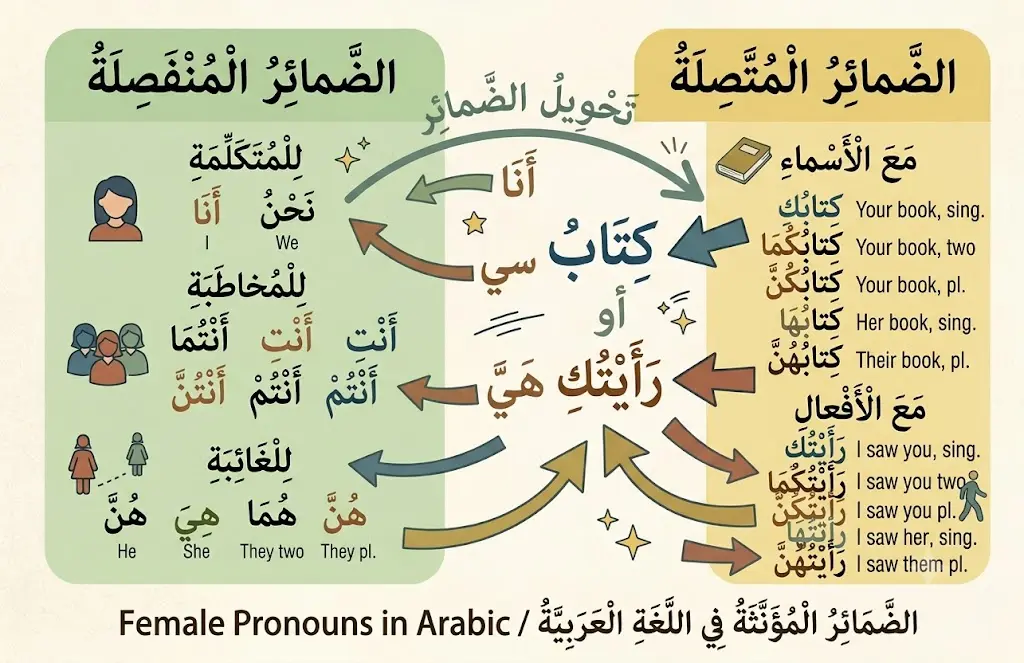
| Arabic has two distinct third-person singular female pronouns: هِيَ (hiya) meaning “she” and its attached form ـهَا (-hā) meaning “her/her.” |
| The second-person female pronoun أَنْتِ (anti) differs from the male أَنْتَ (anta) only by a short kasra vowel on the final letter. |
| Female pronouns in Arabic trigger specific verb conjugations and adjective endings that differ entirely from their masculine equivalents. |
| Attached female pronouns like ـكِ (-ki) and ـهَا (-hā) are suffixed directly onto nouns, verbs, and prepositions — they never stand alone. |
Arabic grammar makes gender central to every sentence — and for learners coming from English, that is one of the first genuinely surprising features of the language. Knowing a few vocabulary words is not enough; Arabic requires you to match pronouns, verbs, and adjectives to the gender of the subject every time.
Female pronouns in Arabic are a precise, rule-governed system. Once you understand the complete set — independent forms, attached forms, pronunciation, and agreement patterns — you gain the ability to produce grammatically correct Arabic sentences about any female subject with confidence.
Table of Contents:
What Are Female Pronouns in Arabic?
Female pronouns in Arabic function as grammatical markers that determine the form of every other word in the sentence. Arabic has three grammatical persons (first, second, third), two genders (masculine and feminine), and three numbers (singular, dual, plural) — and female pronouns exist across all of these categories.
For learners of Modern Standard Arabic, mastering female pronouns unlocks accurate verb conjugation, correct adjective agreement, and natural sentence construction.
In our Arabic Online Classes, students frequently arrive with a working list of vocabulary but no framework for gender agreement.
The moment they internalize female pronouns as triggers — not just labels — their sentence accuracy improves noticeably.
Book your FREE Arabic trial online Arabic class at Buruj

Arabic female pronouns divide into two structural types:
Independent pronouns stand alone as the subject of a sentence — like “she” in English.
Attached pronouns (ḍamā’ir muttaṣila) are suffixes joined directly to verbs, nouns, or prepositions — they carry meanings like “her,” “your (f.),” or “you (f.).”
The table below maps the complete female pronoun inventory in MSA:
| Person | Arabic Pronoun | Transliteration | English Meaning |
| 3rd person singular (f.) | هِيَ | hiya | she |
| 3rd person singular (f.) attached | ـهَا | -hā | her / hers |
| 2nd person singular (f.) | أَنْتِ | anti | you (f.) |
| 2nd person singular (f.) attached | ـكِ | -ki | you / your (f.) |
| 1st person singular (shared) | أَنَا | anā | I |
| 1st person singular attached | ـي / ـنِي | -ī / -nī | me / my |
| 3rd person plural (f.) | هُنَّ | hunna | they (f.) |
| 3rd person plural (f.) attached | ـهُنَّ | -hunna | them / their (f.) |
| 2nd person plural (f.) | أَنْتُنَّ | antunna | you all (f.) |
The first-person pronouns (أَنَا / ـي) are gender-neutral in form; gender agreement is shown instead on the verb or adjective.
Read also:Different Types of Arabic Nouns
How Do You Say “She” and “Her” in Arabic?
“She” in Arabic is هِيَ (hiya) — an independent pronoun used when the female subject is the topic of the sentence. “Her” in Arabic is expressed through the attached pronoun ـهَا (-hā), which is added as a suffix to verbs, nouns, and prepositions.
These two forms cover the majority of female pronoun usage a learner encounters in everyday Arabic.
Here are practical sentence examples contrasting both forms:
Using هِيَ (hiya) — “she”:
| Arabic Sentence | Transliteration | English Meaning |
| هِيَ طَالِبَةٌ. | Hiya ṭālibatun. | She is a student. |
| هِيَ تَذْهَبُ إِلَى الْمَدْرَسَةِ. | Hiya tadhhabu ilā al-madrasa. | She goes to school. |
| هِيَ مُعَلِّمَةٌ مَاهِرَةٌ. | Hiya muʿallima māhiratun. | She is a skilled teacher. |
| هِيَ تَقْرَأُ الْكِتَابَ. | Hiya taqraʾu al-kitāba. | She reads the book. |
Using ـهَا (-hā) — “her”:
| Arabic Sentence | Transliteration | English Meaning |
| رَأَيْتُهَا. | Raʾaytuhā. | I saw her. |
| أَعْطَيْتُهَا الْكِتَابَ. | Aʿṭaytuhā al-kitāba. | I gave her the book. |
| بَيْتُهَا كَبِيرٌ. | Baytuhā kabīrun. | Her house is big. |
| كَلَّمْتُهَا أَمْسِ. | Kallamtuhā amsi. | I spoke to her yesterday. |
Notice that ـهَا attaches directly to the end of the verb or noun with no space. This is one of the first patterns we train students on in our Arabic Grammar Course — recognizing and producing attached pronouns fluently.
Understand the Arabic Grammar with Buruj’s free trial lesson
How Are Female Pronouns Written in Arabic Letters?
Female pronouns in Arabic letters follow clear, learnable script patterns. Each pronoun has a consistent written form, and recognizing these shapes in text is a foundational reading skill.
For a solid grounding in Arabic script first, our Arabic Alphabet Learning Course builds letter recognition before grammar concepts are introduced.
| Pronoun | Arabic Script | Key Letter Features |
| هِيَ (hiya) | هـ + يـ + ـا | Hā’ + yā’ + alif |
| ـهَا (-hā) | ـهَا | Hā’ with alif — always suffixed |
| أَنْتِ (anti) | أ + نـ + تِ | Alif + nūn + tā’ with kasra |
| ـكِ (-ki) | ـكِ | Kāf with kasra — always suffixed |
| هُنَّ (hunna) | هـ + نَّ | Hā’ + shaddah on nūn |
One detail that confuses beginners: أَنْتِ (anti, “you” feminine) and أَنْتَ (anta, “you” masculine) are written with the same letters — the only written distinction is the vowel mark on the final تِ (kasra for feminine) versus تَ (fatḥa for masculine).
In unvowelled text, context determines which is meant. This is precisely why learning to read vowelled Arabic first is so important for grammar learners.
Read also: Attached and Detached Pronouns in Arabic
Discover the Buruj Academy Difference
Step into our virtual classrooms and see how our expert instructors make learning Quran and Arabic intuitive and clear. We focus on overcoming the specific hurdles non-native speakers face, building your confidence and connection with the Quran.
Master the Arabic Language
Join our expert-led courses and build a strong foundation in Classical and Modern Arabic.
Get Your Free TrialHow Do You Pronounce Female Pronouns in Arabic?
Female pronoun pronunciation in Arabic rests on three key sounds that learners must distinguish clearly: the short kasra (ِ) beneath ك in ـكِ, the long ā in ـهَا, and the doubled nūn in هُنَّ and أَنْتُنَّ.
Mispronouncing these creates genuine grammatical ambiguity — especially confusing هِيَ (hiya, “she”) with هُوَ (huwa, “he”).
| Pronoun | Pronunciation Tips | Common Error |
| هِيَ (hiya) | Short hi + soft ya | Pronouncing as “hee-ya” with long vowel |
| ـهَا (-hā) | Long open ā sound | Shortening to “ha” — loses the length |
| أَنْتِ (anti) | Stress on AN, final kasra on tī | Saying “anta” (masculine) |
| ـكِ (-ki) | Very short ki with kasra | Merging with previous syllable |
| هُنَّ (hunna) | Double nūn — hold the sound | Single n — loses the shaddah |
In our experience at Arabic Speaking Classes teaching Arabic pronunciation to non-native speakers, the most consistent error is students saying أَنْتَ (masculine “you”) when addressing a female — a natural mistake when you haven’t yet internalized that the final vowel carries grammatical weight.
Drilling these contrasts in pairs is the most efficient correction technique we use.
Book your free trial to start speaking Arabic fluently

How Do Female Pronouns Change Arabic Verbs?
Female pronouns in Arabic require specific verb conjugations that differ completely from masculine forms. When هِيَ (she) is the subject, the verb takes a prefix تـ (ta-) in the present tense and a suffix ـَت (-at) in the past tense.
This agreement is non-negotiable in Standard Arabic — a masculine verb form with a feminine subject is a grammatical error.
Understanding verb conjugation connects directly to Arabic tenses — and gender agreement applies across all three.
Past Tense — Third Person Singular:
| Subject | Arabic Verb (to write) | Transliteration | English |
| هُوَ (he) | كَتَبَ | kataba | He wrote |
| هِيَ (she) | كَتَبَتْ | katabat | She wrote |
The feminine suffix ـَتْ (-at) is the key marker. Examples across common verbs:
| Verb Root | هُوَ (he) | هِيَ (she) |
| ذَهَبَ (to go) | ذَهَبَ | ذَهَبَتْ |
| قَرَأَ (to read) | قَرَأَ | قَرَأَتْ |
| جَلَسَ (to sit) | جَلَسَ | جَلَسَتْ |
| عَمِلَ (to work) | عَمِلَ | عَمِلَتْ |
For Arabic past tense practice, the ـَتْ suffix is one of the first feminine markers to internalize.
Present Tense — Third Person Singular:
| Subject | Arabic Verb (to study) | Transliteration | English |
| هُوَ (he) | يَدْرُسُ | yadrusu | He studies |
| هِيَ (she) | تَدْرُسُ | tadrusu | She studies |
The prefix shifts from يـ (ya-) for masculine to تـ (ta-) for feminine. This pattern holds across the entire Arabic present tense system.
How Do Female Pronouns Affect Arabic Adjectives?
Arabic adjectives must agree in gender with the noun or pronoun they describe. When a female pronoun or feminine noun is the subject, the adjective takes the feminine form — typically formed by adding ة (tā’ marbūṭa) to the masculine base.
This connects directly to the broader system of masculine and feminine nouns in Arabic.
| Masculine Form | Feminine Form | Meaning |
| كَبِيرٌ (kabīrun) | كَبِيرَةٌ (kabīratun) | big |
| جَمِيلٌ (jamīlun) | جَمِيلَةٌ (jamīlatun) | beautiful |
| سَرِيعٌ (sarīʿun) | سَرِيعَةٌ (sarīʿatun) | fast |
| ذَكِيٌّ (dhakiyyun) | ذَكِيَّةٌ (dhakiyyatun) | intelligent |
Example sentences showing pronoun-adjective agreement:
هِيَ طَالِبَةٌ ذَكِيَّةٌ
(Hiya ṭālibatun dhakiyyatun.)
“She is an intelligent student.”
هِيَ مُدِيرَةٌ مَشْهُورَةٌ
(Hiya mudīratun mashhūratun.)
“She is a famous director.”
Every element agrees: the pronoun هِيَ triggers a feminine noun (طَالِبَةٌ / مُدِيرَةٌ) which in turn triggers a feminine adjective. This chain of agreement is what Arabic grammar calls al-muṭābaqah (المطابقة).
Female Pronouns in Arabic and English
One of the clearest ways to internalize the Arabic female pronoun system is to map it directly against its English equivalents.
English has three distinct female pronoun forms — she, her, hers — while Arabic distributes these meanings across independent and attached pronoun forms.
| English Pronoun | Function | Arabic Equivalent | Form Type |
| She | Subject | هِيَ (hiya) | Independent |
| Her | Object of verb | ـهَا (-hā) | Attached to verb |
| Her / Hers | Possessive | ـهَا (-hā) | Attached to noun |
| You (f. singular) | Subject | أَنْتِ (anti) | Independent |
| Your (f. singular) | Possessive | ـكِ (-ki) | Attached to noun |
| They (f. plural) | Subject | هُنَّ (hunna) | Independent |
| Their (f. plural) | Possessive | ـهُنَّ (-hunna) | Attached to noun |
A key structural difference: English uses the same form “her” for both object (“I saw her”) and possessive (“her book”). Arabic uses ـهَا for both but the grammatical role is determined by what it attaches to — a verb signals object; a noun signals possession.
Read also:How Definite Pronouns Work in Arabic
Practice Exercises for Female Pronouns in Arabic
Structured practice is how grammar rules become instinctive. The following exercises are designed for self-study reinforcement — the same activity types our instructors use in live sessions.
Exercise 1: Fill in the Correct Pronoun
Choose هِيَ, أَنْتِ, or هُنَّ to complete each sentence:
- ____ تَذْهَبِينَ إِلَى السُّوقِ. (You (f.) are going to the market.)
- ____ طَبِيبَةٌ مَشْهُورَةٌ. (She is a famous doctor.)
- ____ يَذْهَبْنَ إِلَى الْمَدْرَسَةِ. (They (f.) go to school.)
Answers:
1. أَنْتِ 2. هِيَ 3. هُنَّ
Exercise 2: Attach the Correct Pronoun Suffix
Add the correct attached pronoun (ـهَا or ـكِ) to complete the meaning:
- كِتَاب____ جَمِيلٌ. (Her book is beautiful.)
- سَأَلْتُ____ عَنِ الدَّرْسِ. (I asked you (f.) about the lesson.)
- بَيْت____ قَرِيبٌ. (Her house is nearby.)
Answers:
1. كِتَابُهَا 2. سَأَلْتُكِ 3. بَيْتُهَا
Exercise 3: Conjugate the Verb for هِيَ
Convert each masculine past-tense verb to the feminine form:
| Masculine (هُوَ) | Feminine (هِيَ) |
| ذَهَبَ | ____ |
| كَتَبَ | ____ |
| فَهِمَ | ____ |
Answers: ذَهَبَتْ / كَتَبَتْ / فَهِمَتْ
Read also: Arabic Subject and Object Pronouns
Master Arabic Grammar with Buruj Academy’s Expert Instructors
Arabic pronouns, agreement rules, and conjugation patterns become intuitive with the right structured guidance.
Buruj Academy’s Arabic Grammar Course teaches gender agreement, pronoun systems, and sentence construction systematically — tailored for English-speaking learners from beginner to advanced.
Our Al-Azhar University graduates with 12+ years teaching non-native speakers use the Buruj Method’s context-before-abstraction approach, ensuring rules are learned through meaningful use — not memorization.
Sessions are personalized, 1-on-1, and flexibly scheduled.
Book your free trial lesson and experience structured Arabic learning that actually sticks.
Begin your transformation today by choosing the path that fits your goals:
- Online Arabic Classes (General & Comprehensive)
- Arabic Course for Beginners
- Arabic Alphabet Learning Course
- Online Arabic Classes for Kids
- Arabic Classes for Adults
- Arabic Grammar Course (Nahw & Sarf)
- Intermediate Arabic Course (B1/B2)
- Arabic Speaking Course (Conversational Fluency)
- Arabic Reading Course (Literary Excellence)
- Learn Arabic Writing Course (Calligraphy & Composition)
Ready to speak with confidence? Join the global community at Buruj Academy and book your free placement interview today!
Master the Arabic Language
Join our expert-led courses and build a strong foundation in Classical and Modern Arabic.
Get Your Free TrialConclusion
Female pronouns in Arabic are not just vocabulary — they are grammatical switches that affect verbs, adjectives, and the structure of every sentence they enter. The independent forms هِيَ and أَنْتِ anchor the subject; the attached forms ـهَا and ـكِ carry possessive and object meanings.
Frequently Asked Questions About Female Pronouns in Arabic
What Is the Difference Between هِيَ and ـهَا in Arabic?
هِيَ (hiya) is the independent pronoun meaning “she,” used as the grammatical subject of a sentence. ـهَا (-hā) is the attached pronoun meaning “her” or “hers,” suffixed to verbs, nouns, or prepositions. They cannot substitute for each other — one is a subject form, the other is an object or possessive form.
How Do You Say “Her” in Arabic When It Means Possession?
To express possession — “her book,” “her house” — attach ـهَا (-hā) directly to the noun: كِتَابُهَا (her book), بَيْتُهَا (her house). The suffix replaces the indefinite nunation (tanwīn) and indicates that the noun belongs to her. This is the standard possessive construction in Modern Standard Arabic.
Does Arabic Have a Neutral Pronoun Like “They” in English?
Arabic does not have a singular gender-neutral pronoun equivalent to the English singular “they.” Arabic grammar assigns gender to every noun and requires agreement — a grammatical feature that is structurally built into the language. The plural هُنَّ refers specifically to an all-female or female-majority group.
How Do I Know When to Use أَنْتِ vs. أَنْتَ in Arabic?
أَنْتِ (anti) addresses a female — note the kasra (ِ) beneath the final تِ. أَنْتَ (anta) addresses a male — note the fatḥa (َ) on the final تَ. In vowelled text, the distinction is clear. In unvowelled text, context — including the verb conjugation that follows — determines the correct reading.