 Arabic
| Key Takeaways |
| Arabic has 12 subject pronouns covering singular, dual, and plural forms for first, second, and third person. |
| Subject pronouns in Arabic are often embedded inside verb conjugations, making the standalone pronoun optional but emphatic when used. |
| Arabic object pronouns are attached suffixes (ضمائر المتصلة), not standalone words — they attach directly to verbs, prepositions, and nouns. |
| Gender distinction is mandatory in Arabic pronouns: second and third person forms differ for masculine and feminine in both subject and object systems. |
Knowing when to say “he,” “she,” or “they” in English is automatic. In Arabic, pronouns carry far more grammatical weight — they change verb forms, attach to words as suffixes, and mark gender distinctions that English ignores entirely.
Arabic subject pronouns and object pronouns operate through two distinct grammatical systems.
Subject pronouns (ضمائر الرفع) function as sentence actors, while object pronouns (ضمائر النصب) attach as suffixes to verbs and prepositions — and mastering both systems is what separates functional Arabic speakers from perpetual beginners.
Table of Contents:
What Are Arabic Subject Pronouns?
Arabic subject pronouns are the words that identify who performs an action in a sentence. They include أنا (I), أنتَ (you, masculine), هو (he), and their full family of related forms.
Unlike English, Arabic subject pronouns carry built-in gender and number information, making them grammatically active elements rather than simple identifiers.
When a verb is conjugated, the pronoun is technically embedded inside the verb ending — saying أنا before a conjugated verb adds emphasis, not grammatical necessity.
This is one of the most important early distinctions we teach at Buruj Academy. Beginners frequently assume Arabic sentences require a subject pronoun the way English does. They don’t. “ذَهَبَ” (he went) is a complete sentence — the “he” is already inside the verb form.
Our Online Arabic Grammar Course builds exactly this foundation through structured, step-by-step instruction.
Understand the Arabic Grammar with Buruj’s free trial lesson
What Does the Complete Arabic Subject Pronouns List Look Like?
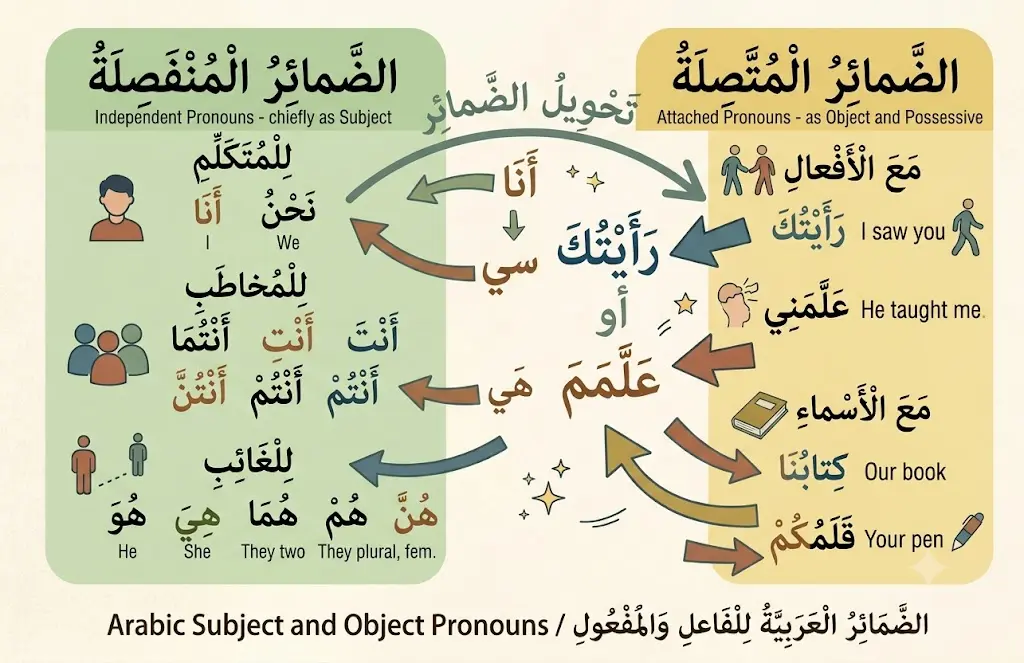
The full Arabic subject pronoun system covers three persons, two genders, and three numbers (singular, dual, plural). This table is the foundation — memorize it before attempting verb conjugation.
| Person | Arabic Pronoun | Transliteration | Meaning |
| 1st — Singular | أنا | Ana | I |
| 1st — Plural | نحن | Nahnu | We |
| 2nd — Masc. Singular | أنتَ | Anta | You (m.) |
| 2nd — Fem. Singular | أنتِ | Anti | You (f.) |
| 2nd — Dual | أنتُما | Antuma | You two |
| 2nd — Masc. Plural | أنتُم | Antum | You (m. pl.) |
| 2nd — Fem. Plural | أنتُنَّ | Antunna | You (f. pl.) |
| 3rd — Masc. Singular | هو | Huwa | He / It (m.) |
| 3rd — Fem. Singular | هي | Hiya | She / It (f.) |
| 3rd — Dual | هُما | Huma | They two |
| 3rd — Masc. Plural | هُم | Hum | They (m.) |
| 3rd — Fem. Plural | هُنَّ | Hunna | They (f.) |
Three features demand your attention immediately.
First, Arabic has no equivalent to the English gender-neutral “you” — every second-person address specifies masculine or feminine.
Second, the dual forms (أنتُما and هُما) have no English equivalent at all. Third, first-person pronouns (أنا and نحن) carry no gender distinction.
If you’re just starting out with Arabic grammar fundamentals, our guide on how to learn Arabic grammar easily provides essential context before working with pronoun systems.
How Do Arabic Subject Pronouns Work in Real Sentences?
Arabic subject pronouns appear most clearly in nominal sentences (الجملة الاسمية) — sentences built around a subject and predicate without a conjugated verb. In verbal sentences, the pronoun is optional and emphatic.
Here are varied examples showing the pronoun in action across different contexts:
Subject Pronoun Examples in Nominal Sentences
| Arabic Sentence | Transliteration | English Meaning |
| أنا طالبٌ | Ana ṭālibun | I am a student. |
| هي مُعلِّمةٌ | Hiya mu’allimah | She is a teacher. |
| هم في المدرسة | Hum fil-madrasa | They are at school. |
| نحن أصدقاء | Nahnu aṣdiqā’ | We are friends. |
| أنتِ ذكيَّةٌ | Anti dhakiyyah | You (f.) are smart. |
Read also:Types of Nouns in Arabic
Subject Pronoun Examples with Verbs (Emphatic Use)
| Arabic Sentence | Transliteration | English Meaning | Note |
| هو كَتَبَ الرسالة | Huwa kataba l-risālah | He wrote the letter. | Emphasis on “he” |
| أنا أكلتُ الطعام | Ana akaltu ṭ-ṭa’ām | I ate the food. | Pronoun reinforces verb ending |
| أنتُم تعلَّمتُم جيداً | Antum ta’allamtum jayyidan | You all learned well. | Emphasis on plural subject |
Notice in the verbal examples that removing the pronoun entirely leaves a grammatically correct sentence. “كتب الرسالة” means “he wrote the letter” — the هو is pure emphasis. This “pronoun-inside-the-verb” feature is one reason Arabic tenses feel complex to English speakers at first.
What Are Object Pronouns in Arabic?
Object pronouns in Arabic are attached suffixes that indicate who or what receives the action of a verb. They are called ضمائر متصلة (connected/attached pronouns), and they never stand alone — they bond directly to the end of verbs, prepositions, and sometimes nouns.
This is the point where Arabic object pronouns diverge most sharply from English. In English, “him,” “her,” and “them” are separate words. In Arabic, the equivalent information is a short suffix glued to the word before it: ضَرَبَهُ means “he hit him” — the هُ suffix is the entire object pronoun.
Understanding this attached system is essential for Arabic sentence structure and real reading fluency.
In our sessions at Buruj Academy, the attached pronoun system is where intermediate students most commonly stall.
The issue is almost always the same: students learn the suffix table but struggle to attach suffixes correctly when the verb ends in a long vowel or when the noun requires a connecting vowel.
We address this systematically in our Online Arabic Classes through repeated production practice before moving to grammar rules.
Book your FREE Arabic trial online Arabic class at Buruj

What Is the Full Object Pronouns in Arabic Grammar System?
The Arabic object pronoun suffixes follow a consistent pattern. These same suffixes attach to verbs (as direct objects), prepositions (as objects of prepositions), and nouns (as possessives — a related but distinct use).
| Person | Suffix | Pronunciation | Meaning | Example | Translation |
| 1st — Singular | ـني / ـي | -nī / -ī | me | سألني | He asked me. |
| 1st — Plural | ـنا | -nā | us | سألنا | He asked us. |
| 2nd — Masc. Sg. | ـكَ | -ka | you (m.) | سألكَ | He asked you (m.). |
| 2nd — Fem. Sg. | ـكِ | -ki | you (f.) | سألكِ | He asked you (f.). |
| 2nd — Dual | ـكُما | -kumā | you two | سألكُما | He asked you two. |
| 2nd — Masc. Pl. | ـكُم | -kum | you (m. pl.) | سألكُم | He asked you all (m.). |
| 2nd — Fem. Pl. | ـكُنَّ | -kunna | you (f. pl.) | سألكُنَّ | He asked you all (f.). |
| 3rd — Masc. Sg. | ـهُ | -hu | him / it (m.) | سألهُ | He asked him. |
| 3rd — Fem. Sg. | ـها | -hā | her / it (f.) | سألها | He asked her. |
| 3rd — Dual | ـهُما | -humā | them two | سألهُما | He asked them two. |
| 3rd — Masc. Pl. | ـهُم | -hum | them (m.) | سألهُم | He asked them (m.). |
| 3rd — Fem. Pl. | ـهُنَّ | -hunna | them (f.) | سألهُنَّ | He asked them (f.). |
A critical technical note: the first-person singular suffix has two forms. After a consonant-ending verb, use ـني (-nī): ضَرَبَنِي (he hit me).
After a vowel-ending verb or preposition, use ـي (-ī): كتابي (my book). This alternation trips up nearly every learner initially.
Read also: Female Pronouns in Arabic
Discover the Buruj Academy Difference
Step into our virtual classrooms and see how our expert instructors make learning Quran and Arabic intuitive and clear. We focus on overcoming the specific hurdles non-native speakers face, building your confidence and connection with the Quran.
Master the Arabic Language
Join our expert-led courses and build a strong foundation in Classical and Modern Arabic.
Get Your Free TrialRead also:Verbal Nouns in Arabic
How Do Object Pronouns in Arabic Work with Real Examples?
The attached pronoun system becomes natural quickly once you see it across different grammatical contexts — verbs, prepositions, and the bridge to possessives.
Arabic Object Pronoun Examples Attached to Verbs
| Arabic | Transliteration | English | Pronoun Suffix |
| شَاهَدَهُ | Shāhadahu | He saw him. | ـهُ (him) |
| سَمِعَتْها | Sami’at-hā | She heard her. | ـها (her) |
| عَلَّمَنا | ‘Allamanā | He taught us. | ـنا (us) |
| أَحَبَّكَ | Aḥabbaka | He loved you (m.). | ـكَ (you, m.) |
| فَهِمْتُهُم | Fahimtuhum | I understood them. | ـهُم (them, m.) |
Read also:Understanding Indefinite Pronouns in Arabic
Arabic Object Pronoun Examples Attached to Prepositions
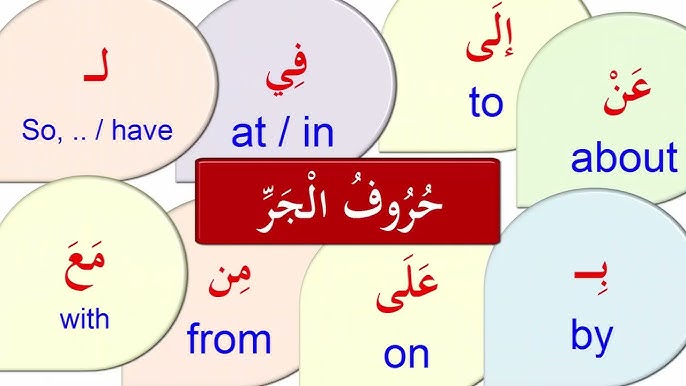
Prepositions in Arabic also take attached pronouns. This is object pronouns in Arabic grammar applied to prepositional phrases — a structure English learners often overlook:
| Arabic | Transliteration | English | Preposition |
| مَعَهُ | Ma’ahu | With him | مع (with) |
| عَلَيْها | ‘Alayhā | On her / Upon her | على (on) |
| لَنا | Lanā | For us | لـ (for) |
| مِنْكَ | Minka | From you (m.) | من (from) |
| فيكُم | Fīkum | In you all (m.) | في (in) |
Preposition + pronoun combinations appear constantly in daily Arabic speech. Phrases like “معك” (with you) and “عليه” (upon him) are indispensable early vocabulary for anyone working toward improving Arabic speaking skills.
How Do You Tell the Difference Between Subject and Object Pronouns in Arabic?
The functional rule is straightforward: subject pronouns perform the action; object pronouns receive it. In Arabic grammar terms, subject pronouns occupy the nominative case (مرفوع) position, while object pronouns occupy the accusative case (منصوب) position — whether as verb objects or prepositional objects.
| Feature | Subject Pronouns (ضمائر الرفع) | Object Pronouns (ضمائر النصب) |
| Form | Standalone independent words | Attached suffixes |
| Position | Before or after verb as actor | Suffixed to verb, noun, or preposition |
| Case | Nominative (مرفوعة) | Accusative/Genitive (منصوبة / مجرورة) |
| Example | هو كتب (He wrote) | كتب لهُ (He wrote to him) |
| Required? | Optional in verbal sentences | Yes — no standalone equivalent |
The clearest diagnostic: if you can remove the pronoun and the sentence remains complete and grammatical, it was a subject pronoun.
Object pronoun suffixes, by contrast, cannot be removed without breaking the sentence or leaving a dangling preposition.
Understanding these case distinctions connects directly to broader Arabic grammar — our article on Arabic grammatical concepts for beginners extends these foundations into practical application.
Practice Exercises: Arabic Subject and Object Pronouns
These exercises build the production habit. Work through each set before checking the answers below.
Exercise 1 — Fill in the Correct Subject Pronoun
Complete each sentence with the correct Arabic subject pronoun:
- _____ طالبٌ في الجامعة. (He is a student at university.)
- _____ نذهب إلى المسجد. (We go to the mosque.)
- _____ مُعلِّمةٌ ماهرة. (She is a skilled teacher.)
- _____ تَعلَّمتِ العربية. (You [f.] learned Arabic.)
- _____ في البيت. (They [m. pl.] are at home.)
Answers:
1. هو 2. نحن 3. هي 4. أنتِ 5. هُم
Exercise 2 — Attach the Correct Object Pronoun Suffix
Attach the appropriate suffix to complete each sentence:
- شاهَدَ ـ _____ (He saw me.)
- أَعطى ـ _____ الكتاب. (He gave her the book.)
- سَأَلَ ـ _____ (He asked us.)
- كَتَبَ ـ _____ رسالة. (He wrote you [m.] a letter.)
- عَلَّمَ ـ _____ (He taught them [m. pl.])
Answers:
1. شاهدني 2. أعطاها 3. سألنا 4. كتبكَ 5. علَّمهُم
Exercise 3 — Translate Using Both Systems
Translate these English sentences into Arabic, choosing the correct pronoun type:
- She is my teacher. (nominal sentence — subject pronoun)
- He saw us. (verb + object pronoun suffix)
- The book is for them (m.). (preposition + object pronoun suffix)
Answers:
- هي مُعلِّمتي
- رآنا
- الكتابُ لهُم
These exercises reflect the approach our instructors use in Buruj Academy’s Arabic Grammar Course — short, targeted production practice before moving to the next grammatical layer.
Book your FREE Arabic trial online Arabic class at Buruj

Read also: Attached and Detached Pronouns in Arabic
Master Arabic Grammar with Buruj Academy’s Personalized Arabic Classes
Arabic pronouns — both subject and object — are grammatical anchors. Every sentence you will ever read, write, or speak in Arabic depends on this system working correctly in your mind.
At Buruj Academy, our Online Arabic Classes are led by Al-Azhar University graduates with 12+ years of experience teaching non-native speakers.
We use the Buruj Method’s context-before-abstraction approach: you practice pronouns inside real sentences from lesson one, not abstract tables in isolation.
Every session is personalized 1-on-1, flexible around your schedule, and built around real-time correction from qualified instructors.
Book your free trial lesson and experience the difference structured instruction makes.
Begin your transformation today by choosing the path that fits your goals:
- Online Arabic Classes (General & Comprehensive)
- Arabic Course for Beginners
- Arabic Alphabet Learning Course
- Online Arabic Classes for Kids
- Arabic Classes for Adults
- Arabic Grammar Course (Nahw & Sarf)
- Intermediate Arabic Course (B1/B2)
- Arabic Speaking Course (Conversational Fluency)
- Arabic Reading Course (Literary Excellence)
- Learn Arabic Writing Course (Calligraphy & Composition)
Ready to speak with confidence? Join the global community at Buruj Academy and book your free placement interview today!
Master the Arabic Language
Join our expert-led courses and build a strong foundation in Classical and Modern Arabic.
Get Your Free TrialConclusion
Arabic pronouns are not a peripheral grammar topic — they are embedded in every sentence structure Arabic uses. Subject pronouns establish who acts; object pronoun suffixes show who receives that action. The two systems work together across nominal sentences, verbal sentences, and prepositional phrases, and they interact with gender and number distinctions English simply does not require.
Once these systems feel automatic, Arabic grammar opens up considerably. Verb conjugations become predictable, sentence reading accelerates, and building complex sentences stops feeling like guesswork.
Frequently Asked Questions About Arabic Subject and Object Pronouns
What Are the Most Common Arabic Subject Pronouns for Beginners to Learn First?
Start with the six core pronouns: أنا (I), أنتَ (you, m.), أنتِ (you, f.), هو (he), هي (she), and نحن (we). These cover most everyday sentences. Add هُم (they, m.) and هُنَّ (they, f.) next. The dual forms (أنتُما, هُما) come after the singular and plural are solid.
Are Object Pronouns in Arabic Always Attached to the Verb?
Object pronouns in Arabic attach to whichever word governs them grammatically — verbs, prepositions, or occasionally nouns. When a preposition like على (on) or مع (with) takes a pronoun object, the suffix attaches to the preposition: عليهِ (on him), معنا (with us). The suffix is always attached, never a separate word.
What Is the Difference Between ـني and ـي as First-Person Object Suffixes?
Both mean “me” or “my,” but their context differs. The suffix ـني attaches to verbs as a direct object: سألني (he asked me). The suffix ـي attaches to nouns as a possessive or to certain prepositions: كتابي (my book), فيَّ (in me). The distinction is grammatical context, not meaning.
Related Articles
Arabic