 Arabic

| Key Takeaways |
| Short Arabic poems build letter recognition and pronunciation faster than flashcards because rhyme and rhythm aid memory retention. |
| Poems for beginners should use short repeated lines, a clear refrain, and one focused theme like a single letter shape. |
| Reading Arabic poems aloud daily for 5–10 minutes strengthens letter recognition, word stress, and natural sentence flow. |
| Repetition-based poems with a refrain line help children internalize sounds and shapes without formal grammar instruction. |
| Pairing each poem with a simple recognition exercise turns passive listening into active letter and vocabulary recall within days. |
Many parents notice their child can recite entire English nursery rhymes by age four, yet struggles to remember even a handful of Arabic letters after months of flashcards. The gap often isn’t ability — it’s method.
Arabic poems for kids work because rhyme, rhythm, and repetition activate memory pathways that isolated letter drills simply cannot reach.
A well-chosen four-line poem, read aloud daily, teaches more letter recognition and pronunciation than a week of flashcards alone.
Table of Contents:
What Does Make a Poem Effective for Teaching Arabic to Children?
An effective Arabic poem for children pairs a simple, repeated sentence structure with a single clear focus — often one letter shape, one sound, or one small idea repeated in different forms. The best poems use short lines under six words, so a child can predict the next word before hearing it.
That predictability is not a coincidence. It is the entire mechanism.
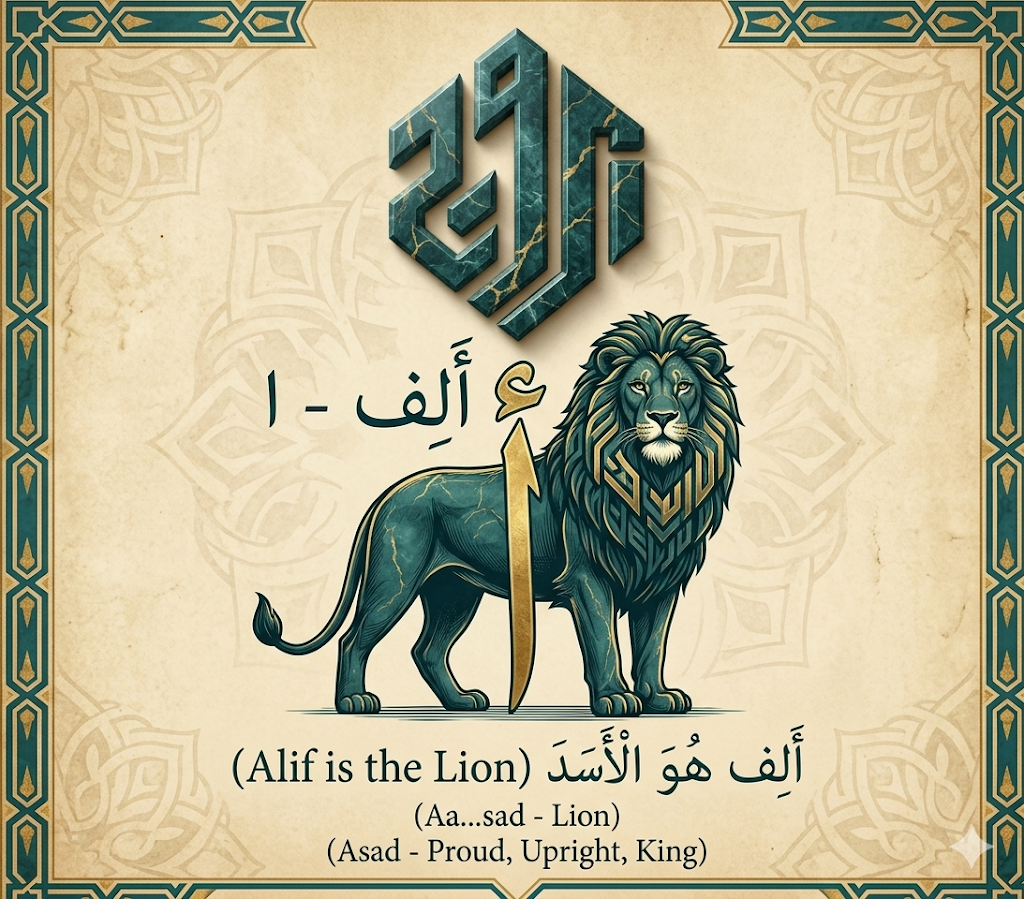
Consider the poem for the letter Alif, which opens with the same two lines repeated as a refrain: اِسْمي الألِفُ، اِسْمي الألِفُ (“My name is Alif, my name is Alif”).
A child hears the letter’s name twice before the poem has even introduced a single new idea — and that repetition is deliberate, not filler.
In our experience teaching Arabic to non-native-speaking children at Buruj Academy, the students who progress fastest in early letter recognition are consistently the ones exposed to rhyme and repetition early — not the ones who started with the most flashcards. Poetry gives the ear something a worksheet cannot: a pattern it wants to finish.
This is also where a structured Online Arabic Classes for Kids program adds real value — an instructor can select and sequence poems calibrated exactly to a child’s current letter recognition level, rather than a parent guessing at difficulty from a book.
Book a FREE Arabic trial for your Child

1. A Kid’s Poem for the Letter Alif
A poem built around a single letter should describe its shape, its sound, and how it behaves – using language simple enough that a child pictures the letter as they listen.
This traditional poem for Alif does exactly that, describing the letter as something that always “stands” and “never bends.”
حرف الألف
اِسْمي الألِفُ
اِسْمي الألِفُ
شَكْلي أبَدًا لا يَخْتَلِفُ
حينَ تَراني دَومًا أقِفُ
أَبَدًا أبَدًا لا أنْحَرِفُ
Ismi al-alifu
Ismi al-alifu
Shakli abadan La yakhtalifu
Hina tarani Dawman aqifu
Abadan abadan La anharifu
“My name is Alif, my name is Alif. My shape never changes. When you see me, I am always standing. Never, ever do I bend.”
Notice the letter speaks in first person – a technique that lets a child imagine the letter as a character with a personality, rather than an abstract shape on a page.
The poem continues with a short section on the hamza, a mark that can appear above or below the Alif:
ومَعي هَمْزَةْ
حِينًا تَأتي
إمّا فوقي أو مِنْ تحتي
Wa ma’i hamzah
Hinan ta’ti
Imma fawqi Aw min tahti
“And with me there is a hamza, sometimes it comes -either above me or below me.”
The final short stanza turns the letter into something personally relevant, using a child’s name as an example:
هيّا نكتبْ اسمَ إيادْ
فيهِ ألفٌ يا أولادْ
Hayya naktub Isma Iyad
Fihi alifun Ya awlad
“Come, let’s write the name Iyad – it has an Alif in it, children.”
Read also:Arabic Body Parts for Kids
Why This Poem Structure Works So Well for First Letters
The poem never explains the letter Alif in abstract terms. Instead, it describes what the letter does — it stands, it never bends — using verbs a young child already understands from everyday movement and posture.
This is precisely the kind of concrete, embodied description we rely on when introducing early letters through our Arabic Alphabet Learning Course, since children retain physical, action-based descriptions far longer than technical ones.
The closing stanza is also worth noting for a separate reason: it connects the abstract letter shape to something intensely personal — a name. Parents can extend this exact idea at home using the Arabic alphabet with pictures approach, substituting their own child’s name wherever a letter appears.
Get your kid a free trial now in Buruj’s Best Alphabet course
2. A Kid’s Poem for the Letter Baa
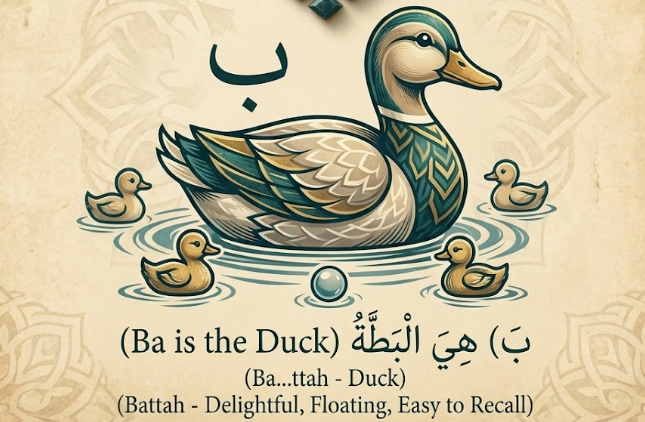
A poem introducing the letter Baa can use visual comparison — describing the letter’s shape as resembling an everyday object — to help a child recognize it instantly on the page. This traditional poem compares the Baa to an uncovered plate, then playfully notes how flipping the letter Qaf’s dot position turns it into a Baa.
حرف الباء
ما أَجْمَلَهُ حرفَ الباءْ
يَبْدو صَحْنًا دونَ غِطاءْ
Ma ajmalahu Harfal-ba’
Yabdu sahnan Duna ghita’
“How beautiful is the letter Baa — it looks like a plate without a cover.”
في أَسْفِلهِ تَبدو نُقْطَهْ
فإذا انقَلَبتْ قافُ القِطَّهْ
صارتْ باءً تُقْرَأُ بَطَّهْ
Fi asfilihi Tabdu nuqtah
Fa-itha inqalabat Qaful-qittah
Sarat ba’an Tuqra’u battah
“Beneath it appears a dot. And if the Qaf of ‘qittah’ (cat) flips over, it becomes a Baa, read as ‘battah’ (duck).”
This single wordplay moment — turning “qittah,” cat, into “battah,” duck, just by moving a dot — is a genuinely clever way to teach that Arabic letters are often distinguished only by dot placement, a foundational literacy concept.
The poem then connects the letter to a warm, familiar word:
وبه يبدأُ اسمُ ال “بابا”
يَضْحَكُ فَخْرًا أو إعْجابَا
Wa bihi yabda’u Ismu al-“baba”
Yadhaku fakhran Aw i’jaba
“And with it begins the word ‘baba’ (father) — he laughs with pride or admiration.”
It closes with a quick list of familiar Baa-words, followed by direct thanks to the letter itself:
باءٌ جُبْنٌ للأصْحابْ
باءٌ بَيْضٌ باءٌ بابْ
شكرًا .. شكرًا .. حرفَ الباءْ
كَمْ تَحْلو فِيكَ الأسْماءْ
Ba’un jubnun Lil-ashab
Ba’un baydun Ba’un bab
Shukran, shukran Harfal-ba’
Kam tahlu Fika al-asma’
“Baa is for cheese, for friends. Baa is for eggs, Baa is for door. Thank you, thank you, letter Baa — how sweet the names are within you.”
Read also:Stories to Learn Arabic for Kids
Discover the Buruj Academy Difference
Step into our virtual classrooms and see how our expert instructors make learning Quran and Arabic intuitive and clear. We focus on overcoming the specific hurdles non-native speakers face, building your confidence and connection with the Quran.
Read also: Arabic Grammar for Kids
Master the Arabic Language
Join our expert-led courses and build a strong foundation in Classical and Modern Arabic.
Get Your Free TrialTurning Letter-Shape Comparisons Into a Home Activity
This poem’s central trick — comparing a letter’s shape to a familiar object — is one parents can replicate easily at home, even beyond Baa.
After reading the poem aloud, ask your child what other everyday object the letter Baa reminds them of. There is no wrong answer here; the goal is simply to make the child look closely at the letter’s shape rather than glance past it.
| Poem Element | Teaching Purpose | Follow-Up Question to Ask |
| “Plate without a cover” comparison | Builds visual shape memory | “What else looks like this letter?” |
| Qaf-to-Baa dot flip | Teaches that dots distinguish letters | “Can you find the dot in this word?” |
| “Baba” (father) word connection | Links the letter to an emotionally familiar word | “What other Baa-words do we know?” |
This kind of shape-based recognition work pairs naturally with structured practice from our Learn Arabic Writing Course, where children move from recognizing a letter’s shape to reproducing it by hand.
Book your kid’s free trial to start writing Arabic
3. A Poem Celebrating Reading for Kids
Beyond individual letters, some of the most effective Arabic poems for children celebrate reading as an activity — framing “اقرأ” (read) as an exciting word rather than a chore. This poem repeats the command “اقْرأ” across several short stanzas, each one attaching a new reason to love reading.
اِقرأ.. اِقرأ
اِقْرأ.. اِقْرأ أحْلى كِلْمَ
ةْ وبها نَصْعَدُ نحوَ القِمَّةْ
Iqra’, iqra’ Ahla kilmah
Wa biha nas’adu Nahwal-qimmah
“Read, read — the sweetest word. And with it, we climb toward the summit.”
اقْرأ.. اقْرأ لُغَةَ الضَّادِ
أجملَ إرثٍ للأحفادِ
Iqra’, iqra’ Lughatad-dad
Ajmala irthin Lil-ahfad
“Read, read the language of the ‘Dad’ (Arabic) — the most beautiful inheritance for grandchildren.”
اقْرأ كُتُبَ الأدَبِ العربي
وحَضَاراتِ العَصْرِ الذَهَبي
Iqra’ kutubal Adabil-‘arabi
Wa hadaratil Asrdh-dhahabi
“Read the books of Arabic literature, and the civilizations of the golden age.”
اقْرأ.. اقْرأ هيَ مِفْتاحْ
كَنْزُ البَهْجَةِ والأفْراحْ
Iqra’, iqra’ Hiya miftah
Kanzul-bahjati Wal-afrah
“Read, read — it is a key. The treasure of joy and happiness.”
عَنْها قَالوا بالإجْمَاعِ
تَدعُو دوماً للإبْداعِ
‘Anha qalu Bil-ijma’i Tad’u dawman Lil-ibda’i
“About it, they said unanimously: it always calls toward creativity.”
Read also: Arabic Writing for Kids
Why Repeating “Read, Read” Builds More Than Vocabulary
The refrain “اقْرأ.. اقْرأ” opens three of the five stanzas, which means a child hears the command to read at least six times across one short poem — without it ever feeling like a lecture.
In our teaching sessions, we’ve consistently found that framing reading as something exciting, rather than obligatory, changes how quickly a child volunteers to practice at home.
A poem that treats “اقرأ” as a beautiful word does more for motivation than any amount of parental encouragement alone.
Each stanza also attaches a different, concrete reward to reading — climbing to a summit, inheriting something beautiful, unlocking a treasure of joy.
This layered-reward structure is worth discussing directly with your child: ask which reason for reading appeals to them most, and why.
4. A Short Poem for Kids About Loving One’s Own Book
The shortest and simplest poem in this set focuses on a single, deeply personal idea: a child’s love for their own book. Its brevity and heavy repetition make it ideal for the very earliest stage of learning, even before a child recognizes every letter used within it.
كتابي كتابٌ ما أحلاه!
كتابي كتابٌ أنا أهواه
أنا أفتحه..أنا أقرأه
كتابي كتابٌ ما أحلاه!
كتابي كتابٌ أنا أهواه
Kitabi kitabun ma ahlah!
Kitabi kitabun ana ahwah
Ana aftahuhu, ana aqra’uhu
Kitabi kitabun ma ahlah!
Kitabi kitabun ana ahwah
“My book is a book — how sweet it is! My book is a book, I love it. I open it, I read it. My book is a book — how sweet it is! My book is a book, I love it.”
This poem repeats “كتابي كتابٌ” — my book is a book — four times across five lines, making it one of the easiest possible entry points for a child who has never recited Arabic before.
Using the Shortest Poems as True Starting Points
For a child who has never attempted Arabic recitation, starting with the Alif or Baa poems above may still feel like a lot. This book-themed poem, with its constant repetition of just two words, works well as a genuine first attempt.
Because nearly every line reuses the same core phrase, a child can often recite the entire poem confidently after just two or three read-throughs — an early success that builds real motivation to continue.
Parents looking for more entry-level material at this exact difficulty level will find additional options in our Arabic sentences for kids collection, which follows the same short, high-repetition structure.
How to Teach These Poems to Kids Step by Step
Teaching any of these poems effectively follows a five-step sequence: pre-teach the featured letter or word, read the poem aloud slowly, have the child repeat line by line, discuss the meaning simply, then practice recitation from memory. Skipping the pre-teaching step is the most common reason children lose interest halfway through.
Step One: Pre-Teach the Featured Letter Before Reading
Before opening the Alif or Baa poem, show your child the letter’s written shape on its own — trace it, draw it, or point to it in another word — so it feels familiar the moment the poem names it.
A child who already recognizes the shape of Alif before hearing “اِسْمي الألِفُ” will feel a spark of recognition rather than confusion on the first read-through.
Step Two: Read the Poem Aloud Slowly, Without Interruption
Read the entire poem once, at a natural but unhurried pace, without stopping to explain anything mid-line. Children need to hear the complete rhythm and rhyme pattern before it gets broken apart for analysis.
In our teaching sessions, we’ve consistently observed that children who hear a poem read fluently once — even without understanding every word — pick up correct pronunciation and stress patterns faster than those who start with word-by-word translation.
Step Three: Repeat Line by Line, Modeling Pronunciation
Read one line, then pause and have the child repeat it back exactly. This is where Arabic pronunciation habits are actually formed, since children are modeling a live voice rather than sounding out letters cold.
Correct any mispronunciation gently, in the moment, rather than waiting until the end of the poem — early correction prevents a mistake from being repeated four or five more times during the same session.
Step Four: Discuss Meaning Using Simple Follow-Up Questions
Ask two or three simple comprehension questions after reading: “What shape does Alif always keep?” or “What does Baa look like?” Keep questions answerable in one word or short phrase at this stage.
| Teaching Step | Time Estimate | Primary Goal |
| Pre-teach the letter or word | 2–3 minutes | Build recognition before first exposure |
| First full read-aloud | 1–2 minutes | Establish rhythm and rhyme pattern |
| Line-by-line repetition | 3–5 minutes | Correct pronunciation in real time |
| Meaning discussion | 2–3 minutes | Confirm comprehension, not just recitation |
A typical first session runs 8–12 minutes total — short enough to hold a young child’s attention, long enough for real retention to occur.
Read also: Days of the Week in Arabic for Kids
Step Five: Practice Recitation From Memory Over Several Days
Rather than moving to a new poem the next day, revisit the same one for 3–4 consecutive short sessions, encouraging the child to recite more from memory each time.
In our instructors’ experience, most children ages 5–8 can recite a well-chosen poem like the Alif or “my book” poem fully from memory within three to four short sessions, provided the letter was properly pre-taught.
This kind of spaced, low-pressure repetition mirrors the context-before-abstraction principle at the core of the Buruj Method — meaning children absorb letter shapes and sounds through meaningful, memorable content before formal rules are ever named explicitly.
Learn Arabic Naturally with Buruj Academy’s Personalized Classes
Poetry works because it makes language memorable, not just correct – and that principle guides everything we teach at Buruj Academy.
Our Online Arabic Classes for Kids pair carefully sequenced letter poems, stories, and vocabulary with Al-Azhar University-trained instructors who have spent 12+ years teaching non-native speakers of every age.
Every lesson plan is personalized to your child’s current level, not a fixed curriculum applied uniformly.
Sessions are 1-on-1, scheduled flexibly around your family’s routine, with real-time pronunciation correction built into every session rather than left for a later review.
Book a free trial lesson today and see how quickly rhyme and repetition can move your child from hesitant reader to confident speaker.
Enroll your child in one of our specialized, kid-friendly tracks today:
- Online Quran Classes for Kids
- Tajweed Classes for Kids
- Hifz Classes for Kids
- Online Arabic Classes for Kids
- Quranic Arabic Course for Kids
- Noorani Qaida Course for Kids
- Islamic Studies Classes for Kids
Discover the Buruj Academy Difference
Step into our virtual classrooms and see how our expert instructors make learning Quran and Arabic intuitive and clear. We focus on overcoming the specific hurdles non-native speakers face, building your confidence and connection with the Quran.
Master the Arabic Language
Join our expert-led courses and build a strong foundation in Classical and Modern Arabic.
Get Your Free TrialConclusion
Rhyme and repetition succeed where letter drills often stall, because a well-built poem gives a child’s memory something to hold onto beyond an isolated shape or sound. The right poem — whether it introduces a single letter or simply celebrates the joy of reading — does more instructional work in ten minutes than an hour of flashcards ever could.
Real progress comes not from finding one perfect poem, but from applying the same five-step teaching sequence consistently — pre-teaching the featured letter, reading aloud, repeating line by line, discussing meaning, and revisiting across several sessions until recitation becomes memory.
Frequently Asked Questions About Arabic Poems for Kids
What Age Should Children Start Learning Arabic Poems?
Children can begin with very short, repetitive Arabic poems as early as age four, provided the content stays limited to one letter or a small handful of familiar words. Comprehension should always guide pacing rather than a fixed starting age.
How Long Should an Arabic Poem Be for a Beginner?
A beginner-level Arabic poem should stay short, using a repeated refrain and a single focused idea, such as one letter’s shape and sound. Longer, multi-theme poems overwhelm early learners before rhythm and rhyme can take effect.
Can Arabic Poems Help with Letter Recognition, Not Just Vocabulary?
Yes — poems that describe a letter’s shape, like comparing Baa to a plate, give children a visual anchor that plain letter drills rarely provide. Repetition of the letter’s name throughout the poem reinforces recognition through sheer exposure.
How Often Should a Child Practice an Arabic Poem?
Revisiting the same short poem for 8–12 minutes across three to four consecutive days produces stronger retention than reading a new poem daily. Spaced repetition of familiar material builds lasting memory more effectively than constant novelty.
Are Arabic Poems Useful for Homeschool or Classroom Settings?
Yes — poems work especially well in group settings through call-and-response recitation, which builds fluency and confidence simultaneously across multiple students. Teachers can also use name-substitution drills to check individual letter recognition within a shared poem.