 Arabic
| Key Takeaways |
| Arabic nouns are either masculine or feminine, and this gender determines how adjectives and verbs agree throughout the sentence. |
| Arabic sentences can begin with a noun (جملة اسمية) or a verb (جملة فعلية), each following its own clear grammatical pattern. |
| Arabic adjectives always follow the noun they describe and must match it in gender, number, and definiteness using the definite article ال. |
| Dual and plural forms in Arabic are rule-based and teachable early — kids can master them through simple pattern recognition exercises. |
| Starting Arabic grammar through familiar Quranic words gives children meaningful context, accelerating both comprehension and retention. |
Children absorb grammatical patterns far more naturally than adults do — and Arabic grammar for kids, when taught correctly, follows clear, logical rules that young minds find surprisingly manageable.
The challenge is not the grammar itself, but the sequencing.
The basic Arabic grammar rules for kids center on five foundational concepts: grammatical gender, the definite article, noun-adjective agreement, sentence types, and number forms.
Introduced in order, with real examples and short daily practice, these rules become second nature long before a child reaches formal study age.
Table of Contents:
1. Every Arabic Noun Is Either Masculine or Feminine
Arabic nouns carry grammatical gender — every single one. There is no neutral “it.” A book (كِتَابٌ kitābun) is masculine; a school (مَدْرَسَةٌ madrasatun) is feminine. This single rule shapes everything else in the sentence, so it must come first.
The practical teaching shortcut: most feminine nouns end in the letter ة (tā’ marbūṭa). Teaching children to spot this ending early gives them an immediate, reliable clue that works in the vast majority of cases.
How to Introduce Gender to Young Learners?
Start with two columns — boys’ words and girls’ words — using vocabulary the child already knows. Keep early lists to five to eight words per category.
In our experience at Buruj Academy, children aged six to ten grasp the masculine/feminine distinction within two to three lessons when it is presented visually with familiar objects.
| Masculine Nouns | Feminine Nouns |
| كِتَابٌ (kitābun) — book | مَدْرَسَةٌ (madrasatun) — school |
| بَيْتٌ (baytun) — house | غُرْفَةٌ (ghurfatun) — room |
| وَلَدٌ (waladun) — boy | بِنْتٌ (bintun) — girl |
| قَلَمٌ (qalamun) — pen | سَيَّارَةٌ (sayyāratun) — car |
Quick exercise for kids: Read five object names aloud. Ask the child: does it end in ة? Masculine or feminine? Repeat daily for one week.
Through Buruj Academy’s Online Arabic Classes for Kids, our instructors introduce grammatical gender through color-coded flashcards and sorting games, making this abstract concept genuinely fun for young learners from day one.
Book a FREE Arabic trial for your Child

2. Arabic Uses One Definite Article — ال —
In Arabic, the only definite article is ال (al-), equivalent to “the” in English. It attaches directly to the beginning of a noun: كِتَابٌ (a book) becomes اَلْكِتَابُ (the book). Every noun in Arabic begins indefinite, and ال makes it definite.
The critical grammar point for kids: when ال meets certain letters called sun letters (الحروف الشمسية), the “l” sound assimilates into the following letter. With moon letters (الحروف القمرية), ال is pronounced clearly.
Sun Letters vs. Moon Letters in Arabic for Kids
Children do not need to memorize the full lists immediately. Teach them to listen — does the ال sound disappear? Then it is a sun letter. Does it stay clear? Moon letter. The ear learns this faster than a chart.
| Moon Letter Example | Pronunciation | Sun Letter Example | Pronunciation |
| اَلْكِتَابُ (the book) | al-kitābu | اَلشَّمْسُ (the sun) | ash-shamsu |
| اَلْبَيْتُ (the house) | al-baytu | اَلنَّجْمُ (the star) | an-najmu |
Quick exercise for kids: Say each word with ال. Ask the child: did you hear the “l” or did it blend? Mark it sun or moon. Ten words, five minutes.
3. Arabic Adjectives Follow the Noun and Must Match It in Gender
In English, adjectives come before the noun — “a big house.” In Arabic, the adjective always comes after: بَيْتٌ كَبِيرٌ (baytun kabīrun — a big house). This word order switch is one of the first structural habits children need to build deliberately.
More importantly, the adjective must match the noun in gender. A masculine noun takes a masculine adjective. A feminine noun takes a feminine adjective — usually by adding ة to the adjective.
Gender Agreement in Practice
| Masculine Phrase | Feminine Phrase | Translation |
| وَلَدٌ كَبِيرٌ | بِنْتٌ كَبِيرَةٌ | a big boy / a big girl |
| كِتَابٌ جَدِيدٌ | مَدْرَسَةٌ جَدِيدَةٌ | a new book / a new school |
| قَلَمٌ أَحْمَرُ | سَيَّارَةٌ حَمْرَاءُ | a red pen / a red car |
Important note: The color adjective for feminine follows a separate pattern (أَحْمَرُ → حَمْرَاءُ) — introduce this later, after the basic ة pattern is solid.
Quick exercise for kids: Give the child a masculine phrase. Ask them to switch it to feminine. Five pairs, repeated across three days.
This is also an excellent time to explore Arabic sentences for kids — short, meaningful phrases give adjective agreement real context that isolated drills cannot replicate.
4. Arabic Has Two Sentence Types, and Kids Should Learn Both Early
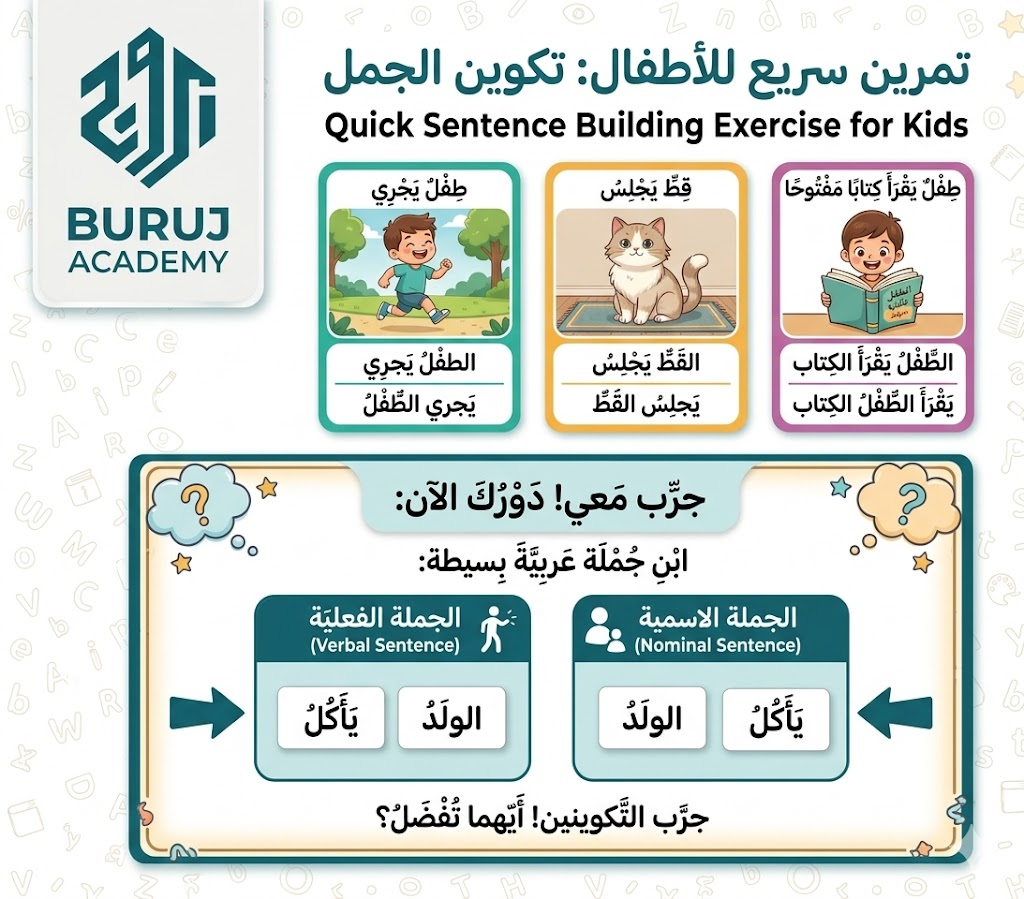
Arabic grammar recognizes two sentence structures. The nominal sentence (جُمْلَةٌ اِسْمِيَّةٌ) begins with a noun and typically describes a state or identity. The verbal sentence (جُمْلَةٌ فِعْلِيَّةٌ) begins with a verb and describes an action. Both are used constantly in Quranic Arabic and everyday speech.
Children do not need the Arabic terms at first. Teach the patterns through examples, and the grammatical labels follow naturally.
Nominal Sentences: Noun + Noun or Noun + Adjective
A nominal sentence in its simplest form places two nouns together to make a statement. Arabic drops the verb “to be” in the present tense:
اَلْوَلَدُ كَبِيرٌ — al-waladu kabīrun — “The boy is big.”
There is no word for “is” — the sentence is grammatically complete without it. This surprises English-speaking children, but they adapt quickly when they see enough examples.
Verbal Sentences: Verb First, Then Subject
In a verbal sentence, the verb leads: ذَهَبَ الوَلَدُ (dhahaba al-waladu — “The boy went”). The verb appears first and already carries gender agreement with the subject.
Quick exercise for kids: Show five pictures — a running child, a sitting cat, an open book. Ask the child to build a simple sentence: verb or noun first? Let them experiment with both structures.
5. Arabic Has Singular, Dual, and Plural — and Kids Can Master the Dual Quickly
English has two number forms: singular and plural. Arabic has three: singular (مُفْرَدٌ), dual (مُثَنَّى), and plural (جَمْعٌ). The dual form is one of Arabic’s most logical patterns — and children find it satisfying once they see how it works.
To make a noun dual, add ـَانِ (-āni) in the nominative case to the singular form. A boy (وَلَدٌ) becomes two boys (وَلَدَانِ). A book (كِتَابٌ) becomes two books (كِتَابَانِ).
Discover the Buruj Academy Difference
Step into our virtual classrooms and see how our expert instructors make learning Quran and Arabic intuitive and clear. We focus on overcoming the specific hurdles non-native speakers face, building your confidence and connection with the Quran.
Dual Formation Table
| Singular | Dual | Meaning |
| وَلَدٌ (waladun) | وَلَدَانِ (waladāni) | one boy → two boys |
| كِتَابٌ (kitābun) | كِتَابَانِ (kitābāni) | one book → two books |
| مَدْرَسَةٌ (madrasatun) | مَدْرَسَتَانِ (madrasatāni) | one school → two schools |
For feminine nouns, the ة changes to ت before adding ـَانِ — مَدْرَسَةٌ becomes مَدْرَسَتَانِ. This pattern is fully rule-governed and teachable in a single session.
Plural forms in Arabic are more varied — sound plurals follow a pattern while broken plurals require memorization.
We recommend introducing sound plurals first and building broken plural vocabulary gradually through reading. Our guide on learning Arabic words for kids provides excellent vocabulary sets organized around these number patterns.
Master the Arabic Language
Join our expert-led courses and build a strong foundation in Classical and Modern Arabic.
Get Your Free Trial6. Definiteness Agreement Extends to Adjectives — Both Must Match
When a noun is definite (using ال), its adjective must also carry ال. This is a rule children frequently miss in early lessons, and it is worth drilling specifically. اَلْوَلَدُ الْكَبِيرُ (the big boy) — both the noun and adjective carry ال.
Without ال on the adjective, the phrase changes meaning: اَلْوَلَدُ كَبِيرٌ means “The boy is big” — a complete sentence, not just a noun phrase.
Read also: The Best Islamic Apps for Kids
The Definiteness Rule at a Glance
| Structure | Example | Meaning |
| Noun + Adjective (both indefinite) | وَلَدٌ كَبِيرٌ | a big boy (noun phrase) |
| Noun (definite) + Adjective (indefinite) | اَلْوَلَدُ كَبِيرٌ | The boy is big (sentence) |
| Noun (definite) + Adjective (definite) | اَلْوَلَدُ الْكَبِيرُ | the big boy (noun phrase) |
This table takes children two to three minutes to absorb but prevents a persistent and common error. We use exactly this three-row contrast in our Buruj Academy grammar sessions with young learners.
Quick exercise: Give the child six phrases. Ask: is this a noun phrase or a complete sentence? The answer depends entirely on whether the adjective carries ال.
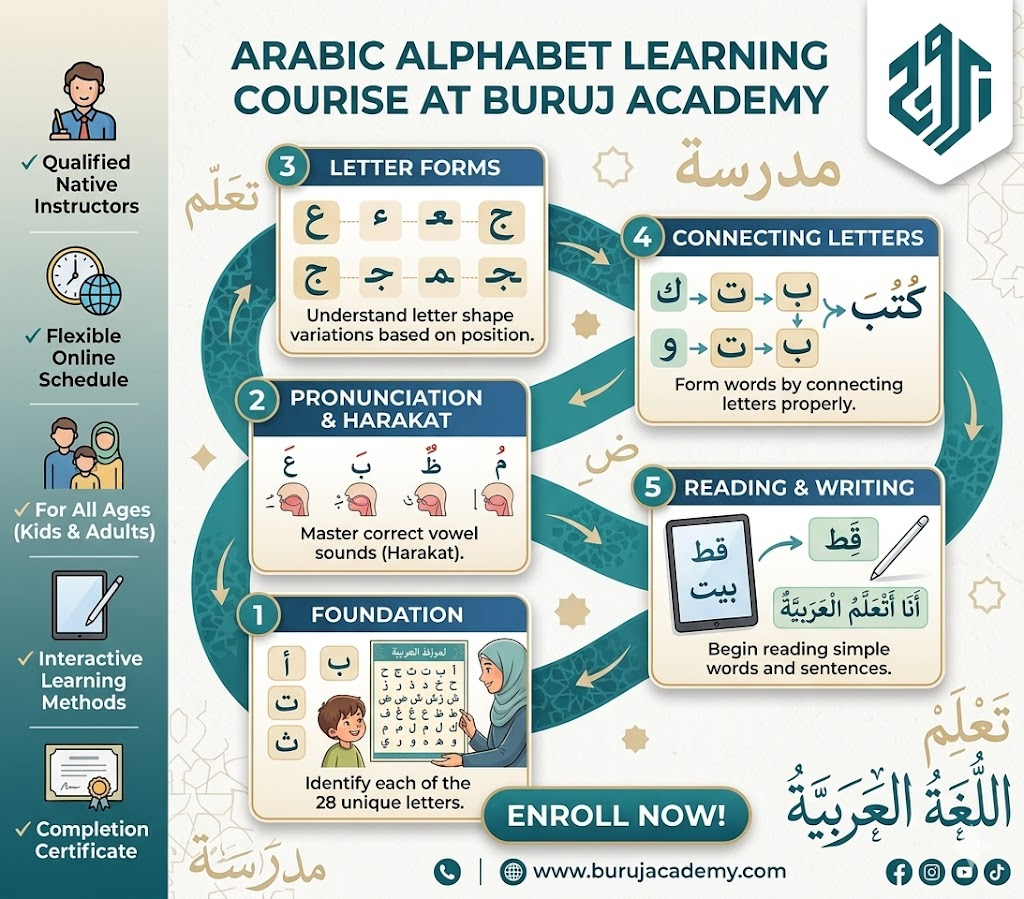
For children building these skills systematically from the alphabet stage, our article on learning the Arabic alphabet for kids is an essential companion to this grammar foundation.
Get you child’s free trial now in Buruj’s Alphabet course
Should a Kid Learn Arabic Grammar?
Yes — and earlier is better, with the right approach. Children aged five to ten are in a prime window for language pattern acquisition. Their brains build grammatical intuition faster than adult learners, meaning rules introduced playfully at age seven often become automatic by age nine.
The concern many parents have — that grammar is too abstract for young children — disappears when grammar is taught through examples, games, and real sentences rather than metalinguistic labels. A child does not need to know the term “nominal sentence” to correctly produce one.
Research in second language acquisition consistently supports early structured exposure to grammar as a framework for accelerated fluency. The key is keeping sessions short (ten to fifteen minutes), varied, and tied to vocabulary the child already enjoys using.
At What Age Should Grammar Introduction Begin?
| Age Range | Recommended Focus |
| 4–6 years | Arabic alphabet, letter sounds, simple vocabulary |
| 6–8 years | Gender, ال, basic adjective agreement |
| 8–10 years | Sentence types, dual/plural, definiteness rules |
| 10–12 years | Verb conjugation, case endings, expanded sentence building |
Buruj Academy’s Arabic Grammar Course places each child through a structured placement process before assigning a learning plan — so grammar is introduced at the right stage, never too early and never skipped.
Get your child’s free trial lesson in Buruj’s Arabic Grammar course

What Are the Benefits of Learning Arabic Grammar at a Young Age?
The benefits of learning Arabic grammar young extend well beyond language ability alone. Children who develop Arabic grammatical awareness early gain a measurable advantage in Quran comprehension, academic Arabic literacy, and cognitive flexibility.
Grammatically aware young readers understand Quranic text at a deeper level than those who only memorize sounds.
When a child recognizes that الرَّحْمَٰنِ الرَّحِيمِ uses two adjectives in genitive case agreeing with a preceding noun, their comprehension of Al-Fatiha moves from phonetic to meaningful.
Key Benefits Documented by Arabic Language Educators
Young grammar learners consistently demonstrate stronger reading accuracy because they recognize word patterns rather than treating each word as isolated. They also develop superior spelling in Arabic script, since understanding root structures and word patterns directly supports writing accuracy.
Additionally, children who learn Arabic grammar young show greater confidence in Arabic-speaking environments.
They can construct sentences — not just recall memorized phrases — giving them genuine communicative ability rather than surface fluency.
Our how to learn Arabic for kids guide outlines the full pedagogical roadmap we use at Buruj Academy, showing exactly how grammar fits into a complete language learning plan for children at every stage.
Read also: Best App to Learn Arabic for Kids
Start Your Child’s Arabic Grammar Foundation with Buruj Academy’s Expert Instructors
These six grammar rules give children the structural foundation Arabic reading, writing, and Quran comprehension all build on. The rules are learnable — what makes the difference is how they are taught.
Buruj Academy’s Arabic Grammar Course for kids is built around child-appropriate pacing, visual reinforcement, and short daily sessions guided by Al-Azhar University graduates with 12+ years teaching non-native speakers.
Our Online Arabic Classes for Kids offer:
- Personalized 1-on-1 sessions with flexible scheduling
- The Buruj Method: context-before-abstraction, patience-before-performance
- Real-time correction and age-appropriate teaching techniques
- Structured progression from alphabet through grammar mastery
Book your child’s free trial lesson today.
Enroll your child in one of our specialized, kid-friendly tracks today:
- Online Quran Classes for Kids
- Tajweed Classes for Kids
- Hifz Classes for Kids
- Online Arabic Classes for Kids
- Quranic Arabic Course for Kids
- Noorani Qaida Course for Kids
- Islamic Studies Classes for Kids
Ready to watch your child grow in knowledge and character? Join the Buruj Academy family and book a free trial session for your child today!
Master the Arabic Language
Join our expert-led courses and build a strong foundation in Classical and Modern Arabic.
Get Your Free TrialConclusion
Arabic grammar is not a wall — it is a set of logical, learnable patterns that young minds are genuinely equipped to absorb. Gender, definiteness, adjective agreement, sentence structure, and number forms are the building blocks every Arabic sentence rests on.
Taught in sequence, with real examples and short consistent practice, they become intuitive rather than burdensome.
The best time to start is always now. Children who build this foundation early carry it through Quran comprehension, formal Arabic study, and lifelong literacy — Insha’Allah.
Frequently Asked Questions About Arabic Grammar for Kids
What Is the Best Age to Start Arabic Grammar for Kids?
Most children are ready for basic Arabic grammar introduction between ages six and eight, after they have solid letter recognition. At this stage, gender and the definite article ال can be introduced through games and visual drills. Formal grammatical terminology is unnecessary — patterns and examples are sufficient for this developmental window.
How Long Does It Take for a Child to Learn Basic Arabic Grammar?
With consistent sessions of ten to fifteen minutes, three to four times per week, most children can internalize the six foundational rules covered in this guide within three to six months. Mastery depends heavily on consistency and the quality of examples used — grammar learned through real sentences sticks far longer than isolated drills.
Can Kids Learn Arabic Grammar Without Knowing the Alphabet First?
No — Arabic alphabet mastery must precede grammar instruction. A child who cannot read letters cannot engage meaningfully with written grammatical patterns. We recommend completing foundational alphabet work first. Our article on the Arabic alphabet for kids outlines exactly what that foundation should include before grammar begins.
Is Arabic Grammar Difficult for Non-Arabic Speaking Children?
Arabic grammar has clear, rule-governed patterns that children find logically satisfying when taught well. The challenge is not complexity but unfamiliarity — English and Arabic structure differently. Children who receive patient, sequential instruction consistently adapt within a few months and often find Arabic grammar more regular than English spelling rules.