 Quran
Quran
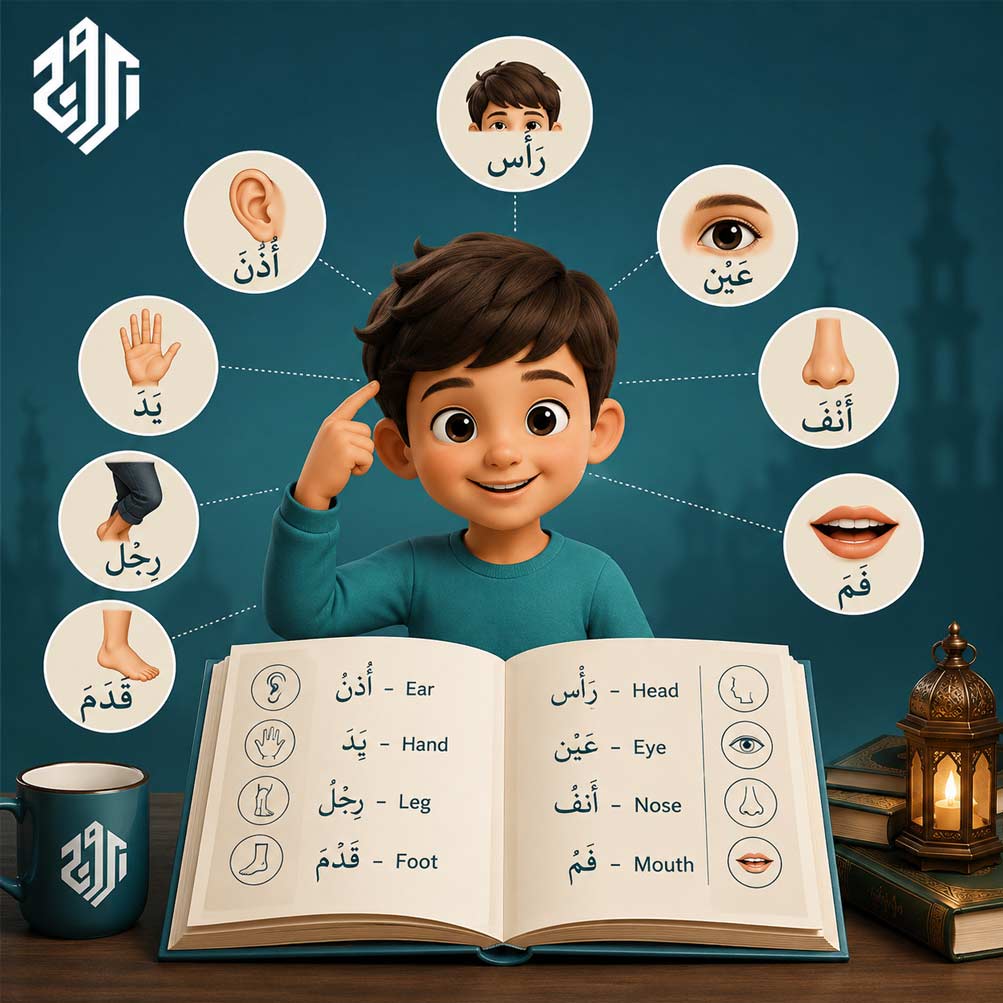
Every parent teaching Arabic at home eventually hits the same wall: abstract vocabulary lists that a five-year-old forgets by dinner. Body parts solve this problem instantly, because children already understand the concept in their own language.
Arabic body parts vocabulary for kids includes roughly 15–20 essential nouns — from رَأْس (head) to قَدَم (foot) — organized around the face, upper body, and limbs. In our sessions at Buruj Academy, this topic consistently produces the fastest vocabulary retention of any beginner unit, because children can point, touch, and act out every single word.
Table of Contents:
What Are the Essential Arabic Words for Body Parts Kids Learn First?
Beginner Arabic vocabulary for children starts with 12 core body parts: head, face, eyes, nose, mouth, ears, hair, hands, arms, legs, feet, and stomach. These twelve words cover roughly 90% of everyday body-related conversation a child will use at home, at the doctor, or during play.
We introduce these words in a specific sequence, moving from the most visible and expressive parts of the face outward to the limbs. This order matters more than most parents realize.
Read also:Arabic Kids Shows: 7 Best Educational Shows for Learning Arabic
The Head and Face Group in Arabic
Starting with the face keeps lessons engaging because children can make expressions while naming each part. رَأْس (Ra’s) means head, وَجْه (Wajh) means face, and شَعْر (Sha’r) means hair.
The word عَيْن (ʿAyn) means eye, though children will almost always hear its dual form عَيْنَان (ʿAynān) since we naturally have two. We cover this dual pattern in detail later in this article.
| Arabic Word | Transliteration | English Meaning | Gender |
| رَأْس | Ra’s | Head | Masculine |
| وَجْه | Wajh | Face | Masculine |
| عَيْن | ʿAyn | Eye | Feminine |
| أَنْف | Anf | Nose | Masculine |
| فَم | Fam | Mouth | Masculine |
| أُذُن | Udhun | Ear | Feminine |
Notice that عَيْن and أُذُن are feminine despite not ending in taa marbuta — an important exception children’s Arabic learners must memorize individually, since not every feminine noun follows the visible ending pattern.
The Hands, Arms, and Legs Group in Arabic
Moving to the limbs, children learn يَد (Yad) for hand, ذِرَاع (Dhirāʿ) for arm, رِجْل (Rijl) for leg, and قَدَم (Qadam) for foot. Most non-Arabic-speaking parents mispronounce the “ع” in ذِرَاع on the first attempt — it requires a deep guttural sound with no English equivalent.
We teach this sound by asking students to imagine gently gargling water at the very back of the throat.
Repetition across a full week fixes this pronunciation for the vast majority of learners, according to our instructors’ classroom observations.
| Arabic Word | Transliteration | English Meaning | Gender |
| يَد | Yad | Hand | Feminine |
| ذِرَاع | Dhirāʿ | Arm | Feminine |
| رِجْل | Rijl | Leg | Feminine |
| قَدَم | Qadam | Foot | Feminine |
| بَطْن | Baṭn | Stomach | Masculine |
| ظَهْر | Ẓahr | Back | Masculine |
A structured introduction like this works far better than an unordered list, which is exactly why families benefit from a proper Online Arabic Classes for Kids course where sequencing and pacing are handled by a trained instructor rather than guesswork.
Book a FREE Arabic trial for your child

How Does Gender Work in Arabic Body Parts Vocabulary?
Arabic nouns are either masculine or feminine, and body parts follow this rule without exception, even when the noun describes a body part shared equally by boys and girls. Feminine body part nouns typically end in taa marbuta (ة), though several — like عَيْن and أُذُن — are feminine by convention alone.
This distinction affects every adjective a child later attaches to the noun, which is why Buruj Academy’s Arabic curriculum introduces gender at the vocabulary stage rather than delaying it until formal grammar lessons.
Read also:Colours in Arabic for Kids: 10 Essential Colours Every Child Should Know
Recognizing the Taa Marbuta Pattern in the Arabic Body Parts for Kids
Several body parts display the feminine ending clearly, giving children a visual anchor for the rule. شَفَة (Shafah) means lip, رَقَبَة (Raqabah) means neck, and رُكْبَة (Rukbah) means knee — all three end in ة, signaling feminine gender at a glance.
Once a child recognizes this ending pattern, they can predict gender for dozens of unrelated nouns encountered later in their Arabic studies. This single pattern, once internalized, removes one of the most common grammar mistakes non-native Arabic speakers make well into intermediate levels.
| Body Part | Arabic | Taa Marbuta Visible? |
| Lip | شَفَة | Yes |
| Neck | رَقَبَة | Yes |
| Knee | رُكْبَة | Yes |
| Eye | عَيْن | No (feminine by convention) |
| Ear | أُذُن | No (feminine by convention) |
| Hand | يَد | No (feminine by convention) |
Students preparing for more advanced grammar milestones benefit from reviewing masculine and feminine nouns in Arabic alongside this body parts unit, since the two topics reinforce each other directly.
Discover the Buruj Academy Difference
Step into our virtual classrooms and see how our expert instructors make learning Quran and Arabic intuitive and clear. We focus on overcoming the specific hurdles non-native speakers face, building your confidence and connection with the Quran.
Master the Arabic Language
Join our expert-led courses and build a strong foundation in Classical and Modern Arabic.
Get Your Free TrialWhat Is the Arabic Dual Form for Paired Body Parts in Arabic?
Arabic marks pairs of body parts using the dual noun form, adding ـَان (ān) in the subject position or ـَيْن (ayn) elsewhere in the sentence. This applies to every naturally paired body part — eyes, ears, hands, arms, legs, and feet — making the dual one of the highest-utility grammar patterns in this vocabulary set.
Unlike English, which simply adds “s” for any plural regardless of quantity, Arabic distinguishes precisely between one, exactly two, and three-or-more. In our teaching experience, this is the single concept that most surprises Western parents, since English has no equivalent grammatical category.
Read also: The Islamic Way of Raising Children
Building the Dual Form Step by Step
The base noun عَيْن (eye, singular) becomes عَيْنَان (two eyes) in the subject position and عَيْنَيْن in most other sentence positions. The same transformation applies consistently across every paired body part.
| Body Part (Singular) | Dual Form (Subject) | Dual Form (Object/Other) | Meaning |
| عَيْن (eye) | عَيْنَان | عَيْنَيْن | Two eyes |
| أُذُن (ear) | أُذُنَان | أُذُنَيْن | Two ears |
| يَد (hand) | يَدَان | يَدَيْن | Two hands |
| رِجْل (leg) | رِجْلَان | رِجْلَيْن | Two legs |
We recommend introducing this pattern only after a child has fully memorized the singular forms, typically after two to three weeks of consistent practice. Rushing the dual form before singular mastery is the most frequent error we observe among self-taught beginners.
For a deeper grammar foundation, families can review our complete guide to dual nouns in Arabic, which expands this exact pattern across all noun categories, not just body parts.
How Can Parents Practice Arabic Body Parts Vocabulary at Home?
Physical movement games produce the fastest vocabulary retention for young children learning Arabic body parts, outperforming static flashcards by a wide margin. The three most effective methods are Arabic Simon Says, labeling exercises on a printed body outline, and call-and-response songs repeated daily for five to ten minutes.
Students who struggle with retention almost always share one habit — they review vocabulary passively by reading a list rather than physically touching the corresponding body part while saying the word aloud.
Exercise One: Arabic Simon Says
Call out “المعلم يقول المس أنفك” (The teacher says touch your nose) and have the child physically touch the named part. Increase speed gradually across sessions to build automatic recall rather than translated recall.
Rotate through all twelve core words across a single ten-minute session, repeating each word two to three times to fully anchor pronunciation and meaning.
Exercise Two: Label the Body Outline
Print or draw a simple human outline and have children label each part with the Arabic word, including the correct diacritical marks. This exercise doubles as handwriting practice and strengthens the connection between Arabic script and meaning.
For children still building foundational reading skills, pairing this activity with our Arabic alphabet with pictures for kids resource reinforces letter recognition alongside new vocabulary.
Exercise Three: The Daily Body Parts Song
Short, repetitive songs naming body parts in sequence — head, shoulders, or face-to-feet patterns — build long-term memory through rhythm and repetition. In our experience, children exposed to a five-minute daily song retain vocabulary roughly twice as long as those relying on weekly flashcard review alone, based on our instructors’ classroom observations across multiple age groups.
Consistency matters more than session length here. Five focused minutes daily outperforms one long weekly session by a significant margin, according to the pacing principles built into the Buruj Method.
| Practice Method | Best For Ages | Session Length | Frequency |
| Simon Says Game | 4–8 years | 10 minutes | 3–4x weekly |
| Body Outline Labeling | 6–10 years | 15 minutes | 2x weekly |
| Daily Repetition Song | 3–7 years | 5 minutes | Daily |
Read also: Best Islamic Animation Channels for Children
What Sentence Patterns Help Kids Use Body Parts Vocabulary?
Beyond memorizing isolated nouns, children need functional sentence patterns to actually use body parts vocabulary in conversation. The three most useful beginner patterns are possession (“my hand”), description (“my eyes are brown”), and simple commands (“wash your hands”).
Introducing sentence structure early prevents the common plateau where children can name body parts on a flashcard but freeze when asked to form a real sentence.
Possession Pattern: “My” and “Your”
Arabic attaches possession directly to the noun using suffix pronouns rather than a separate possessive word. Adding ي to a noun creates “my,” so يَدِي means “my hand” and عَيْنِي means “my eye.”
For “your,” the suffix changes based on whether you’re addressing a male or female child — يَدُكَ for “your hand” (to a boy) and يَدُكِ for “your hand” (to a girl). This distinction trips up many beginners initially, but becomes automatic with steady practice.
| English | Arabic (My) | Arabic (Your – Male) | Arabic (Your – Female) |
| My/Your hand | يَدِي | يَدُكَ | يَدُكِ |
| My/Your eye | عَيْنِي | عَيْنُكَ | عَيْنُكِ |
| My/Your head | رَأْسِي | رَأْسُكَ | رَأْسُكِ |
This possessive suffix system connects directly to broader Arabic sentence construction, which families can explore further through our guide on Arabic sentence structure for beginners.
Master Arabic Vocabulary Building with Buruj Academy’s Personalized Classes
Learning body parts vocabulary is just the starting point — real fluency requires structured, sequential vocabulary building across dozens of everyday topics. Buruj Academy’s Online Arabic Classes for Kids use the context-before-abstraction method, introducing every new word through real situations rather than isolated memorization.
Our Al-Azhar University graduate instructors bring 12+ years of experience teaching non-Arabic speakers of every age, adapting pacing to each child’s attention span and learning style.
Every session is personalized 1-on-1, with flexible scheduling available around school and family routines.
Real-time pronunciation correction ensures children build accurate habits from their very first lesson rather than reinforcing mistakes over time.
Book a free trial lesson today and see how quickly your child progresses with expert guidance.
Begin your transformation today by choosing the path that fits your goals:
- Online Arabic Classes (General & Comprehensive)
- Arabic Course for Beginners
- Arabic Alphabet Learning Course
- Online Arabic Classes for Kids
- Arabic Classes for Adults
- Arabic Grammar Course (Nahw & Sarf)
- Intermediate Arabic Course (B1/B2)
- Arabic Speaking Course (Conversational Fluency)
- Arabic Reading Course (Literary Excellence)
- Learn Arabic Writing Course (Calligraphy & Composition)
Ready to speak with confidence? Join the global community at Buruj Academy and book your free placement interview today!
Discover the Buruj Academy Difference
Step into our virtual classrooms and see how our expert instructors make learning Quran and Arabic intuitive and clear. We focus on overcoming the specific hurdles non-native speakers face, building your confidence and connection with the Quran.
Excel in Your Quranic Studies
Join Buruj Academy and master the Quran with our structured, professional curriculum.
Book Your Free TrialConclusion
Body parts vocabulary works as an entry point into Arabic precisely because it’s tangible — every noun connects to something a child can point to, touch, and physically demonstrate. The gender patterns, dual forms, and possessive suffixes introduced through this single topic quietly prepare children for grammar concepts they’ll encounter throughout their entire Arabic learning journey.
What separates lasting retention from forgotten flashcards is consistent, physical practice rather than passive review. A child who plays Simon Says in Arabic for five minutes daily will outperform one who memorizes a list once and moves on.
Frequently Asked Questions About Arabic Body Parts for Kids
What Age Should Children Start Learning Arabic Body Parts Vocabulary?
Children as young as three can begin learning basic Arabic body parts vocabulary, since the concept requires no abstract reasoning — only pointing and repetition. Most instructors introduce the full 12-word core list between ages four and six for stronger retention.
How Long Does It Take a Child to Memorize Basic Body Parts in Arabic?
Most children memorize the 12 core body parts within 1 to 2 weeks with daily five-to-ten-minute practice sessions. Retention improves significantly when vocabulary is reinforced through physical movement rather than passive flashcard review alone.
Why Do Some Arabic Body Parts Use the Dual Form Instead of Plural?
Arabic grammar distinguishes precisely between one, exactly two, and three-or-more items, so naturally paired body parts like eyes and hands always use the dual form. This grammatical category doesn’t exist in English, making it a notable early learning milestone.