 Quran
Quran
Arabic children’s television actually has a rich, decades-long history of original programming built specifically to teach language, values, and identity to young viewers.
The strongest options for language learning are Modern Standard Arabic productions like Iftah Ya Simsim, Alam Simsim, and Ahlan Simsim — shows engineered by educators, not just animators, to teach letters, vocabulary, and comprehension through story and song.
Table of Contents:
What Are the Best Arabic Kids Shows for Language Learning?
The best Arabic kids shows for language learning are Modern Standard Arabic productions built by educational teams rather than general entertainment studios. Iftah Ya Simsim, Alam Simsim, and Ahlan Simsim lead this category because every episode is designed around specific literacy and vocabulary goals, not just entertainment value.
In our work helping non-Arabic speaking families choose learning resources, we consistently point parents toward Sesame Street’s Arabic co-productions first. Iftah Ya Simsim premiered in Kuwait and Morocco on September 14, 1979, and was broadcast in 22 Arabic-speaking countries, making it one of the most widely-viewed educational programs in the region’s history.
It was the first educational TV show for children in the Arab world and the first Sesame Street show in the region to use Modern Standard Arabic.
That MSA foundation matters enormously for learners following a structured curriculum.
Students working through our Arabic Alphabet Learning Course often tell us that shows using Modern Standard Arabic reinforce exactly what they’re practicing in lessons, while dialect-only shows can feel like a completely different language.
Get your child a free trial now in Buruj’s Alphabet course
How Was Iftah Ya Simsim Designed to Teach Children?
Iftah Ya Simsim was built through years of formal educational research before a single episode aired, not created as a generic cartoon. Research began in August 1977, led by a team including a teacher, a language expert, and a psychologist from Kuwait University, who tested the show on children aged three to six.
That research process produced a genuinely comprehensive curriculum. The formative research resulted in 170 specific objectives across 10 categories, targeting emotional, social, and intellectual development for children aged 3 to 6. Few children’s shows anywhere in the world have that level of academic grounding behind them.
The show’s puppet cast also carries real pedagogical weight. The original show featured Nu’man, a full-body camel, Malsun the parrot, Yaqut, a lavender monster, and Abla, a full-body cat, while the 2015 revival introduced yellow monster girl Shams, along with Gargur and several Anything Muppets, camels, cows, chickens, and penguins.
Read also:Arabic Poems for Kids
Which Arabic Shows Teach Modern Standard Arabic vs. Dialect?
Arabic children’s shows split clearly between Modern Standard Arabic (Fusha) productions built for reading and writing, and dialect-heavy shows built mainly for entertainment and listening comprehension. This distinction is the single most important factor when choosing a show for a child who is actively learning to read.
| Show | Primary Language | Best For |
| Iftah Ya Simsim | Modern Standard Arabic | Reading, alphabet, vocabulary |
| Alam Simsim | MSA (segments) + Egyptian dialect (skits) | Bilingual listening + reading |
| Ahlan Simsim | Modern Standard Arabic | Emotional vocabulary, social skills |
| Freej | Emirati dialect | Cultural exposure, listening only |
Alam Simsim actually demonstrates this split within a single show, which we’ve found genuinely useful for intermediate learners.
The letter and reading segments are taught in Modern Standard Arabic, which is the language that all Arabic children will use for reading and writing, while the skits are all in Egyptian Arabic dialect, used in Egypt for regular interaction.
A child watching a segment on a specific letter will see a picture of a car called by its Standard Arabic name, Sayara, while cars appearing in the dialect skits are called “arabiya,” as commonly known in Egypt.
We’ve noticed that students who don’t understand this split often get confused mid-lesson, assuming they’ve misheard a word when they’ve simply encountered the dialect version. Explaining this distinction upfront — much like we cover in our guide to Modern Standard Arabic for beginners — prevents that frustration entirely.
Why Does Alam Simsim Use Two Forms of Arabic in One Show?
Alam Simsim deliberately mixes Modern Standard Arabic and Egyptian dialect so children absorb literacy skills and everyday conversational speech at the same time. This dual approach mirrors exactly how bilingual and diglossic children naturally acquire language in real Arabic-speaking households.
In this way, children learn that there are two words for the object depending on the context and therefore are not confused when learning to read Modern Standard Arabic. This is the same way that a bilingual child learns words in different languages at the same time.
The show’s three Muppet characters reinforce this daily: Nimnim is a large green furry character who enjoys gardening, Khokha is an inquisitive, imaginative character whose main message is to encourage young girls, and Filfil is a bearded purple monster who loves to eat honey-sesame sticks.
Discover the Buruj Academy Difference
Step into our virtual classrooms and see how our expert instructors make learning Quran and Arabic intuitive and clear. We focus on overcoming the specific hurdles non-native speakers face, building your confidence and connection with the Quran.
Master the Arabic Language
Join our expert-led courses and build a strong foundation in Classical and Modern Arabic.
Get Your Free TrialWhat Is Ahlan Simsim Show and How Does It Differ From Older Shows?
Ahlan Simsim is a newer Arabic-language Sesame Street production created specifically to support displaced and refugee children across the Middle East, distinguishing it from earlier shows built for general audiences.
Since 2011, the Syrian conflict has displaced more than 12 million people, among them 5 million children, prompting Sesame Workshop and the International Rescue Committee to create Ahlan Simsim.
The show’s characters were built around this specific mission. Locally relevant characters like Jad, a boy who had to leave his home, and Basma, a gregarious new friend who welcomes him to the neighborhood, invite children in displaced and host communities to see themselves on screen.
The newest Ahlan Simsim friend, Ameera, brings visibility to displaced people with a disability, as well as to the role of girls in STEM.
Ahlan Simsim’s scale is genuinely significant for families anywhere in the region. Millions have been reached through Ahlan Simsim — more than 3 million children and caregivers in Iraq, Jordan, Lebanon, and Syria through direct services, and 27 million more through the award-winning locally produced Arabic-language version airing across the Middle East and North Africa.
Read also:Arabic Body Parts for Kids
Does Ahlan Simsim Teach the Alphabet Like Older Sesame Street Shows?
Yes, Ahlan Simsim retains core Sesame Street literacy segments while adding an emotional and social-emotional learning layer that older Arabic co-productions didn’t prioritize as heavily. It draws on the same puppetry format and Muppet-driven skit structure that made Iftah Ya Simsim and Alam Simsim effective for over four decades.
Families following a structured phonics approach at home will recognize this format immediately from our learning the Arabic alphabet guide, which uses the same letter-by-letter, context-first approach these shows model on screen.
What Are Freej and Other Culturally Rich Arabic Shows?
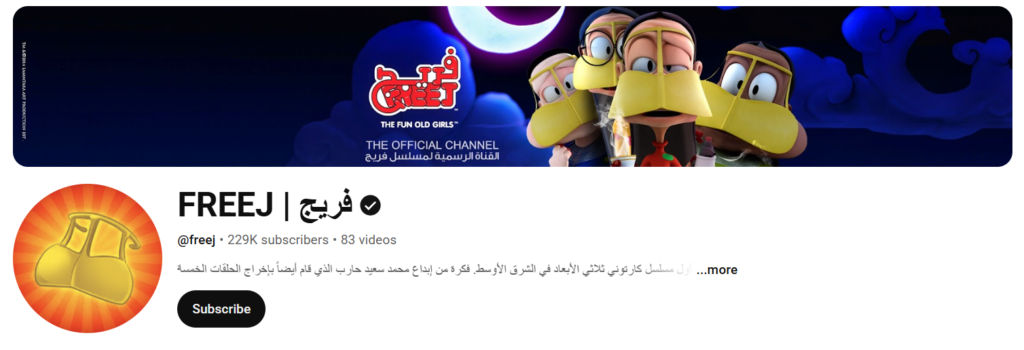
Freej is an Emirati animated series that teaches children Gulf Arabic dialect and Emirati cultural values through the daily lives of four elderly grandmother characters. It’s best used as a cultural-immersion supplement rather than a primary literacy tool, since it airs in dialect rather than Modern Standard Arabic.
Freej is an Emirati CGI television series for children, telling the tale of four old Emirati women living in a secluded neighbourhood in modern-day Dubai. The main characters — Um Saeed, Um Saloom, Um Allawi, and Um Khammas — try to live a peaceful life amid the ever-expanding city around them. The show’s title itself references “freej,” a term meaning “neighbourhood” in Emirati Arabic.
The show’s creator built it around a genuinely thoughtful cultural gap he’d noticed. Harib explained that Arab culture is very rich in superheroes such as Aladdin and Alibaba, but he could not find a suitably modern Arabic character that fit the role, and after researching grandfathers’ struggles as pearl divers, found hardly any mention of grandmothers.
For families whose children already speak some conversational Gulf Arabic at home, Freej offers rich listening practice in authentic dialect — but it should sit alongside, not replace, MSA-focused resources like those in our Arabic stories for kids collection.
Read also: Colours in Arabic for Kids
Is Freej Appropriate for Young Children or Older Kids?
Freej works best for older children and family co-viewing rather than as a standalone tool for toddlers or early readers, since its humor and social commentary target a broader, all-ages Ramadan television audience. Freej began in 2006 as an instant hit released during Ramadan, with many viewers waiting patiently each year for the newest episode, a viewing pattern more typical of family entertainment than early-childhood curriculum content.
How Should Parents Use Arabic Shows Alongside Structured Lessons?
Arabic shows work best as reinforcement for structured lessons, not as a replacement for them, since even the most educationally-designed program can’t correct a child’s pronunciation or check their comprehension in real time.
Pairing 15–20 minutes of daily viewing with an actual course produces measurably stronger results than screen time alone.
In our sessions at Buruj Academy, we’ve noticed that children who watch MSA shows regularly recognize vocabulary faster during lessons, but they still need an instructor to catch mispronunciations that a show simply can’t correct. A puppet character models a word once; a teacher can hear a child repeat it back and adjust the sound immediately.
This combination approach mirrors what research has found in Egypt with Alam Simsim specifically. Studies have found that children who watch the program show improvement in literacy and math skills, and caregivers who watch the program show some modifications in their parenting styles.
A 2013 study found that children’s exposure to the program was significantly associated with learning. That’s a strong result — but it’s measured alongside caregiver involvement, not screen time in isolation.
At Buruj Academy, our Online Arabic Classes for Kids use the context-before-abstraction method, pairing exactly this kind of show-based vocabulary exposure with structured, age-appropriate speaking practice guided by instructors experienced in teaching non-native speakers.
Book a FREE Arabic trial for your Child
Give Your Child a Head Start with Buruj Academy’s Arabic Classes for Kids
Arabic shows build genuine vocabulary and cultural familiarity, but pairing that exposure with real instruction is what turns passive watching into actual fluency.
At Buruj Academy, our Online Arabic Classes for Kids combine the context-before-abstraction Buruj Method with Al-Azhar-trained instructors who’ve spent 12+ years teaching non-Arabic speaking children specifically.
Every session is personalized to your child’s age and current level, with flexible 24/7 scheduling and real-time pronunciation correction no show alone can offer.
If your child already enjoys Iftah Ya Simsim or Alam Simsim, they’re closer to ready than you might think. Book a free trial lesson today and let us show you exactly where to start.
Begin your transformation today by choosing the path that fits your goals:
- Online Arabic Classes (General & Comprehensive)
- Arabic Course for Beginners
- Arabic Alphabet Learning Course
- Online Arabic Classes for Kids
- Arabic Classes for Adults
- Arabic Grammar Course (Nahw & Sarf)
- Intermediate Arabic Course (B1/B2)
- Arabic Speaking Course (Conversational Fluency)
- Arabic Reading Course (Literary Excellence)
- Learn Arabic Writing Course (Calligraphy & Composition)
Ready to speak with confidence? Join the global community at Buruj Academy and book your free placement interview today!
Discover the Buruj Academy Difference
Step into our virtual classrooms and see how our expert instructors make learning Quran and Arabic intuitive and clear. We focus on overcoming the specific hurdles non-native speakers face, building your confidence and connection with the Quran.
Excel in Your Quranic Studies
Join Buruj Academy and master the Quran with our structured, professional curriculum.
Book Your Free TrialConclusion
Arabic children’s television has quietly produced some of the most educationally rigorous programming in the region, built by researchers and linguists rather than entertainment studios alone.
The real skill for parents isn’t finding a show — it’s matching the right one to a child’s actual stage, whether that means MSA-heavy literacy content or dialect-rich cultural immersion. Screen time becomes genuinely useful the moment it’s paired with structured, corrective instruction a puppet simply can’t provide.
Frequently Asked Questions About Arabic Kids Shows
Are Arabic Kids Shows Available With English Subtitles?
Some are. Freej, for instance, is available with English subtitles, which helps parents who don’t speak Arabic follow along and reinforce vocabulary at home. Sesame Street co-productions like Iftah Ya Simsim are typically watched without subtitles since the visual and puppet-based teaching style is designed to work independent of translation.
Is Alam Simsim Still Being Produced Today?
Alam Simsim’s original run consisted of ten seasons released from 2000 to 2010, with a thirty-episode revival released for the month of Ramadan in 2017. Older episodes remain widely available for streaming and continue to be used in literacy programs across Egypt.
What Age Group Are These Shows Designed For?
Most MSA educational co-productions target children roughly three to eight years old. Iftah Ya Simsim’s revived version specifically targets the educational, social and language needs of children aged three to eight in the Middle East and North Africa region. Freej and similar dialect-based entertainment shows suit a broader, older, and more family-oriented audience.