 Quran
Quran
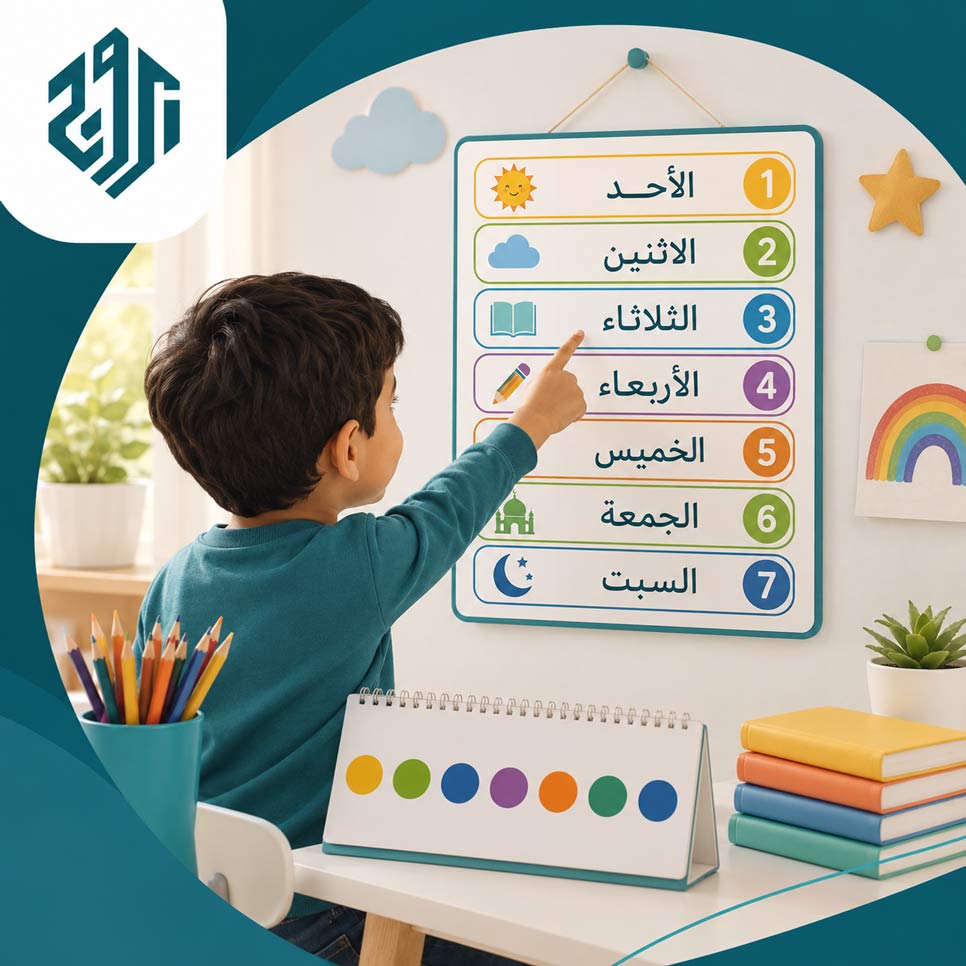
| Key Takeaways |
| Arabic has seven day names, and five of the seven derive directly from Arabic ordinal numbers one through five. |
| Friday, الجمعة (al-Jumu’ah), means “the gathering,” named for the Muslim congregational prayer held that day. |
| Every Arabic day name takes the prefix “yawm” (يوم) when used in a full sentence, meaning “day of.” |
Learning days of the week in Arabic gives children one of the easiest vocabulary wins in the entire language. Unlike many Arabic words, day names follow a clear numerical pattern that young learners can spot within minutes.
Children learn day names fastest through repetition, songs, and visual charts rather than isolated memorization drills.
Table of Contents:
What Are the Seven Days of the Week in Arabic?
The seven Arabic day names are: الأحد (Sunday), الاثنين (Monday), الثلاثاء (Tuesday), الأربعاء (Wednesday), الخميس (Thursday), الجمعة (Friday), and السبت (Saturday). Five come directly from the numbers one through five.
The seven Arabic days are named largely after ordinal numbers, with two exceptions carrying deeper cultural meaning. Sunday through Thursday follow a first-through-fifth numbering pattern, while Friday and Saturday break from numbers entirely.
Understanding this system transforms a memorization task into pattern recognition, something children naturally excel at. Once a child learns to count to five in Arabic, four day names practically teach themselves.
In our experience teaching young learners at Buruj Academy, children who first master Arabic numbers for kids absorb the day names roughly twice as fast as those who tackle both topics simultaneously. The number foundation matters enormously here.
Here is the complete list every child should learn first:
| Day | Arabic | Transliteration | Meaning |
| Sunday | الأحد | al-Ahad | The First |
| Monday | الاثنين | al-Ithnayn | The Second |
| Tuesday | الثلاثاء | ath-Thulatha | The Third |
| Wednesday | الأربعاء | al-Arbi’a | The Fourth |
| Thursday | الخميس | al-Khamis | The Fifth |
| Friday | الجمعة | al-Jumu’ah | The Gathering |
| Saturday | السبت | as-Sabt | The Rest |
This table becomes a child’s first reference chart. We recommend printing it and placing it somewhere the child sees daily, like a bedroom door or kitchen wall.
Building consistent home routines like these mirrors exactly what we emphasize inside our Online Arabic Classes for Kids, where age-appropriate gamification turns vocabulary practice into something children genuinely look forward to each week.
Book a FREE Arabic trial for your child

How Does Sunday Become “The First Day” in Arabic?
Sunday in Arabic is الأحد (al-Ahad), derived from the root word أحد (ahad), meaning “one” or “first.” This makes Sunday the natural starting point for teaching the entire numbered sequence to children.
The connection between al-Ahad and the number one is not coincidental linguistic decoration.
الأحد
al-Ahad
Sunday, “the first”
Practical Exercise: Sunday Recognition
Ask your child to write الأحد five times while saying “Sunday, the first day” aloud each time. Pairing the written form with spoken meaning builds dual-channel memory that sticks longer than silent repetition alone.
Read also:Colours in Arabic for Kids
Why Do Monday Through Thursday Follow a Number Pattern in Arabic?
Monday through Thursday in Arabic directly mirror the Arabic ordinal numbers two through five, making this four-day stretch the most teachable block in the entire week. Once children grasp Sunday’s “first” pattern, these four days follow logically.
This numerical backbone is precisely why we always sequence Arabic vocabulary lessons around patterns rather than isolated word lists. Recognizing structure reduces the cognitive load children face when a subject seems to offer nothing but random new sounds.
Let’s examine each day individually with full detail.
What is Monday in Arabic: الاثنين (al-Ithnayn)
Monday in Arabic is الاثنين (al-Ithnayn), and it derives from اثنين (ithnayn), the Arabic word for “two.” Children who already know how to count often blurt out “two!” the instant they hear this word, which is exactly the recognition moment we want to encourage.
الاثنين
al-Ithnayn
Monday, “the second”
A useful classroom exercise: have the child hold up two fingers every time they say “al-Ithnayn.”
Physical gesture paired with vocabulary dramatically improves recall for kinesthetic learners, a group that makes up a significant portion of young Arabic students.
What is Tuesday in Arabic?
Tuesday in Arabic is الثلاثاء (ath-Thulatha), it comes from ثلاثة (thalatha), meaning “three.” Note the slight sound shift, from “th-a-la-tha” to “ath-thu-la-tha,” which is common when numbers transform into day names.
الثلاثاء
ath-Thulatha
Tuesday, “the third”
Many young learners stumble on this word because of the doubled “th” sound at the start. We recommend breaking it into two syllable chunks, “ath” then “thulatha,” before asking the child to blend them into one smooth word.
What is Wednesday in Arabic? الأربعاء (al-Arbi’a)
Wednesday in Arabic is الأربعاء (al-Arbi’a). Wednesday stems from أربعة (arba’ah), the number four. This day introduces the Arabic letter ع (ain), a throat sound that many non-Arabic speaking children find unfamiliar at first encounter.
الأربعاء
al-Arbi’a
Wednesday, “the fourth”
Mastering the ain sound properly matters far beyond this single word, since it recurs constantly throughout Arabic vocabulary.
Our instructors dedicate specific practice time to this letter within our Arabic Alphabet Learning Course, where children build correct pronunciation habits from the very beginning.
Get a free trial now in Buruj’s Alphabet course

What is Thursday in Arabic?
Thursday in Arabic is الخميس (al-Khamis). Thursday comes from خمسة (khamsah), meaning “five,” completing the numbered sequence that started with Sunday. By this point, children have typically internalized the entire numbering pattern without realizing they memorized five separate words.
الخميس
al-Khamis
Thursday, “the fifth”
Interestingly, Khamis also functions as a common Arabic boy’s name, traditionally given to sons born on a Thursday. This cultural detail often delights children and gives them a memorable talking point to share with family members.
Read also: Arabic Writing for Kids
Discover the Buruj Academy Difference
Step into our virtual classrooms and see how our expert instructors make learning Quran and Arabic intuitive and clear. We focus on overcoming the specific hurdles non-native speakers face, building your confidence and connection with the Quran.
Master the Arabic Language
Join our expert-led courses and build a strong foundation in Classical and Modern Arabic.
Get Your Free TrialWhat Makes Friday and Saturday Different in Arabic?
Friday and Saturday break entirely from the number pattern, carrying names rooted in meaning rather than counting. Friday, الجمعة (al-Jumu’ah), means “the gathering,” while Saturday, السبت (as-Sabt), means “the rest.”
This shift signals something important to young learners: not every pattern in language holds forever, and irregularity is normal rather than confusing. We treat this moment as a teaching opportunity rather than an exception to apologize for.
What is Friday in Arabic? الجمعة (al-Jumu’ah)
Friday in Arabic is الجمعة (al-Jumu’ah). Friday holds the deepest religious significance among all seven days in the Islamic Arabic-speaking world. The name الجمعة comes directly from the Arabic verb meaning “to gather” or “to congregate.”
For Muslim families, this connects naturally to Jumu’ah prayer, the weekly congregational worship held every Friday afternoon. The Quran directly references this gathering in Surah Al-Jumu’ah.
يَا أَيُّهَا الَّذِينَ آمَنُوا إِذَا نُودِيَ لِلصَّلَاةِ مِن يَوْمِ الْجُمُعَةِ فَاسْعَوْا إِلَىٰ ذِكْرِ اللَّهِ وَذَرُوا الْبَيْعَ
Ya ayyuhal-latheena amanoo itha noodiya lissalati min yawmil-jumu’ati fas’aw ila thikrillahi wa tharul-bay’*
“O you who have believed, when [the adhan] is called for the prayer on the day of Jumu’ah [Friday], then proceed to the remembrance of Allah and leave trade.” (Al-Jumu’ah 62:9)
Children raised in Muslim households often already sense that Friday feels different from other days. Connecting that lived experience to the actual word meaning deepens comprehension far beyond rote memorization.
What is Saturday in Arabic? السبت (as-Sabt)
Saturday in Arabic is السبت (as-Sabt). Saturday’s name, السبت (as-Sabt), means “rest” or “Sabbath,” sharing linguistic roots with the Hebrew Shabbat and the English word “Sabbath” itself. This etymological connection reflects the shared Semitic language family both tongues belong to.
السبت
as-Sabt
Saturday, “the rest”
We find this cross-linguistic link genuinely fascinating for older children studying comparative language history, though younger learners can simply enjoy knowing that “Saturday means resting” as a simple memory hook.
Read also:Arabic Poems for Kids
How Do You Use Day Names in Full Arabic Sentences?
Every Arabic day name requires the word يوم (yawm), meaning “day,” placed before it to form a natural sentence, as in يوم الجمعة (yawm al-Jumu’ah), “the day of Friday” or simply “Friday.” This small addition is essential for correct, natural-sounding Arabic.
Without yawm, day names can sound clipped or incomplete in spoken conversation, much like saying only “Monday” instead of “on Monday” might feel abrupt in English. Children should practice this pairing from their very first lesson.
Sentence Pattern Practice Table
| English | Arabic | Transliteration |
| Today is Sunday | اليوم الأحد | al-yawm al-Ahad |
| I have school on Monday | عندي مدرسة يوم الاثنين | ‘indi madrasah yawm al-Ithnayn |
| We visit grandma on Friday | نزور جدتي يوم الجمعة | nazoor jaddati yawm al-Jumu’ah |
| I rest on Saturday | أرتاح يوم السبت | artah yawm as-Sabt |
Have your child practice building three new sentences using this exact pattern, substituting different activities like “eating,” “playing,” or “reading” into the template. Repetition inside varied context builds true fluency rather than mechanical recitation.
This kind of pattern-based sentence building connects directly to broader lessons in Arabic sentence structure, a skill children continue developing well beyond this single vocabulary set.
Practical Exercises to Practice Arabic Days at Home for Kids
Consistent, varied practice cements Arabic day names far more effectively than a single memorization session ever could. We recommend combining written repetition, oral drills, and simple games across a two-week practice window for lasting retention.
Exercise One: The Weekly Calendar Fill-In
Print a blank seven-day calendar and have your child label each box in Arabic script, checking their spelling against the reference table above. This visual exercise reinforces both meaning and correct letter formation simultaneously.
Exercise Two: Flashcard Matching Game
Create fourteen cards, seven with Arabic day names and seven with English equivalents, then have your child match pairs against a timer. Racing against their own previous time keeps the activity motivating rather than tedious.
Exercise Three: Daily Greeting Ritual
Each morning, ask your child “أي يوم اليوم؟” (“Which day is today?”) and require a full Arabic sentence response using the yawm pattern. This single daily habit, repeated consistently, builds automatic recall within roughly two to three weeks for most young learners in our experience.
Exercise Four: The Song Method
Arabic day-of-the-week songs, widely available for children online, use melody and rhythm to anchor vocabulary far more durably than flat repetition. Music engages memory pathways that plain drilling simply cannot reach for most young children.
Master the Arabic Language
Join our expert-led courses and build a strong foundation in Classical and Modern Arabic.
Get Your Free TrialMaster Arabic Vocabulary with Buruj Academy’s Expert Instructors
Learning Arabic days of the week opens the door to broader vocabulary confidence and natural conversational ability. Buruj Academy’s Online Arabic Classes for Kids build on exactly this foundation.
Our approach features Al-Azhar University graduates with 12+ years teaching non-Arabic speakers, using the Buruj Method’s context-before-abstraction pedagogy. Every lesson pairs new vocabulary with real sentence use, not isolated word lists.
Students receive personalized 1-on-1 sessions, flexible 24/7 scheduling, and real-time pronunciation correction tailored to their exact age and level.
Book a free trial lesson today and watch your child’s Arabic confidence grow week by week, Insha’Allah.
Begin your transformation today by choosing the path that fits your goals:
- Online Arabic Classes (General & Comprehensive)
- Arabic Course for Beginners
- Arabic Alphabet Learning Course
- Online Arabic Classes for Kids
- Arabic Classes for Adults
- Arabic Grammar Course (Nahw & Sarf)
- Intermediate Arabic Course (B1/B2)
- Arabic Speaking Course (Conversational Fluency)
- Arabic Reading Course (Literary Excellence)
- Learn Arabic Writing Course (Calligraphy & Composition)
Ready to speak with confidence? Join the global community at Buruj Academy and book your free placement interview today!
Conclusion
Mastering Arabic days of the week gives children a genuine head start, since the numerical pattern behind five of the seven names turns memorization into simple recognition. Friday and Saturday’s meaning-based names add cultural depth that pure number drilling never could.
With consistent practice through sentences, songs, and daily greeting rituals, most young learners internalize all seven days within two to three weeks. This foundation supports every future Arabic vocabulary lesson that follows, Alhamdulillah.
Frequently Asked Questions About Days of the Week in Arabic
What Is the Easiest Arabic Day to Teach First?
Sunday, الأحد (al-Ahad), is easiest to teach first since it directly means “one” or “first,” anchoring the entire numerical naming pattern that carries through Thursday and helping children build recognition from day one.
Why Does the Arabic Week Sometimes Start on Saturday?
In traditional Islamic reckoning, the week begins on Saturday and ends on Friday, the holy day of congregational prayer. Modern calendars in Arabic-speaking regions, however, commonly display Sunday as the first day for everyday convenience.
Do All Arabic-Speaking Countries Use the Same Day Names?
Yes, all seven Standard Arabic day names remain consistent across Arabic-speaking countries, since they derive from classical Arabic roots. Regional dialects may adjust pronunciation slightly, but the written forms and core meanings stay uniform.