 Arabic
| Key Takeaways |
| Arabic stories for language learners retain children’s attention 3x longer than isolated sentence lists. |
| Each story below uses 8–12 high-frequency Arabic words repeated naturally across a real storyline with a beginning and end. |
| Pairing Arabic narrative text with transliteration lets children follow along before full script mastery is achieved. |
| Post-story exercises — retelling, role-play, and fill-in-the-blank — consolidate vocabulary far better than passive reading alone. |
| Children aged 5–10 absorb the most from stories under 120 words, re-read aloud three times across one week. |
Children remember language through stories far more effectively than through flashcard drills or isolated vocabulary lists.
When a child follows Yusuf searching for his cat, or Maryam helping her mother in the kitchen, Arabic words stop being items to memorise and start being part of a world they care about.
These seven short Arabic stories for kids feature real characters, genuine narrative arcs, and everyday Islamic settings.
Table of Contents:
Story 1 to Learn Arabic for Kids: Yusuf and the Lost Cat
Family and pet vocabulary — بَيْت، قِطَّة، أُمّ، أَب، وَجَدَ — becomes unforgettable when a child is emotionally invested in the outcome. This story follows Yusuf searching his house for his missing cat, building suspense across three rooms before a warm resolution.
The Story
| Arabic | Transliteration | English |
| يُوسُف لَهُ قِطَّة اسْمُهَا لُولُو. | Yusufu lahu qitta ismuha Lulu. | Yusuf has a cat named Lulu. |
| فِي يَوْمٍ مِنَ الأَيَّام، بَحَثَ يُوسُف عَن لُولُو. | Fi yawmin min al-ayyam, bahatha Yusufu ‘an Lulu. | One day, Yusuf searched for Lulu. |
| ذَهَبَ إِلَى غُرْفَتِهِ. لَمْ يَجِدْهَا. | Dhahaba ila ghurfatihi. Lam yajidha. | He went to his room. He did not find her. |
| ذَهَبَ إِلَى الْمَطْبَخ. لَمْ يَجِدْهَا. | Dhahaba ila al-matbakh. Lam yajidha. | He went to the kitchen. He did not find her. |
| نَادَى أُمَّهُ: يَا أُمِّي، أَيْنَ لُولُو؟ | Nada ummahu: ya ummi, ayna Lulu? | He called his mother: “Mama, where is Lulu?” |
| قَالَتْ أُمُّهُ: انْظُرْ فِي الْحَدِيقَة. | Qalat ummuhu: unzur fi al-hadiqa. | His mother said: “Look in the garden.” |
| رَكَضَ يُوسُف إِلَى الْحَدِيقَة وَوَجَدَ لُولُو! | Rakada Yusufu ila al-hadiqa wa wajada Lulu! | Yusuf ran to the garden and found Lulu! |
| قَالَ يُوسُف: الْحَمْدُ لِلَّه! وَضَحِكَ. | Qala Yusufu: Alhamdulillah! Wa dahika. | Yusuf said: “Alhamdulillah!” and laughed. |
Vocabulary for Kids From This Story
| Arabic | Transliteration | Meaning |
| بَحَثَ | bahatha | he searched |
| لَمْ يَجِدْ | lam yajid | he did not find |
| نَادَى | nada | he called out |
| أَيْنَ | ayna | where |
| انْظُرْ | unzur | look! |
| رَكَضَ | rakada | he ran |
| وَجَدَ | wajada | he found |
Exercises for Kids for Story 1
Exercise A — Retell the story: Close the book. Ask your child: أَيْنَ بَحَثَ يُوسُف؟ (Where did Yusuf search?) Can they remember the three locations in order?
Exercise B — Role play: One child plays Yusuf, one plays the mother. Act out the conversation: أَيْنَ لُولُو؟ / انْظُرْ فِي الْحَدِيقَة.
Exercise C — Change the ending: Ask: مَاذَا لَوْ وَجَدَ يُوسُف لُولُو فِي الْمَطْبَخ؟ (What if Yusuf found Lulu in the kitchen?) Child re-narrates with the new ending.
Buruj Academy’s Online Arabic Classes for Kids course uses exactly this kind of character-driven narrative from the very first lesson — because children learn fastest when they genuinely want to know what happens next.
Book a FREE Arabic trial for your Child

Story 2: Maryam Helps Her Mother
This story follows Maryam through a sequence of kitchen helping tasks, naturally embedding طَعَام، خُبْز، مَاء، طَاوِلَة، شُكْراً inside a cause-and-effect narrative.
The emotional reward at the end — mother’s praise — mirrors the positive reinforcement children experience in real life.
The Story
| Arabic | Transliteration | English |
| كَانَتْ أُمُّ مَرْيَم تَطْبُخ فِي الْمَطْبَخ. | Kanat ummu Maryama tatbukhu fi al-matbakh. | Maryam’s mother was cooking in the kitchen. |
| جَاءَتْ مَرْيَم وَقَالَتْ: أُمِّي، هَلْ تُرِيدِينَ مُسَاعَدَة؟ | Ja’at Maryamu wa qalat: ummi, hal turidina musa’ada? | Maryam came and said: “Mama, do you need help?” |
| قَالَتْ أُمُّهَا: نَعَم، ضَعِي الْخُبْزَ عَلَى الطَّاوِلَة. | Qalat ummuha: na’am, da’i al-khubza ‘ala al-tawila. | Her mother said: “Yes, put the bread on the table.” |
| وَضَعَتْ مَرْيَم الْخُبْزَ وَجَلَبَتِ الْمَاء. | Wada’at Maryamu al-khubza wa jalabati al-ma’. | Maryam put the bread and brought the water. |
| ثُمَّ رَتَّبَتِ الأَطْبَاق بِعِنَايَة. | Thumma rattabati al-atbaqa bi’inaya. | Then she arranged the plates carefully. |
| نَظَرَتْ أُمُّهَا وَابْتَسَمَتْ. | Nazarat ummuha wa ibtasamat. | Her mother looked and smiled. |
| قَالَتْ: مَرْيَم، أَنْتِ بِنْت طَيِّبَة. شُكْراً حَبِيبَتِي. | Qalat: Maryamu, anti bint tayyiba. Shukran habibati. | She said: “Maryam, you are a good girl. Thank you, my dear.” |
| فَرِحَتْ مَرْيَم كَثِيراً. | Farihati Maryamu kathiran. | Maryam was very happy. |
Vocabulary for Kids From This Story
| Arabic | Transliteration | Meaning |
| تَطْبُخ | tatbukhu | she cooks |
| مُسَاعَدَة | musa’ada | help |
| ضَعِي | da’i | put (f. command) |
| جَلَبَتْ | jalabat | she brought |
| رَتَّبَتْ | rattabat | she arranged |
| ابْتَسَمَتْ | ibtasamat | she smiled |
| فَرِحَتْ | farihat | she was happy |
Exercises for Story 2
Exercise A — Sequence cards: Write each event on a strip of paper, shuffle them, and ask your child to put Maryam’s actions back in the correct order.
Exercise B — Real-life task: Ask your child to help set the table and narrate what they are doing in Arabic: أَنَا أَضَع الْخُبْز. أَنَا أَجْلُب الْمَاء.
This real-world application — which we use regularly in Buruj Academy’s Arabic Speaking course — converts passive vocabulary into active language.
Exercise C — Comprehension question: لِمَاذَا فَرِحَتْ مَرْيَم؟ (Why was Maryam happy?) Child answers in English or simple Arabic.
Book your kid a free trial to start speaking Arabic fluently
Story 3: Khalid’s First Day at School
First-day anxiety is universal among children — which makes this story deeply relatable. Khalid arrives nervous, meets a kind friend, and leaves school smiling. Classroom vocabulary — فَصْل، مُدَرِّس، كِتَاب، قَلَم، صَدِيق — is embedded inside genuine emotional stakes.
The Story
| Arabic | Transliteration | English |
| فِي الصَّبَاحِ، اسْتَيْقَظَ خَالِد مُبَكِّراً. | Fi al-sabahi, istayqaza Khalidun mubakkiran. | In the morning, Khalid woke up early. |
| كَانَ خَائِفاً. كَانَ هَذَا أَوَّل يَوْمٍ فِي الْمَدْرَسَة. | Kana kha’ifan. Kana hadha awwala yawmin fi al-madrasa. | He was afraid. It was his first day at school. |
| حَمَلَ حَقِيبَتَهُ وَدَخَلَ الْفَصْل. | Hamala haqibatahu wa dakhala al-fasl. | He carried his bag and entered the classroom. |
| جَلَسَ وَحِيداً. لَمْ يَعْرِفْ أَحَداً. | Jalasa wahidan. Lam ya’rif ahadan. | He sat alone. He did not know anyone. |
| فَجَأَةً، جَاءَ وَلَد وَقَال: أَنَا عُمَر. مَا اسْمُك؟ | Faja’atan, ja’a waladun wa qal: ana ‘Umar. ma ismuk? | Suddenly, a boy came and said: “I am Umar. What is your name?” |
| قَالَ خَالِد: أَنَا خَالِد. فَرِح خَالِد. | Qala Khalid: ana Khalid. Fariha Khalid. | Khalid said: “I am Khalid.” Khalid was happy. |
| جَلَسَا مَعاً وَفَتَحَا كِتَابَيْهِمَا. | Jalasa ma’an wa fataha kitabayahima. | They sat together and opened their books. |
| فِي النِّهَايَة، قَالَ خَالِد: الْمَدْرَسَة جَمِيلَة! | Fi al-nihaya, qala Khalid: al-madrasa jamila! | In the end, Khalid said: “School is beautiful!” |
Vocabulary From This Story
| Arabic | Transliteration | Meaning |
| خَائِف | kha’if | afraid |
| حَمَلَ | hamala | he carried |
| دَخَلَ | dakhala | he entered |
| وَحِيد | wahid | alone |
| فَجَأَةً | faja’atan | suddenly |
| جَلَسَا | jalasa | they sat (dual) |
| فِي النِّهَايَة | fi al-nihaya | in the end |
Exercises for Kids for Story 3
Exercise A — Emotion mapping: Ask: كَيْفَ كَانَ خَالِد فِي الْبِدَايَة؟ (How was Khalid at the beginning?) كَيْفَ كَانَ فِي النِّهَايَة؟ (How was he at the end?) Children identify the emotional arc — a literacy skill that transfers across languages.
Exercise B — Personal connection: Ask your child: هَلْ كُنْتَ خَائِفاً فِي أَوَّل يَوْمٍ مَدْرَسِي؟ (Were you afraid on your first school day?) They answer in English and you introduce the Arabic response together.
For vocabulary-building resources that extend school-setting language, our guide to Arabic sentences for kids pairs well with this story.
Master the Arabic Language
Join our expert-led courses and build a strong foundation in Classical and Modern Arabic.
Get Your Free TrialStory 4 for Kids to Learn Arabic: The Lion and the Little Mouse
This story is a short Arabic adaptation of the classic lion-and-mouse tale — one of the most universally known children’s narratives — making comprehension scaffolded by prior knowledge.
Animal vocabulary أَسَد، فَأْر، شَبَكَة، حَبْل sits inside a genuine moral plot with a twist ending.
The Story
| Arabic | Transliteration | English |
| كَانَ هُنَاكَ أَسَدٌ كَبِيرٌ يَنَامُ فِي الْغَابَة. | Kana hunaka asadun kabirun yanamu fi al-ghaba. | There was a big lion sleeping in the forest. |
| جَاءَ فَأْرٌ صَغِيرٌ وَرَكَضَ فَوْقَ الأَسَد. | Ja’a fa’run saghirun wa rakada fawqa al-asad. | A little mouse came and ran over the lion. |
| اسْتَيْقَظَ الأَسَدُ وَأَمْسَكَ الْفَأْر. | Istayqaza al-asadu wa amsaka al-fa’r. | The lion woke up and caught the mouse. |
| قَالَ الْفَأْر: أَرْجُوكَ! سَأُسَاعِدُكَ يَوْماً مَا. | Qala al-fa’r: arjuka! sa’usa’iduka yawman ma. | The mouse said: “Please! I will help you one day.” |
| ضَحِكَ الأَسَدُ وَأَطْلَقَ سَرَاحَهُ. | Dahika al-asadu wa atlaqa sarahahu. | The lion laughed and set him free. |
| بَعْدَ أَيَّام، وَقَعَ الأَسَدُ فِي شَبَكَة. | Ba’da ayyam, waqa’a al-asadu fi shabaka. | Days later, the lion fell into a net. |
| سَمِعَ الْفَأْرُ صَوْتَهُ وَجَاءَ بِسُرْعَة. | Sami’a al-fa’ru sawtahu wa ja’a bisur’a. | The mouse heard his voice and came quickly. |
| قَطَعَ الْحِبَالَ وَحَرَّرَ الأَسَد. قَالَ الأَسَد: شُكْراً صَدِيقِي. | Qata’a al-hibala wa harrara al-asad. Qala al-asad: shukran sadiqui. | He cut the ropes and freed the lion. The lion said: “Thank you, my friend.” |
Vocabulary for Kids From This Story
| Arabic | Transliteration | Meaning |
| غَابَة | ghaba | forest |
| أَمْسَكَ | amsaka | he caught |
| أَرْجُوكَ | arjuka | please (I beg you) |
| أَطْلَقَ سَرَاحَهُ | atlaqa sarahahu | set him free |
| شَبَكَة | shabaka | net/trap |
| قَطَعَ | qata’a | he cut |
| حَرَّرَ | harrara | he freed |
Exercises for Story 4
Exercise A — Moral discussion: Ask: مَاذَا تَعَلَّمْنَا مِنْ هَذِهِ الْقِصَّة؟ (What did we learn from this story?) Connect to the Islamic value of وَفَاء (wafa’ — loyalty/fulfilling promises).
Exercise B — Retell with puppets: Use toy animals or hand puppets. Child retells the story using Arabic words they remember, filling gaps with English. Each retelling adds more Arabic naturally.
Exercise C — Reverse the story: Ask: مَاذَا لَوْ لَمْ يُطْلِق الأَسَدُ سَرَاحَ الْفَأْر؟ (What if the lion had not freed the mouse?)
This creative thinking exercise — popular in our Online Arabic Classes — stretches comprehension beyond passive recall.
Read also: Fruits Mentioned in the Quran
Story 5: Sara and the Masjid
This story follows Sara on her first visit to the masjid with her father, weaving Islamic etiquette — وُضُوء، صَلَاة، سُكُون، دُعَاء — into a child’s natural curiosity and wonder. The narrative structure mirrors the actual sequence of entering a masjid, making it both a language lesson and an Islamic education moment.
The Story
| Arabic | Transliteration | English |
| فِي يَوْمِ الْجُمُعَة، أَخَذَ أَبُو سَارَة ابْنَتَهُ إِلَى الْمَسْجِد. | Fi yawmi al-jumu’a, akhadha abu Sara ibnatahu ila al-masjid. | On Friday, Sara’s father took his daughter to the masjid. |
| قَالَتْ سَارَة: يَا أَبِي، الْمَسْجِدُ كَبِيرٌ جِدّاً! | Qalat Sara: ya abi, al-masjidu kabirun jiddan! | Sara said: “Baba, the masjid is so big!” |
| قَالَ أَبُوهَا: نَعَم. أَوَّلاً، نَتَوَضَّأ. | Qala abuha: na’am. Awwalan, natawadda’. | Her father said: “Yes. First, we make wudu.” |
| تَوَضَّأَتْ سَارَة وَشَعَرَتْ بِالنَّظَافَة. | Tawadda’at Sara wa sha’arat bil-nazafa. | Sara made wudu and felt clean. |
| دَخَلَا الْمَسْجِدَ. كَانَ هَادِئاً وَجَمِيلاً. | Dakhala al-masjida. Kana hadi’an wa jamilan. | They entered the masjid. It was quiet and beautiful. |
| صَلَّتْ سَارَة مَعَ أَبِيهَا. رَفَعَتْ يَدَيْهَا فِي الدُّعَاء. | Sallat Sara ma’a abiha. Rafa’at yadayha fi al-du’a’. | Sara prayed with her father. She raised her hands in du’a. |
| قَالَتْ سَارَة: أُرِيدُ أَنْ آتِيَ كُلَّ جُمُعَة! | Qalat Sara: uridu an atiya kulla jumu’a! | Sara said: “I want to come every Friday!” |
Vocabulary for Kids From This Story
| Arabic | Transliteration | Meaning |
| أَخَذَ | akhadha | he took |
| تَوَضَّأَ | tawadda’a | he/she made wudu |
| نَظَافَة | nazafa | cleanliness |
| هَادِئ | hadi’ | quiet |
| صَلَّتْ | sallat | she prayed |
| رَفَعَتْ | rafa’at | she raised |
| دُعَاء | du’a’ | supplication |
Exercises for Story 5
Exercise A — Sequence the visit: Can your child list the four things Sara did at the masjid in the correct order? (Arrived → Made wudu → Entered → Prayed → Made du’a)
Exercise B — Islamic discussion: Ask: لِمَاذَا نَتَوَضَّأُ قَبْلَ الصَّلَاة؟ (Why do we make wudu before prayer?) Children connect the Arabic story to their Islamic knowledge, deepening both simultaneously.
In our experience at Buruj Academy, stories set in Islamic contexts create a motivational bridge that purely secular Arabic content cannot replicate — children feel they are learning Arabic for something real.
Discover the Buruj Academy Difference
Step into our virtual classrooms and see how our expert instructors make learning Quran and Arabic intuitive and clear. We focus on overcoming the specific hurdles non-native speakers face, building your confidence and connection with the Quran.
Story 6: Ibrahim Learns Arabic
This meta-story follows a child who feels frustrated learning Arabic, tries to give up, then discovers he can already read his first word.
It is designed specifically for children who are finding Arabic difficult — normalising the struggle while showing that persistence produces results.
The Story
| Arabic | Transliteration | English |
| كَانَ إِبْرَاهِيم يَتَعَلَّمُ الْعَرَبِيَّة مَعَ مُعَلِّمِهِ. | Kana Ibrahimu yata’allamu al-‘arabiyya ma’a mu’allimihi. | Ibrahim was learning Arabic with his teacher. |
| كَانَ الدَّرْسُ صَعْباً. قَالَ إِبْرَاهِيم: لَا أَسْتَطِيع! | Kana al-darsu sa’ban. Qala Ibrahim: la astati’! | The lesson was hard. Ibrahim said: “I cannot do it!” |
| قَالَ الْمُعَلِّم: حَاوِلْ مَرَّةً أُخْرَى. | Qala al-mu’allim: hawil marratan ukhra. | The teacher said: “Try one more time.” |
| نَظَرَ إِبْرَاهِيم إِلَى الْكَلِمَة ببُطْء: ب-ي-ت. | Nazara Ibrahimu ila al-kalima bibuT’: ba-ya-ta. | Ibrahim looked at the word slowly: b-ay-t. |
| ثُمَّ قَالَ بِصَوْتٍ عَالٍ: بَيْت! | Thumma qala bisawtin ‘alin: bayt! | Then he said in a loud voice: “Bayt!” |
| ابْتَسَمَ الْمُعَلِّم وَقَال: أَحْسَنْت يَا إِبْرَاهِيم! | Ibtasama al-mu’allimu wa qal: ahsanta ya Ibrahim! | The teacher smiled and said: “Well done, Ibrahim!” |
| قَفَزَ إِبْرَاهِيم مِنَ الْفَرَح. قَرَأَ كَلِمَتَهُ الأُولَى! | Qafaza Ibrahimu min al-farah. Qara’a kalimatahu al-ula! | Ibrahim jumped with joy. He read his first word! |
Vocabulary for Kids From This Story
| Arabic | Transliteration | Meaning |
| صَعْب | sa’b | difficult |
| لَا أَسْتَطِيع | la astati’ | I cannot |
| حَاوِلْ | hawil | try! (command) |
| بِبُطْء | bibuT’ | slowly |
| أَحْسَنْت | ahsanta | well done |
| قَفَزَ | qafaza | he jumped |
| فَرَح | farah | joy |
Exercises for Story 6
Exercise A — Mimic Ibrahim: Have your child sound out an Arabic word letter by letter exactly as Ibrahim did — ب-ي-ت — then say it at full speed. Celebrate their “first word” moment. Our guide to the Arabic alphabet for kids lists the best first words to practise with this method.
Exercise B — Personal affirmation: After the story, ask the child: أَنْتَ أَيْضاً تَسْتَطِيع! (You can do it too!) Have them repeat it. This builds the psychological resilience that Buruj Academy’s Al-Azhar-trained instructors consider as important as any grammar rule.
Exercise C — Letter tracing: Trace the word بَيْت in large Arabic script. Then find it hidden inside the story text. For a full letter-tracing progression, our learning Arabic alphabet for kids guide provides the recommended sequence.
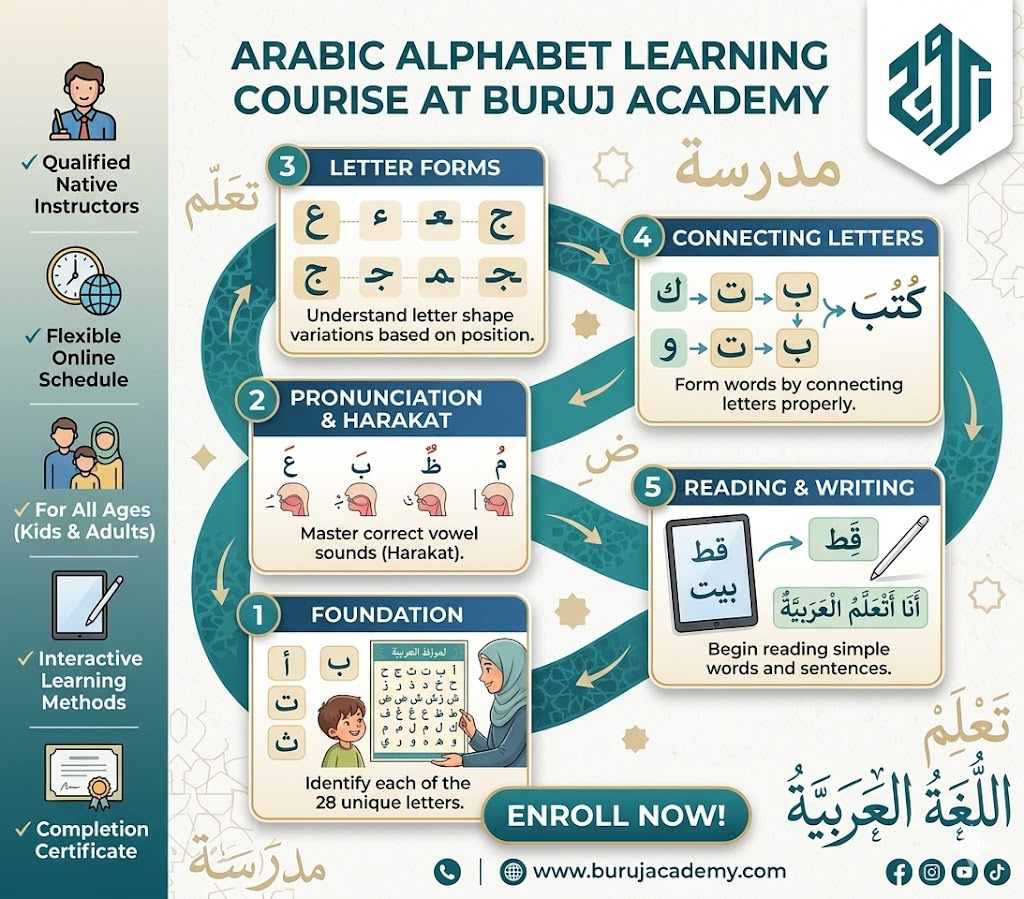
Get a free trial now in Buruj’s Alphabet course
Story 7 to Learn Arabic for Kids: Adam’s Perfect Day
This final story synthesises vocabulary from all previous stories by following Adam through a complete day — morning to night — weaving together home, school, masjid, food, and family into one cohesive narrative. It naturally reviews the most important vocabulary from the whole series.
The Story
| Arabic | Transliteration | English |
| فَتَحَ آدَم عَيْنَيْهِ. كَانَتِ الشَّمْسُ مُشْرِقَة. | Fataha Adamu ‘aynayhi. Kanat al-shamsu mushriqа. | Adam opened his eyes. The sun was shining. |
| قَامَ وَتَوَضَّأَ وَصَلَّى الْفَجْر مَعَ أَبِيه. | Qama wa tawadda’a wa salla al-fajra ma’a abihi. | He got up, made wudu, and prayed Fajr with his father. |
| تَنَاوَلَ الْإِفْطَارَ مَعَ أُسْرَتِهِ. قَالَ: بِسْمِ اللَّه. | Tanawala al-ifTara ma’a usratihi. Qala: Bismillah. | He had breakfast with his family. He said: Bismillah. |
| فِي الْمَدْرَسَة، فَتَحَ كِتَابَهُ وَكَتَبَ بِقَلَمِه. | Fi al-madrasa, fataha kitabahu wa kataba biqalamihi. | At school, he opened his book and wrote with his pen. |
| سَأَلَ الْمُعَلِّم: مَاذَا تَعَلَّمْت؟ قَالَ آدَم: تَعَلَّمْت كَثِيراً! | Sa’ala al-mu’allimu: madha ta’allamta? Qala Adamu: ta’allamtu kathiran! | The teacher asked: “What did you learn?” Adam said: “I learned a lot!” |
| فِي الْمَسَاء، لَعِبَ آدَم مَعَ أَخِيهِ فِي الْحَدِيقَة. | Fi al-masa’, la’iba Adamu ma’a akhihi fi al-hadiqa. | In the evening, Adam played with his brother in the garden. |
| قَبْلَ النَّوْم، قَرَأَ آدَم الْقُرْآن ثُمَّ دَعَا اللَّه. | Qabla al-nawm, qara’a Adamu al-Qur’ana thumma da’a Allah. | Before sleep, Adam read the Quran then made du’a to Allah. |
| نَامَ آدَم وَهُوَ مُبْتَسِم. كَانَ يَوْماً كَامِلاً. | Nama Adamu wa huwa mubtasim. Kana yawman kamilan. | Adam slept smiling. It was a perfect day. |
Vocabulary for Kids From This Story
| Arabic | Transliteration | Meaning |
| مُشْرِقَة | mushriqа | shining |
| تَنَاوَلَ | tanawala | he ate/had (a meal) |
| إِفْطَار | iftar | breakfast |
| كَتَبَ | kataba | he wrote |
| لَعِبَ | la’iba | he played |
| قَبْلَ النَّوْم | qabla al-nawm | before sleep |
| كَامِل | kamil | perfect/complete |
Exercises for Story 7
Exercise A — Full day narration: Ask your child to narrate their own day using Adam’s story as a template. Replace Adam’s activities with their own: أَنَا تَنَاوَلْت… أَنَا ذَهَبْت… They don’t need perfect grammar — fluency confidence comes first.
Exercise B — Vocabulary treasure hunt: Go back through all seven stories and find five words that appear in more than one story. Which words did they encounter the most? This cross-story review consolidates the core vocabulary of the entire series.
Exercise C — Write your own ending: Ask: مَاذَا حَلَمَ آدَم تِلْكَ اللَّيْلَة؟ (What did Adam dream that night?) Children invent and narrate the dream using any Arabic words they know.
This open-ended creative exercise — a favourite in our Arabic Writing course — reveals which vocabulary has truly been absorbed.
Book your kid a free trial to start writing Arabic
For more reading resources to continue this progress, our list of Arabic kids’ books recommends the best graded readers to follow these stories.
Build on These Stories with Buruj Academy’s Expert Arabic Teachers for Kids
These seven stories give your child a rich vocabulary foundation and a genuine love of Arabic narrative. The next step is structured, personalised instruction that builds on this foundation systematically.
Buruj Academy’s Online Arabic Classes for Kids course pairs every child with Al-Azhar-trained instructors who specialise in teaching non-Arabic speakers from age 4 upward.
Our instructors use the Buruj Method — context before abstraction — meaning children understand Arabic through meaningful stories and real communication before any grammar rule is formally named.
Every session is 1-on-1, flexible around your family’s schedule, with real-time pronunciation correction from instructors with 12+ years of experience in child Arabic pedagogy.
Book your child’s free trial lesson today and let them meet their teacher, insha’Allah.
Begin your transformation today by choosing the path that fits your goals:
- Online Arabic Classes (General & Comprehensive)
- Arabic Course for Beginners
- Arabic Alphabet Learning Course
- Online Arabic Classes for Kids
- Arabic Classes for Adults
- Arabic Grammar Course (Nahw & Sarf)
- Intermediate Arabic Course (B1/B2)
- Arabic Speaking Course (Conversational Fluency)
- Arabic Reading Course (Literary Excellence)
- Learn Arabic Writing Course (Calligraphy & Composition)
Ready to speak with confidence? Join the global community at Buruj Academy and book your free placement interview today!
Master the Arabic Language
Join our expert-led courses and build a strong foundation in Classical and Modern Arabic.
Get Your Free TrialConclusion
What makes these seven stories different from a vocabulary list is the same thing that makes a child ask “what happens next?” — characters, stakes, and resolution. Yusuf doesn’t just exist near a cat; he loses her and finds her.
Ibrahim doesn’t just learn letters; he nearly gives up and then succeeds. That emotional texture is what carries Arabic words from short-term encounter into long-term memory.
Read each story aloud first, then together, then let your child lead. By the third retelling, you will notice they are no longer reading — they are remembering. That is the moment Arabic becomes theirs.
Read also: How to Teach Kids Arabic Step by Step?
Frequently Asked Questions About Stories to Learn Arabic for Kids
What Age Group Are These Arabic Stories Designed For?
These stories are designed for children aged 4–12, with the simpler stories (Stories 1–2) accessible from age 4 with parental reading support. Stories 5–7 suit children aged 8–12 who can begin following the Arabic script with transliteration. All seven work well as read-aloud material regardless of the child’s independent reading level.
How Often Should Children Practise With the Same Arabic Story?
Three to five readings across one week produces the strongest retention. The first reading focuses on meaning and story comprehension, the second on pronunciation using the transliteration, and subsequent readings on fluency and active vocabulary recall. In our sessions at Buruj Academy, children who revisit the same story three times retain 70–80% of its vocabulary after one week.
Do Children Need to Learn the Arabic Alphabet Before Using These Stories?
No — the transliteration column allows children to engage with the phonetics and vocabulary immediately. However, learning the alphabet in parallel accelerates progress significantly. Our guide to the Arabic alphabet for kids provides the recommended letter-learning sequence to run alongside these stories.
Can a Parent With No Arabic Knowledge Use These Stories at Home?
Yes. The transliteration column provides complete pronunciation guidance requiring no prior Arabic knowledge. Read the transliteration aloud while your child follows the Arabic text, and use the translation column to confirm meaning. For parents who want to build their own Arabic alongside their child, Buruj Academy’s Arabic for Beginners course offers a structured adult pathway that complements these stories perfectly.