 Arabic
| Key Takeaways |
| Arabic prayer phrases include specific Quranic verses and supplications that Muslims recite in a fixed sequence across five daily prayers. |
| Learning the Arabic of Salah requires mastering pronunciation, meaning, and grammatical structure of approximately 15 distinct phrases and passages. |
| Understanding Arabic word roots within prayer phrases accelerates both memorization and comprehension of Muslim prayer words in Arabic. |
| Correct pronunciation of prayer Arabic differs significantly from casual spoken Arabic, requiring attention to short vowels, long vowels, and word endings. |
| Structured study — separating memorization from meaning study from pronunciation practice — produces faster and more durable results than studying all three simultaneously. |
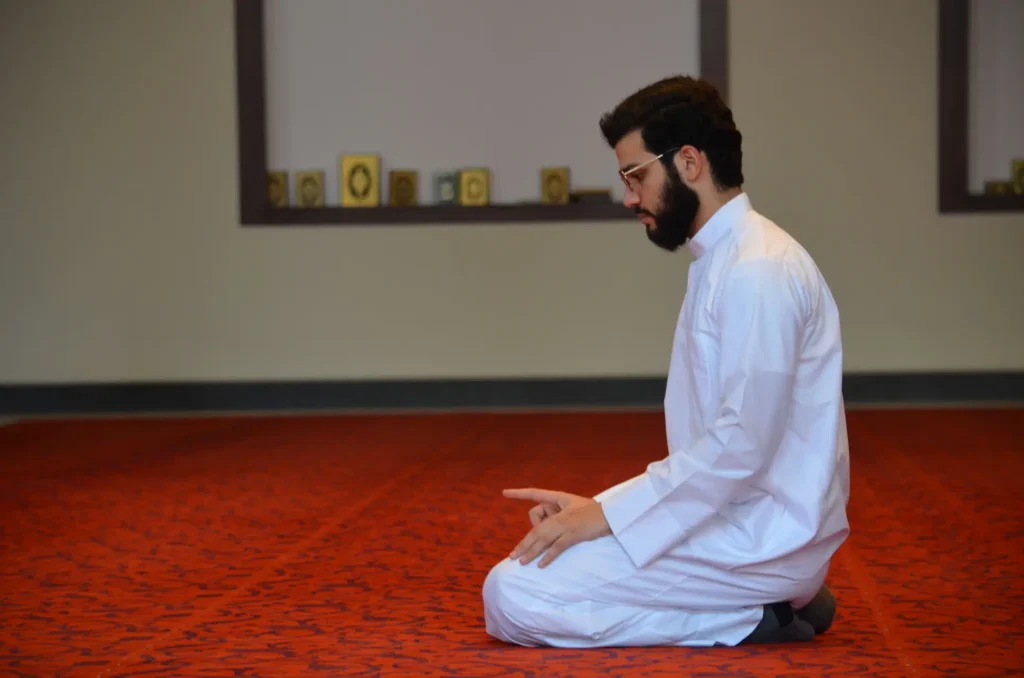
Every Muslim is required to pray five times daily in Arabic, yet the majority of the world’s 1.8 billion Muslims are non-Arabic speakers. That gap — between obligation and comprehension — is exactly where meaningful learning begins.
Learning to pray in Islam in Arabic is not just about memorizing sounds. It means understanding the Arabic words you stand before Allah and speak.
When you know what Allahu Akbar, Subhana Rabbiyal Adheem, and Attahiyyatu actually mean — word by word — your Salah becomes a living conversation, not a recitation.
Table of Contents:
1. Understand What Arabic You Are Actually Learning in Salah
The Arabic of Salah is a defined, finite set of texts. Every phrase you recite in prayer comes from one of three sources: Quranic verses (such as Surah Al-Fatihah), Prophetic supplications (such as the Tashahhud and Du’a al-Istiftah), and glorification phrases (such as the Tasbih in Ruku’ and Sujud).
This is genuinely encouraging news for learners. Unlike learning conversational Arabic — which involves open-ended vocabulary and unpredictable grammar — the Arabic of prayer is fixed and bounded. You are not learning a language from scratch. You are learning a specific, sacred repertoire.
What Are the Core Arabic Texts in Prayer?
| Prayer Section | Arabic Text | Type |
| Opening Takbir | Allahu Akbar | Prophetic phrase |
| Opening Du’a (optional Sunnah) | Du’a al-Istiftah | Prophetic supplication |
| Surah Al-Fatihah | Full 7-verse Surah | Quranic |
| Additional Surah/Verses | Any memorized passage | Quranic |
| Ruku’ Tasbih | Subhana Rabbiyal Adheem | Prophetic phrase |
| Rising from Ruku’ | Sami’allahu liman hamidah / Rabbana lakal hamd | Prophetic phrase |
| Sujud Tasbih | Subhana Rabbiyal A’la | Prophetic phrase |
| Tashahhud | Full Attahiyyatu text | Prophetic supplication |
| Salawat (Ibrahimiyyah) | Allahumma salli ‘ala Muhammad… | Prophetic supplication |
| Final Tasleem | Assalamu alaykum wa rahmatullah | Prophetic phrase |
At Buruj Academy, our Online Arabic Classes begin exactly here — helping students map the full structure of what they are learning before touching a single phrase. This structural overview alone removes the anxiety that makes many learners plateau before they begin.
Begin Understanding Quranic Arabic with a FREE Lesson

2. Start with the Arabic Alphabet Before Memorizing Sounds
Many learners skip this step and pay for it later. They memorize Salah phrases phonetically — from transliteration — and develop pronunciation habits that are genuinely difficult to correct.
In our instructors’ experience at Buruj Academy, students who memorize prayer Arabic from transliteration alone consistently mispronounce the ح (Ha), ع (Ain), غ (Ghain), and ق (Qaf) — four letters that appear repeatedly throughout Salah.
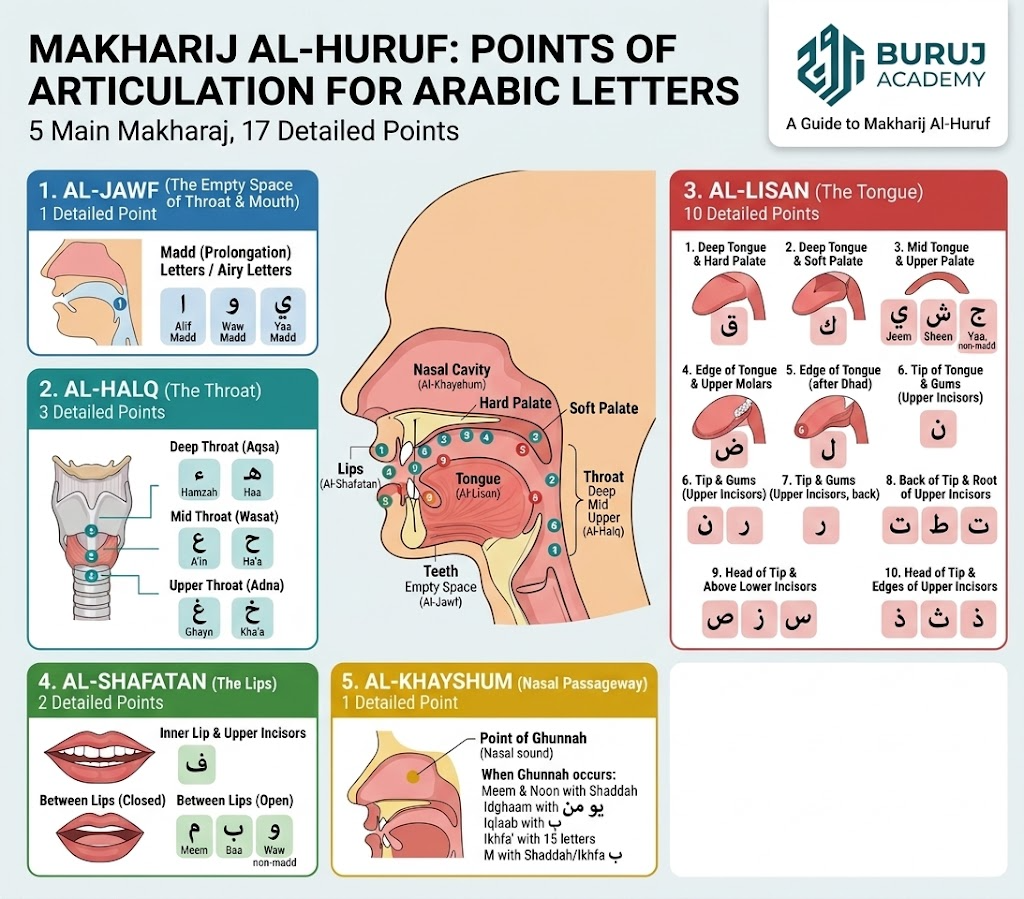
The Arabic alphabet has 28 letters, each produced from a specific point in the mouth or throat called a Makhraj (articulation point).
Prayer Arabic demands that these sounds be produced correctly — not because of perfectionism, but because mispronunciation can alter meaning in classical Arabic.
Why Transliteration Alone Is Not Enough for Prayer Arabic
Transliteration maps Arabic sounds onto English letters, but English has no equivalent for ع, ح, خ, or ق. When you read “Ayn” or “Ha” in transliteration, you are reading an approximation. For everyday conversation, approximations are acceptable. For Salah, where Allah’s words are being recited, accuracy matters.
Learning the Arabic script — even at a basic reading level — anchors your pronunciation to the actual letter being produced.
Our Arabic Alphabet Learning course at Buruj Academy typically brings adult beginners to confident letter recognition within four to six weeks of short daily sessions.
Get a free trial now in Buruj’s Alphabet course
3. Learn Each Prayer Phrase with Its Word-by-Word Arabic Meaning
This is the step that transforms rote recitation into conscious worship. Muslim prayer words in Arabic carry dense, specific meaning — and understanding them at the word level, not just the phrase level, is what makes Arabic comprehension in Salah permanent.
Take the opening Takbir: اللَّهُ أَكْبَرُ
- اللَّهُ — Allah — the proper name of God, in the nominative case (subject of the sentence)
- أَكْبَرُ — Akbar — from the root ك-ب-ر (K-B-R), meaning “great,” in the elative/superlative form: “greater” or “greatest”
The phrase is a nominal sentence in Arabic — no verb required. Understanding that أَكْبَرُ is an elative adjective, not simply “great,” helps you understand why the translation is “Allah is the Greatest” rather than merely “Allah is great.”
How Do Arabic Word Roots Help You Learn Prayer Words Faster?
Arabic is a root-based language. Most words derive from a three-letter root, and once you know a root, you can recognize entire word families. This is one of the most powerful tools for learning Arabic grammar through the context of prayer.
| Root | Meaning | Prayer Words Sharing This Root |
| ح-م-د (H-M-D) | Praise | Al-Hamdulillah, Hamidah, Mahmud |
| س-ب-ح (S-B-H) | Glorify | Subhanallah, Subhana Rabbiy, Tasbih |
| ر-ح-م (R-H-M) | Mercy | Al-Rahman, Al-Raheem, Rahmatullah |
| م-ل-ك (M-L-K) | Own/Rule | Maliki, Maalik, Mulk |
Recognizing these roots across the prayer transforms isolated phrases into a connected vocabulary system. This is foundational to understanding Arabic sentence structure as it appears in Salah.
Read also: How to Learn Arabic for Business?
4. Study Surah Al-Fatihah as an Arabic Grammar Lesson, Not Just a Memorization Task
Surah Al-Fatihah is recited in every unit (Rak’ah) of every prayer. A person who prays the minimum obligatory prayers recites Al-Fatihah seventeen times daily. No text in Salah receives more repetition — which makes it the single highest-return passage for deep Arabic study.
بِسْمِ اللَّهِ الرَّحْمَٰنِ الرَّحِيمِ
Bismillahir-Rahmanir-Raheem
“In the name of Allah, the Entirely Merciful, the Especially Merciful.” (Al-Fatihah 1:1)
The بِ (Bi) prefix means “in” or “with.” اسْم (Ism) means “name.” اللَّه is the subject. الرَّحْمَٰنِ and الرَّحِيمِ are both adjectives (Sifah) derived from the root ر-ح-م, but they carry distinct grammatical weight: الرَّحْمَٰن refers to general, universal mercy, while الرَّحِيم indicates specific, ongoing mercy directed at the believers.
Master the Arabic Language
Join our expert-led courses and build a strong foundation in Classical and Modern Arabic.
Get Your Free TrialBreaking Down Al-Fatihah Verse by Verse for Arabic Comprehension
| Verse | Key Arabic Grammar Point |
| Verse 1 — Bismillah | Prepositional phrase; two divine names as adjectives |
| Verse 2 — Al-Hamdulillah | Nominal sentence; Lam of ownership (لِ) in “lillah” |
| Verse 3 — Al-Rahman Al-Raheem | Apposition (Badal/Sifah); two attributes of the same noun |
| Verse 4 — Maliki Yawmid-Deen | Genitive construction (Mudaf and Mudaf ilayh) |
| Verse 5 — Iyyaka na’budu | Object-first word order for exclusive emphasis |
| Verse 6–7 — Sirat / Ghayril Maghdubi | Relative clause structure; two contrasting groups |
Studying Al-Fatihah this way — phrase by phrase, with grammar awareness — is precisely what we mean by the Buruj Method’s context-before-abstraction approach in our Quran classes for beginners. Grammar is taught through meaning, not before it.
Begin Learning Quran With a FREE Trial Lesson
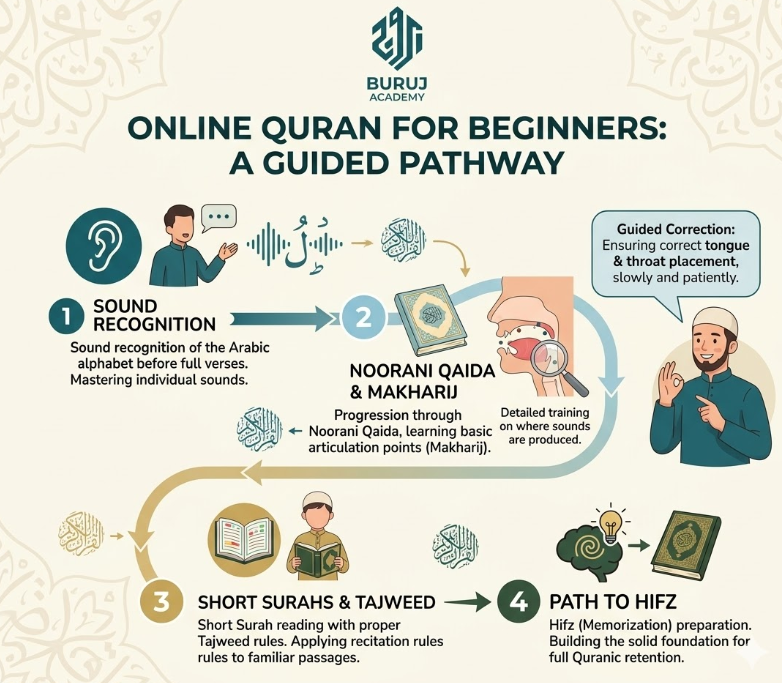
5. Master the Pronunciation of Letters That Non-Arabic Speakers Consistently Mispronounce in Prayer
Prayer Arabic contains several sounds with no English equivalent. These are not minor variations — they are distinct phonemes that, when mispronounced, change the word entirely. Our instructors have identified four letters that non-Arabic speaking students consistently struggle with across the prayer texts.
The most common error we see involves the ع (Ain) in أَعُوذُ (A’udhu) and نَعْبُدُ (Na’budu). Students frequently pronounce it as a simple glottal stop or omit it entirely, producing “na-budu” instead of the correct constricted throat sound. In both cases, the word changes or becomes unclear — and both appear in daily prayer.
The Four Most Mispronounced Letters in Salah
| Letter | Name | Makhraj (Articulation Point) | Appears in Prayer |
| ع | Ain | Middle of the throat, constricted | A’udhu, Na’budu, Al-Aalameen |
| ح | Ha | Lower throat, unvoiced | Al-Rahman, Subhana, Al-Fatihah |
| خ | Kha | Soft palate, fricative | No major prayer word (rare) |
| ق | Qaf | Back of tongue against uvula | Sirat, Mustaqeem |
For accurate pronunciation guidance tailored to English speakers, our Arabic pronunciation course resources address exactly these challenges with audio-supported comparison drills.
6. Learn the Tashahhud as a Complete Arabic Grammatical Text
The Tashahhud (Attahiyyatu) is the most grammatically dense text in Salah. It is a formal address to Allah, then to the Prophet ﷺ, then a testimony of faith — and it contains several Arabic grammatical structures that, once understood, unlock comprehension of broader Quranic Arabic.
The opening line: التَّحِيَّاتُ لِلَّهِ وَالصَّلَوَاتُ وَالطَّيِّبَاتُ
- التَّحِيَّاتُ — all forms of greeting and honor (plural of Tahiyyah) — subject in nominative case
- لِلَّهِ — “belong to Allah” — Lam of ownership + the divine name
- وَالصَّلَوَاتُ — all prayers and blessings (also nominative)
- وَالطَّيِّبَاتُ — all good things (nominative plural)
This is a list of three nominative subjects sharing one predicate (لِلَّهِ). Recognizing this structure — a topic central to Arabic grammar for learners — transforms the Tashahhud from a memorized block into a readable Arabic sentence.
Our Quranic Arabic Classes for Beginners at Buruj Academy dedicates specific attention to the Tashahhud’s grammar, because students who understand it structurally retain it for life — while those who memorize it phonetically often confuse word order and lose sections under pressure.
Begin Understanding Quranic Arabic with a FREE Lesson
7. Use Spaced Repetition to Embed Prayer Arabic into Long-Term Memory
Understanding Arabic prayer phrases is necessary — but durable retention requires a deliberate review system. Spaced repetition is the most evidence-supported method for retaining new vocabulary, and it applies directly to learning Muslim prayer words in Arabic.
The principle is simple: review a new phrase after one day, then after three days, then after one week, then after two weeks. Each successful recall pushes the next review further into the future. This is how the brain consolidates information from short-term to long-term storage.
A Practical Weekly Review Plan for Prayer Arabic
| Day | Activity | Time Required |
| Day 1 | Learn 3 new prayer phrases with meaning | 20 minutes |
| Day 2 | Review Day 1 phrases; add 2 new | 15 minutes |
| Day 4 | Review all phrases from Days 1–2 | 10 minutes |
| Day 7 | Full review of week’s phrases + pronunciation check | 20 minutes |
| Day 14 | Integration review: recite in real prayer consciously | 5 minutes |
In our instructors’ experience, adult non-Arabic speakers who follow a structured review plan like this typically achieve confident comprehension of all obligatory prayer phrases within eight to twelve weeks of consistent fifteen-minute daily sessions — significantly faster than unstructured self-study.
Read also: How to Learn Arabic Through and From the Quran?
8. Connect Prayer Arabic to Broader Quranic and Arabic Vocabulary
Prayer Arabic does not exist in isolation. The vocabulary, grammar, and sentence structures you learn through Salah are the same ones that appear throughout the Quran and classical Arabic. Treating prayer phrases as entry points into the broader Arabic language accelerates your overall progress dramatically.
سَمِعَ اللَّهُ لِمَنْ حَمِدَهُ
Sami’allahu liman hamidah
Allah hears whoever praises Him.” (Sahih Bukhari 795)
The verb سَمِعَ (sami’a) — “he heard” — is a past-tense verb in the third-person masculine singular form (Fi’l Madhi). لِمَنْ combines the Lam preposition with مَن (whoever) — a relative pronoun. حَمِدَهُ is another past-tense verb: “praised Him.” Recognizing these verb forms connects directly to mastering Arabic vocabulary and reading Quranic Arabic with comprehension.
How Prayer Arabic Connects to Learning Arabic More Broadly
If your goal extends beyond Salah — toward reading Arabic, understanding the Quran, or even speaking — then every word you learn in prayer is genuine Arabic vocabulary that transfers. Students in our Arabic for Beginners course who already know Salah Arabic consistently demonstrate stronger early vocabulary recognition than those starting from zero, because they arrive with forty-plus meaningful words already embedded.
Understanding why learning Arabic matters beyond Salah gives this step powerful long-term motivation — and motivation directly sustains consistency.
Discover the Buruj Academy Difference
Step into our virtual classrooms and see how our expert instructors make learning Quran and Arabic intuitive and clear. We focus on overcoming the specific hurdles non-native speakers face, building your confidence and connection with the Quran.
Start Learning Arabic Prayer Language with Buruj Academy’s Expert Instructors
The Arabic of Salah is both an obligation and an opportunity. Mastering it is not reserved for scholars — it is available to every Muslim willing to study it systematically.
Buruj Academy’s Online Arabic Classes and Quranic Arabic Classes course are designed by Al-Azhar University graduates with 12+ years of experience teaching non-Arabic speakers. Our instructors apply the Buruj Method — context-before-abstraction — so you understand before you memorize, and retain permanently rather than forget seasonally.
- Ijazah-certified instructors and Al-Azhar graduates
- Personalized 1-on-1 sessions tailored to your level
- Flexible scheduling for working adults globally
- Real-time pronunciation correction in every session
Book your free trial lesson today — Insha’Allah, your Salah will never feel the same again.
Begin your transformation today by choosing the path that fits your goals:
- Online Arabic Classes (General & Comprehensive)
- Arabic Course for Beginners
- Arabic Alphabet Learning Course
- Online Arabic Classes for Kids
- Arabic Classes for Adults
- Arabic Grammar Course (Nahw & Sarf)
- Intermediate Arabic Course (B1/B2)
- Arabic Speaking Course (Conversational Fluency)
- Arabic Reading Course (Literary Excellence)
- Learn Arabic Writing Course (Calligraphy & Composition)
Ready to speak with confidence? Join the global community at Buruj Academy and book your free placement interview today!
Master the Arabic Language
Join our expert-led courses and build a strong foundation in Classical and Modern Arabic.
Get Your Free TrialConclusion
Learning to pray in Islam in Arabic is one of the most rewarding things a Muslim can do — not because it is difficult, but because of what it opens. When the words of Salah carry meaning, every prayer becomes an act of conscious communication rather than habitual recitation.
The path is structured and learnable: understand the texts, study the alphabet, learn word roots, and build comprehension phrase by phrase.
Each step compounds the one before it. With consistent effort and qualified guidance, fluency in prayer Arabic is well within reach — for beginners, for reverts, and for anyone who has prayed for years without ever truly understanding what they were saying.
Frequently Asked Questions About Learning Arabic Prayers
How Long Does It Take to Learn the Arabic of All Five Prayers?
With structured daily study of fifteen to twenty minutes, most non-Arabic speaking adults reach confident pronunciation and basic comprehension of all obligatory prayer phrases within a week to 4 weeks. Full word-by-word understanding of every prayer text — including the Tashahhud and Du’a al-Istiftah — typically takes three to six months of consistent practice.
Do I Need to Learn the Entire Arabic Language to Understand My Prayers?
No. The Arabic of Salah is a fixed, bounded set of texts. You can achieve full comprehension of every word in the five daily prayers without learning conversational or Modern Standard Arabic. However, prayer Arabic does share vocabulary and grammar with broader Arabic, so it provides an excellent foundation if you choose to continue.
What Is the Difference Between Memorizing Prayer Arabic and Understanding It?
Memorization means you can reproduce the sounds accurately. Understanding means you know what each word means and why it is grammatically constructed as it is. Both are valuable — but understanding produces permanent retention, deeper spiritual connection, and the ability to recorrect yourself if you forget a phrase mid-prayer.
Is It Permissible to Use Transliteration When Learning How to Pray in Islam in Arabic?
Transliteration is a useful initial tool for connecting sounds to memory, but it is not a substitute for learning the Arabic script and correct Makhraj-based pronunciation. Scholars across the major Madhabs agree that learning accurate pronunciation of Quranic and prayer Arabic is an individual obligation (Fard Ayn) for every Muslim, making proper phonetic study — beyond transliteration — necessary.
Can Children Learn Arabic Prayer Phrases the Same Way Adults Do?
Children learn prayer Arabic most effectively through auditory repetition, short phrase-by-phrase exposure, and connection to the physical actions of Salah. Adults benefit more from grammatical explanation and root-based vocabulary study. Buruj Academy’s Online Arabic Classes for Kids course uses age-appropriate methods — including visual anchors and movement-based learning — that align naturally with how children acquire language and memorize prayer words.