 Arabic
| Key Takeaways |
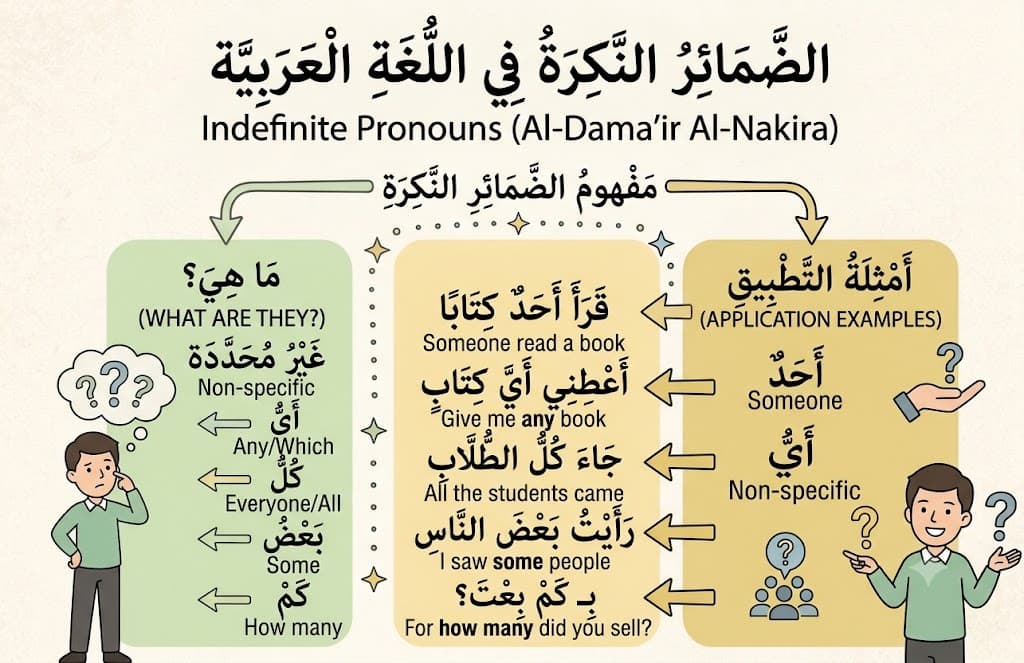
| The indefinite pronoun in Arabic is expressed using specific undefined nouns rather than a separate grammatical category. |
| The most common Arabic indefinite words include أحد (someone), شيء (something), كل (every/all), بعض (some), and لا أحد (no one). |
| Several Arabic words function as both indefinite pronouns and other word classes; context and sentence position determine their grammatical role. |
Arabic indefinite pronouns are words that replace or refer to unspecified people, things, or quantities — without identifying them by name. They include words like أحد (someone/anyone), شيء (something/anything), كل (every/all), بعض (some), and لا شيء (nothing).
Once you understand how they work grammatically, they become one of the most useful tools in your Arabic sentence-building toolkit.
Table of Contents:
What Are Indefinite Pronouns in Arabic?
Indefinite pronouns in Arabic is expressed using words that stand in place of a noun but do not specify which person, thing, or amount is being referred to. They function as subjects, objects, or the second term of an إضافة (genitive construction) depending on their position in the sentence.
Unlike English, where indefinite pronouns are invariable (“someone” stays “someone”), Arabic indefinite pronouns shift their case endings based on their grammatical role.
A word like أحد will carry a Dammah (ـُ) as a subject, a Fathah (ـَ) as an object, and a Kasrah (ـِ) after a preposition. This case sensitivity is a defining feature of Arabic grammar that applies across noun categories.
How Do Arabic Indefinite Pronouns Differ from English Ones?
In English, indefinite pronouns are a closed, fixed list — words like “someone,” “anything,” “nobody,” “everything.” Arabic works differently: many words that function as indefinite pronouns in certain contexts also function as nouns, adjectives, or adverbs in others.
For example, كل can mean “every,” “all,” or “each” depending on what follows it and how it is structured.
This grammatical flexibility makes Arabic indefinite pronouns richer but also more demanding.
We consistently see students in our Online Arabic Grammar Course struggle precisely at this point — they know the word بعض means “some,” but they don’t know how to place it correctly in a sentence with proper case marking.
Understand the Arabic Grammar with Buruj’s free trial lesson
The Core Indefinite Pronouns List in Arabic
The following table presents the essential indefinite words in Arabic that every intermediate student must know. These are the foundational forms used in Modern Standard Arabic (MSA).
| Arabic | Transliteration | Meaning | Category |
| أَحَدٌ | Aḥadun | Someone / Anyone | Person |
| لَا أَحَدَ | Lā aḥada | No one / Nobody | Person (negative) |
| شَيْءٌ | Shay’un | Something / Anything | Thing |
| لَا شَيْءَ | Lā shay’a | Nothing | Thing (negative) |
| كُلٌّ | Kullun | Every / All / Each | Quantity |
| بَعْضٌ | Ba’ḍun | Some / A part of | Quantity |
| جَمِيعٌ | Jamī’un | All / Everyone | Quantity |
| آخَرُ / أُخْرَى | Ākharu / Ukhrā | Another (m/f) | Reference |
| غَيْرٌ | Ghayrun | Other / Other than | Reference |
| مَنْ | Man | Whoever / Anyone who | Relative-indefinite |
| مَا | Mā | Whatever / What | Relative-indefinite |
Each of these words follows standard Arabic case rules, and their meaning often shifts based on whether the sentence is affirmative or negative — a nuance we will address in the examples below.
20 Examples of Indefinite Pronouns in Arabic Sentences
The best way to master these words is through rich, varied examples. Below, we present 20 example sentences that show indefinite pronouns functioning as subjects, objects, and prepositional objects. Each example includes an explanation of the grammatical role.
Examples with أَحَدٌ and لَا أَحَدَ (Someone / No One)
جَاءَ أَحَدٌ إِلَى الْبَابِ
Jā’a aḥadun ilā al-bāb.
Someone came to the door.
أَحَدٌ is the subject (فاعل), carrying Dammah.
لَمْ يَأْتِ أَحَدٌ
Lam ya’ti aḥadun.
No one came.
In Arabic, negation with لَمْ keeps أَحَدٌ in its nominative form; the negative force comes from the particle, not the word itself.
لَا أَحَدَ فِي الْغُرْفَةِ
Lā aḥada fī al-ghurfa.
There is no one in the room.
Here لَا النافية للجنس (the category-negating لا) takes أحدَ in the accusative with Fathah.
سَأَلْتُ أَحَدًا عَنِ الطَّرِيقِ
Sa’altu aḥadan ‘an al-ṭarīq.
I asked someone about the road.
أَحَدًا is the object (مفعول به), carrying Fathah + tanwin.
Examples with شَيْءٌ and لَا شَيْءَ (Something / Nothing)
سَمِعْتُ شَيْئًا غَرِيبًا
Sami’tu shay’an gharīban.
I heard something strange.
شَيْئًا is the object (مفعول به); the adjective غَرِيبًا follows it in case and tanwin.
لَيْسَ هُنَاكَ شَيْءٌ مُهِمٌّ
Laysa hunāka shay’un muhimmun.
There is nothing important there.
شَيْءٌ is the noun of لَيْسَ (its subject, called اسم ليس), carrying Dammah.
لَا شَيْءَ يُقَارِنُ بِالصِّدْقِ
Lā shay’a yuqārinu bil-ṣidq. Nothing compares to honesty.
Again, لَا النافية للجنس takes the accusative Fathah.
تَكَلَّمَ عَنْ شَيْءٍ مُعَقَّدٍ
Takallama ‘an shay’in mu’aqqadin.
He spoke about something complicated.
After the preposition عَنْ, شَيْءٍ takes Kasrah (مجرور).
Read also:How to Use Interrogative Particles in Arabic
Examples with كُلٌّ (Every / All / Each)
كُلُّ طَالِبٍ يَجِبُ أَنْ يَدْرُسَ
Kullu ṭālibin yajību an yadrus.
Every student must study.
كُلُّ is the subject (مبتدأ) in a nominal sentence, and طَالِبٍ after it is a genitive (مضاف إليه).
كَلَّمْتُ كُلَّ وَاحِدٍ مِنْهُمْ
Kallamtu kulla wāḥidin minhum.
I spoke to each one of them.
كُلَّ governs the phrase as a whole through إضافة.
Examples with بَعْضٌ (Some / Part of)
بَعْضُ الطُّلَّابِ غَائِبُونَ
Ba’ḍu al-ṭullābi ghā’ibūn.
Some of the students are absent.
بَعْضُ is the subject (مبتدأ) with Dammah; الطُّلَّابِ is مضاف إليه with Kasrah.
أَكَلْتُ بَعْضَ الطَّعَامِ
Akaltu ba’ḍa al-ṭa’ām.
I ate some of the food.
بَعْضَ is the object with Fathah.
تَحَدَّثْنَا مَعَ بَعْضِهِمْ
Taḥaddathnā ma’a ba’ḍihim.
We spoke with some of them.
After the preposition مَعَ, بَعْضِ takes Kasrah, and the attached pronoun هِمْ makes it definite.
Examples with آخَرُ / أُخْرَى (Another)
أُرِيدُ كِتَابًا آخَرَ
Urīdu kitāban ākhara.
I want another book.
آخَرَ is a diptote (ممنوع من الصرف) and therefore takes Fathah instead of Kasrah in the genitive/accusative.
جَاءَتْ فَتَاةٌ أُخْرَى.
Jā’at fatātun ukhrā.
Another girl came.
أُخْرَى is the feminine form, functioning as an adjective-pronoun here.
Read also: Kasra in Arabic
Discover the Buruj Academy Difference
Step into our virtual classrooms and see how our expert instructors make learning Quran and Arabic intuitive and clear. We focus on overcoming the specific hurdles non-native speakers face, building your confidence and connection with the Quran.
Master the Arabic Language
Join our expert-led courses and build a strong foundation in Classical and Modern Arabic.
Get Your Free TrialExamples with مَنْ and مَا (Whoever / Whatever)
مَنْ يَعْمَلْ خَيْرًا يَجِدْهُ
Man ya’mal khayran yajidhu.
Whoever does good will find it.
مَنْ here is a conditional-relative indefinite pronoun (اسم شرط), governing both the condition and response verbs in the jussive (مجزوم).
مَا تَزْرَعْهُ تَحْصُدْهُ
Mā tazra’hu taḥṣudhu.
Whatever you plant, you will harvest.
مَا functions identically to مَنْ but refers to non-humans/things.
أَعْطِهِ مَا يَحْتَاجُ
A’ṭihi mā yaḥtāj.
Give him whatever he needs.
مَا functions as the object of أَعْطِ.
Read also:How Demonstrative Pronouns Work in Arabic
Plural Indefinite Pronouns in Arabic and How They Work
Plural indefinite pronouns in Arabic refer to unspecified groups or multiple unspecified items. The key words here are جَمِيعٌ (all/everyone), كُلٌّ (all/every), بَعْضٌ (some), آخَرُونَ (others, masculine plural), and أُخَرُ (others, feminine plural).
What makes plural indefinite pronouns particularly interesting in Arabic is that they often govern the following noun in the genitive case (مضاف إليه), rather than agreeing with it in case. This grammatical construction — إضافة — is one of the core patterns in Arabic sentence structure.
| Arabic | Translation | Notes |
| جَمِيعُ الطُّلَّابِ حَضَرُوا | All the students attended | جَمِيعُ is the مبتدأ; الطُّلَّابِ is مضاف إليه |
| آخَرُونَ سَيَأْتُونَ | Others will come | آخَرُونَ is the subject, sound masculine plural |
| رَأَيْتُ آخَرِينَ | I saw others | آخَرِينَ is the object form of the sound masculine plural |
| بَعْضُهُمْ مُوَافِقُونَ | Some of them agree | Pronoun suffix هُمْ attached to بَعْضُ |
| كُلُّهُمْ نَجَحُوا | All of them passed | كُلُّ + attached pronoun + plural verb |
We have found in our Online Arabic Classes that the مضاف إليه construction trips up most students initially — they want to make both nouns agree in case, but the rule is that the first noun (المضاف) carries the case required by its sentence role, while the second noun (المضاف إليه) always takes Kasrah.
Book your FREE Arabic trial online Arabic class at Buruj

How Grammatical Case Changes the Form of Arabic Indefinite Pronouns
Arabic indefinite pronouns are fully case-sensitive. The same word carries different endings depending on whether it is a subject (مرفوع), object (منصوب), or follows a preposition (مجرور). This table demonstrates this pattern clearly.
| Pronoun | Nominative (مرفوع) | Accusative (منصوب) | Genitive (مجرور) |
| Someone | أَحَدٌ | أَحَدًا | أَحَدٍ |
| Something | شَيْءٌ | شَيْئًا | شَيْءٍ |
| Some of | بَعْضُ | بَعْضَ | بَعْضِ |
| All / Every | كُلُّ | كُلَّ | كُلِّ |
| All (group) | جَمِيعُ | جَمِيعَ | جَمِيعِ |
Understanding these shifts is foundational to learning Arabic grammar correctly. If you are still consolidating your understanding of nouns and their gender, our guide on masculine and feminine nouns in Arabic will provide helpful context before moving deeper into pronoun use.
Indefinite Pronouns Exercises in Arabic
Exercises are where knowledge becomes skill. The following exercises move from recognition to production, matching how we structure practice in our Arabic Grammar Course at Buruj Academy.
Exercise 1: Fill in the Correct Indefinite Pronoun
Choose the correct word from the box (أَحَدٌ / شَيْءٌ / كُلُّ / بَعْضُ / لَا أَحَدَ) to complete each sentence:
- ـــــــ الطُّلَّابِ نَجَحُوا فِي الاِمْتِحَانِ. (All the students passed the exam.)
- سَمِعْتُ ـــــــ فِي الْخَارِجِ. (I heard something outside.)
- ـــــــ فِي الْمَكْتَبِ الْآنَ. (No one is in the office now.)
- ـــــــ الْكِتُبِ مُفِيدَةٌ. (Some books are useful.)
- جَاءَ ـــــــ وَطَرَقَ الْبَابَ. (Someone came and knocked on the door.)
Answer Key:
1. كُلُّ 2. شَيْئًا 3. لَا أَحَدَ 4. بَعْضُ 5. أَحَدٌ
Exercise 2: Identify the Case of the Underlined Pronoun
For each sentence, state whether the underlined indefinite pronoun is مرفوع، منصوب، or مجرور, and explain why:
- قَرَأَ أَحَدٌ الرِّسَالَةَ.
- أَعْطَيْتُ بَعْضَ الطَّعَامِ لِلضَّيْفِ.
- تَكَلَّمْنَا عَنْ شَيْءٍ مُهِمٍّ.
- كُلُّ إِنْسَانٍ يَحْتَاجُ إِلَى النَّوْمِ.
- رَأَيْتُ آخَرِينَ فِي الطَّرِيقِ.
Answer Key:
- مرفوع — it is the فاعل (subject) of the verb قَرَأَ.
- منصوب — it is the مفعول به (direct object) of أَعْطَيْتُ.
- مجرور — it follows the preposition عَنْ.
- مرفوع — it is the مبتدأ (subject of nominal sentence) with Dammah.
- منصوب — it is the مفعول به of رَأَيْتُ, in sound masculine plural accusative form.
Exercise 3: Translate into Arabic Using the Correct Indefinite Pronoun
Translate the following sentences, paying careful attention to case endings:
- No one answered the question.
- She said something important.
- All the teachers were present.
- I met someone at the conference.
- Some of the information was incorrect.
Answer Key:
- لَمْ يُجِبْ أَحَدٌ عَلَى السُّؤَالِ.
- قَالَتْ شَيْئًا مُهِمًّا.
- حَضَرَ كُلُّ الْمُعَلِّمِينَ.
- قَابَلْتُ أَحَدًا فِي الْمُؤْتَمَرِ.
- كَانَ بَعْضُ الْمَعْلُومَاتِ خَاطِئًا.
Read also: Arabic Pronouns
Master Arabic with Buruj Academy’s Expert-Led Online Classes
Arabic grammar — including the precise use of indefinite pronouns — becomes manageable with the right guidance, structured practice, and a teacher who can correct your errors in real time.
Buruj Academy’s Online Arabic Classes are led by Al-Azhar University graduates with 12+ years of experience teaching non-native speakers worldwide. Our Arabic Grammar Course uses the context-before-abstraction method — you learn grammar through real, meaningful sentences before abstract rules. Features include:
- Personalized 1-on-1 sessions with flexible 24/7 scheduling
- Real-time correction and individualized learning plans
- Proven progression from beginner to advanced MSA mastery
- Patient instructors trained in adult and child pedagogy
Book your free trial lesson today and experience the Buruj Method firsthand.
Begin your transformation today by choosing the path that fits your goals:
- Online Arabic Classes (General & Comprehensive)
- Arabic Course for Beginners
- Arabic Alphabet Learning Course
- Online Arabic Classes for Kids
- Arabic Classes for Adults
- Arabic Grammar Course (Nahw & Sarf)
- Intermediate Arabic Course (B1/B2)
- Arabic Speaking Course (Conversational Fluency)
- Arabic Reading Course (Literary Excellence)
- Learn Arabic Writing Course (Calligraphy & Composition)
Ready to speak with confidence? Join the global community at Buruj Academy and book your free placement interview today!
Master the Arabic Language
Join our expert-led courses and build a strong foundation in Classical and Modern Arabic.
Get Your Free TrialConclusion
Arabic indefinite pronouns are grammatically active words that carry case, govern following nouns through إضافة, and shift meaning depending on sentence context. Mastering words like أحد، شيء، كل، بعض، and آخر — and knowing how to deploy them correctly across subjects, objects, and prepositional phrases — is what separates functional Arabic from fluent Arabic. With consistent practice using the exercises and examples above, these structures become second nature, Insha’Allah.
Related Articles
Arabic