 Arabic
| Key Takeaways |
| Arabic has 14 independent personal pronouns, each changing based on person, gender, and number. |
| Arabic pronouns distinguish singular, dual, and plural forms — a three-way distinction English completely lacks. |
| Attached pronouns in Arabic function as suffixes, replacing independent pronouns in possession and object contexts. |
| Verb conjugation in Arabic encodes the pronoun, making independent pronouns optional but emphatic when used. |
Most English speakers learning Arabic hit an early wall — not because Arabic pronouns are complicated, but because they work on a completely different logic. English has one word for “you.” Arabic has five.
Arabic pronouns are organized by person, gender, and number — including a dual form that marks exactly two people or things. Once you understand this three-axis system, the entire pronouns chart becomes predictable, and your grammar accuracy across Arabic tenses improves dramatically.
Table of Contents:
What Are Arabic Pronouns?
Arabic pronouns are words that replace nouns and indicate who is speaking, who is being spoken to, or who is being spoken about. Arabic encodes gender into every pronoun — there is no gender-neutral “they” in classical or Modern Standard Arabic (MSA). Every pronoun specifies whether the subject is masculine or feminine, singular, dual, or plural.
This system might feel unfamiliar at first, but it is actually more precise than English. Once you internalize the logic, you stop guessing and start predicting — which is exactly how fluency builds.
At Buruj Academy, we introduce pronouns in our Online Arabic Classes through a context-before-abstraction method — students hear and use pronouns in real sentences before memorizing abstract tables. The difference in retention is significant.
Book your FREE Arabic trial online Arabic class at Buruj

The 14 Arabic Pronouns Chart with English
Arabic has exactly 14 independent personal pronouns in Modern Standard Arabic. Here is the complete Arabic pronouns chart with English translation.
Arabic Pronouns Chart with English Translation:
| Arabic Pronoun | Transliteration | English Meaning | Person / Number / Gender |
| أَنَا | Ana | I | 1st person singular |
| نَحْنُ | Nahnu | We | 1st person plural |
| أَنْتَ | Anta | You (m. singular) | 2nd person masculine singular |
| أَنْتِ | Anti | You (f. singular) | 2nd person feminine singular |
| أَنْتُمَا | Antuma | You two | 2nd person dual (m.) |
| أَنْتُمَا | Antuma | You two | 2nd person dual (f.) |
| أَنْتُمْ | Antum | You (m. plural) | 2nd person masculine plural |
| أَنْتُنَّ | Antunna | You (f. plural) | 2nd person feminine plural |
| هُوَ | Huwa | He / It (m.) | 3rd person masculine singular |
| هِيَ | Hiya | She / It (f.) | 3rd person feminine singular |
| هُمَا | Huma | They two (m.) | 3rd person masculine dual |
| هُمَا | Huma | They two (f.) | 3rd person feminine dual |
| هُمْ | Hum | They (m. / mixed) | 3rd person masculine plural |
| هُنَّ | Hunna | They (f.) | 3rd person feminine plural |
This Arabic pronoun list covers every pronoun a learner needs for MSA reading, writing, speaking, and understanding. Note that هُمَا (Huma) serves for both masculine and feminine dual — context clarifies the intended gender.
Read also:Understanding Demonstrative Pronouns in Arabic
How Do the 14 Pronouns in Arabic Divide by Category?
The 14 pronouns in Arabic fall into three clear groups based on grammatical person. Understanding this division makes the chart far easier to memorize.
1. First-Person Pronouns — The Speaker
There are only two first-person pronouns in Arabic — simpler than most students expect.
| Pronoun | Arabic | Use |
| I | أَنَا (Ana) | One speaker |
| We | نَحْنُ (Nahnu) | Two or more speakers |
Arabic does not distinguish gender in the first person. أَنَا means “I” whether the speaker is male or female — a welcome simplicity for beginners.
Example sentences:
- أَنَا طَالِبٌ — Ana taalibun — I am a student (male speaker).
- أَنَا طَالِبَةٌ — Ana taalibatun — I am a student (female speaker).
- نَحْنُ مُعَلِّمُونَ — Nahnu mu’allimoona — We are teachers.
2. Second-Person Pronouns — The Person Addressed
This is where Arabic expands beyond English. There are five second-person pronouns — singular masculine, singular feminine, dual, masculine plural, and feminine plural.
| Pronoun | Arabic | English Equivalent |
| You (m. singular) | أَنْتَ (Anta) | You (talking to one man) |
| You (f. singular) | أَنْتِ (Anti) | You (talking to one woman) |
| You two | أَنْتُمَا (Antuma) | You both |
| You (m. plural) | أَنْتُمْ (Antum) | You all (men or mixed group) |
| You (f. plural) | أَنْتُنَّ (Antunna) | You all (women only) |
Example sentences:
- أَنْتَ مُهَنْدِسٌ — Anta muhandisun — You are an engineer. (addressing a man)
- أَنْتِ مُهَنْدِسَةٌ — Anti muhandisatun — You are an engineer. (addressing a woman)
- أَنْتُمَا صديقان— Antuma sadiqan — You two are friends.
- أَنْتُمْ طُلَّابٌ — Antum tullaabun — You all are students. (group of men or mixed)
3. Third-Person Pronouns — The Person or Thing Discussed
Third-person pronouns in Arabic cover masculine, feminine, singular, dual, and plural — seven pronouns in total.
| Pronoun | Arabic | English Equivalent |
| He / It (m.) | هُوَ (Huwa) | He, or any masculine noun |
| She / It (f.) | هِيَ (Hiya) | She, or any feminine noun |
| They two | هُمَا (Huma) | They (exactly two) |
| They (m. plural) | هُمْ (Hum) | They (men or mixed group) |
| They (f. plural) | هُنَّ (Hunna) | They (women only) |
For a deeper look at how masculine and feminine nouns work in Arabic, that article covers the full gender assignment system including irregular cases.
What Are Attached Pronouns in Arabic?
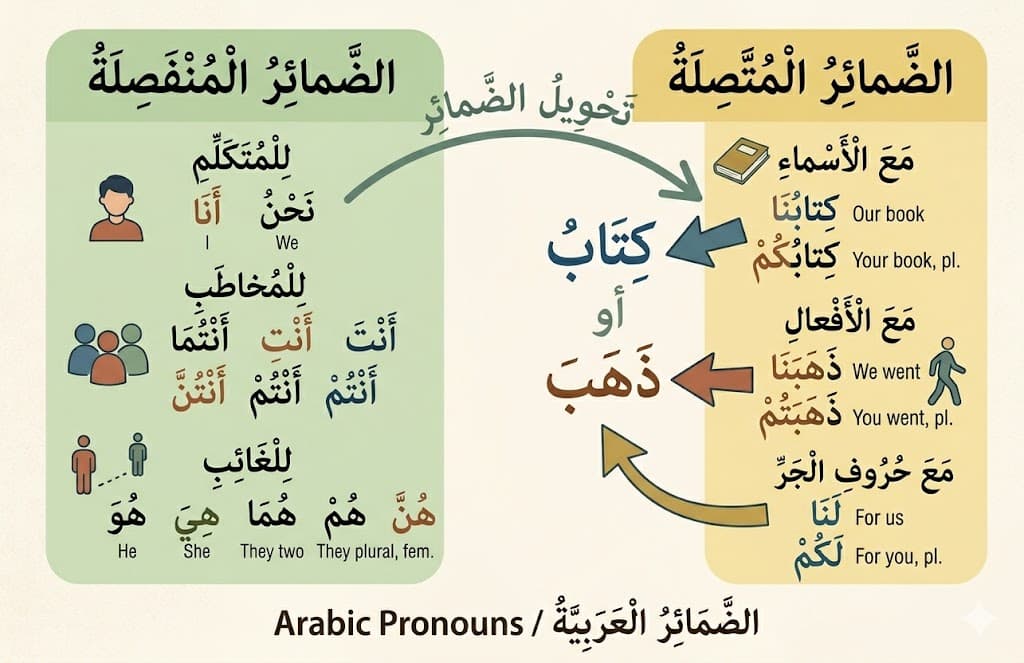
Arabic has two pronoun systems — independent pronouns (الضَّمَائِرُ الْمُنْفَصِلَة) and attached pronouns (الضَّمَائِرُ الْمُتَّصِلَة). Most learners focus only on independent pronouns, but attached pronouns are used far more frequently in natural Arabic speech and writing.
Attached pronouns are suffixes added to nouns, verbs, or prepositions. They carry possessive meaning when attached to nouns and object meaning when attached to verbs or prepositions.
| Attached Pronoun | Arabic | Meaning | Type |
| ـي / ـنِي | -i / -ni | My / Me | 1st person singular |
| ـنَا | -na | Our / Us | 1st person plural |
| ـكَ | -ka | Your (m.) | 2nd person masculine singular |
| ـكِ | -ki | Your (f.) | 2nd person feminine singular |
| ـكُمَا | -kuma | Your (dual) | 2nd person dual |
| ـكُمْ | -kum | Your (m. plural) | 2nd person masculine plural |
| ـكُنَّ | -kunna | Your (f. plural) | 2nd person feminine plural |
| ـهُ | -hu | His / It (m.) | 3rd person masculine singular |
| ـهَا | -ha | Her / It (f.) | 3rd person feminine singular |
| ـهُمَا | -huma | Their (dual) | 3rd person dual |
| ـهُمْ | -hum | Their (m. plural) | 3rd person masculine plural |
| ـهُنَّ | -hunna | Their (f. plural) | 3rd person feminine plural |
Attached Pronouns with Nouns — Showing Possession
Attach a pronoun suffix to a noun, and it expresses possession — equivalent to “my,” “your,” “his,” etc.
Examples:
- كِتَابٌ — Kitaabun — A book
- كِتَابِي — Kitaabi — My book
- كِتَابُكَ — Kitaabuka — Your book (m.)
- كِتَابُهُ — Kitaabuhu — His book
- كِتَابُهَا — Kitaabuha — Her book
- كِتَابُنَا — Kitaabuna — Our book
This is one of the first structures we teach in Buruj Academy’s Arabic Grammar Course — because once students master possessive suffixes, they immediately build hundreds of natural Arabic phrases.
Understand the Arabic Grammar with Buruj’s free trial lesson
Attached Pronouns with Verbs — Expressing Objects
When attached to verbs, these same suffixes function as direct or indirect objects.
Examples using كَتَبَ (kataba — he wrote):
- كَتَبَهُ — Katabuhu — He wrote it.
- كَتَبَهَا — Katabaha — He wrote it (feminine object, e.g., the letter).
- كَتَبَهُمْ — Katabahum — He wrote them (their names).
In our experience at Buruj Academy, students who study attached pronouns alongside independent ones plateau far less than those who learn them in isolation. The two systems reinforce each other naturally.
Read also: Fatha in Arabic
Discover the Buruj Academy Difference
Step into our virtual classrooms and see how our expert instructors make learning Quran and Arabic intuitive and clear. We focus on overcoming the specific hurdles non-native speakers face, building your confidence and connection with the Quran.
Master the Arabic Language
Join our expert-led courses and build a strong foundation in Classical and Modern Arabic.
Get Your Free TrialPronouns in Arabic with Examples
Seeing pronouns in real Arabic sentences accelerates both recognition and production. Here are varied examples across different contexts.
1. Using هُوَ and هِيَ in Descriptive Sentences
- هُوَ طَبِيبٌ مَاهِرٌ — Huwa tabibun maahirun — He is a skilled doctor.
- هِيَ مُدِيرَةٌ نَاجِحَةٌ — Hiya mudeeratun naajihah — She is a successful manager.
2. Using أَنَا and نَحْنُ in Introductions
- أَنَا مِنْ كَنَدَا — Ana min Canada — I am from Canada.
- نَحْنُ نَتَعَلَّمُ الْعَرَبِيَّةَ — Nahnu nata’allamul-‘arabiyyah — We are learning Arabic.
- أَنَا لَا أَعْرِفُ هَذَا — Ana la a’rifu haadha — I do not know this.
3. Using أَنْتَ and أَنْتِ in Conversation
- أَنْتَ مُجْتَهِدٌ جِدًّا — Anta mujtahidun jiddan — You are very hardworking. (to a man)
- أَنْتِ تَتَكَلَّمِينَ جَيِّدًا — Anti tatakallameena jayyidan — You speak well. (to a woman)
Notice that the verb itself also changes between the two examples — because Arabic verbs conjugate according to the pronoun’s gender. This is why understanding pronouns directly impacts Arabic verb conjugation accuracy.
4. Using the Dual هُمَا in Natural Sentences
- هُمَا أَخَوَانِ — Huma akhawani — They two are brothers.
- هُمَا جَالِسَتَانِ — Huma jaalisataani — They two (women) are sitting.
The dual form is one of the most distinctive features of Arabic. For more on how dual forms function across nouns and verbs, see our guide to dual nouns in Arabic.
Why Arabic Verbs Sometimes Don’t Need Independent Pronouns
Arabic verbs already encode the subject pronoun within their conjugation. This is a fundamental feature of Semitic grammar that surprises most English speakers — because in English, dropping “I” from “I go” would make the sentence grammatically incomplete.
In Arabic, the verb form itself signals who is doing the action.
| Conjugated Verb | Meaning | Independent Pronoun Redundant? |
| أَذْهَبُ (adhabu) | I go | أَنَا is optional |
| تَذْهَبُ (tadhabu) | You go (m.) | أَنْتَ is optional |
| يَذْهَبُ (yadhabu) | He goes | هُوَ is optional |
| نَذْهَبُ (nadhabu) | We go | نَحْنُ is optional |
So why use independent pronouns at all? For emphasis or contrast.
- أَنَا أَذْهَبُ، لَا أَنْتَ — Ana adhabu, la anta — I am going, not you.
- هُوَ كَتَبَ الرِّسَالَةَ — Huwa kataba ar-risaalah — He wrote the letter. (emphasizing the doer)
This connects directly to how Arabic sentence structure works — Arabic is flexible in word order partly because verbs carry subject information independently.
Arabic Pronouns Exercises to Practice
Practice is where pronouns move from recognized to automatic. Work through these exercises actively — write the answers before checking.
Exercise 1 — Choose the Correct Pronoun
Fill in the blank with the correct Arabic pronoun:
- _______ مُعَلِّمٌ. (He is a teacher.) → هُوَ
- _______ نَتَكَلَّمُ الْعَرَبِيَّةَ. (We speak Arabic.) → نَحْنُ
- _______ طَالِبَةٌ مُجْتَهِدَةٌ. (She is a hardworking student.) → هِيَ
- _______ مِنْ أَيْنَ؟ (Where are you from? — addressing a woman) → أَنْتِ
- _______ يَلْعَبُونَ فِي الْحَدِيقَةِ. (They (men) are playing in the garden.) → هُمْ
Read also: Understanding Attached and Detached Pronouns in Arabic
Exercise 2 — Attach the Correct Possessive Pronoun
Transform the noun using the indicated possessive:
- بَيْتٌ + my → بَيْتِي (baytī)
- سَيَّارَةٌ + her → سَيَّارَتُهَا (sayyaaratuha)
- كِتَابٌ + your (m.) → كِتَابُكَ (kitaabuka)
- مَدْرَسَةٌ + our → مَدْرَسَتُنَا (madrasatuna)
- قَلَمٌ + his → قَلَمُهُ (qalamuh)
Exercise 3 — Translate into Arabic
Write the full Arabic sentence, choosing the correct pronoun:
- They (women) are doctors. → هُنَّ طَبِيبَاتٌ.
- You two are students. → أَنْتُمَا طَالِبَانِ.
- I am from Egypt. → أَنَا مِنْ مِصْرَ.
- He is in the office. → هُوَ فِي الْمَكْتَبِ.
- We study every day. → نَحْنُ نَدْرُسُ كُلَّ يَوْمٍ.
These exercises reflect the types of drills we use in Buruj Academy’s Arabic for Beginners course — short, targeted, and building toward real sentence production from the first week.
Begin learning Arabic at Buruj with a FREE trial lesson

How Do Arabic Pronouns Connect to Verb Conjugation and Tenses?
Pronouns and verb conjugation in Arabic are inseparable. Every verb tense — past, present, and future — conjugates differently for each pronoun. This is why mastering the pronouns chart is a prerequisite, not an optional step.
Here is the verb كَتَبَ (to write) conjugated across all pronouns in the past tense:
| Pronoun | Past Tense Verb | Meaning |
| أَنَا | كَتَبْتُ (katabtu) | I wrote |
| نَحْنُ | كَتَبْنَا (katabnaa) | We wrote |
| أَنْتَ | كَتَبْتَ (katabta) | You wrote (m.) |
| أَنْتِ | كَتَبْتِ (katabti) | You wrote (f.) |
| أَنْتُمَا | كَتَبْتُمَا (katabtumaa) | You two wrote |
| أَنْتُمْ | كَتَبْتُمْ (katabtum) | You wrote (m. pl.) |
| أَنْتُنَّ | كَتَبْتُنَّ (katabtunna) | You wrote (f. pl.) |
| هُوَ | كَتَبَ (kataba) | He wrote |
| هِيَ | كَتَبَتْ (katabat) | She wrote |
| هُمَا | كَتَبَا (katabaa) | They two wrote (m.) |
| هُمَا | كَتَبَتَا (katabataa) | They two wrote (f.) |
| هُمْ | كَتَبُوا (katabuu) | They wrote (m. pl.) |
| هُنَّ | كَتَبْنَ (katabna) | They wrote (f. pl.) |
Seeing this full conjugation table makes one thing clear: the 14 pronouns are not 14 things to memorize in isolation — they are the key that unlocks every verb in the language.
A full breakdown of how these conjugations extend into present and future forms is in our articles on the Arabic present tense and the Arabic future tense.
Read also: Kasra in Arabic
Master Arabic Pronouns with Buruj Academy’s Expert Instructors
Arabic pronouns are the grammatical foundation everything else is built on — verb conjugation, possession, sentence structure, and natural conversation all depend on knowing them precisely.
Buruj Academy’s Online Arabic Grammar Course teaches pronouns the way they actually function — connected to real sentences, real tenses, and real conversation from day one, not as isolated vocabulary lists.
- Al-Azhar University graduate instructors with 12+ years teaching non-native speakers
- The Buruj Method: context-before-abstraction for natural retention
- Personalized 1-on-1 sessions with flexible 24/7 scheduling
- Real-time correction and individualized progression plans
- Proven track record from beginner to advanced fluency
Book your free trial lesson today and experience the difference of learning Arabic grammar with qualified, experienced instructors.
Begin your transformation today by choosing the path that fits your goals:
- Online Arabic Classes (General & Comprehensive)
- Arabic Course for Beginners
- Arabic Alphabet Learning Course
- Online Arabic Classes for Kids
- Arabic Classes for Adults
- Arabic Grammar Course (Nahw & Sarf)
- Intermediate Arabic Course (B1/B2)
- Arabic Speaking Course (Conversational Fluency)
- Arabic Reading Course (Literary Excellence)
- Learn Arabic Writing Course (Calligraphy & Composition)
Ready to speak with confidence? Join the global community at Buruj Academy and book your free placement interview today!
Master the Arabic Language
Join our expert-led courses and build a strong foundation in Classical and Modern Arabic.
Get Your Free TrialConclusion
Arabic pronouns follow a precise, logical system — once you see the three-axis structure of person, gender, and number, the full chart of 14 pronouns becomes predictable rather than overwhelming. The key insight is that independent pronouns, attached pronouns, and verb conjugations all work together as one unified system.
Spend time with the exercises in this guide, return to the conjugation table regularly, and connect each pronoun to real sentences rather than abstract definitions.
Grammar accuracy follows pronunciation confidence, and both follow consistent, structured practice.
Frequently Asked Questions About Arabic Pronouns
How Many Pronouns Are There in Arabic?
Modern Standard Arabic has 14 independent personal pronouns. They are divided across three grammatical persons — first, second, and third — and each group distinguishes gender (masculine and feminine) and number (singular, dual, and plural). This is more granular than English’s 8 personal pronouns.
What Is the Difference Between Independent and Attached Pronouns in Arabic?
Independent pronouns in Arabic stand alone as separate words, such as هُوَ (he) or أَنَا (I). Attached pronouns are suffixes joined to nouns, verbs, or prepositions to express possession or object relationships, such as كِتَابُكَ (your book) or كَتَبَهُ (he wrote it). Both sets cover the same 14 grammatical categories.
Why Does Arabic Have Dual Pronouns?
Arabic marks a distinction between two people or things (dual) and three or more (plural) — a category English lost centuries ago. The dual pronouns هُمَا (they two) and أَنْتُمَا (you two) are fully functional in MSA and are required for grammatical accuracy, especially in formal writing and Quranic Arabic.